

Larry Page’s Original AI Vision Behind Google’s Long Game
Explore how Larry Page’s early ideas about AI and knowledge shaped Google’s long-term strategy—from search quality to moonshots and AI-first bets.
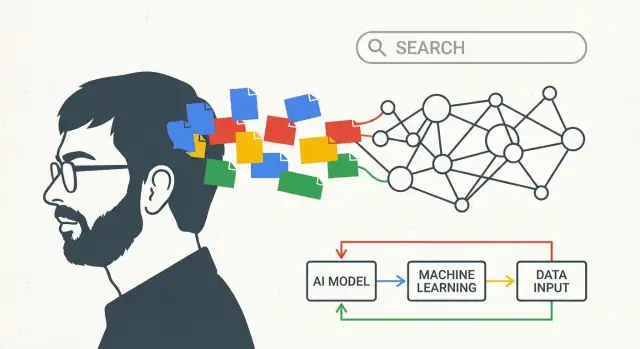
What this post means by “Larry Page’s AI vision”
This isn’t a hype piece about a single breakthrough moment. It’s about long-term thinking: how a company can pick a direction early, keep investing through multiple technology shifts, and slowly turn a big idea into everyday products.
When this post says “Larry Page’s AI vision,” it doesn’t mean “Google predicted today’s chatbots.” It means something simpler—and more durable: building systems that learn from experience.
A plain-English definition
In this post, “AI vision” refers to a few connected beliefs:
- Computers should improve their performance by learning from data, not only by following hand-written rules.
- The best systems get better over time because real-world use creates feedback (what people click, what they ignore, what they rephrase).
- To make learning practical, you need infrastructure: fast computing, reliable storage, and a way to run experiments safely at huge scale.
In other words, the “vision” is less about a single model and more about an engine: collect signals, learn patterns, ship improvements, repeat.
The arc we’ll follow
To make that idea concrete, the rest of the post traces a simple progression:
- Search: start with a clear problem—help people find good answers.
- Data + infrastructure: use real usage to learn what “good” looks like, and build the machinery to process it.
- AI-first products: treat learning systems as the default approach, so voice, images, and new interfaces can work well without rewriting everything from scratch.
By the end, “Larry Page’s AI vision” should feel less like a slogan and more like a strategy: invest early in learning systems, build the pipes that feed them, and stay patient while compounding progress over years.
The early problem Google tried to solve: finding good answers
The early web had a simple problem with messy consequences: there was suddenly far more information than any person could sift through, and most search tools were basically guessing what mattered.
If you typed a query, many engines relied on obvious signals—how often a word appeared on a page, whether it was in the title, or how many times the site owner could “stuff” it into invisible text. That made results easy to game and hard to trust. The web was growing faster than the tools meant to organize it.
PageRank, explained like you’d explain a recommendation
Larry Page and Sergey Brin’s key insight was that the web already contained a built-in voting system: links.
A link from one page to another is a bit like a citation in a paper or a recommendation from a friend. Not all recommendations are equal, though. A link from a page that many others consider valuable should count more than a link from an unknown page. PageRank turned that idea into math: instead of ranking pages only by what they said about themselves, Google ranked pages by what the rest of the web “said” about them through linking.
This did two important things at once:
- It helped surface authoritative pages even when they didn’t repeat the exact query terms.
- It made ranking harder to manipulate, because credibility had to be earned across the network of sites.
Why measurement and iteration mattered from day one
Just having a clever ranking idea wasn’t enough. Search quality is a moving target: new pages appear, spam adapts, and what people mean by a query can change.
So the system had to be measurable and updatable. Google leaned on constant testing—trying changes, measuring whether results improved, and repeating. That habit of iteration shaped the company’s long-term approach to “learning” systems: treat search as something you can continuously evaluate, not a one-time engineering project.
Data as a flywheel: learning from real-world use
Great search isn’t only about clever algorithms—it’s about the quality and quantity of signals those algorithms can learn from.
Early Google had a built-in advantage: the web itself is full of “votes” about what matters. Links between pages (the foundation behind PageRank) act like citations, and anchor text (“click here” vs. “best hiking boots”) adds meaning. On top of that, language patterns across pages help a system understand synonyms, spelling variants, and the many ways people ask the same question.
The feedback loop that compounds
Once people start using a search engine at scale, usage creates additional signals:
- Clicks show which results look relevant to real users for a given query.
- “Long clicks” vs. quick back-and-forth can hint at satisfaction.
- Query reformulations (searching again with different words) can reveal mismatches between intent and results.
This is the flywheel: better results attract more usage; more usage creates richer signals; richer signals improve ranking and understanding; and that improvement pulls in even more users. Over time, search becomes less like a fixed set of rules and more like a learning system that adapts to what people actually find useful.
Why data variety matters
Different types of data reinforce each other. Link structure may surface authority, while click behavior reflects current preferences, and language data helps interpret ambiguous queries (“jaguar” the animal vs. the car). Together, they make it possible to answer not just “what pages contain these words,” but “what is the best answer for this intent.”
A note on privacy
This flywheel raises obvious privacy questions. Public, well-sourced reporting has long noted that large consumer products generate massive interaction data, and that companies use aggregated signals to improve quality. It’s also widely documented that Google has invested in privacy and security controls over time, though the details and effectiveness are debated.
The takeaway is simple: learning from real-world use is powerful—and trust depends on how responsibly that learning is handled.
Building the “machine”: infrastructure that made AI practical
Google didn’t invest early in distributed computing because it was trendy—it was the only way to keep up with the messy scale of the web. If you want to crawl billions of pages, update rankings frequently, and answer queries in fractions of a second, you can’t rely on one big computer. You need thousands of cheaper machines working together, with software that treats failures as normal.
Why distributed computing mattered so early
Search forced Google to build systems that could store and process huge amounts of data reliably. That same “many computers, one system” approach became the foundation for everything that followed: indexing, analytics, experimentation, and eventually machine learning.
The key insight is that infrastructure isn’t separate from AI—it determines what kinds of models are possible.
How infrastructure turns AI from a demo into a product
Training a useful model means showing it a lot of real examples. Serving that model means running it for millions of people, instantly, without outages. Both are “scale problems”:
- Training needs massive compute to crunch through data repeatedly.
- Serving needs low-latency systems to make predictions fast (often in milliseconds), even during traffic spikes.
Once you’ve built pipelines for storing data, distributing computation, monitoring performance, and rolling out updates safely, learning-based systems can improve continuously rather than arriving as rare, risky rewrites.
Simple, everyday examples of “AI powered by plumbing”
A few familiar features show why the machine mattered:
- Spell correction: noticing patterns like “restarant” → “restaurant” requires learning from many searches and clicks, then applying corrections instantly at query time.
- Autocomplete: predicting what you’re about to type depends on aggregated behavior and fast inference—otherwise suggestions lag and feel wrong.
- Translation: better translation quality comes from training on large datasets and shipping models that can run quickly for users around the world.
Google’s long-term advantage wasn’t just having clever algorithms—it was building the operational engine that let algorithms learn, ship, and improve at internet scale.
From rules to learning: how search quietly became more “AI-like”
Early Google already looked “smart,” but much of that intelligence was engineered: link analysis (PageRank), hand-tuned ranking signals, and lots of heuristics for spam. Over time, the center of gravity shifted from explicitly written rules to systems that learned patterns from data—especially about what people mean, not just what they type.
How ML changed the feel of search
Machine learning gradually improved three things everyday users notice:
- Ranking quality: instead of weighting signals with fixed formulas, models learned which combinations of signals tended to satisfy users (measured through anonymized aggregate behavior and human quality rater feedback).
- Intent understanding: queries like “jaguar speed” or “apple support” forced models to infer meaning, context, and ambiguity. Learning-based systems got better at mapping wording to concepts and likely goals.
- Spam and trust: as content farms and manipulative SEO scaled up, ML helped detect unnatural link patterns, thin content, and other tactics—supporting the broader push toward high-quality results.
A reader-friendly milestone timeline
- 1998: PageRank and the original Google paper set the foundation for relevance via links.
- Early 2000s: statistical spelling correction and query suggestions improve “did you mean” and reformulations.
- 2011: Panda targets low-quality content; quality signals become more systematic.
- 2012: Penguin penalizes link manipulation, pushing anti-spam beyond manual rules.
- 2015: RankBrain (learning-based ranking component) helps with unfamiliar or ambiguous queries.
- 2018–2019: neural matching and BERT bring stronger language understanding, especially for longer queries and prepositions.
- 2021+: MUM-era multi-task models and “helpful content” efforts push toward deeper intent and usefulness signals.
Sources worth citing
For credibility, cite a mix of primary research and public product explanations:
- Research papers: Brin & Page (PageRank, 1998), BERT (Devlin et al., 2018).
- Official search announcements: Google Search blog posts on RankBrain, BERT, MUM, Panda/Penguin updates.
- Talks/interviews/events: Amit Singhal interviews on ranking evolution; Sundar Pichai keynotes (Google I/O); “Search On” events for modern milestones.
Research culture: turning long shots into useful systems
Google’s long game wasn’t only about having big ideas—it depended on a research culture that could turn academic-looking papers into things millions of people actually used. That meant rewarding curiosity, but also building pathways from a prototype to a dependable product.
From “publish” to “ship”
Many companies treat research as a separate island. Google pushed for a tighter loop: researchers could explore ambitious directions, publish results, and still collaborate with product teams who cared about latency, reliability, and user trust. When that loop works, a paper isn’t the finish line—it’s the start of a faster, better system.
A practical way to see this is in how model ideas show up in “small” features: better spelling correction, smarter ranking, improved recommendations, or translation that sounds less literal. Each step can look incremental, but together they change what “search” feels like.
Landmark efforts that set the pace
Several efforts became symbols of that paper-to-product pipeline. Google Brain helped push deep learning inside the company by proving it could outperform older approaches when you had enough data and compute. Later, TensorFlow made it easier for teams to train and deploy models consistently—an unglamorous but crucial ingredient for scaling machine learning across many products.
Research work on neural machine translation, speech recognition, and vision systems similarly moved from lab results to everyday experiences, often after multiple iterations that improved quality and reduced cost.
Why patience matters
The payoff curve is rarely immediate. Early versions can be expensive, inaccurate, or hard to integrate. The advantage comes from staying with the idea long enough to build infrastructure, collect feedback, and refine the model until it’s dependable.
That patience—funding “long shots,” accepting detours, and iterating for years—helped convert ambitious AI concepts into useful systems people could trust at Google scale.
New inputs: voice, images, and video forced smarter models
Text search rewarded clever ranking tricks. But the moment Google started taking in voice, photos, and video, the old approach hit a wall. These inputs are messy: accents, background noise, blurry images, shaky footage, slang, and context that isn’t written down anywhere. To make them useful, Google needed systems that could learn patterns from data instead of relying on hand-written rules.
Voice: turning sound into intent
With voice search and Android dictation, the goal wasn’t just “transcribe words.” It was to understand what someone meant—quickly, on-device or over shaky connections.
Speech recognition pushed Google toward large-scale machine learning because performance improved most when models trained on huge, diverse audio datasets. That product pressure justified serious investment in compute (for training), specialized tooling (data pipelines, evaluation sets, deployment systems), and hiring people who could iterate on models as living products—not one-off research demos.
Photos: meaning, not metadata
Photos don’t come with keywords. Users expect Google Photos to find “dogs,” “beach,” or “my trip to Paris,” even if they never tagged anything.
That expectation forced stronger image understanding: object detection, face grouping, and similarity search. Again, rules couldn’t cover the variety of real life, so learning systems became the practical path. Improving accuracy meant more labeled data, better training infrastructure, and faster experimentation cycles.
Video and recommendations: scale exposes weaknesses
Video added a double challenge: it’s images over time plus audio. Helping users navigate YouTube—search, captions, “Up next,” and safety filters—demanded models that could generalize across topics and languages.
Recommendations made the need for ML even clearer. When billions of users click, watch, skip, and return, the system must adapt continuously. That kind of feedback loop naturally rewarded investments in scalable training, metrics, and talent to keep models improving without breaking trust.
The AI-first pivot: making AI a default, not a feature
“AI-first” is easiest to understand as a product decision: instead of adding AI as a special tool on the side, you treat it as part of the engine inside everything people already use.
Google described this direction publicly around 2016–2017, framing it as a shift from being “mobile-first” to “AI-first.” The idea wasn’t that every feature suddenly became “smart,” but that the default way products improve would increasingly be through learning systems—ranking, recommendations, speech recognition, translation, and spam detection—rather than manually tuned rules.
AI inside the core loop
In practical terms, an AI-first approach shows up when the “core loop” of a product quietly changes:
- Search results get better because the system learns patterns in queries and clicks, not because a team hard-codes thousands of new if-then rules.
- Photos are organized by what’s in them, not just filenames and folders.
- Gmail catches more unwanted messages by learning evolving behaviors, not only matching known keywords.
The user may never see a button labeled “AI.” They just notice fewer wrong results, less friction, and faster answers.
Assistants raised the bar for natural language
Voice assistants and conversational interfaces reshaped expectations. When people can say, “Remind me to call Mom when I get home,” they begin to expect software to understand intent, context, and messy everyday language.
That nudged products toward natural language understanding as a baseline capability—across voice, typing, and even camera input (pointing your phone at something and asking what it is). The pivot, then, was as much about meeting new user habits as it was about research ambitions.
Importantly, “AI-first” is best read as a direction—one supported by repeated public statements and product moves—rather than a claim that AI replaced every other approach overnight.
Alphabet and the long game: space for bets beyond search
Alphabet’s creation in 2015 was less a rebrand and more an operating decision: separate the mature, revenue-generating core (Google) from the riskier, longer-horizon efforts (often called “Other Bets”). That structure matters if you’re thinking about Larry Page’s AI vision as a multi-decade project rather than a single product cycle.
Why split “core” from “bets”
Google Search, Ads, YouTube, and Android needed relentless execution: reliability, cost control, and steady iteration. Moonshots—self-driving cars, life sciences, connectivity projects—needed something different: tolerance for uncertainty, room for expensive experiments, and permission to be wrong.
Under Alphabet, the core could be managed with clear performance expectations, while bets could be evaluated on learning milestones: “Did we prove a key technical assumption?” “Did the model improve enough with real-world data?” “Is the problem even solvable at acceptable safety levels?”
The moonshot logic: experimentation as a strategy
This “long game” mindset doesn’t assume every project will succeed. It assumes that sustained experimentation is how you discover what will matter later.
A moonshot factory like X is a good example: teams try bold hypotheses, instrument the results, and kill ideas quickly when the evidence is weak. That discipline is especially relevant to AI, where progress often depends on iteration—better data, better training setups, better evaluation—not just a single breakthrough.
What to take away (without promises)
Alphabet wasn’t a guarantee of future wins. It was a way to protect two different rhythms of work:
- Keep the core business focused and accountable.
- Create an explicit home for high-variance research and product bets.
For teams, the lesson is structural: if you want long-term AI outcomes, design for them. Separate near-term delivery from exploratory work, fund experiments as learning vehicles, and measure progress in validated insights—not just headlines.
The hard parts: quality, safety, and trust at scale
When AI systems serve billions of queries, small error rates turn into daily headlines. A model that is “mostly right” can still mislead millions—especially on health, finance, elections, or breaking news. At Google-scale, quality isn’t a nice-to-have; it’s a compounding responsibility.
The core tradeoffs
Bias and representation. Models learn patterns from data, including social and historical bias. “Neutral” rankings can still amplify dominant viewpoints or under-serve minority languages and regions.
Mistakes and overconfidence. AI often fails in ways that sound convincing. The most damaging errors aren’t obvious bugs; they’re plausible-sounding answers that users trust.
Safety vs. usefulness. Strong filters reduce harm but can also block legitimate queries. Weak filters improve coverage but raise the risk of enabling scams, self-harm, or misinformation.
Accountability. As systems become more automated, it gets harder to answer basic questions: Who approved this behavior? How was it tested? How do users appeal or correct it?
Why scaling increases the need for guardrails
Scaling improves capability, but it also:
- Expands the number of edge cases (languages, cultures, sensitive contexts)
- Increases incentives for abuse (spam, prompt injection, adversarial SEO)
- Makes failures harder to roll back once integrated across products
That’s why guardrails must scale too: evaluation suites, red-teaming, policy enforcement, provenance for sources, and clear user interfaces that signal uncertainty.
A practical checklist for evaluating AI claims
Use this to judge any “AI-powered” feature—whether from Google or anyone else:
- What is the failure mode? Do they show where it breaks, not just demos?
- How is it measured? Look for real metrics (accuracy, toxicity rates, hallucination rates), not vague “improvements.”
- What data is it trained on? At minimum: broad categories, recency, and exclusion policies.
- What are the guardrails? Safety rules, human review paths, and abuse monitoring.
- Can users verify? Citations, links, or explanations that let you check claims.
- How are corrections handled? Clear reporting, fast updates, and auditability.
Trust is earned through repeatable processes—not a single breakthrough model.
Lessons for teams: how to think long-term about AI
The most transferable pattern behind Google’s long arc is simple: clear goal → data → infrastructure → iteration. You don’t need Google’s scale to use the loop—you need discipline about what you’re optimizing for, and a way to learn from real usage without fooling yourself.
The core pattern you can copy
Start with one measurable user promise (speed, fewer errors, better matches). Instrument it so you can observe outcomes. Build the minimum “machine” that lets you collect, label, and ship improvements safely. Then iterate in small, frequent steps—treating every release as a learning opportunity.
If your bottleneck is simply getting from “idea” to “instrumented product” fast enough, modern build workflows can help. For example, Koder.ai is a vibe-coding platform where teams can create web, backend, or mobile apps from a chat interface—useful for spinning up an MVP that includes feedback loops (thumbs up/down, report-a-problem, quick surveys) without waiting weeks for a full custom pipeline. Features like planning mode plus snapshots/rollback also map neatly to the “experiment safely, measure, iterate” principle.
6 takeaways leaders can apply (without being Google)
- Pick a north star that’s user-facing. “Improve the search experience” is clearer than “adopt AI.” Define success in terms people feel.
- Design your product to create learning data. Add feedback loops (thumbs up/down, corrections, “did this help?”) that capture intent, not just clicks.
- Invest early in plumbing, not just models. Data quality checks, evaluation dashboards, and deployment workflows beat one-off prototypes.
- Treat evaluation as a product feature. Create a repeatable scorecard (quality, latency, cost, safety) so iteration doesn’t become guesswork.
- Ship in slices. Start with narrow use cases, roll out to a small audience, measure, then expand. Momentum beats big-bang launches.
- Make long bets survivable. Protect a small portion of capacity for experiments, but require clear learning milestones to keep them honest.
Related reads
If you want practical next steps, link these into your team’s reading list:
- /blog/ai-strategy-basics
- /blog/data-flywheels-for-product-teams
- /blog/evaluating-ml-models-without-a-phd
- /blog/ai-governance-lightweight
FAQ
What does Larry Page's AI vision mean in this article?
It means a long-term approach to building systems that learn from data and improve through real use. The idea covers more than chatbots or one model.
How did PageRank change search?
PageRank used links as signals of trust and relevance. It helped Google rank pages by how other sites connected to them, not only by repeated keywords.
Why does user feedback matter for AI products?
Clicks, query rewrites, and time spent on results can show whether people found something useful. Teams should collect these signals carefully and protect user privacy.
Why does AI need so much infrastructure?
AI needs reliable data storage, computing power, testing, and fast delivery systems. Without that foundation, a model may work in a demo but fail under real traffic.
What is the difference between rules and machine learning?
Rules follow instructions written by people. Machine learning finds patterns in examples, which helps with changing language, ambiguous queries, spam, speech, and images.
What was RankBrain?
RankBrain used machine learning to help interpret unfamiliar and ambiguous search queries. It marked a move toward stronger intent understanding in Google Search.
What does AI-first mean for a product team?
AI-first means treating learning systems as part of how products improve by default. In practice, it can affect ranking, recommendations, translation, spam filtering, and voice features.
Why did Alphabet matter to Google's long-term AI work?
Alphabet separated Google's established businesses from longer-term experiments. That gave exploratory projects room to test difficult ideas while the core business kept operating with clear goals.
How can a small team apply this approach?
Start with one user problem you can measure, such as fewer support errors or faster matching. Add a small feedback loop, test with a limited group, and compare quality, speed, cost, and safety before expanding.
How should teams evaluate AI claims?
Look for clear failure cases, real measurement, training-data policies, safety controls, and a way for users to correct mistakes. A polished demo alone does not show that a system works reliably.