

Leonard Adleman and RSA: How the Internet Learned to Trust
Leonard Adleman helped create RSA, a public-key system that enabled HTTPS, online banking, and signed updates. Learn how it works and why it matters.
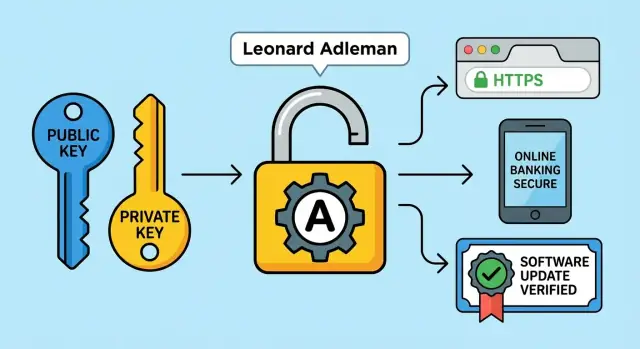
Why RSA Matters for Everyday Internet Trust
When people say they “trust” a website or an online service, they usually mean three practical things:
- Privacy: strangers can’t read your messages, passwords, or payment details while they travel across the internet.
- Identity: you’re really talking to your bank (or that store), not an impostor.
- Integrity: what you receive hasn’t been quietly changed—whether it’s a login page, a bank transfer request, or a software update.
RSA became famous because it helped make those promises possible at internet scale.
Everyday systems RSA helped enable
You’ve felt RSA’s impact even if you’ve never heard the name. It’s closely tied to how:
- HTTPS protects many connections between your browser and a website (the “padlock” idea).
- Online banking moved from “maybe don’t do that on the internet” to something millions of people rely on.
- Signed software and updates can prove they came from the real publisher—and weren’t tampered with on the way to your device.
The common thread is trust without having to personally know (or pre-arrange secrets with) every server and software vendor you interact with.
What to expect in this guide
This article keeps the explanations simple: no heavy math, and no need for a computer science background. We’ll focus on the everyday “why it works” view.
The key idea: two keys, two roles
RSA popularized a powerful approach: instead of one shared secret, you use a public key you can share openly and a private key you keep secret. That split makes it possible to protect privacy and prove identity in situations where people and systems have never met before.
Leonard Adleman’s Role in the RSA Breakthrough
Leonard Adleman is the “A” in RSA, alongside Ron Rivest and Adi Shamir. While Rivest and Shamir are often credited for the core construction, Adleman’s contribution was essential: he helped shape the system into something that was not just clever, but convincing—an algorithm people could analyze, test, and trust.
What Adleman brought to the team
A big part of Adleman’s role was pressure-testing the idea. In cryptography, a scheme isn’t valuable because it sounds plausible; it’s valuable because it survives careful attacks and scrutiny. Adleman worked on validation, helped refine assumptions, and contributed to the early framing of why RSA should be hard to break.
Just as importantly, he helped translate “this might work” into “this is a cryptosystem others can evaluate.” That clarity—making the design understandable enough for the wider research community to inspect—was crucial for adoption.
Where RSA fits in cryptography history
Before RSA, secure communication usually depended on both parties already sharing a secret key. That approach works within closed groups, but it doesn’t scale when strangers need to communicate safely (for example, a shopper and a website meeting for the first time).
RSA changed that story by popularizing a practical public-key cryptosystem: you can publish one key for others to use, while keeping a separate private key secret.
The lasting impact
RSA’s influence is bigger than one algorithm. It made two internet essentials feel feasible at scale:
- Encryption, so data can be protected in transit
- Digital signatures, so software and messages can be verified as authentic
Those ideas underpin how HTTPS, online banking, and signed software updates became normal expectations rather than rare exceptions.
The Core Problem RSA Solved: Secure Communication Without Shared Secrets
Before RSA, secure communication mostly meant shared-secret encryption: both sides had to possess the same secret key ahead of time. That works for a small group, but it breaks down quickly when you try to run a public service used by millions.
Why shared secrets don’t scale
If every customer needs a unique secret key to talk to a bank, the bank must generate, deliver, store, rotate, and protect an enormous number of secrets. The hardest part isn’t the math—it’s the coordination.
How do you safely deliver the secret key to each person in the first place? Mailing it is slow and risky. Telling it over the phone can be intercepted or socially engineered. Sending it over the internet defeats the purpose, because the channel is exactly what you’re trying to secure.
Two strangers, one safe conversation
Imagine two strangers—say, you and an online store—who have never met. You want to send a payment securely. With shared-secret encryption, you’d need a private key you both already know. But you don’t.
RSA’s breakthrough was enabling secure communication without pre-sharing a secret. Instead, you can publish one key (a public key) that anyone can use to protect a message to you, while keeping another key (a private key) that only you hold.
Why “just encrypt it” isn’t enough
Even if you could encrypt messages, you still need to know who you’re encrypting to. Otherwise, an attacker can impersonate the bank or store, trick you into using their key, and quietly read or alter everything.
That’s why secure internet communication needs two properties:
- Confidentiality: outsiders can’t read the data.
- Authenticity: you can verify who you’re talking to (and that messages weren’t tampered with).
RSA helped make both possible, laying the groundwork for how online trust works at scale.
Public-Key Cryptography Basics (Without the Jargon)
Public-key cryptography is a simple idea with big consequences: you can lock something for someone without first agreeing on a shared secret. That’s the core shift RSA helped make practical.
Public key vs. private key (plain language)
Think of a public key as a lock you’re happy to hand out to anyone. People can use it to protect a message for you—or (in signature systems) to check that something really came from you.
A private key is the one thing you must keep to yourself. It’s the key that opens what was locked with your public key, and it’s also what lets you create signatures that only you could have made.
Together, the public key and private key form a key pair. They’re mathematically connected, but not interchangeable. Sharing the public key is safe because knowing it doesn’t give someone a practical way to derive the private key.
Two main jobs: encryption and digital signatures
Encryption is about privacy. If someone encrypts a message with your public key, only your private key can decrypt it.
Digital signatures are about trust and integrity. If you sign something with your private key, anyone with your public key can verify two things:
- it was signed by the holder of the private key
- it wasn’t altered after signing
Why it works (no equations)
The security isn’t magic—it relies on hard math problems that are easy to do one way and extremely difficult to reverse with current computers. That “one-way” property is what makes sharing the public key safe while keeping the private key powerful.
How RSA Works at a High Level
RSA is built around a simple asymmetry: it’s easy to do the “forward” math to lock something, but extremely hard to reverse that math to unlock it—unless you have a special secret.
The one-way idea (with a trapdoor)
Think of RSA as a kind of mathematical padlock. Anyone can use the public key to lock a message. But only the person holding the private key can unlock it.
What makes this possible is a carefully chosen relationship between the two keys. They’re generated together, and while they’re related, you can’t realistically derive the private key just by looking at the public one.
Why factoring matters
At a high level, RSA relies on the fact that multiplying large prime numbers is easy, but working backward—figuring out which primes were multiplied—is extremely difficult when the numbers are huge.
For small numbers, factoring is quick. For the sizes used in real RSA keys (thousands of bits), the best known methods still require an impractical amount of time and computing power. That “hard to reverse” property is what keeps attackers from reconstructing the private key.
The basic flow
- Generate keys: Your device creates a matched pair: a public key and a private key.
- Publish the public key: It can be shared openly—on a website, in a certificate, or in an app.
- Protect the private key: It must stay secret. If it leaks, the lock is effectively broken.
A practical detail people miss
RSA is usually not used to encrypt large files or long messages directly. Instead, it commonly protects small secrets—most notably a randomly generated session key. That session key then encrypts the real data using faster symmetric encryption, which is better suited for bulk traffic.
Encryption vs Digital Signatures: Two Different Jobs
RSA is famous because it can do two related—but very different—jobs: encryption and digital signatures. Mixing them up is a common source of confusion.
Three goals: confidentiality, integrity, authenticity
- Confidentiality means “only the intended person can read it.” Example: you send your bank account number to a website and don’t want anyone else to see it.
- Integrity means “it wasn’t changed along the way.” Example: an attacker shouldn’t be able to alter “transfer $10” into “transfer $10,000.”
- Authenticity means “it really came from who it claims to come from.” Example: you want to know an email or software update truly originated from your bank or a trusted vendor.
Encryption mainly targets confidentiality. Digital signatures mainly target integrity + authenticity.
RSA for encryption: protecting a message (or, more commonly, a key)
With RSA encryption, someone uses your public key to lock something so that only your private key can unlock it.
In practice, RSA is often used to protect a small secret, like a randomly generated session key. That session key then encrypts the bulk data efficiently.
RSA for signatures: proving who made something—and that it wasn’t altered
With RSA signatures, the direction flips: the sender uses their private key to create a signature, and anyone with the public key can verify:
- Did this really come from the holder of the private key? (authenticity)
- Has anything changed since it was signed? (integrity)
Why signatures matter in real life
Digital signatures show up in everyday “approval” moments:
- Approving transactions: a bank can sign messages so your app can trust the instructions it receives.
- Downloads: a signed installer helps your computer verify it’s from the real publisher.
- Updates: signed updates prevent attackers from swapping in a malicious version, even if they can tamper with the delivery channel.
Encryption keeps secrets; signatures keep trust.
RSA and HTTPS: What Happens When You See the Padlock
The padlock in your browser is a shortcut for one idea: your connection to this website is encrypted and (usually) authenticated. It means other people on the network—like someone on public Wi‑Fi—can’t read or silently change what your browser and the site send each other.
It does not mean the website is “safe” in every sense. The padlock can’t tell you whether a store is honest, whether a download is malware, or whether you typed the right domain name. It also doesn’t guarantee the site will protect your data once it reaches their servers.
A simplified TLS handshake (what your browser actually does)
When you visit an HTTPS site, your browser and the server run a setup conversation called the TLS handshake:
- The server sends a certificate. This includes the site’s public key and the domain name it claims to be.
- Your browser checks identity. It verifies the certificate is valid for that domain, not expired, and signed by a trusted Certificate Authority (CA).
- They create session keys. Once the browser is satisfied it’s talking to the right party, the two sides agree on temporary symmetric keys for this session.
Where RSA fits
Historically, RSA was often used to exchange the session key (the browser encrypts a secret with the server’s RSA public key). In many modern TLS configurations, RSA is used mainly for authentication via signatures (proving the server controls the private key), while key agreement is done with other methods.
Why your data isn’t encrypted with RSA
RSA is great for establishing trust and protecting small pieces of data during setup, but it’s slow compared to symmetric encryption. After the handshake, HTTPS switches to fast symmetric algorithms for the actual page loads, logins, and banking transactions.
How RSA-Enabled HTTPS Made Online Banking Practical
Online banking has a simple promise: you should be able to log in, review balances, and move money without someone else learning your credentials—or quietly changing what you submit.
What banks needed the web to do
A banking session has to protect three things at once:
- Logins: your password (and any other secrets) can’t be exposed in transit.
- Transactions: amounts and destination accounts must arrive exactly as you sent them.
- Personal data: account details, addresses, and messages shouldn’t be readable to anyone watching the network.
Without HTTPS, anyone on the same Wi‑Fi, a compromised router, or a malicious network operator could potentially eavesdrop or tamper with traffic.
How HTTPS made it safe enough to trust
HTTPS (via TLS) secures the connection so that data moving between your browser and the bank is encrypted and integrity-checked. In practical terms, that means:
- Attackers can’t read your traffic (no easy password theft by interception).
- Attackers can’t silently alter requests (no “change $50 to $5,000” mid-flight).
RSA’s historical role was crucial here because it helped solve the “first contact” problem: establishing a secure session over an insecure network.
Why identity matters as much as encryption
Encryption alone isn’t enough if you’re encrypting to the wrong party. Online banking only works if your browser can tell it’s talking to the real bank, not an impostor site or a man-in-the-middle.
Extra layers (helpful, not replacements)
Banks still add MFA, device checks, and fraud monitoring. These reduce damage when credentials are stolen—but they don’t replace HTTPS. They work best as backstops on top of a connection that’s already private and tamper-resistant.
Secure Software Distribution: Why Signed Updates Matter
Software updates are a trust problem as much as a technical one. Even if an app is written carefully, an attacker can target the delivery step—swapping a legitimate installer for a modified one, or slipping a tampered update into the path between the publisher and the user. Without a reliable way to authenticate what you downloaded, “update available” can become an easy entry point.
The simple attack: swap the package
If updates are only protected by a download link, an attacker who compromises a mirror, hijacks a network connection, or tricks a user into visiting a look‑alike page can serve a different file with the same name. The user may install it normally, and the damage can be “silent”: malware bundled with the update, backdoors added to the program, or security settings weakened.
Code signing: prove who built it (and that it wasn’t changed)
Code signing uses public‑key cryptography (including RSA in many systems) to attach a digital signature to an installer or update package.
The publisher signs the software with a private key. Your device (or operating system) verifies that signature using the publisher’s public key—often delivered via a certificate chain. If even one byte is altered, verification fails. This shifts trust from “where did I download it?” to “can I verify who created it and that it’s intact?”
In modern app delivery pipelines, these same ideas extend beyond installers to things like API calls, build artifacts, and deployment rollouts. For example, platforms such as Koder.ai (a vibe-coding platform for shipping web, backend, and mobile apps from a chat interface) still rely on the same foundations: HTTPS/TLS for data in transit, careful certificate handling for custom domains, and practical rollback-style workflows (snapshots and restore points) to reduce risk when pushing changes.
What this means for everyday users
Signed updates reduce the number of unnoticed tampering opportunities. Users get clearer warnings when something is off, and automated update systems can reject altered files before they run. It’s not a guarantee that the software itself is bug‑free, but it’s a powerful defense against impersonation and supply‑chain meddling.
To go deeper on how signatures, certificates, and verification fit together, see /blog/code-signing-basics.
Certificates and PKI: How Public Keys Become Trusted
If RSA gives you a public key, a natural question follows: whose public key is it?
A certificate is the internet’s answer. It’s a small, signed data file that connects a public key to an identity—like a website name (example.com), an organization, or a software publisher. Think of it as an ID card for a key: it says “this key belongs to this name,” and it includes details like the certificate’s owner, the public key itself, and validity dates.
Certificate Authorities: trust connectors, not magic
Certificates matter because they’re signed by someone else. That “someone” is usually a Certificate Authority (CA).
A CA is a third party that checks certain proofs (which can range from basic domain control to deeper business verification) and then signs the certificate. Your browser or operating system ships with a built-in list of trusted CAs. When you visit a site over HTTPS, your device uses that list to decide whether to accept the certificate’s claim.
This system isn’t perfect: CAs can make mistakes, and attackers can try to trick or compromise them. But it creates a practical chain of trust that works at global scale.
Expiration and revocation: what happens when things change
Certificates expire on purpose. Short lifetimes limit damage if a key is stolen and encourage regular maintenance.
Certificates can also be revoked before they expire. Revocation is a way to say, “Stop trusting this certificate,” for example if a private key may have leaked or the certificate was issued incorrectly. Devices can check revocation status (with varying reliability and strictness), which is one reason key hygiene still matters.
Practical key-management advice
Keep your private key private: store it in secure key storage, restrict access, and avoid copying it between systems unless necessary.
Rotate keys when needed—after an incident, during planned upgrades, or when policy requires it. And track expiration dates so renewals don’t become last-minute emergencies.
Limits, Risks, and Common Misunderstandings About RSA
RSA is a foundational idea, but it’s not a magic shield. Most real-world breaks don’t happen because someone “solved RSA”—they happen because systems around RSA fail.
Common failure modes (the stuff that actually goes wrong)
A few patterns show up again and again:
- Weak keys: using too-short RSA keys or outdated settings lowers the cost of attack.
- Poor key storage: private keys left on a compromised server, copied into backups, or checked into a repo can be stolen without any cryptography being broken.
- Phishing and endpoint compromise: if an attacker tricks a person into approving a login or installs malware on a device, RSA can’t help; encryption doesn’t fix a hacked endpoint.
- Misissued certificates: if a certificate authority issues the wrong certificate, users may be sent to an attacker while still seeing “valid” HTTPS.
Why key length and randomness matter
RSA’s safety depends on generating keys that are large enough and truly unpredictable. Good randomness is essential: if key generation uses a weak random number source, attackers can sometimes reproduce or narrow down the possible keys. Likewise, key length matters because improvements in computing power and math techniques steadily reduce the margin of safety for small keys.
RSA isn’t “too slow,” but it is used selectively
RSA operations are heavier than modern alternatives, which is why many protocols use RSA sparingly—often for authentication or exchanging a temporary secret, then switch to faster symmetric encryption for bulk data.
The biggest misunderstanding: “RSA alone makes you secure”
Security works best as defense-in-depth: protect private keys (ideally in hardware), monitor certificate issuance, patch systems, use phishing-resistant authentication, and design for safe key rotation. RSA is one tool in the chain—not the whole chain.
RSA Today: Where It Still Fits and What’s Often Used Instead
RSA is one of the most widely supported cryptographic tools on the internet. Even if a service doesn’t “prefer” RSA anymore, it often keeps RSA compatibility because it’s everywhere: older devices, long-lived enterprise systems, and certificate infrastructures built over many years.
Why systems move beyond RSA
Cryptography evolves for the same reasons other security tech does:
- Speed and efficiency: RSA operations can be relatively slow and require large keys. Newer methods can deliver the same security with smaller keys and faster handshakes.
- New threats and security margins: As research improves, the community re-evaluates what’s safest and easiest to implement correctly.
- Better designs for modern usage: The web now needs quick connections, mobile performance, and high-scale services—pushing standards toward algorithms that fit those constraints.
What’s often used alongside or instead of RSA
You’ll commonly see alternatives in TLS and modern applications:
- ECDSA and Ed25519 for digital signatures (proving “this server/app is authentic”). They’re generally faster and use smaller keys than RSA.
- ECDH for key exchange (agreeing on a shared secret to start an encrypted session). This is a big reason many HTTPS connections no longer rely on RSA for the main “lock in the secret” step.
Plainly: RSA can do both encryption and signatures, but newer systems often split the work—using one method optimized for signatures and another optimized for establishing session keys.
So… is RSA obsolete?
No. RSA is still heavily supported and remains a valid choice in many contexts, especially where compatibility is crucial or where existing certificate and key-management practices are built around it. The “best” option depends on factors like device support, performance needs, compliance requirements, and how keys are stored and rotated.
If you want to see how these choices show up in real HTTPS connections, the next step is: /blog/ssl-tls-explained.
FAQ
What problem did RSA solve for the early internet?
RSA helped make internet-scale trust practical by enabling public-key cryptography, which supports:
- Confidentiality (encrypting small secrets like session keys)
- Authenticity + integrity (digital signatures)
Those building blocks are central to HTTPS, online banking, and signed software updates.
What was Leonard Adleman’s role in the RSA breakthrough?
Leonard Adleman helped turn RSA from a clever idea into a cryptosystem others could analyze and trust. Practically, that meant pressure-testing assumptions, refining the presentation, and strengthening the argument for why breaking RSA should be hard under realistic attack models.
What’s the difference between a public key and a private key in RSA?
A public key is meant to be shared; people use it to encrypt something to you or to verify your signatures.
A private key must stay secret; it’s used to decrypt what was encrypted to you (in RSA-encryption setups) and to create signatures that only you could produce.
If the private key leaks, attackers can impersonate you and/or decrypt protected secrets depending on how the key is used.
Why is factoring important to how RSA works?
RSA security relies (at a high level) on a one-way math problem: multiplying large primes is easy, but factoring the resulting huge number back into primes is extremely hard at real key sizes.
The public and private keys are mathematically related, but the relationship is designed so the public key doesn’t reveal the private key in any practical way.
How are RSA encryption and RSA digital signatures different?
They solve different trust goals:
- Encryption (usually of a small secret like a session key) targets confidentiality.
- Digital signatures target authenticity and integrity.
A common rule of thumb: encryption keeps secrets; signatures prove who sent something and that it wasn’t altered.
Where does RSA fit when I visit an HTTPS site and see the padlock?
In a simplified HTTPS/TLS flow:
- The server sends a certificate containing its public key and identity claims.
- Your browser validates the certificate (domain match, expiration, CA signature).
- The connection switches to fast symmetric encryption using session keys.
RSA may be used for authentication (signatures), and historically was also used to help protect the initial session secret in some configurations.
Does the HTTPS padlock mean a website is safe?
No. The padlock mainly indicates the connection is encrypted and typically authenticated.
It does not guarantee:
- the site is honest or non-malicious
- you typed the correct domain
- the website will protect your data after it reaches their servers
Treat HTTPS as a necessary transport safety layer, not a full trust verdict.
How do certificates and Certificate Authorities (CAs) make public keys trustworthy?
A certificate binds a public key to an identity (like a domain name). Browsers trust that binding because a Certificate Authority (CA) signs the certificate, and browsers/OSes ship with a trusted CA list.
If you’re deploying services, plan for:
- renewals before expiration
- key protection (limit access, secure storage)
- an incident process for replacement/revocation if a key might be exposed
Why do signed software updates matter for everyday users?
Signed updates let your device verify two things:
- the update really came from the expected publisher
- the file wasn’t altered in transit
This defends against “swap the package” attacks (compromised mirrors, hijacked networks, look-alike download pages). For a deeper primer, see /blog/code-signing-basics.
What are the biggest risks and mistakes people make with RSA in practice?
Common real-world failures are usually operational, not “RSA math got broken”:
- using weak/outdated key sizes or settings
- poor private-key storage (repos, backups, compromised servers)
- phishing/endpoint malware (encryption can’t fix a hacked device)
- certificate mis-issuance
Practical steps: protect private keys (prefer hardware-backed storage), track expirations, rotate keys deliberately, and monitor certificate issuance where possible.