

Letting AI Design Backend Schemas, APIs, and Data Models
Explore how AI-generated schemas and APIs speed delivery, where they fail, and a practical workflow to review, test, and govern backend design.
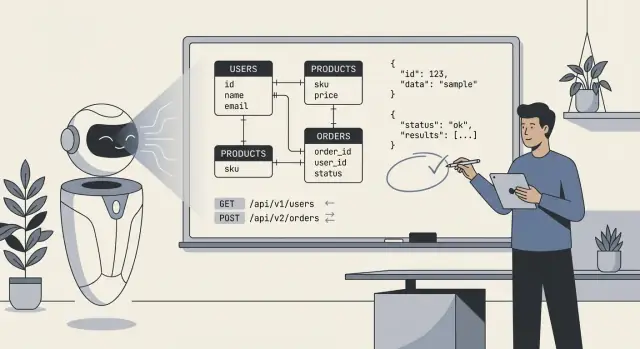
What “AI Designs Your Backend” Actually Means
When people say “AI designed our backend,” they usually mean the model produced a first draft of the core technical blueprint: database tables (or collections), how those pieces relate, and the APIs that read and write data. In practice, it’s less “AI built everything” and more “AI proposed a structure we can implement and refine.”
What an AI-designed backend typically includes
At a minimum, AI can generate:
- Schemas and entities: tables/collections like
users,orders,subscriptions, plus fields and basic types. - Relationships: one-to-many and many-to-many links (e.g., an order has many line items; a product belongs to many categories).
- Constraints and validations: required fields, unique keys, basic ranges, enum-like statuses, and simple referential integrity rules.
- API surface area: CRUD endpoints, request/response shapes, pagination patterns, error formats, and sometimes versioning suggestions.
What it can’t decide without your business context
AI can infer “typical” patterns, but it cannot reliably choose the right model when requirements are ambiguous or domain-specific. It won’t know your real policies for:
- What counts as a “user” (roles? organizations? guest accounts?).
- Which fields are legally required, sensitive, or subject to retention rules.
- Which actions should be auditable, reversible, or require approval.
- The true meaning of statuses (e.g.,
cancelledvsrefundedvsvoided).
The right expectation: copilot, not final authority
Treat AI output as a fast, structured starting point—useful for exploring options and catching omissions—but not as a spec you can ship untouched. Your job is to supply crisp rules and edge cases, then review what the AI produced the same way you’d review a junior engineer’s first draft: helpful, sometimes impressive, occasionally wrong in subtle ways.
Inputs That Determine the Quality of AI Output
AI can draft a schema or API quickly, but it can’t invent the missing facts that make a backend “fit” your product. The best results happen when you treat AI like a fast junior designer: you provide clear constraints, and it proposes options.
The inputs AI actually needs
Before you ask for tables, endpoints, or models, write down the essentials:
- Core entities and definitions: What objects exist (e.g., User, Subscription, Order) and what each one means in your business.
- Key workflows: The main journeys (sign-up, checkout, refunds, approvals) and the states they move through.
- Roles and permissions: Who can do what (admin, staff, customer, auditor) and what needs to be restricted.
- Reporting and analytics needs: The questions you must answer later (monthly revenue, cohort retention, SLA metrics), including “group by” dimensions.
- Integrations and external IDs: Payment providers, CRMs, identity systems—plus which IDs must be stored.
- Scale and performance expectations: Rough order of magnitude (hundreds vs. millions of records) and latency expectations.
- Compliance and retention: GDPR/CCPA, audit logs, data deletion rules, data residency, retention periods.
- Operational realities: Backfills, imports, manual overrides, and “support team needs to edit X” scenarios.
Why unclear requirements create brittle models
When requirements are fuzzy, AI tends to “guess” defaults: optional fields everywhere, generic status columns, unclear ownership, and inconsistent naming. That often leads to schemas that look reasonable but break under real usage—especially around permissions, reporting, and edge cases (refunds, cancellations, partial shipments, multi-step approvals). You’ll pay for that later with migrations, workarounds, and confusing APIs.
Copyable requirements template
Use this as a starting point and paste it into your prompt:
Product summary (2–3 sentences):

Entities (name → definition):
-

Workflows (steps + states):
-

Roles & permissions:
- Role:
  - Can:
  - Cannot:

Reporting questions we must answer:
-

Integrations (system → data we store):
-

Constraints:
- Compliance/retention:
- Expected scale:
- Latency/availability:

Non-goals (what we won’t support yet):
-
Where AI Helps Most: Speed, Consistency, Coverage
AI is at its best when you treat it like a fast draft machine: it can sketch a sensible first-pass data model and a matching set of endpoints in minutes. That speed changes how you work—not because the output is magically “correct,” but because you can iterate on something concrete right away.
Speed: from blank page to working skeleton
The biggest win is eliminating the cold start. Give AI a short description of entities, key user flows, and constraints, and it can propose tables/collections, relationships, and a baseline API surface. This is especially valuable when you need a demo quickly or you’re exploring requirements that aren’t stable yet.
Speed pays off most in:
- Prototypes where you need to validate a concept with real data flows
- Internal tools where “good enough” structure matters more than perfect modeling
- Early iterations of a product where you expect to rewrite parts anyway
Consistency: boring decisions done the same way every time
Humans get tired and drift. AI doesn’t—so it’s great at repeating conventions across the whole backend:
- Consistent naming patterns (e.g.,
createdAt,updatedAt,customerId) - Predictable endpoint shapes (
/resources,/resources/:id) and payloads - Standard pagination and filtering parameters
This consistency makes your backend easier to document, test, and hand off to another developer.
Coverage: “did we forget an endpoint?”
AI is also good at completeness. If you ask for a full CRUD set plus common operations (search, list, bulk updates), it will usually generate a more comprehensive starting surface area than a rushed human draft.
A common quick win is standardized errors: a uniform error envelope (code, message, details) across endpoints. Even if you later refine it, having one shape everywhere from the start prevents a messy mix of ad-hoc responses.
The key mindset: let AI produce the first 80% quickly, then spend your time on the 20% that requires judgment—business rules, edge cases, and the “why” behind the model.
Typical Failure Modes in AI-Generated Schemas
AI-generated schemas often look “clean” at first glance: tidy tables, sensible names, and relationships that match the happy path. The problems usually appear when real data, real users, and real workflows hit the system.
Normalization: too much or too little
AI can swing between extremes:
- Over-normalization: splitting everything into many tables (e.g., separate tables for every attribute), which makes common queries expensive and increases join complexity.
- Under-normalization: stuffing repeated fields into a single table (e.g., multiple address columns, denormalized status flags) that becomes hard to validate and update.
A quick smell test: if your most common pages need 6+ joins, you may be over-normalized; if updates require changing the same value in many rows, you may be under-normalized.
Missing edge cases that matter in production
AI frequently omits “boring” requirements that drive real backend design:
- Multi-tenant data: forgetting tenant_id on tables, or not enforcing tenant scoping in unique constraints.
- Soft deletes: adding deleted_at but not updating uniqueness rules or query patterns to exclude deleted records.
- Auditing: missing created_by/updated_by, change history, or immutable event logs.
- Time zones: mixing “date” and “timestamp” without a clear rule (UTC storage vs local display), leading to off-by-one-day bugs.
Wrong assumptions about uniqueness and lifecycle
AI may guess:
- a field is globally unique when it’s only unique per tenant (e.g., “invoice_number”),
- a field is required when it’s actually optional during onboarding,
- a single status is enough when you need lifecycle states (draft → active → suspended → archived).
These errors usually surface as awkward migrations and application-side workarounds.
Performance blind spots
Most generated schemas don’t reflect how you’ll query:
- missing composite indexes for common filters (tenant_id + created_at),
- no plan for “hot paths” (latest items, unread counts),
- heavy reliance on JSON fields without indexing strategy.
If the model can’t describe the top 5 queries your app will run, it can’t reliably design the schema for them.
API Design: What AI Gets Right and Wrong
AI is often surprisingly good at producing an API that “looks standard.” It will mirror familiar patterns from popular frameworks and public APIs, which can be a real time-saver. The risk is that it may optimize for what looks plausible rather than what’s correct for your product, your data model, and your future changes.
What AI usually gets right
Resource modeling basics. Given a clear domain, AI tends to pick sensible nouns and URL structures (e.g., /customers, /orders/{id}, /orders/{id}/items). It’s also good at repeating consistent naming conventions across endpoints.
Common endpoint scaffolding. AI frequently includes the essentials: list vs. detail endpoints, create/update/delete operations, and predictable request/response shapes.
Baseline conventions. If you ask explicitly, it can standardize pagination, filtering, and sorting. For example: ?limit=50&cursor=... (cursor pagination) or ?page=2&pageSize=25 (page-based), plus ?sort=-createdAt and filters like ?status=active.
Where AI often goes wrong
Leaky abstractions. A classic failure is exposing internal tables directly as “resources,” especially when the schema has join tables, denormalized fields, or audit columns. You end up with endpoints like /user_role_assignments that reflect implementation detail rather than the user-facing concept (“roles for a user”). This makes the API harder to use and harder to change later.
Inconsistent error handling. AI may mix styles: sometimes returning 200 with an error body, sometimes using 4xx/5xx. You want a clear contract:
- Use proper HTTP status codes (
400,401,403,404,409,422) - A consistent error envelope (e.g.,
{ "error": { "code": "...", "message": "...", "details": [...] } })
Versioning as an afterthought. Many AI-generated designs skip a versioning strategy until it’s painful. Decide on day one whether you’ll use path versioning (/v1/...) or header-based versioning, and define what triggers a breaking change. Even if you never bump the version, having the rules prevents accidental breakage.
A good rule of thumb
Use AI for speed and consistency, but treat API design as a product interface. If an endpoint mirrors your database instead of your user’s mental model, it’s a hint the AI optimized for easy generation—not for long-term usability.
A Practical Workflow to Use AI Without Losing Control
Treat AI like a fast junior designer: great at producing drafts, not accountable for the final system. The goal is to use its speed while keeping your architecture intentional, reviewable, and test-driven.
If you’re using a vibe-coding tool like Koder.ai, this separation of responsibilities becomes even more important: the platform can quickly draft and implement a backend (for example, Go services with PostgreSQL), but you still need to define the invariants, authorization boundaries, and migration rules you’re willing to live with.
A repeatable loop: prompt → draft → review → tests → revise
Start with a tight prompt that describes the domain, constraints, and “what success looks like.” Ask for a conceptual model first (entities, relationships, invariants), not tables.
Then iterate in a fixed loop:
- Prompt: state requirements, non-goals, scale assumptions, and naming conventions.
- Draft: have AI propose a conceptual model + a first-pass schema + API contracts.
- Review: you check for domain correctness, edge cases, and consistency with product decisions.
- Tests: write or generate tests that encode the decisions (validation rules, authorization, idempotency, migration safety).
- Revise: feed back what failed (review findings + test failures) and request a corrected version.
This loop works because it turns “AI suggestions” into artifacts that can be proven or rejected.
Separate the conceptual model from the physical schema and API contracts
Keep three layers distinct:
- Conceptual model: what the business cares about (e.g., “Subscription can be paused,” “Invoice must reference a billing period”).
- Physical schema: how you store it (tables/collections, indexes, constraints, partitioning).
- API contracts: how clients interact with it (resources, request/response shapes, error codes, versioning strategy).
Ask the AI to output these as separate sections. When something changes (say, a new status or rule), you update the conceptual layer first, then reconcile schema and API. This reduces accidental coupling and makes refactors less painful.
Keep decisions traceable with lightweight design notes
Every iteration should leave a trail. Use short, ADR-style summaries (one page or less) that capture:
- Decision: what you chose (e.g., “soft delete via
deleted_at”). - Rationale: why (audit requirements, restore flow).
- Alternatives considered: and why rejected.
- Consequences: migration impact, query complexity, API behavior.
When you paste feedback back into the AI, include the relevant decision notes verbatim. That prevents the model from “forgetting” prior choices and helps your team understand the backend months later.
Prompts That Produce Better Schemas and APIs
AI is easiest to steer when you treat prompting like a spec-writing exercise: define the domain, state the constraints, and insist on concrete outputs (DDL, endpoint tables, examples). The goal isn’t “be creative”—it’s “be precise.”
Prompts for entities and relationships (with constraints)
Ask for a data model and the rules that keep it consistent.
- “Design a relational schema for subscriptions with entities: User, Plan, Subscription, Invoice. Include cardinalities, unique constraints, and soft-delete strategy. Rules: one active subscription per user; invoices must reference immutable plan price at purchase time; store currency as ISO code; timestamps in UTC.”
If you already have conventions, say so: naming style, ID type (UUID vs bigint), nullable policy, and indexing expectations.
Prompts for endpoints and contracts (with examples)
Request an API table with explicit contracts, not just a list of routes.
- “Propose REST endpoints for Subscription management. For each endpoint: method, path, auth, query params, request JSON, response JSON, error codes, and idempotency guidance. Include examples for success and two failure cases.”
Add business behavior: pagination style, sorting fields, and how filtering works.
Prompts for migrations and backwards compatibility
Make the model think in releases.
- “We’re adding
billing_addressto Customer. Provide a safe migration plan: forward migration SQL, backfill steps, feature-flag rollout, and a rollback strategy. API must remain compatible for 30 days; old clients may omit the field.”
Anti-pattern prompts to avoid
Vague prompts produce vague systems.
- “Design the database for an e-commerce app” (too broad)
- “Make it scalable and secure” (missing measurable constraints)
- “Generate the best schema” (no domain rules)
- “Create APIs for everything” (no boundaries or prioritization)
When you want better output, tighten the prompt: specify the rules, the edge cases, and the format of the deliverable.
Human Review Checklist Before You Ship
AI can draft a decent backend, but shipping it safely still needs a human pass. Treat this checklist as a “release gate”: if you can’t answer an item confidently, pause and fix it before it becomes production data.
Schema checklist (tables, collections, and columns)
- Primary keys: Every table has a clear PK. If using UUIDs, confirm generation strategy (DB vs app) and indexing.
- Foreign keys & constraints: Add FK constraints where relationships are real. Verify ON DELETE/ON UPDATE rules are intentional (restrict vs cascade vs set null).
- Uniqueness: Enforce uniqueness in the database (not only in code): emails, external IDs, composite constraints (e.g.,
(tenant_id, slug)). - Nullability: Review every nullable field. If “unknown” is different from “empty,” model it explicitly.
- Indexes: Add indexes for frequent filters/sorts/joins. Remove accidental indexes on low-cardinality fields that won’t help.
- Naming consistency: Pick conventions (singular vs plural,
_idsuffixes, timestamps) and apply them uniformly.
Data integrity decisions (the ones that are expensive to change later)
Confirm the system’s rules in writing:
- Referential integrity: Which relationships must never break? Which can be best-effort?
- Cascading rules: If a parent is deleted, should children be deleted, orphaned, or blocked?
- Soft delete strategy: If you use soft deletes, ensure queries won’t “resurrect” deleted records. Decide whether unique constraints should ignore soft-deleted rows.
API checklist (behavior and safety)
- Auth & authorization: Identify who can call each endpoint and what they can access (especially in multi-tenant data).
- Validation: Validate types, ranges, formats, and cross-field rules. Don’t rely on database errors as validation.
- Rate limits & abuse controls: Add sensible defaults, per user/token/IP where appropriate.
- Idempotency: For create/payment-like operations, support idempotency keys or deterministic request IDs.
- Consistent errors: Standardize error shape and HTTP codes. Ensure error messages don’t leak sensitive internals.
Before merging, run a quick “happy path + worst path” review: one normal request, one invalid request, one unauthorized request, one high-volume scenario. If the API’s behavior surprises you, it will surprise your users too.
Testing Strategy for AI-Designed Backends
AI can generate a plausible schema and API surface quickly, but it can’t prove that the backend behaves correctly under real traffic, real data, and future changes. Treat AI output as a draft and anchor it with tests that lock in behavior.
Contract tests for APIs
Start with contract tests that validate requests, responses, and error semantics—not just “happy paths.” Build a small suite that runs against a real instance (or container) of the service.
Focus on:
- Status codes and error bodies (e.g., 400 vs 404 vs 409 conflicts)
- Validation edge cases (empty strings, oversized payloads, unexpected fields)
- Pagination and sorting stability (consistent ordering, cursor correctness)
- Idempotency for create/update endpoints (safe retries, idempotency keys if used)
If you publish an OpenAPI spec, generate tests from it—but also add hand-written cases for the tricky parts your spec can’t express (authorization rules, business constraints).
Migration tests and rollback plans
AI-generated schemas often miss operational details: safe defaults, backfills, and reversibility. Add migration tests that:
- Apply migrations from an empty DB and from a “dirty” older snapshot
- Verify constraints (unique, foreign keys) behave as expected after backfill
- Exercise rollback (or at least a forward-fix plan) for each migration
Keep a scripted rollback plan for production: what to do if a migration is slow, locks tables, or breaks compatibility.
Load/performance testing tied to real query patterns
Don’t benchmark generic endpoints. Capture representative query patterns (top list views, search, joins, aggregation) and load test those.
Measure:
- p95/p99 latency per endpoint
- DB query counts and slow queries
- Index usage (and missing indexes)
This is where AI designs commonly fall down: “reasonable” tables that produce expensive joins under load.
Security testing essentials
Add automated checks for:
- AuthZ rules (user A cannot access user B’s resources)
- Injection (SQL/NoSQL, path traversal, JSON injection)
- Sensitive data handling (no secrets in logs, correct field redaction, encryption where required)
Even basic security tests prevent the most costly class of AI mistakes: endpoints that work, but expose too much.
Migrations, Refactors, and Long-Term Maintainability
AI can draft a good “version 0” schema, but your backend lives through version 50. The difference between a backend that ages well and one that collapses under change is how you evolve it: migrations, controlled refactors, and clear documentation of intent.
Evolving AI-generated schemas safely
Treat every schema change as a migration, even if AI suggests “just alter the table.” Use explicit, reversible steps: add new columns first, backfill, then tighten constraints. Prefer additive changes (new fields, new tables) over destructive ones (rename/drop) until you’ve proven nothing depends on the old shape.
When you ask AI for schema updates, include the current schema and the migration rules you follow (for example: “no dropping columns; use expand/contract”). This reduces the chance it proposes a change that’s correct in theory but risky in production.
Handling breaking changes without chaos
Breaking changes are rarely a single moment; they’re a transition.
- Deprecations: keep old fields/endpoints working while logging usage.
- Dual-write: write to both old and new columns/tables during the transition window.
- Backfills: run a one-time or incremental job to populate new structures.
AI is helpful at producing the step-by-step plan (including SQL snippets and rollout order), but you should validate the runtime impact: locks, long-running transactions, and whether the backfill can be resumed.
Refactoring data models without rewriting everything
Refactors should aim to isolate change. If you need to normalize, split a table, or introduce an event log, keep compatibility layers: views, translation code, or “shadow” tables. Ask AI to propose a refactor that preserves existing API contracts, and to list what must change in queries, indexes, and constraints.
Document assumptions so future prompts stay consistent
Most long-term drift happens because the next prompt forgets the original intent. Keep a short “data model contract” document: naming rules, ID strategy, timestamp semantics, soft-delete policy, and invariants (“an order total is derived, not stored”). Link it in your internal docs (e.g., /docs/data-model) and reuse it in future AI prompts so the system designs within the same boundaries.
Security and Privacy Considerations
AI can draft tables and endpoints quickly, but it doesn’t “own” your risk. Treat security and privacy as first-class requirements you add to the prompt, then verify in review—especially around sensitive data.
Start with data classification
Before you accept any schema, label fields by sensitivity (public, internal, confidential, regulated). That classification should drive what gets encrypted, masked, or minimized.
For example: passwords should never be stored (only salted hashes), tokens should be short-lived and encrypted at rest, and PII like email/phone may need masking in admin views and exports. If a field isn’t necessary for product value, don’t store it—AI will often add “nice to have” attributes that increase exposure.
Access control: RBAC vs ABAC
AI-generated APIs often default to simple “role checks.” Role-based access control (RBAC) is easy to reason about, but breaks down with ownership rules (“users can only see their own invoices”) or context rules (“support can view data only during an active ticket”). Attribute-based access control (ABAC) handles these better, but requires explicit policies.
Be clear about the pattern you’re using, and ensure every endpoint enforces it consistently—especially list/search endpoints, which are common leakage points.
Prevent accidental logging of sensitive fields
Generated code may log full request bodies, headers, or database rows during errors. That can leak passwords, auth tokens, and PII into logs and APM tools.
Set defaults like: structured logs, allowlist fields to log, redact secrets (Authorization, cookies, reset tokens), and avoid logging raw payloads on validation failures.
Privacy, retention, and deletion
Design for deletion from day one: user-initiated deletes, account closure, and “right to be forgotten” workflows. Define retention windows per data class (e.g., audit events vs marketing events), and ensure you can prove what was deleted and when.
If you keep audit logs, store minimal identifiers, protect them with stricter access, and document how to export or delete data when required.
When to Use AI (and When Not To)
AI is at its best when you treat it like a fast junior architect: great at producing a first draft, weaker at making domain-critical tradeoffs. The right question is less “Can AI design my backend?” and more “Which parts can AI draft safely, and which parts require expert ownership?”
Good fits: drafts, prototypes, and well-understood patterns
AI can save real time when you’re building:
- Small prototypes, internal tools, and MVPs where the goal is learning quickly.
- CRUD-heavy systems with familiar entities (users, orders, subscriptions) and standard constraints.
- “Blank page” moments: generating an initial schema, API surface, and naming conventions to iterate on.
Here, AI is valuable for speed, consistency, and coverage—especially when you already know how you want the product to behave and can spot mistakes.
Poor fits: regulated, high-risk, or domain-heavy systems
Be cautious (or avoid AI-generated designs as anything more than inspiration) when you’re working in:
- Finance: ledgers, reconciliation, audit trails, and idempotency rules that must be exact.
- Healthcare: patient data, consent models, retention rules, interoperability constraints.
- Safety-critical domains: where a “reasonable assumption” can become a costly incident.
In these areas, domain expertise outweighs AI speed. Subtle requirements—legal, clinical, accounting, operational—often aren’t present in the prompt, and AI will confidently fill gaps.
Decision guide: use AI for drafts, mandate human sign-off
A practical rule: let AI propose options, but require a final review for data model invariants, authorization boundaries, and migration strategy. If you can’t name who is accountable for the schema and API contracts, don’t ship an AI-designed backend.
Next steps
If you’re evaluating workflows and guardrails, see related guides in /blog. If you want help applying these practices to your team’s process, check /pricing.
If you prefer an end-to-end workflow where you can iterate via chat, generate a working app, and still keep control via source code export and rollback-friendly snapshots, Koder.ai is designed for exactly that style of build-and-review loop.
FAQ
What does “AI designed our backend” usually mean in practice?
It usually means the model generated a first draft of:
- entities/tables (or collections) and fields
- relationships and basic constraints
- a starter set of CRUD-style API endpoints
A human team still needs to validate business rules, security boundaries, query performance, and migration safety before shipping.
What information should I give AI before asking for a schema or API?
Provide concrete inputs the AI can’t safely guess:
- entity definitions (what each object means)
- key workflows + state transitions
- roles/permissions and tenant boundaries
- reporting questions you’ll need later
- integrations + external IDs to store
- scale/latency targets
- compliance, retention, and deletion rules
The clearer the constraints, the less the AI “fills gaps” with brittle defaults.
Why should I separate the conceptual model from the physical schema and API?
Start with a conceptual model (business concepts + invariants), then derive:
- physical schema (tables, constraints, indexes)
- API contracts (resources, payloads, errors)
Keeping these layers separate makes it easier to change storage without breaking the API—or to revise the API without accidentally corrupting business rules.
What are the most common failure modes in AI-generated schemas?
Common issues include:
- over- or under-normalization (too many joins vs duplicated data)
- missing multi-tenant scoping (
tenant_idand composite unique constraints) - soft delete mistakes (uniqueness and queries not accounting for
deleted_at) - missing audit fields/logs when you actually need traceability
- inconsistent time handling (UTC vs local, date vs timestamp)
- performance blind spots (no composite indexes for real query patterns)
A schema can look “clean” and still fail under real workflows and load.
How do I make sure an AI-designed schema won’t be slow in production?
Ask the AI to design around your top queries and then verify:
- which filters/sorts are most common (e.g.,
tenant_id + created_at) - which endpoints are “hot paths” (latest items, unread counts)
- what needs composite indexes
- where joins will be frequent and expensive
If you can’t list the top 5 queries/endpoints, treat any indexing plan as incomplete.
What does AI usually get wrong when generating REST APIs?
AI is good at standard scaffolding, but you should watch for:
- endpoints that mirror tables (leaky abstractions like join-table resources)
- mixed error semantics (returning
200with errors, inconsistent 4xx/5xx) - missing versioning rules and breaking-change policy
Treat the API as a product interface: model endpoints around user concepts, not database implementation details.
What’s a safe workflow for iterating with AI without losing control?
Use a repeatable loop:
- Prompt with constraints, non-goals, conventions, and scale assumptions
- Draft conceptual model + schema + API contracts
- Review for domain correctness, edge cases, and security
- Tests (contract, authz, validations, idempotency, migrations)
- Revise using concrete failures from review/tests
This turns AI output into artifacts you can prove or reject instead of trusting prose.
How should I standardize error handling in an AI-generated API?
Use consistent HTTP codes and a single error envelope, for example:
- status codes:
400,401,403,404,409,422,429 - body shape:
{"error":{"code":"...","message":"...","details":[...]}}
Also ensure error messages don’t leak internals (SQL, stack traces, secrets) and stay consistent across all endpoints.
What should I test first on an AI-designed backend?
Prioritize tests that lock in behavior:
- API contract tests (status codes, validation edge cases, pagination stability)
- authorization tests (user A cannot access user B’s resources)
- idempotency tests for create/payment-like operations
- migration tests (apply from empty + older snapshot; verify constraints post-backfill)
- basic security tests (injection, sensitive-field redaction in logs)
Tests are how you “own” the design instead of inheriting the AI’s assumptions.
When is it a bad idea to rely on AI for backend design?
Use AI mainly for drafts when patterns are well-understood (CRUD-heavy MVPs, internal tools). Be cautious when:
- requirements are regulated or high-risk (finance, healthcare, safety-critical)
- correctness depends on subtle domain rules (ledgers, reconciliation, consent)
- you can’t name a human accountable for invariants, auth boundaries, and migrations
A good policy: AI can propose options, but humans must sign off on schema invariants, authorization, and rollout/migration strategy.