

MediaTek’s Integrated SoCs and Fast Cycles Win Mid-Market Scale
Explore how MediaTek’s integrated SoCs and rapid release cadence help OEMs ship high-volume mid-market phones worldwide—faster, cheaper, and on schedule.
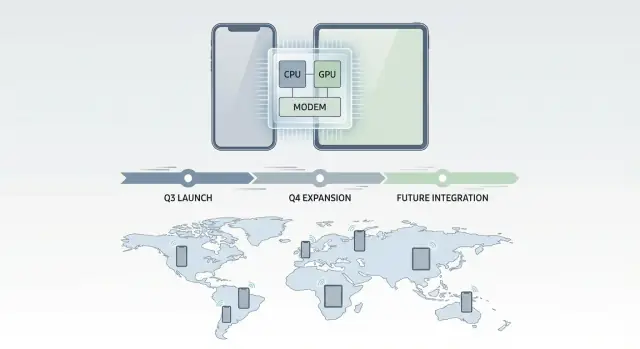
Why the Mid-Market Rewards Speed and Integration
Mid-market phones win on a simple promise: “good enough on everything, at a price most people will actually pay.” That segment is typically the $200–$500 range (varying by country, taxes, and carrier subsidies). Buyers care less about benchmark trophies and more about everyday reliability—camera consistency, battery life, smooth scrolling, and solid connectivity. Because these devices target the broadest audience, volumes are huge, and small execution advantages scale fast.
What “integrated SoC” means (in plain terms)
An integrated SoC (system-on-chip) is the phone’s main “brain board” condensed into one chip package. Instead of sourcing many separate parts, the SoC bundles key blocks that must work together tightly:
- CPU for app and system tasks
- GPU for graphics and gaming
- Modem for 4G/5G and voice/data connectivity
- ISP (image signal processor) for camera processing
- AI/NPU blocks for on-device features like photo enhancement and voice tasks
When more of this is integrated, device makers generally get fewer interconnect headaches, simpler tuning, and a clearer path to predictable performance and power behavior.
Strategy, not secrets
This article focuses on the mechanics of how integrated chip platforms and faster refresh cycles can translate into mid-market scale. It’s not about confidential pricing, private contracts, or any single OEM’s internal plans.
The levers to watch
MediaTek’s playbook in the mid-market tends to revolve around three practical levers: integration (more capabilities in one platform), platform reuse (one core design stretched across many models), and fast refresh cycles (keeping shelves stocked with “new enough” devices). The sections ahead break down how those levers affect cost, launch timing, regional variants, and real-world user experience.
What Integrated SoCs Change for Device Makers
For phone makers, “integration” mostly means fewer major chips on the main board and fewer vendor relationships to coordinate. Instead of pairing an applications processor from one supplier with a separate modem (and sometimes separate connectivity or power-management components) from another, an integrated smartphone chipset combines more of the “must-have” blocks into a single package.
That abstraction turns into schedule reality. Fewer chips typically means fewer high-speed links to route, fewer board spins to fix signal issues, and less time aligning roadmaps, driver stacks, and certification requirements across vendors. It also makes it easier for OEMs and ODMs to reuse a proven design with minor changes—exactly what mid-range Android programs depend on.
Integrated modem = simpler board, less tuning
A 4G/5G modem integrated into the SoC can reduce board complexity because the most timing-sensitive connections stay inside the silicon package. Practically, teams spend less effort on:
- Inter-chip interoperability testing (AP ↔ modem)
- RF and thermal tuning driven by extra components and board routing
- Coordinating power behavior across multiple chips (sleep states, handoffs, peaks)
It doesn’t eliminate RF work—antennas, bands, and carrier requirements still dominate—but it can narrow the “unknowns” that slow late-stage validation.
The trade-offs: flexibility vs. simplicity
Integration can limit mix-and-match flexibility. If you want a particular modem feature set or a different connectivity approach, you may have fewer options than with a discrete design. Vendors also tier features across SKUs (camera pipelines, GPU bins, modem categories), so product planners must choose the right rung without overpaying.
One platform, many devices
A single MediaTek SoC platform might power a 4G entry model, a 5G variant, and a “plus” SKU by reusing the same core board and software stack, then adjusting memory, cameras, charging speed, and regional band support—turning one validated base into multiple sellable devices.
Cost, BOM, and the Practical Economics of Volume Devices
Mid-market phones win on pricing discipline as much as features. For OEMs and ODMs shipping at scale, small per-unit changes add up quickly—but only if they also reduce operational friction (procurement, factory throughput, and returns).
Where the real costs sit
A phone’s “cost” isn’t just the headline chip price. The biggest drivers typically include:
- Bill of materials (BOM): application processor/SoC, memory, display, cameras, RF front-end, power management, sensors, mechanicals, and passives
- Assembly and calibration: line time, tooling, camera and antenna tuning, and functional checks
- Testing: RF tests, throughput/power verification, and final quality screening
- Certification and compliance: carrier/regulatory requirements, regional radio approvals, and ongoing paperwork
How integration changes the economics
An integrated SoC (especially with an integrated 4G/5G modem and tighter RF/platform support) can lower BOM in two practical ways: it can reduce the number of discrete chips needed around the core platform, and it can simplify sourcing by shrinking the list of critical components that must be qualified, procured, and kept in sync.
Fewer components also tends to improve manufacturing outcomes. With fewer interconnects and fewer separate parts to place and validate, factories often see higher yield and less rework risk—not because quality issues disappear, but because there are simply fewer places for tolerances, firmware mismatches, or supplier variation to cause failures.
Important nuance: savings aren’t universal
The size of these savings varies by design choices (camera/RF complexity, memory configuration), region (band support and certification), and volume commitments. Integration helps most when it reduces both parts count and process complexity, not when it merely shifts costs from one line item to another.
Fast Product Cycles: How Cadence Turns Into Market Share
A “product cycle” is the time from one platform launch to the next—new chipset tiering, updated CPU/GPU blocks, modem features, ISP changes, and the software package that makes it usable in real devices. In the Android ecosystem, cadence matters because OEMs aren’t shipping one flagship a year; they’re maintaining a full ladder of phones across multiple price bands, regions, and carrier requirements.
Cadence keeps lineups current—without starting from scratch
Frequent platform updates let an OEM refresh the mid-range more often with meaningful, marketable improvements: better camera processing, incremental power gains, newer Bluetooth/Wi‑Fi combos, and modem updates aligned with what carriers are promoting. When the underlying SoC platform arrives on a predictable schedule, product teams can plan a steady rhythm of releases rather than betting everything on a single “big” device.
This is especially important at value-oriented price points, where small spec bumps can unlock new marketing messages (“night mode,” “faster charging,” “5G in more bands”) and protect margins without redesigning the entire phone.
Retail and carrier dynamics reward timing
Market share isn’t only about peak performance; it’s about being available at the right moments:
- Seasonal launches (back-to-school, holiday, major sales periods)
- Carrier promos that spotlight a specific feature (5G, battery life, camera)
- Silent refreshes to keep a best-seller competitive as rivals update
If a vendor’s roadmap supports those windows with ready-to-ship platforms, OEMs can place more SKUs in more channels—often the difference between “a model exists” and “a model is everywhere.”
Faster cycles also help counter competitors and new standards
When a competitor makes a sudden pricing move—or when standards shift (new 5G bands, updated codec requirements, regional certification changes)—shorter cycles reduce the time OEMs spend stuck with last-generation limitations. That responsiveness translates into more design wins, more shelf space, and ultimately more mid-market volume.
A quick parallel: cadence matters for software, too
The same “fast refresh + reuse” logic increasingly applies to the software around devices—companion apps, onboarding flows, warranty/returns portals, and internal certification dashboards. Teams that need those tools quickly often use platforms like Koder.ai to vibe-code web, backend, and mobile apps via chat, iterate in planning mode, and rely on snapshots/rollback to keep rapid changes controlled—without rebuilding an entire dev pipeline for every model year.
Platform Reuse: One Core Design, Many SKUs
MediaTek’s mid-market advantage isn’t only about a single chip being “good enough.” It’s about platform families: a set of related SoCs built around shared IP blocks (CPU/GPU clusters, ISP, modem, multimedia engines) and a shared software foundation. When the hardware building blocks stay familiar, the work to bring up Android, validate radios, tune cameras, and pass operator requirements becomes repeatable instead of starting from zero.
Platform families: shared hardware, shared software
For OEMs and ODMs, reusing a proven baseboard and software stack reduces risk. The same driver set, calibration tools, and manufacturing tests can be carried forward with targeted updates for a new SKU. That consistency matters in the value segment, where margins don’t leave room for prolonged debugging.
Regional reuse with small, controlled changes
A single “core” design can be deployed across regions with adjustments that are easier to isolate and certify:
- Connectivity bands and carrier features: regional LTE/5G band combinations, VoLTE/VoNR profiles, and certification packages
- Modem tiering: a 4G variant for price-sensitive markets, a 5G variant where operators demand it
- Memory/storage: 6GB vs 8GB RAM, UFS tier changes, or different suppliers based on availability
- Camera modules: same main sensor with alternate ultra-wide or macro modules, different OIS presence, or tuned ISP parameters
- Display options: 90Hz vs 120Hz panels, resolution changes, and power profiles
Why ODMs benefit: repeatable builds and faster ramps
ODMs thrive on repeatability. A reusable platform lets them run the same manufacturing fixtures, automated test scripts, and QA processes across multiple customer brands. That means faster factory ramps, fewer line stoppages, and smoother component substitutions—turning one validated design into a family of devices that can ship at scale with predictable timelines.
Reference Designs and Software Stacks That Shorten Time-to-Market
For mid-market phones, the clock often matters as much as the spec sheet. One reason MediaTek-based programs can move quickly is the amount of “starting material” OEMs and ODMs get beyond the silicon itself: reference designs plus a broad software enablement package.
What a reference design actually gives you
A reference design isn’t just a demo phone. It’s a practical blueprint for building a shippable device with fewer unknowns.
It typically includes core schematics, PCB layout guidance (stack-up, critical traces, RF routing patterns), and power/thermal recommendations that reflect what has already worked in real hardware. For teams trying to hit a launch window, that guidance reduces re-spins and avoids spending weeks rediscovering basic constraints.
Just as important, reference platforms provide tuning baselines—known-good starting points for display timings, audio paths, charging behavior, thermals, and camera pipelines—so early prototypes behave predictably.
Software enablement: the other half of the schedule
On the software side, speed comes from having a mature set of building blocks ready at bring-up. That usually means board support packages (BSPs), drivers for key peripherals, modem and connectivity stacks, and camera frameworks that integrate the ISP with common sensor combinations.
When those pieces are already aligned with a target Android release and common hardware options, engineering effort shifts from “make it boot and connect” to “make it feel great,” which is a better use of limited time.
Validation labs and test suites reduce surprises
Hardware and software still fail in new ways, but structured validation helps catch issues early. Certification support, RF/regional band test coverage, and automated test suites (modem stability, thermal limits, battery drain, camera regressions) reduce late-stage surprises that can derail launches.
The boundary: where OEMs still differentiate
Reference designs don’t erase differentiation. OEMs still win or lose on industrial design, materials, camera tuning choices, UI/UX, feature prioritization, and how well the whole product is costed and packaged for a specific market.
The advantage is starting closer to “working phone,” then spending limited schedule on choices customers actually notice.
Connectivity as a Volume Driver: 4G/5G and Regional Band Needs
For mid-range phones, connectivity isn’t a “nice to have”—it’s often the deciding factor. Buyers may not compare CPU cores, but they do notice whether a phone holds signal on the commute, uploads quickly, supports dual SIM reliably, and doesn’t drain the battery on 5G. For carriers and retailers, a device that performs well on real networks gets fewer returns and better reviews, which directly affects volume.
Why the modem is central in the mid-range
In the value segment, the modem largely determines everyday satisfaction: call stability, data speed, coverage in weak-signal areas, and battery life during mobile data use. Mid-range devices also tend to be used longer, and network changes (new 5G deployments, refarmed LTE bands) can expose “good enough” modems over time.
Integration benefits: RF design, heat, power, and certification
When the 4G/5G modem is tightly integrated into the SoC platform, OEMs/ODMs can simplify the hardest parts of phone design:
- RF layout becomes more predictable, reducing trial-and-error on antenna tuning and board routing
- Power management is easier to optimize, improving screen-on time during data-heavy use
- Thermals are more controllable, so phones throttle less during navigation, video upload, or hotspot use
- Certification effort can shrink, because the platform has clearer reference paths for carrier testing and regulatory compliance
That matters most in the mid-market, where teams are building to strict budgets and timelines.
Regional band support and global rollouts
Volume models rarely ship to just one country. Band support—LTE and 5G NR combinations, plus carrier-specific requirements—can make or break a global launch. A platform that already targets broad band coverage reduces region-by-region redesigns, lowers the chance of late-stage carrier rejections, and makes it easier to reuse the same core device across markets with minor SKU tweaks.
Beyond cellular: the full connectivity bundle
A mid-range “platform” story also includes integrated Wi‑Fi, Bluetooth, and GNSS. When these radios are validated together, it’s easier to hit stable Wi‑Fi performance, reliable Bluetooth accessories, accurate navigation, and acceptable standby drain—details that add up to better reviews and bigger shipments.
Performance, Power, and Real-World User Experience in the Value Segment
Mid-market buyers don’t benchmark for sport; they notice whether the phone feels smooth, lasts a full day, and doesn’t turn into a hand-warmer during a long game. That’s why balanced CPU/GPU performance, efficient modems, and tightly integrated power management matter as much as peak specs.
Power efficiency shows up as design freedom
A more efficient SoC can hit the same everyday responsiveness while consuming less energy. For device makers, that translates into practical choices:
- Battery size vs. thickness: If the platform sips power, an OEM can use a smaller battery to make a thinner, lighter phone—or keep the battery size and market longer battery life
- Cost control: Batteries are a meaningful cost item. Saving even a little capacity (while holding battery life steady) can reduce BOM pressure
- Thermal design: Lower heat output can mean simpler cooling solutions and fewer performance drops
“Good enough” performance targets (that users actually feel)
In the value segment, “good enough” usually means: apps open quickly, scrolling stays smooth at common refresh rates, multitasking doesn’t lag, and the camera pipeline keeps up with bursts and HDR. Users also notice network responsiveness—fast wake, quick page loads, stable calls—where integrated modem behavior and power tuning show up immediately.
Sustained performance for gaming and video
Peak frame rates are less important than steady frame rates. Efficient cores and sensible thermal limits help keep gameplay consistent over 15–30 minutes, and maintain stable video recording without aggressive throttling or dropped frames.
On-device AI in practical terms
Dedicated AI blocks are most valuable when they enable features without draining the battery: faster scene detection and portrait effects, cleaner low-light photos, real-time voice enhancement, smarter noise reduction in videos, and snappier on-device assistants that don’t always need the cloud.
Supply Chain Fit: Predictability, Scale, and Manufacturing Reality
Mid-market phones are built on schedules, not dreams. The winners are the teams that can ship millions of units on time, week after week, with yields and logistics that don’t surprise finance or retail partners.
The manufacturing chain (and where things can slip)
A typical volume program flows like this: silicon vendor defines the chipset and reference BOM → wafer production at the foundry → packaging and test (turning wafers into usable chips) → shipment to OEM/ODM factories for PCB assembly, final device assembly, and QA.
Any weak link creates missed launch windows. If packaged chip output lags for a month, it doesn’t matter that the spec sheet looks great—factories sit idle, air freight bills rise, and channel plans break.
Why predictable supply beats peak specs at scale
For high volumes, brands usually prefer “good performance that we can get every month” over “best performance that arrives in bursts.” Predictability supports:
- Stable production runs (less rework, fewer last-minute substitutions)
- Consistent regional launches (carriers and retailers care about date certainty)
- Cleaner pricing (less panic-buying components)
An integrated SoC also reduces reliance on extra companion chips, which can become surprise bottlenecks.
Multi-sourcing vs. single-platform risk (plainly)
Using one main chipset platform across many models simplifies tooling, testing, and certification—but it increases exposure if that platform faces a constraint. Multi-sourcing (having an alternative chipset option) reduces that risk, yet adds engineering effort: separate board designs, different RF tuning, and different software validation.
Long-lead components: memory and displays set the tempo
Chipset plans don’t exist in isolation. Memory (LPDDR/UFS) and displays are often long-lead items with allocation cycles. If a phone is designed around a specific memory configuration or panel interface, late changes can ripple into the SoC choice, PCB layout, and even thermal design. The most manufacturable programs align chipset roadmap, memory availability, and display sourcing early—so the factory can build continuously, not in stop-start waves.
Why This Strategy Works Globally, Not Just in One Region
Mid-market phones aren’t a single “segment” worldwide. They’re a patchwork of regional realities: sharper price sensitivity in some countries, very specific network band needs in others, and wildly different sales channels (open market retail, operator bundles, online-only launches, or carrier certification-heavy routes).
Regional variation: price, networks, and channels
A $200–$300 device can mean “entry premium” in one market and “mass-market default” in another. Network requirements also differ: LTE/5G band combinations, VoLTE/VoWiFi expectations, and regional tuning for coverage can make one SKU unsuitable elsewhere. Channel mix matters too—operator-led markets often demand certification schedules and feature checklists that unlocked retail markets can skip.
Local brands and operator requirements
Local brands and ODM-driven programs frequently win on speed and sharp product definition: the right camera stack, the right display, the right battery size, and the right connectivity set—without overbuilding. Operators add another layer: they may require specific modem features, test plans, or regional band support before a device can ship at volume.
Why a broad, integrated lineup scales globally
A wide range of integrated smartphone chipsets lets device makers “snap” products to local constraints quickly. If one platform tier isn’t cost- or band-appropriate, there’s often an adjacent option on the chipset roadmap that preserves the schedule. Pair that with reference platforms and the path from prototype to shelf gets shorter across many countries.
A simple decision framework
Start with region needs (price ceiling, bands, operator rules) → choose a platform tier (value to upper mid-range) → finalize the device configuration (memory, cameras, thermals, battery). That flow helps teams ship mid-range Android devices that fit local demand—fast enough to capture global device volumes.
Trade-Offs and Risks: What Fast Cycles Can Complicate
Speed and integration can be a winning formula, but they also shift work and risk onto OEMs/ODMs in ways that aren’t always obvious on a spec sheet.
Competitive pressure isn’t standing still
Mid-market device makers are squeezed from both sides: flagship-tier features drifting downward, and low-end price aggression pushing upward. Rival SoCs from Qualcomm and Samsung compete on modem features, GPU efficiency, and brand pull. At the same time, some large OEMs invest in custom silicon for differentiation (camera pipelines, AI blocks, power management), which can reduce appetite for a tightly defined platform—even if it’s cost-effective.
Fast cycles also interact with shifting OEM strategies: one year an OEM wants maximum reuse across regions, the next year it prioritizes camera “signature” features or a specific ISP path. Platform choices can become political as well as technical.
Software and support costs can rise
A quicker cadence means more platform variants in the field. That increases:
- Update workload (Android version bumps, security patches, kernel merges)
- Testing matrix size (carriers, regions, memory configs, cameras)
- Long-tail support cost when multiple generations remain on shelves
If an organization isn’t set up for disciplined branch management and automated testing, fast releases can translate into fragmentation and slower updates—hurting user trust and carrier relationships.
Connectivity changes multiply certification work
Integrated 4G/5G modems help on BOM and power, but each new band combination, carrier requirement, or region-specific feature (VoLTE/VoNR, emergency services, SAR) adds certification cycles. A new modem feature set can trigger re-testing, lab scheduling risk, and documentation overhead that erodes time-to-market gains.
Balanced guidance
Integration helps most when you value predictable schedules, controlled BOM, and proven reference stacks. It can limit choices when you need unusual RF front-end flexibility, deep custom camera/AI differentiation, or multi-year software maintenance with minimal platform churn. The best teams plan this trade-off up front and budget engineering time for validation and updates—not just hardware bring-up.
Key Takeaways and a Practical Evaluation Checklist
MediaTek’s mid-market scale playbook is repeatable: build highly integrated smartphone chipsets (CPU/GPU + ISP + multimedia + security + 4G/5G modem integration), ship them as reference design platforms with proven software, refresh the lineup quickly, and enable OEMs/ODMs to reuse a core design across multiple SKUs. The result is simpler engineering, fewer external parts, and faster time-to-market electronics—exactly what mid-range Android devices compete on.
The repeatable playbook (in one view)
Integration reduces risk and BOM variability; rapid refresh keeps specs current without a full redesign; reuse turns one validated hardware/software base into a family of products that can target different price bands and regions.
OEM/PM checklist when choosing a platform
- Regional fit: Does the modem support the exact bands and carrier features you need (VoNR/VoLTE, carrier aggregation, SA/NSA) for your launch countries?
- Software maturity: Is the BSP stable, security patch cadence clear, and Android version support aligned with your update promise?
- Reference design readiness: Are antenna guidelines, thermal design, camera tuning tools, and certification support included—or left to you?
- Performance per watt: Sustained performance after 10–15 minutes of load (gaming, camera, navigation), not just peak benchmarks
- Camera and multimedia: ISP features you can actually ship (HDR, low-light, video stabilization) and codec support that matches your market
- Supply chain compatibility: Package availability, lead times, second-source options for key peripherals, and proven ODM manufacturing flows
- SKU reuse potential: How easily can you scale RAM/storage, cameras, or displays without redoing RF, thermal, or compliance work?
- Roadmap clarity: Smartphone chipset roadmap timing, pin/package continuity, and migration effort between generations
What to watch next
Expect differentiation to move toward modem features (more bands and better uplink), efficiency gains that improve real battery life, and “AI” features that are practical on-device (camera, voice, translation) rather than marketing-only.
If you’re standardizing your evaluation process, keep a lightweight scorecard and revisit assumptions each quarter—fast cycles reward teams that decide early. For more frameworks, see /blog. If you’re comparing support options or commercial terms, check /pricing.
FAQ
What is an “integrated SoC” in a smartphone, and why does it matter?
An integrated SoC (system-on-chip) combines major phone “brain” components into one package—typically CPU, GPU, cellular modem, ISP (camera processing), and AI/NPU blocks.
For OEMs/ODMs, this usually means fewer separate chips to source, route on the PCB, and validate, which can reduce surprises late in development.
How does an integrated 4G/5G modem speed up phone development?
With an integrated modem, many timing-sensitive connections stay inside the chip package, which often reduces:
- AP ↔ modem interoperability work
- Board routing complexity and re-spins
- Power-state coordination across multiple chips
You still have to do antenna/RF tuning and carrier testing, but integration can narrow the set of “unknowns” that delay launch.
What are the main trade-offs of higher integration?
Common trade-offs include:
- Less mix-and-match flexibility versus pairing separate application processors and modems
- Feature tiering across SKUs (you may need to pick a higher tier to get a specific camera/modem capability)
- More dependency on a single platform’s roadmap and availability
The key is to decide early whether simplicity or customization is the priority for your product.
Does an integrated SoC always reduce the bill of materials (BOM)?
Not always. BOM impact depends on whether integration actually reduces total parts count and process complexity.
Savings tend to be strongest when fewer companion chips also mean simpler assembly, fewer placement steps, fewer failure points, and less rework—not when costs just shift to other required components (RF front-end, memory, display, cameras).
Why do fast product cycles matter more in the mid-market than in flagships?
Fast refresh cycles let OEMs ship “new enough” improvements—camera processing tweaks, efficiency gains, newer connectivity combos—without a full redesign.
That helps align launches with retail and carrier windows (holidays, promos, back-to-school), which often matters more for volume than peak benchmark wins.
What does “one platform, many devices” look like in practice?
Platform reuse means taking one validated core design (board + software stack) and producing multiple SKUs by changing controlled variables such as:
- RAM/storage tiers
- Camera module combinations
- Display refresh rate or panel options
- 4G vs 5G variants and regional band sets
This reduces engineering repetition and speeds certification and manufacturing ramps.
What do smartphone reference designs actually provide to OEMs and ODMs?
A reference design is a practical blueprint that usually includes schematics guidance, PCB/routing recommendations, power/thermal baselines, and known-good tuning starting points.
It reduces early guesswork and PCB re-spins, helping teams move faster from prototype to a stable, shippable configuration.
How does software maturity affect time-to-market for mid-range phones?
A mature software enablement package typically means a stable BSP, peripheral drivers, modem/connectivity stacks, and camera framework integration that matches common sensors and an Android release.
This shifts effort from “make it boot and connect” to “polish the experience,” which is usually where mid-market devices win or lose reviews.
Why is connectivity (modem + bands) such a big volume driver in the mid-market?
Because buyers notice coverage, call stability, hotspot behavior, and battery drain on mobile networks more than synthetic CPU scores.
A strong modem and well-validated connectivity bundle (cellular + Wi‑Fi + Bluetooth + GNSS) can reduce returns and improve ratings—directly influencing channel confidence and shipment volume.
What’s a practical way to evaluate a mid-market SoC platform before committing?
Use a lightweight checklist focused on execution risk and regional fit:
- Exact LTE/5G bands + carrier features (VoLTE/VoNR, SA/NSA)
- Sustained performance per watt (not just peak)
- Camera/ISP features you can ship with your module choices
- Software support plan (security patches, Android version path)
- Reference design + certification/test support coverage
- Supply predictability and contingency options
- Reuse potential across SKUs and regions
For related frameworks, see /blog and for commercial/support options, /pricing.