

Mobile-Friendly Websites: Common Mistakes and How to Fix
Learn the most common mobile-friendly website mistakes—slow pages, tiny tap targets, broken layouts, and hard navigation—and how to fix them fast.
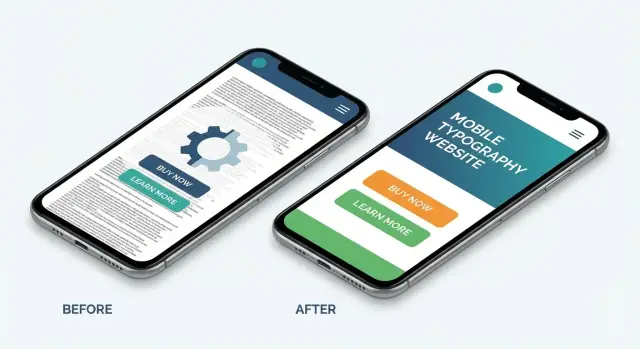
Why Mobile-Friendly Still Matters
Most people first meet your business on a phone—often while distracted, on a slower connection, and using one thumb. If your mobile-friendly website feels cramped, slow, or confusing, visitors don’t “try harder.” They bounce, abandon forms, or call support instead.
Mobile usability impacts revenue (and your support inbox)
Small mobile usability mistakes create outsized business effects:
- Lower signups and sales: Friction like tiny buttons, confusing navigation, or slow checkout adds drop-offs at every step.
- Higher support load: When people can’t find information or complete tasks on mobile, they message, call, or leave negative reviews.
- Weaker trust: Layout glitches, overlapping text, or jumpy pages make a site feel outdated or unsafe.
Search and ads increasingly judge the mobile experience
Search engines and ad platforms pay close attention to mobile experience. If pages are slow or unstable, you may see weaker performance even if your content is great. Metrics tied to Core Web Vitals mobile (like loading speed and layout stability) influence how competitive you are—especially for high-intent searches.
On the paid side, a slow mobile page speed or frustrating landing page can reduce conversion rates and increase cost per acquisition.
What “mobile-friendly” actually includes
A truly mobile-friendly website is more than “it fits on my phone.” It typically means:
- Responsive design fixes: Layout adapts to screen sizes (including the viewport meta tag).
- Readable content: Good mobile typography, spacing, and contrast.
- Touch-friendly UI: Adequate touch target size and comfortable one-handed use.
- Fast media: Responsive images and optimized video so pages load quickly.
- Accessible basics: Keyboard support where needed, clear focus states, and sensible labels.
What this guide covers
Next, you’ll get a quick audit checklist, then 11 common mobile usability mistakes—with practical fixes you can apply immediately to your design, content, and site performance.
How to Audit Your Site on Mobile (Quick Checklist)
Before you fix anything, get a clear baseline. A good mobile audit is a mix of real-device testing and a few fast tools that reveal what users actually experience.
1) Test on real phones (not just a resized browser)
Use at least one iPhone and one Android device if possible, and try both a smaller and a larger screen.
Check:
- Reading: is anything cramped, tiny, or hard to scan?
- Tapping: can you reliably hit buttons and links with your thumb?
- Scrolling: does the page “stick,” jump, or feel heavy?
2) Use browser dev tools for quick breakpoints + throttling
In Chrome or Safari dev tools, switch to responsive mode and sweep through common widths. Then simulate a slower connection and mid-range device.
Look for obvious red flags: horizontal scrolling, elements overlapping, delayed interactions, and sudden layout jumps when images load.
3) Run Lighthouse / PageSpeed Insights (focus on mobile)
Run Lighthouse locally and PageSpeed Insights for a second opinion. Note:
- Mobile performance score
- Core Web Vitals (especially LCP, INP, and CLS)
- Specific “opportunities” like oversized images, render-blocking scripts, and font issues
4) Capture a simple baseline checklist
Create a short checklist (and screenshot evidence) before changes. Record the pages tested, key issues found, and current metrics so you can confirm improvements instead of guessing.
Mistake 1: Viewport and Layout Not Truly Responsive
If your site looks “okay” on desktop but feels cramped on a phone, the root problem is often the viewport and layout rules. When these aren’t set up for mobile, browsers try to squeeze a desktop page into a small screen—leading to tiny text, forced zooming, and horizontal (side) scrolling.
Common symptoms
A few telltale signs:
- Text renders very small until users pinch-zoom
- Buttons or cards fall off-screen and require side scrolling
- The header or hero area looks cut off or oddly scaled
- Columns that should stack stay fixed and cramped
What usually causes it
Missing or incorrect viewport meta tag is the classic culprit. Without it, mobile browsers assume a wider “virtual” viewport.
Another frequent issue is a fixed-width layout (for example, containers set to width: 1200px), which forces the page to overflow on phones.
Finally, many sites rely on pixels everywhere. Pixels can work in moderation, but using px for most sizing makes it harder for layouts to adapt and for users who change text size.
Fix: set the viewport, go fluid, add breakpoints thoughtfully
Start with the correct viewport tag:
<meta name="viewport" content="width=device-width, initial-scale=1" />
Then switch from fixed widths to fluid grids (percentages, flexible columns) and use responsive-friendly units like %, rem, and vw where they make sense. Add breakpoints only when the design actually needs them—too many can create conflicting rules.
A quick validation step: shrink your browser window and confirm content reflows naturally without horizontal scrolling. Then test on a real phone to ensure nothing relies on hover or desktop-only spacing.
Mistake 2: Text and Components Overflow or Overlap
When text spills off the screen or UI elements overlap, mobile users lose trust fast. This usually shows up on smaller phones, in landscape mode, or when users increase their system font size.
Why it happens
A few repeat offenders cause most overflow bugs:
- Hard-coded heights on cards, banners, buttons, and inputs
- Long headlines, product names, or error messages with no room to wrap
- Unbroken strings (URLs, coupon codes, long emails, tracking IDs)
Prevent overflow with a few CSS habits
Design components to flex with content instead of forcing content to fit:
- Allow wrapping in flexible layouts:
flex-wrap: wrap; - Avoid “mysterious shrinking” in flex items: set
min-width: 0;on the child that should shrink - Break long strings:
overflow-wrap: anywhere;(orword-break: break-word;as a fallback) - If truncation is intentional, do it explicitly (and consistently) with line clamping—not accidental clipping
Make cards and forms adapt to real content
Cards should grow vertically with text; forms should handle longer labels and helper text without pushing buttons off-screen. Be especially careful with fixed-height input rows, two-column layouts, and inline error messages.
Test the edge cases (before users find them)
Run a quick “stress test” on mobile:
- Switch to longer translations (German, Finnish) or paste long product names
- Trigger validation errors and success states
- Try large accessibility text sizes and narrow devices
Catching these cases early keeps your mobile-friendly website readable, tappable, and calm under pressure.
Mistake 3: Tap Targets Too Small or Too Close
Small buttons don’t just feel annoying—they cause mis-taps. On mobile, a single wrong tap can send someone to the wrong page, add the wrong item, or dismiss a screen they needed. After two or three slip-ups, many people simply leave.
What “too small” looks like
As a rule of thumb, aim for tap targets around 44×44 px (common iOS guidance) or 48×48 px (common Android guidance). Also leave breathing room—about 8 px of spacing between nearby tappable items helps reduce accidental taps.
You’ll often see this mistake in:
- Text links crammed into a paragraph
- Icon-only buttons (search, share, close) with tiny hit areas
- “Edit” and “Delete” placed right next to each other
Fixes that don’t require a redesign
Make the tap area bigger even if the visual element stays the same:
- Enlarge buttons and increase line-height for link-style actions
- Add padding so the clickable area extends beyond the text/icon
- Separate destructive actions (like Delete/Remove) from primary actions; consider placing them farther away or requiring a confirmation
Don’t rely on hover—show clear states
Mobile users can’t “hover” to discover what’s clickable. Make interactive elements look interactive, and provide clear pressed feedback. Also ensure visible focus states for keyboard users and accessibility tools, so taps and selections are always unambiguous.
Mistake 4: Navigation That’s Hard to Use One-Handed
Mobile navigation often fails not because it’s “missing,” but because it’s awkward. If key actions sit at the very top, menus are buried, or labels are vague, users hesitate—especially when they’re using one thumb while walking, commuting, or multitasking.
What this looks like in real sites
A few common patterns:
- A hamburger icon is so subtle people don’t notice it—or it opens a menu with too many levels.
- Labels like “Solutions” or “Products” hide the path to what users actually want.
- The header takes up lots of space, then changes size as you scroll, making taps inconsistent.
Fix: prioritize top tasks and simplify
Start by deciding the 3–5 actions most mobile visitors need (pricing, booking, contact, shop, login, etc.). Put those in a simple, clearly labeled primary nav.
If you use a sticky header, keep it slim and stable—avoid resizing or shifting elements on scroll. When the browser’s address bar collapses/expands, a jumpy header can cause mis-taps because buttons move under the user’s thumb.
Add visible search when content is heavy
If your site has lots of pages (blog, docs, inventory), add a visible search icon or field in the header. Don’t hide it behind multiple taps.
A good rule: one-handed navigation should feel predictable, not like a scavenger hunt.
Mistake 5: Heavy Images and Media on Mobile
Mobile page speed is often dominated by images and video. A “hero” photo that looks fine on desktop can become a multi‑megabyte download on a phone, especially on cellular networks. The result: slow first load, higher bounce rates, and weaker Core Web Vitals mobile scores.
Fix: Serve responsive images (and modern formats)
Use responsive images so each device downloads only what it needs. Pair srcset/sizes with WebP or AVIF to cut file size without a visible quality hit.
<img
  src="/images/product-800.jpg"
  srcset="/images/product-400.avif 400w, /images/product-800.avif 800w, /images/product-1200.avif 1200w"
  sizes="(max-width: 600px) 92vw, 600px"
  alt="Product photo"
  loading="lazy"
>
This is one of the quickest responsive design fixes that pays off immediately for a mobile-friendly website.
Lazy-load below the fold (without hurting UX)
Lazy-loading is great for galleries and long pages, but don’t lazy-load the first image users see. For embedded video, use a lightweight thumbnail with a play button, then load the player on tap.
Compress icons and switch to SVG
Icon packs are a hidden weight source. Replace decorative PNG icons with SVG where possible, and trim unused icons from libraries. Smaller assets mean faster rendering and fewer mobile usability mistakes tied to slow, janky scrolling.
Mistake 6: Slow Performance from Scripts and Fonts
A mobile-friendly website can still feel “broken” if it loads slowly. On phones, every extra script, font file, and third-party tag competes for bandwidth and CPU—so even a good responsive design can become frustrating.
Common culprits
The usual causes are render-blocking CSS/JS, oversized JavaScript bundles, and third-party tags (analytics, A/B testing, chat widgets, popups). Web fonts can also delay text rendering or trigger extra network requests—especially if you load multiple families, weights, and icon fonts.
Responsive design fixes that speed things up
Start by prioritizing what’s needed for the first screen:
- Load critical CSS first; defer non-critical styles.
- Add
defer(orasyncwhere safe) to scripts so they don’t block rendering. - Reduce bundles: remove unused code, split large bundles, and drop libraries you don’t need.
- Limit chat widgets/popups on the initial view; consider loading them after interaction.
- Optimize fonts: use fewer weights, prefer modern formats (like WOFF2), and enable
font-display: swap.
Track Core Web Vitals on mobile
Use real mobile data (not only desktop tests) to monitor Core Web Vitals mobile:
- LCP (how fast the main content appears)
- INP (how responsive the page feels)
- CLS (whether content shifts unexpectedly)
Make performance a monthly check, not a one-time project. If you need a quick starting point, add this to your audit checklist: /blog/mobile-audit-checklist.
Mistake 7: Layout Shifts That Break Reading and Tapping
Nothing feels “broken” faster on mobile than a page that moves while you’re reading—especially when a button jumps right as you tap it. This problem is measured by Cumulative Layout Shift (CLS), one of the Core Web Vitals.
What causes layout shifts on mobile
Most shifts come from content loading after the initial layout is already on screen:
- Images and video without defined dimensions (the browser doesn’t know how much space to reserve)
- Ads, cookie banners, and promo bars injected at the top of the page
- Web fonts that swap in late and change text size/line breaks
- Widgets and embeds that expand after load
Fixes that prevent the page from jumping
Start by making the browser “predict” the final layout:
- Reserve space for media using
width/heightattributes or CSSaspect-ratio. - For banners and notices, avoid pushing content downward after render. Prefer overlays that don’t reflow the page, or allocate a fixed slot for them from the start.
- Use font-loading strategies that reduce sudden text reflow (and keep fallbacks visually similar).
How to test for visual stability
On a real phone (or device emulation), reload key pages and watch:
- the first screen during load
- any moment you scroll and new elements appear
- the area around primary buttons/links
If taps keep missing because content moves, treat it as a conversion bug—not just a “nice-to-fix” performance detail. For deeper metrics, see /blog/core-web-vitals.
Mistake 8: Poor Mobile Typography and Contrast
Mobile screens are small, used at arm’s length, and often viewed in less-than-ideal lighting. If your copy feels “fine” on desktop but strains the eyes on a phone, you’ll see higher bounce rates and fewer conversions—even when your responsive design looks correct.
What this looks like
Common mobile usability mistakes include tiny base font sizes, low-contrast text (light gray on white), and lines that stretch too long on larger phones. Add inconsistent heading styles, and readers can’t quickly scan or trust the hierarchy of information.
Fix: a readable type system
Start with a simple, repeatable type scale:
- Set body text to ~16–18px with comfortable line-height (about 1.4–1.6).
- Keep line length readable by limiting content width on large phones.
- Use clear heading steps (H1/H2/H3) and consistent spacing so sections are easy to scan.
Fonts: choose speed and clarity
Web fonts can hurt mobile page speed and readability if they load late or swap visibly. Prefer system fonts when possible, or optimize web fonts for mobile: subset character sets, serve WOFF2, limit weights, and set font-display: swap to reduce blank text.
Contrast in real conditions
Check contrast in bright sunlight and in dark mode. Make interactive text (links, buttons) clearly distinguishable, and avoid relying on color alone—especially important for mobile-friendly website accessibility.
Mistake 9: Forms That Are Painful on Mobile
Forms are often where mobile users give up—especially on contact forms, logins, and checkout. The most common issues are too many fields, tiny inputs, unclear labels, and keyboards that don’t match what the field expects.
The pain points to look for
If a form makes users pinch-zoom, hunt for the “Next” key, or retype the same info twice, it’s leaking conversions. Watch for:
- Long, optional-heavy forms (asking for “company,” “fax,” “address line 2,” etc.)
- Small inputs that are hard to tap and hard to read once the keyboard opens
- Wrong keyboard types (email field showing a normal keyboard, phone field not showing digits)
- Errors that appear only after submit, without pointing to the exact field
Fixes that feel immediate
Use the right field settings so the phone helps the user instead of fighting them:
- Set appropriate
typeandinputmode(email, tel, number) so the correct keyboard appears - Add
autocomplete(name, email, address, cc-number) to enable fast autofill - Keep labels visible (don’t rely on placeholders alone)
- Show clear, specific error messages next to the field, and keep the user’s typed values
Make login and checkout frictionless
For authentication and payment steps:
- Add “Show password” and allow paste from password managers
- Offer social sign-in or passkeys if available (as an option, not a requirement)
- Break checkout into short steps, and only ask what you truly need
Finally, test with the sticky keyboard open: key buttons (Submit, Next) should remain reachable, and autofill shouldn’t hide important fields.
Mistake 10: Popups and Overlays That Get in the Way
Popups can work on desktop, but on mobile they often block the exact thing people came for: the content. Intrusive interstitials, stacked promo banners, and hard-to-close modals can turn a quick visit into an instant bounce—especially when the overlay steals scroll, hides navigation, or covers the “Back” path.
What this looks like in real life
A newsletter popup appears the moment the page loads, followed by a cookie banner, followed by a “Download our app” bar. Now only a small strip of the page is visible, and the close “X” is tiny or too close to other tappable elements.
How to fix it (without killing conversions)
Use respectful timing. Trigger prompts after someone has engaged—e.g., after they’ve scrolled, finished an article, or visited a second page—rather than on first paint.
Make closing obvious and easy. The close button should be large enough to tap, have clear contrast, and be placed consistently (typically top-right). Also allow dismissal by tapping outside the modal when it makes sense, and ensure the close control is reachable one-handed.
Avoid blocking content. If the message isn’t critical, don’t use a full-screen takeover. Consider:
- Bottom sheets for offers or signups that can be swiped down
- Toasts/snackbars for confirmation messages or small prompts
- Inline callouts inside the content for newsletters and lead magnets
Keep consent and cookie UI compact (and accessible)
Consent is important, but it doesn’t need to dominate the screen. Use a small, well-structured banner with clear buttons (“Accept”, “Reject”, “Manage”), proper focus handling for keyboard users, and no scrolling traps. If you need a detailed settings panel, open it on demand rather than forcing it immediately.
When in doubt, ask: does this overlay help the user right now? If not, make it smaller, later, or inline.
Mistake 11: Ignoring Mobile Accessibility Basics
A site can be perfectly responsive and still feel “broken” on mobile if it’s not accessible. Mobile users rely more on touch, voice control, larger text settings, and screen readers—and small oversights (like missing labels or weak contrast) can block key actions like checkout or booking.
What to fix first (high impact)
Start with the controls people tap the most: navigation, search, product filters, add-to-cart, and forms.
- Ensure visible focus states for interactive elements (links, buttons, inputs), so keyboard users and switch-control users can see where they are.
- Add clear labels for inputs and controls. When you use icons, include text alternatives (e.g., ARIA labels) so screen readers announce the purpose.
- Don’t rely on color alone to communicate meaning—errors, success states, and required fields should also use icons, text, or patterns.
Respect user preferences on mobile
Many users increase text size or reduce animations to prevent discomfort.
- Support text resizing without breaking layouts (avoid locking font sizes or clipping content).
- Honor reduced motion preferences (limit parallax and auto-animated effects, especially on key flows).
Run a quick mobile accessibility audit
You don’t need a full certification to catch major issues. Test key flows with:
- Your phone’s built-in screen reader (VoiceOver on iOS, TalkBack on Android)
- Keyboard navigation on a mobile browser (or in device emulation)
- A basic automated scan (then manually verify what it flags)
Treat accessibility as a usability feature: the improvements usually make the site clearer and easier for everyone.
A Practical Fix Plan and Ongoing Maintenance
Fixing mobile issues works best when you treat it like a release process, not a one-time cleanup. Start small: pick 3–5 “money pages” (homepage, top landing page, pricing, checkout/signup, contact) and make them your baseline.
Build a simple mobile release checklist
Create a “mobile release checklist” for every page/template so problems don’t return with the next update. Keep it short and repeatable:
- Test on at least one iPhone + one Android device (real devices if possible)
- Verify key actions work one-handed (menu, search, primary CTA)
- Check tap targets, form inputs, and any sticky elements
- Re-run Lighthouse/PageSpeed and confirm no new layout shifts
Set budgets (and enforce them)
Budgets prevent “just one more script” from quietly slowing mobile down.
- Set budgets for page weight and third-party scripts (e.g., max MB per page, max number of tags)
- Decide which fonts are allowed and limit variants
- Require image compression and responsive image sizes by default
Track improvements that matter
Track improvements with analytics, funnels, and Core Web Vitals. Watch mobile-only metrics like conversion rate, bounce/engagement, and rage clicks (if you use session replay). If a fix improves speed but hurts signups, you need to adjust.
Speed up iteration (without cutting corners)
If you’re rebuilding templates or launching new landing pages, it helps to prototype and validate the mobile experience early—before you’ve invested weeks into a desktop-first layout. Teams sometimes use a vibe-coding workflow like Koder.ai to draft responsive React pages from a simple chat prompt, then export the source code and refine performance details (images, fonts, scripts) with the same checklist you used in the audit.
Monthly iteration
Next steps: review your key pages and iterate monthly. Re-audit after major campaigns, CMS changes, or new tracking tools—those are common regression points.
FAQ
What does “mobile-friendly” actually mean beyond “it fits on my phone”?
A mobile-friendly website is one that’s easy to read, tap, and navigate on real phones—on slower connections and with one-thumb use. In practice it includes:
- Responsive layout (including a correct viewport meta tag)
- Readable typography and sufficient contrast
- Touch-friendly controls (adequate tap target size and spacing)
- Fast loading media (responsive images, optimized video)
- Stable pages that don’t jump around (good CLS)
- Basic accessibility (labels, focus states, reduced-motion support)
Why does mobile usability still matter for revenue and support?
Mobile visitors rarely “try harder” when something is slow or awkward—they leave. Small mobile usability issues often cause:
- Lower signups/sales from extra friction in navigation, forms, and checkout
- Higher support volume when users can’t complete tasks
- Reduced trust when layouts look broken or unstable
Even minor improvements to tap targets, forms, and speed can show up directly in conversions and fewer complaints.
How do mobile experience and Core Web Vitals affect SEO and ads?
Search engines and ad platforms evaluate mobile experience signals such as speed, responsiveness, and visual stability. Poor mobile performance can lead to:
- Lower visibility/competitiveness for high-intent searches
- Lower landing page conversion rates from paid traffic
- Higher cost per acquisition (CPA) when mobile users bounce
Use mobile-focused reports in Lighthouse/PageSpeed Insights and watch Core Web Vitals (LCP, INP, CLS).
What’s the quickest way to audit my site on mobile?
Start with a fast baseline that mirrors real users:
- Test on at least one iPhone and one Android device (small + large screens if possible)
- Use browser dev tools to sweep breakpoints and throttle network/CPU
- Run Lighthouse and PageSpeed Insights with a mobile focus
- Capture screenshots and record current metrics so you can verify improvements later
Prioritize your “money pages” first (homepage, top landing pages, signup/checkout, contact).
How do I fix a site that feels cramped or requires pinch-zoom on mobile?
Add (or fix) the viewport meta tag so the browser uses the device width:
<meta name="viewport" content="width=device-width, initial-scale=1" />
Then remove fixed-width containers (e.g., width: 1200px) and move toward fluid layouts using %, rem, and flexible grids. Confirm there’s no horizontal scrolling across common widths and on a real phone.
How can I prevent text and UI elements from overflowing or overlapping on small screens?
Overflow/overlap usually comes from components that can’t adapt to content. Practical fixes:
- Avoid hard-coded heights on cards, banners, and input rows
- Allow wrapping where needed (
flex-wrap: wrap) - Prevent flex children from refusing to shrink (
min-width: 0) - Break long strings:
overflow-wrap: anywhere(orword-break: break-word)
Stress-test with long headlines, validation errors, and larger accessibility text sizes to catch edge cases early.
What tap target size should I use, and how do I reduce mis-taps?
Aim for comfortable tap targets and spacing:
- Target size around 44×44 px (iOS guidance) or 48×48 px (Android guidance)
- Add about 8 px spacing between nearby tappable items
- Increase padding to enlarge the hit area even if the icon/text stays visually small
Also separate destructive actions (like Delete) from primary actions and provide clear pressed/focus feedback since mobile users can’t hover.
How do I make mobile navigation easier to use one-handed?
One-handed navigation should feel predictable and task-focused:
- Identify the top 3–5 actions mobile visitors need (pricing, booking, contact, shop, login)
- Use clear labels (avoid vague categories that hide the path)
- Keep sticky headers stable—don’t resize or shift controls on scroll
- If content is deep (blog/docs/inventory), expose search with minimal taps
Test with your thumb: the primary path should never feel like a scavenger hunt.
What are the fastest fixes for heavy images and media on mobile?
Images and video often dominate mobile page weight. Strong quick wins:
- Use
srcset/sizesto serve appropriately sized responsive images - Prefer modern formats (WebP/AVIF) and compress aggressively
- Lazy-load below-the-fold media, but don’t lazy-load the first (hero) image
- Replace decorative PNG icons with SVG and remove unused icon libraries
This usually improves mobile page speed and Core Web Vitals faster than most code refactors.
How do I stop pages from “jumping” on mobile (CLS/layout shifts)?
CLS happens when content shifts after the page appears, breaking reading and causing mis-taps. Reduce it by reserving space and avoiding late injections:
- Set media dimensions (
width/height) or use CSSaspect-ratio - Allocate a fixed slot for banners/notices instead of pushing content down after render
- Use font strategies that reduce reflow (limit weights, WOFF2,
font-display: swapwith similar fallbacks) - Be careful with embeds/widgets that expand after load
Reload key pages on a real phone and watch the first screen and primary buttons during load.