

MongoDB vs PostgreSQL: Choosing the Right Database in 2026
MongoDB vs PostgreSQL compared across data models, queries, transactions, scaling, security, operations, costs, and practical application fit.
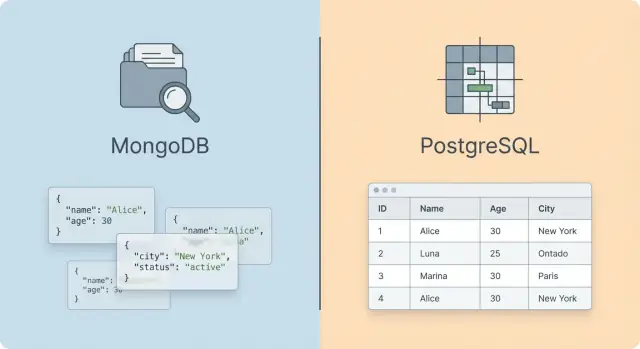
How to think about this comparison
Choose PostgreSQL when relationships, constraints, transactions, and flexible reporting dominate the workload. Choose MongoDB when most operations read or update bounded, self-contained documents whose fields vary substantially. Neither engine is universally faster or simpler.
Start with the application rather than a feature checklist. A billing system has different failure conditions from a content catalog, even if both expose JSON through an API. The database should make the application's hardest operations ordinary, not merely possible.
Evaluate both options against five concrete questions:
- Which records must change together in one transaction?
- Which queries cross entity boundaries, and how often do they change?
- Which rules must remain true even when application code fails?
- How large can one logical record become, and can its child collection grow without bound?
- Who will operate the database, restore it, tune it, and respond to incidents?
PostgreSQL is usually the lower-risk default for SaaS accounts, permissions, orders, billing, inventory, audit trails, CRMs, and ERPs. These domains contain many-to-many relationships and invariants that fit tables, foreign keys, unique constraints, and SQL.
MongoDB often fits content entries, product records with tenant-specific attributes, configuration documents, event payloads, and other aggregates that are normally retrieved as one object. Its flexible document structure can shorten the first implementation, provided the team still controls schema evolution.
Using both databases is reasonable when each owns a clearly separated domain. It is expensive when the boundary is vague. Two stores mean two backup systems, two monitoring models, two security configurations, and a synchronization mechanism. Adopt that cost only when one database would impose a persistent modeling or scaling problem.
Data model: documents or relational tables
MongoDB fits data that can be stored as bounded aggregates, while PostgreSQL fits data whose value depends on relationships among independently changing entities. The distinction is deeper than JSON versus rows because it determines where consistency rules live.
A MongoDB order might embed its shipping address and line items:
{
  "_id": "order_1042",
  "customerId": "customer_28",
  "status": "paid",
  "shippingAddress": {
    "city": "Austin",
    "country": "US"
  },
  "items": [
    { "productId": "product_7", "quantity": 2, "unitPrice": 19.95 }
  ]
}
One indexed lookup can return the complete order. A single update can also change the order and its embedded items atomically. This is attractive when those parts share a lifecycle and the array remains bounded.
The comparable PostgreSQL model separates independently meaningful facts:
CREATE TABLE orders (
    id bigint PRIMARY KEY,
    customer_id bigint NOT NULL REFERENCES customers(id),
    status text NOT NULL,
    placed_at timestamptz NOT NULL
);

CREATE TABLE order_items (
    order_id bigint NOT NULL REFERENCES orders(id),
    product_id bigint NOT NULL REFERENCES products(id),
    quantity integer NOT NULL CHECK (quantity > 0),
    unit_price numeric(12, 2) NOT NULL CHECK (unit_price >= 0),
    PRIMARY KEY (order_id, product_id)
);
This model makes cross-order reporting and product relationships direct. The database can reject an item whose order or product does not exist. It also permits a product to change independently while preserving the price recorded at purchase.
Embedding is a poor fit for unbounded collections such as every event generated by an account. One growing document becomes a write hotspot, consumes more bandwidth, and eventually meets MongoDB's 16 MiB document limit. Store those events as separate documents instead.
Normalization can also go too far. Splitting a small value object across several tables adds joins without creating useful independence. A shipping address captured for a completed order is often a historical snapshot, not a live reference to the customer's current address.
A durable modeling rule is to embed data that changes together and stays bounded. Reference or normalize data that changes independently, participates in many relationships, or grows without a predictable ceiling.
Schema evolution and data integrity
MongoDB makes adding fields easier, while PostgreSQL makes enforcing a uniform shape easier. Production safety depends on disciplined migrations in either system.
MongoDB collections can contain documents with different fields and types. That flexibility helps when attributes vary by tenant or content type, but it can also produce several incompatible versions of the same concept. A renamed field may leave old documents behind, and every reader then needs fallback logic.
MongoDB supports collection validation with JSON Schema-style rules. Teams can introduce validation gradually, backfill existing documents, then reject new writes that violate the chosen shape. A schema version field can help workers migrate old documents predictably, though it does not replace validation.
PostgreSQL changes are explicit. Teams normally add a nullable column, deploy code that writes both old and new forms when necessary, backfill in controlled batches, validate the data, then add stricter constraints. Large indexes can be built concurrently to reduce write disruption. Foreign keys and some constraints can also be introduced in stages before full validation.
Useful invariants belong in the database when the engine can express them:
- Use unique constraints for identifiers, idempotency tokens, and one-per-owner records.
- Use foreign keys for relationships that must never point to missing data.
- Use
CHECKconstraints for local rules such as positive quantities. - Use application validation for contextual rules that require remote services or frequently changing policy.
- Use tests to verify the migration path from every supported schema version.
Application validation remains necessary for helpful error messages and business workflows. Database constraints provide the final barrier against races, forgotten code paths, administrative scripts, and future services that write the same data.
Flexible schema should mean controlled variation, not unknown variation. Before selecting MongoDB for faster iteration, define who owns document shape, how incompatible changes are detected, and when old documents are rewritten.
Querying, joins, and reporting
PostgreSQL is more direct for changing, cross-entity questions, while MongoDB is concise when a query follows one document's boundary. Query ergonomics become increasingly significant as the product accumulates reporting requirements.
SQL is declarative. Filters, joins, grouping, common table expressions, window functions, subqueries, and set operations can be combined without changing the stored model. PostgreSQL's planner chooses join algorithms and access paths from statistics and available indexes.
A revenue query across normalized order data remains readable:
SELECT
    o.customer_id,
    SUM(oi.quantity * oi.unit_price) AS revenue
FROM orders AS o
JOIN order_items AS oi ON oi.order_id = o.id
WHERE o.status = 'paid'
  AND o.placed_at >= CURRENT_DATE - INTERVAL '30 days'
GROUP BY o.customer_id
ORDER BY revenue DESC;
MongoDB uses direct find operations for simple retrieval and an aggregation pipeline for transformations. With embedded line items, the comparable calculation processes documents through ordered stages:
db.orders.aggregate([
  { $match: { status: "paid", placedAt: { $gte: startDate } } },
  { $unwind: "$items" },
  {
    $group: {
      _id: "$customerId",
      revenue: { $sum: { $multiply: ["$items.quantity", "$items.unitPrice"] } }
    }
  },
  { $sort: { revenue: -1 } }
])
The pipeline is capable, but stage order affects meaning and resource use. Large arrays may multiply the working set after $unwind. Filtering and projecting early can reduce that cost.
MongoDB's $lookup joins documents from another collection. It is useful for selected relationships, especially when the joined side is indexed and the result remains small. A model that needs several $lookup stages on common requests is signaling that its boundaries may be relational.
PostgreSQL is generally easier for business intelligence, finance reports, cohort analysis, and unplanned questions because most reporting tools speak SQL. MongoDB reporting works well when dimensions already live together or when a prepared read model matches the report. Teams with frequent ad hoc analysis often export operational data to a warehouse regardless of the primary database.
Object mapping does not remove these tradeoffs. An ORM can make PostgreSQL rows feel like objects, while an object document mapper can impose classes on MongoDB documents. The stored relationships, indexes, and integrity rules still determine behavior under load.
Transactions and concurrency
PostgreSQL gives multi-row and multi-table transactions the most natural model, while MongoDB gives single-document changes the cheapest atomic boundary and supports broader transactions when needed. The correct choice follows the invariants that must survive concurrent requests.
PostgreSQL uses multiversion concurrency control. Ordinary reads and writes can proceed concurrently, although row locks, explicit locks, long transactions, and schema changes can still create waits. Read Committed is the default isolation level. Repeatable Read provides a stable transaction snapshot, and Serializable detects executions that cannot safely be ordered.
MongoDB operations that modify one document are atomic. Embedding a bounded aggregate therefore reduces coordination. MongoDB also supports ACID multi-document transactions in replica sets and sharded clusters. Those transactions add coordination, retain resources for their duration, and can produce transient failures that require the application to retry the complete transaction.
MongoDB exposes read concern, write concern, and read preference separately. These settings affect which data a read may observe, how many replica-set members must acknowledge a write, and whether reads may go to secondaries. Treat them as correctness settings before treating them as latency controls.
Neither database can include an external payment provider in a local database transaction. Holding a transaction open while making a network request increases contention and still cannot make both systems commit atomically. A safer payment workflow records a pending order and an outbox event in one database transaction, processes the external request idempotently, then records the result.
Concurrency tests should target business races, not just successful requests. Examples include two buyers reserving the last item, two workers claiming the same job, or two administrators assigning the same unique name. PostgreSQL can often express these operations with constraints, row locking, or atomic statements. MongoDB can use conditional updates, unique indexes, and transactions.
If strict rules span many independently stored records, PostgreSQL usually requires less application coordination. If each rule fits one well-designed document, MongoDB's atomic document operations are simple and effective.
PostgreSQL JSONB as a middle path
PostgreSQL JSONB is a strong option when stable relational fields surround a limited set of evolving attributes. It does not turn every document-shaped problem into a relational one, but it can remove the need for a second database.
A common design stores identity, ownership, state, and timestamps in typed columns while placing optional attributes in jsonb. Foreign keys protect relationships, ordinary indexes support frequent filters, and GIN or expression indexes accelerate selected JSON predicates.
CREATE TABLE products (
    id bigint PRIMARY KEY,
    account_id bigint NOT NULL REFERENCES accounts(id),
    sku text NOT NULL,
    status text NOT NULL,
    attributes jsonb NOT NULL DEFAULT '{}'::jsonb,
    UNIQUE (account_id, sku)
);

CREATE INDEX products_attributes_gin
    ON products USING gin (attributes);
This works for catalog attributes such as material, dimensions, or regional metadata that differ among product types. It is less suitable when every important field is buried in JSON and every query needs casts, path expressions, or custom validation.
JSONB stores a parsed binary representation, supports containment operators, and discards insignificant formatting such as object property order. It also keeps only one value for a duplicate object property. Applications that must reproduce the original JSON text exactly should retain that text separately.
Updating a small property creates a new PostgreSQL row version and may rewrite a sizable JSONB value. Large, frequently updated documents can therefore generate considerable write-ahead log volume and dead tuples. Splitting hot fields into columns or child tables often performs better.
Foreign keys cannot directly enforce relationships hidden inside arbitrary JSON. Promote frequently queried, joined, sorted, or constrained values into columns. Generated columns and expression indexes can help during a gradual transition, but a relational field is usually clearer once its meaning stabilizes.
Indexing and query plans
Both databases depend on indexes that match real filters, sorting, and cardinality; indiscriminate indexing makes writes slower and consumes memory. The engines offer different index tools, but neither can rescue an access pattern that fights the stored model.
PostgreSQL uses B-tree indexes for equality, ranges, and ordered retrieval. GIN indexes support JSONB containment, arrays, and full-text search. GiST and SP-GiST cover several geometric, range, and specialized operator classes. BRIN indexes are compact choices for very large tables whose physical order correlates with a value such as time.
PostgreSQL also supports partial and expression indexes. A partial index on active subscriptions can be much smaller than an index covering years of inactive records. An expression index can support a normalized email address or a selected JSON property.
MongoDB indexes nested properties and arrays directly. A multikey index expands array values into index entries, which makes membership queries efficient but can enlarge the index quickly. A compound multikey index cannot index more than one array-valued field in the same document. MongoDB also provides geospatial, hashed, wildcard, partial, sparse, and TTL index options for their respective access patterns.
Column order in compound indexes follows query structure, not a universal most-selective-first rule. In a PostgreSQL multicolumn B-tree, equality conditions on leading columns plus a range on the next column often provide an efficient scan. MongoDB practitioners commonly start with equality fields, sort fields, then range fields, while checking whether an alternative order scans fewer entries for the actual distribution.
Use query plans instead of assumptions:
- In PostgreSQL, run
EXPLAIN (ANALYZE, BUFFERS)on representative reads and inspect row estimates, loops, sorts, disk spills, and buffer activity. - Remember that
ANALYZEexecutes the statement, so use care with writes and production traffic. - In MongoDB, request execution statistics and compare documents examined, index entries examined, and results returned.
- Test common parameter values as well as skewed values that match a large share of the data.
- Remove unused indexes only after confirming their absence from periodic, administrative, and failover workloads.
An index that covers one endpoint perfectly may duplicate another index or increase every write. Review the complete index set as a portfolio rather than approving each index independently.
Search, geospatial, and time-series workloads
Both databases cover basic search, location, and time-based queries, but specialized product requirements can justify separate tools or managed features. The decision should follow relevance quality, ingestion rate, retention, and operational ownership.
PostgreSQL full-text search provides tokenization, dictionaries, weighted document vectors, query operators, ranking, and GIN acceleration. It works well for search inside an application when the corpus and relevance rules remain manageable. Trigram indexes can support similarity and substring matching for names or identifiers.
MongoDB text indexes handle basic word search. MongoDB's managed platform also offers separate search and vector-search capabilities designed for richer relevance and retrieval workloads. Treat those as deployment-specific services when comparing portability, pricing, backup behavior, and local development.
Vector search changes the query type, not the need for a transactional source of truth. PostgreSQL can add vector indexing through extensions, while MongoDB deployments can pair operational documents with supported vector-search services. Evaluate recall, filtering, index-build time, update visibility, and cost on the application's own embeddings.
For geospatial work, PostgreSQL commonly uses the PostGIS extension for advanced geometry, coordinate systems, and spatial analysis. MongoDB provides geospatial indexes and operators that fit location-aware application queries. Select the simpler option only after listing the actual operations, since finding nearby points is far less demanding than polygon repair or complex spatial joins.
MongoDB time-series collections organize measurements into internal buckets and support time-based expiry. PostgreSQL handles time-series data through partitioning, BRIN indexes, and optional extensions. Very high-volume telemetry may still belong in a purpose-built analytical store after ingestion, particularly when long retention and broad scans matter more than transactional updates.
Performance and representative benchmarks
Data layout, index coverage, working-set size, and durability settings usually matter more than generic MongoDB versus PostgreSQL benchmark results. A credible test reproduces the application's data distribution and concurrency.
MongoDB can produce low-latency reads when one request maps to one indexed document. That advantage narrows when documents are large, responses need only a few scattered fields, or relationships require repeated lookups. Embedded arrays also grow index entry counts and can make updates increasingly expensive.
PostgreSQL can execute complex joins efficiently when statistics are accurate and join columns are indexed. Performance degrades when a query creates a large intermediate result, spills sorts or hashes to disk, or repeatedly fetches many unrelated pages. Selecting only needed columns and correcting data-model mistakes often matters more than rewriting SQL syntax.
Every secondary index increases write work in both systems. Large JSONB values, wide rows, oversized documents, and duplicate denormalized data increase I/O. Connection storms can exhaust resources even when individual queries are fast, so use bounded pools and test reconnection behavior during failover.
A useful benchmark should preserve these conditions:
- Load enough data to represent the expected ratio between the working set and available memory.
- Match production consistency, journaling, replication, and acknowledgment settings.
- Replay the top application operations with realistic read and write proportions.
- Include skew, hot tenants, large accounts, missing records, and worst-case filters.
- Record throughput plus p50, p95, and p99 latency during steady load and recovery events.
Run one controlled change at a time. Compare normalized tables with JSONB, embedded documents with references, or alternative indexes while holding hardware and request semantics constant. Warm-cache microbenchmarks cannot predict backup pressure, replication lag, checkpoint behavior, or performance after a primary fails.
Capacity planning should include growth in both data and indexes. An index that fits in memory at launch may dominate latency after a year. Repeat the test with projected data volume rather than extrapolating from an empty database.
Horizontal scaling and data distribution
MongoDB offers integrated sharding for distributing writes, while PostgreSQL commonly combines vertical scaling, partitioning, and replicas before adopting a separate distributed architecture. Horizontal scale introduces routing and ownership decisions that affect every query.
A MongoDB sharded cluster distributes documents according to a shard key. A good shard key has enough cardinality, avoids monotonically concentrating writes, supports common routing predicates, and distributes storage evenly. A query that omits the shard key may contact every shard, increasing latency and resource use.
Hashed sharding can distribute sequential identifiers more evenly, but it weakens range locality. Range-based sharding supports targeted intervals but can create a hot end of the range. Zones can place selected ranges on designated shards for tenancy or geographic rules. Resharding can correct a poor choice, but moving a large live dataset still demands planning and spare capacity.
MongoDB transactions can span shards, yet cross-shard coordination costs more than operations routed to one shard. Applications that include the tenant identifier in both the shard key and common queries can often keep related work local.
PostgreSQL native partitioning divides a logical table into child tables, usually by time, tenant, or another routing value. Partition pruning reduces scans and partitions simplify retention operations. Native partitioning alone does not distribute writes across machines, so it should not be described as sharding.
PostgreSQL read replicas can move suitable read traffic away from the primary. Replicas do not increase primary write capacity, and asynchronous replicas may return older data. Applications must decide which reads can tolerate that delay.
When one PostgreSQL writer is no longer sufficient, teams can shard in application code, adopt a distributed PostgreSQL extension or service, or split domains into independently owned databases. Each option changes the behavior of cross-shard joins, uniqueness, sequences, and transactions. Test those limitations before the application depends on global operations.
Scaling requirements should be stated numerically. Expected write operations per second, dataset size, hot-tenant concentration, region placement, and recovery objectives are more useful than a general requirement to scale horizontally.
Replication, failover, and recovery
Both databases can provide high availability, but recovery behavior depends on topology, acknowledgment policy, automation, and repeated testing. Replication alone does not guarantee a short outage or zero data loss.
MongoDB commonly runs as a replica set with one primary and multiple secondaries. Members elect a new primary when the current primary becomes unavailable. Applications should use supported drivers, configure server selection and operation timeouts, and handle transient errors. Retryable writes help selected operations, but retries must still respect application idempotency.
Write concern controls how many members acknowledge a write. Read preference determines whether eligible reads use the primary or secondaries, and read concern controls visibility guarantees. A low-latency configuration may expose more failure or staleness risk, so document the chosen combination for each workload.
PostgreSQL physical streaming replication sends write-ahead log records from a primary to standbys. Asynchronous replication protects availability and latency but can lose recently acknowledged transactions if the primary is destroyed before a standby receives them. Synchronous replication can reduce that exposure while increasing commit latency and sensitivity to standby health.
PostgreSQL failover is normally coordinated by a managed service or external automation. The procedure must promote a suitable standby, redirect clients, and prevent the old primary from accepting conflicting writes. Connection pools and DNS caches can extend the visible outage after promotion.
Backups protect against failures that replication copies faithfully, including accidental deletion and logical corruption. PostgreSQL base backups plus archived write-ahead logs enable point-in-time recovery. MongoDB deployments can use coordinated snapshots and oplog-based recovery through appropriate tooling or managed services.
Define recovery point objective and recovery time objective separately. Then test a full restore into an isolated environment, verify application data, rotate restored credentials, and record the elapsed time. A successful snapshot is not proof that a complete service can be recovered within its objective.
Operational maintenance
PostgreSQL and MongoDB require different routine maintenance, so team experience can outweigh small feature advantages. Managed services reduce some labor but do not own query design, capacity decisions, or recovery verification.
PostgreSQL creates obsolete row versions as transactions update and delete data. Autovacuum reclaims reusable space, updates visibility information, and prevents transaction ID exhaustion. Long-running transactions can delay cleanup. Monitor dead tuples, table and index growth, vacuum progress, transaction age, and queries that keep old snapshots alive.
Planner statistics also need attention. Skewed values or correlated columns can produce inaccurate row estimates and poor plans. Increasing statistics targets or creating extended statistics can help selected queries. Query performance should be reviewed after major data growth, not only after code changes.
MongoDB's WiredTiger storage engine relies heavily on its cache and compression. Monitor cache pressure, disk latency, document growth, checkpoint behavior, replication lag, and the ratio between examined and returned documents. In sharded deployments, watch balancing activity, uneven chunk distribution, and operations that scatter across shards.
Routine runbooks should cover five areas:
- Slow-query capture, ownership, and remediation thresholds.
- Capacity alerts based on growth rate rather than only current fullness.
- Restore drills with recorded recovery times and validation steps.
- Credential rotation and emergency access procedures.
- Version upgrades tested against drivers, extensions, indexes, and rollback plans.
PostgreSQL major upgrades commonly use pg_upgrade, logical replication, or a managed migration process. Extension compatibility can determine the feasible path. MongoDB upgrades use supported version sequences and Feature Compatibility Version controls; sharded clusters require careful component ordering.
Logical export tools such as pg_dump and mongodump are convenient for smaller datasets and selective recovery. They may be too slow for strict recovery objectives at large scale. Measure export and import duration with production-sized data before adopting them as the primary disaster-recovery method.
Security and governance
Both databases can meet demanding security requirements when access, encryption, auditing, and network controls are designed explicitly. Default credentials or private networking alone do not create an auditable system.
PostgreSQL roles can receive privileges at the database, schema, table, sequence, function, and column levels. Views can expose selected fields, and row-level security can restrict rows according to user or tenant context. Keep object ownership separate from normal application roles so a compromised service cannot alter its own restrictions.
MongoDB roles grant actions over databases, collections, and cluster resources. Use separate identities for application reads, application writes, migrations, monitoring, backups, and administration. Avoid sharing one broadly privileged credential across services.
A practical control set includes:
- Require TLS for client and replication traffic, then verify certificate handling in every driver.
- Store secrets in a managed secrets system and rotate them without a full application release.
- Restrict network routes and avoid exposing database listeners directly to the public internet.
- Capture authentication, privilege, schema, and sensitive-data access events required by policy.
- Test that analysts, support staff, and automation accounts cannot exceed their assigned duties.
Encryption at rest may combine database capabilities, encrypted storage, and cloud-managed keys. MongoDB also supports client-side field level encryption in supported deployments. PostgreSQL applications commonly encrypt selected values before storage when database administrators must not see plaintext. Encryption changes indexing and query options, so prototype the protected operations first.
Governance also requires data classification, retention, deletion, residency, and incident-response procedures. Regional placement can support residency goals, but compliance depends on backups, logs, support access, subprocessors, and every system that receives the data.
Cost, licensing, and total ownership
The less expensive database is the one that satisfies the workload with acceptable infrastructure, service fees, and engineering effort. License price alone rarely determines total ownership.
Compute cost rises with complex queries, compression work, index maintenance, background jobs, and replication. Storage includes indexes, retained logs, backups, temporary space, and duplicate data introduced by denormalization. Three data-bearing replicas store multiple copies even before snapshots and cross-region transfer are counted.
PostgreSQL uses the permissive PostgreSQL License and is available through many self-hosted and managed distributions. Commercial support and cloud services are optional purchases. Extensions can have their own licenses, so review them separately.
MongoDB Community Server uses the Server Side Public License, which is source available but is not an Open Source Initiative-approved license. MongoDB Atlas and commercial support use vendor pricing and terms. Organizations embedding or offering database functionality as a service should have counsel review the applicable terms rather than assuming they match a permissive open-source license.
Managed databases exchange higher unit prices for automated provisioning, patching, backups, monitoring integrations, and parts of the failover process. They still leave schema quality, slow queries, connection management, data classification, and application recovery with the customer.
Estimate total ownership with these inputs:
- Production, staging, development, disaster-recovery, and temporary environment counts.
- Data and index growth over at least the next 12 to 24 months.
- Required replicas, regions, backup retention, and network transfer.
- Peak throughput, working-set memory, and provisioned storage performance.
- Staff time for migrations, tuning, incident response, audits, and restore exercises.
A database already supported well by the team may be cheaper than a technically attractive alternative. Training, new automation, revised on-call procedures, and migration risk are real costs.
Application fit by workload
PostgreSQL is the stronger default for relationship-heavy systems of record, while MongoDB earns its place in domains with independently owned, variable documents. Specific workflows reveal the fit more clearly than broad labels such as web application or enterprise system.
A SaaS account model usually includes organizations, memberships, invitations, roles, subscriptions, invoices, entitlements, and audit records. Uniqueness and cross-entity rules are central, and administrators eventually request reports that were not anticipated at launch. PostgreSQL fits this pattern well.
A product catalog may contain different attribute sets for clothing, electronics, industrial parts, and custom tenant categories. MongoDB can store each product as a coherent document without creating a sparse universal table. PostgreSQL with JSONB remains competitive when products also participate heavily in pricing tables, inventory transactions, vendor agreements, and relational reporting.
A content-management domain often maps naturally to documents containing blocks, localization, metadata, and publication state. MongoDB works well when each entry is read and revised as a unit. PostgreSQL may be preferable when editorial permissions, scheduling, cross-content references, and reporting are more demanding than document variation.
Financial ledgers, inventory reservations, and billing records favor PostgreSQL. Append-only design alone does not remove the need for uniqueness, balanced entries, reconciliation queries, and multi-record invariants.
Event and telemetry systems need a more detailed test. MongoDB can ingest document-shaped events, and PostgreSQL can partition append-heavy tables. At sustained analytical scale, the operational database may feed a columnar warehouse or purpose-built time-series system. Retention, aggregation windows, late arrivals, and query scan size should decide the storage path.
A hybrid architecture is justified when authoritative entities remain in PostgreSQL and a document domain has separate ownership and access patterns. Assign one source of truth per entity. Publish changes with an outbox or change-data-capture process, use idempotent consumers, and plan for delayed or repeated delivery. Avoid synchronous dual writes that can leave the stores inconsistent after a partial failure.
A practical decision method
A short proof of concept with production-shaped data is the most reliable way to resolve a close MongoDB versus PostgreSQL decision. The test should concentrate on the difficult parts rather than a generic create, read, update, and delete demo.
Select three representative workflows: the most common request, the most complex query, and the operation with the strictest correctness requirement. Model each workflow honestly in both databases. Do not force PostgreSQL to mimic a document store with one unrestricted JSON column, and do not force MongoDB to reproduce a highly normalized schema across many collections.
Score each candidate on model clarity, correctness, query effort, measured latency, operational familiarity, recovery, security controls, and projected cost. Weight the categories before seeing benchmark results. A finance application should assign more weight to integrity and auditability than to avoiding migrations, while a disposable content prototype may do the reverse.
Reject a design if it depends on any of these assumptions:
- Every future query will follow the first API's access pattern.
- Application validation will execute correctly on every write path forever.
- One large tenant will behave like the median tenant.
- Replication removes the need for backups and restore exercises.
- A second database has little operational cost because its first deployment is managed.
For a general transactional application, PostgreSQL remains the safer starting point. Its tables, SQL, constraints, mature transaction model, and JSONB support leave room for both structured and selected semi-structured data. MongoDB should win because the document model produces a materially simpler design or because its integrated distribution model matches measured requirements, not because migrations seem inconvenient.
Applying the choice to Koder.ai projects
PostgreSQL is the natural starting point for most Koder.ai projects because the platform's primary stack uses React, Go, PostgreSQL, and Flutter for mobile applications. That default suits the websites, CRMs, ERPs, mobile apps, and other transactional systems commonly created through its chat interface.
Planning mode should identify entities, relationships, uniqueness rules, data retention, and high-volume operations before generation begins. Stable properties belong in typed columns. Optional business-specific attributes can use JSONB when their structure is genuinely variable.
Koder.ai supports source code export, deployment and hosting, custom domains, snapshots, and rollback. Snapshots and application rollback should complement database migration planning rather than replace it. Reverting application code after an incompatible schema change may leave the older code unable to read newly written data.
For generated Go services, keep database changes in reviewed migrations and make deployments safe across the transition period. A common sequence is to add compatible schema, deploy code that understands both states, backfill data, switch reads, then remove the obsolete form in a later release.
Koder.ai can run applications on AWS infrastructure in different countries to support data-placement requirements. The database design must extend that decision to replicas, backups, logs, analytics exports, and administrative access. Geographic placement is one control within a broader privacy and governance plan.
Adding MongoDB to a PostgreSQL-backed project should follow the same standard as any other architectural dependency: define the document-owned domain, failure handling, synchronization path, backup policy, and operator responsibility before implementation.
Migration and adoption checklist
A database migration succeeds when the team can prove data completeness, application compatibility, and a recoverable cutover. Converting syntax is only one part of the work.
Start by inventorying tables or collections, data volume, indexes, constraints, query patterns, retention rules, and every writer. Identify semantics that do not translate directly, such as relational foreign keys becoming references, embedded arrays becoming child tables, numeric precision differences, case-sensitive comparisons, or timestamp handling.
Build reconciliation queries before moving production data. Counts alone are insufficient. Compare totals by tenant and date, verify uniqueness, sample large records, check orphan relationships, and compute business-level balances where applicable.
A controlled migration normally includes these stages:
- Perform an initial bulk copy and record rejected or transformed records.
- Capture subsequent changes through a log, outbox, or change-data-capture mechanism.
- Run shadow reads or compare sampled responses without changing user-visible behavior.
- Cut over through a reversible routing change while monitoring errors and lag.
- Keep the old store read-only until reconciliation and the rollback window are complete.
Dual writing from application code is risky unless both writes are idempotent and partial failure is explicitly reconciled. Prefer one committed source plus an asynchronous delivery record that can be retried.
After cutover, rebuild operational baselines. Query plans, connection-pool sizes, alert thresholds, backup duration, and capacity forecasts from the old engine will not transfer automatically. The migration is complete only after the new database has passed a restore exercise and the team can operate it during failure.
FAQ
How do I decide between MongoDB and PostgreSQL without getting stuck in “which is best?”
Start by matching the database to your workload and team:
- Choose PostgreSQL when your data is a set of related entities, you rely on joins/reporting, and you want strong constraints.
- Choose MongoDB when your records are naturally self-contained documents, the shape changes often, and you commonly fetch the whole object at once.
If different parts of the system have different needs, assume a hybrid option is valid.
What types of applications are the strongest fit for each database?
A common rule of thumb:
- Prefer PostgreSQL for systems of record: orders, billing, permissions, audit trails, inventory—anything with many-to-many relationships and strict invariants.
- Prefer MongoDB for document-centric domains: catalogs, content, user profiles, event payloads, session/state, and tenant-specific or rapidly evolving attributes.
Then validate with your actual top queries and update patterns.
Why does MongoDB often feel faster to build with for nested data?
MongoDB stores nested objects naturally, so a single read can return an entire aggregate (for example, an order with line items embedded). This can reduce round trips and simplify early iteration.
The trade-offs are duplication and more complex updates—especially if the same embedded information must be updated in many documents.
What do I gain from PostgreSQL’s relational model and constraints?
PostgreSQL enforces correctness in the database:
- Foreign keys to prevent dangling references
CHECKandUNIQUEconstraints to prevent invalid states- Strong transactional workflows across multiple tables
This reduces the chance that inconsistent data slips in through a missed code path, and it makes concurrency-heavy business rules easier to reason about long-term.
Can PostgreSQL handle document-like data without switching to MongoDB?
Yes—JSONB is often the “middle path.” A common pattern is:
- Put stable fields (IDs, timestamps, status, ownership) in normal columns
- Put evolving or optional attributes in a
JSONBcolumn - Use GIN indexes when you need to query inside JSONB
This keeps relational integrity while still allowing flexible attributes.
How do joins compare: PostgreSQL JOINs vs MongoDB embedding and $lookup?
PostgreSQL treats joins as first-class and is usually more ergonomic for multi-entity querying and ad-hoc analysis.
MongoDB often avoids joins by encouraging embedding. When you need cross-collection joins, $lookup can work, but complex pipelines can become harder to maintain and may not scale as predictably as well-indexed relational joins.
Which database is better for analytics and reporting?
If BI-style reporting and exploratory querying are core requirements, PostgreSQL typically wins because:
- SQL is highly expressive (aggregations, window functions, CTEs)
- Most analytics tools speak SQL natively
- Ad-hoc multi-entity questions map naturally to joins
MongoDB can report well when reports align with document boundaries, but multi-entity analysis often requires more pipeline work or ETL.
How different are transactions and consistency guarantees in practice?
PostgreSQL is “transactions first” and excels at multi-statement, multi-table ACID workflows (for example, order + inventory + ledger updates).
MongoDB is atomic at the single-document level by default (great when you embed), and supports multi-document transactions when needed—typically with more overhead and practical limits. If your core invariants span many records under concurrency, PostgreSQL usually feels simpler.
What’s the most practical way to compare performance and indexing?
Use your real queries and inspect query plans.
- In PostgreSQL, use
EXPLAIN (ANALYZE, BUFFERS)to catch sequential scans, misestimates, and expensive sorts. - In MongoDB, use
explain()and compare docs examined vs returned.
In both systems, compound indexes and selectivity matter, and excessive indexes can crush write performance.
Does it make sense to use both MongoDB and PostgreSQL in one system?
Yes, and it’s common. A pragmatic split is:
- PostgreSQL for system-of-record, constraint-heavy entities
- MongoDB for flexible content, event-heavy features, or cached/read models
To keep it sane, define a single source of truth per entity, use immutable IDs, and synchronize via patterns like outbox/events. If you’re planning changes, the checklist at /blog/database-migration-checklist can help structure the migration work.