

How Netflix Made Streaming a Subscription Software Business
A practical look at how Netflix built streaming reliability, scaled content strategy, and used data to reduce churn—making entertainment feel like software.
Why Netflix Changed the Business of Entertainment
Netflix didn’t just “move TV to the internet.” It changed the rules of entertainment by treating video like a subscription software product: always available, regularly updated, and designed to improve as more people use it.
A generation ago, most viewing followed fixed schedules (TV channels) or single purchases (movie tickets, DVD rentals). Netflix helped normalize a different promise: pay monthly and press play whenever you want—on your phone, TV, laptop, or tablet—without thinking about showtimes, late fees, or storage.
The shift: from titles to access
The key change wasn’t only the delivery method. It was the business model. Instead of asking you to decide, “Is this movie worth buying?” a subscription asks, “Is this service worth keeping?” That pushes the company to focus on long-term value, consistency, and trust.
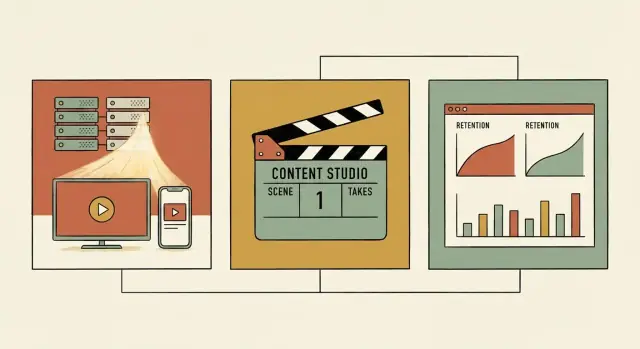
The three pillars behind the subscription machine
A subscription-first approach works when three things reinforce each other:
- Infrastructure: streaming has to start fast, look good, and stay up—even on busy nights.
- Content: a mix of familiar favorites and must-watch originals that gives people a reason to join.
- Retention: product decisions—like recommendations and release strategy—that make it easy to find something good and build a habit.
What you’ll learn in this article
This is a plain-English tour of how those pillars fit together: why speed and reliability matter as much as shows, how content choices affect churn, and how experiments and metrics guide decisions.
It’s about concepts and examples—not confidential Netflix details or heavy engineering. Think of it as a map for understanding (or building) a modern media subscription that behaves more like software than a TV channel.
From Movies to Membership: The Subscription Playbook
A subscription software business is simple: customers don’t pay once and leave—they pay a recurring fee to keep getting value. That value has to be refreshed continuously through improvements, new features, and a consistently good experience. The company wins when people stay subscribed month after month, not when they make a single purchase.
Netflix applied that same logic to entertainment. Instead of “buy this movie” or “rent this DVD,” the promise became: pay a monthly fee and always have something good to watch, on any device, with minimal friction.
The entertainment version of software updates
Software products evolve through releases. Streaming does too, just in different forms:
- Content updates: New titles arrive, old ones leave, and fresh seasons drop. The catalog is the “product inventory,” and it’s never finished.
- App updates: Better search, smoother navigation, new device support, parental controls, improved downloads—these are classic software improvements.
- Playback reliability: When streaming works instantly and consistently, it feels invisible. When it buffers or errors, it feels broken. Reliability is a core feature users implicitly pay for.
The mindset shift is that the subscription isn’t only buying “access to movies.” It’s buying a continually maintained service—content plus product plus delivery.
Why retention beats one-time sales
With a one-time sale, success is closing the transaction. With a subscription, success is keeping the customer satisfied long after sign-up. That changes priorities:
- It’s not enough to have a great launch month; the experience must hold up over time.
- Every frustrating session (can’t find something, buffering, confusing UI) quietly increases the chance someone cancels.
- Every delightful session increases the odds they keep paying without thinking about it.
Metrics that matter in a membership business
A few recurring metrics will show up throughout the article:
- Churn: The share of subscribers who cancel in a given period.
- Engagement: How often people watch, how long they watch, and how consistently they return.
- Lifetime value (LTV): The total revenue a typical subscriber generates before canceling.
These connect product decisions (recommendations, release timing, reliability) to business outcomes (growth, profitability, and staying power).
The Streaming Experience Users Pay For
Streaming isn’t just “access to movies.” The real product is a promise: you press play and it works—quickly, clearly, and without making you think about what’s happening behind the screen.
The promise: instant entertainment
Subscribers don’t evaluate a streaming service the way they evaluate a library. They judge it like a utility. If the experience is smooth, the subscription feels effortless. If it’s frustrating, the monthly fee starts to feel optional.
The journey from tap to playback
A typical session includes many steps, even if it feels simple:
- Open the app (or the built-in TV experience)
- Stay logged in—or log in again without hassle
- Browse and search without lag
- Start a title instantly
- Get buffer-free playback at a quality that matches the screen and connection
Each step is a chance to delight or disappoint. Fast app loading and quick “time to first frame” matter as much as the content itself, because they shape the feeling of reliability.
Small failures turn into cancellations
Most churn doesn’t come from one dramatic outage. It’s the accumulation of little issues: a spinning loader, a cryptic error message, audio that doesn’t sync, a title that starts blurry and takes too long to sharpen.
These moments break the “lean back” experience. When people can’t trust playback, they explore less, watch less, and eventually question why they’re paying.
One service, many devices
Subscribers expect the same standard everywhere: smart TVs, streaming sticks, phones, tablets, game consoles, and browsers. That device diversity raises the bar because the service has to feel consistent even when screens, remotes, operating systems, and connection quality are wildly different.
Streaming Infrastructure Basics: Speed, Scale, and Reliability
Streaming only feels “instant” because a lot of work happens before you press play. The goal is simple: start fast, stay smooth, and avoid interruptions—even when millions of people hit the same title at the same time.
CDNs: like local warehouses for video
A content delivery network (CDN) is a distributed set of servers that store and deliver video. A helpful analogy is local warehouses: instead of shipping every package from one central factory across the country, you keep popular items in warehouses near customers.
For Netflix, a CDN means your device usually pulls the movie from a nearby location, not from a far-away data center. Less distance equals less delay, which directly improves start time and reduces the odds of buffering.
Caching: putting the “hot” titles close to viewers
Caching is the practice of storing copies of frequently watched files closer to where people are watching. When a new season drops or a film trends, those video chunks can be pre-positioned in local servers.
That matters because video is heavy. If every viewer had to request every piece from the origin every time, the network would clog quickly. Caching reduces repeated long-distance traffic and keeps playback steady.
Peak demand and capacity planning
Streaming demand isn’t flat. Evenings, weekends, and big releases create spikes—many people pressing play within the same hour. Capacity planning is how a service prepares enough “room on the highway” (bandwidth, servers, and CDN capacity) so peak moments don’t turn into a traffic jam.
Adaptive bitrate: quality that matches your connection
Adaptive bitrate streaming quietly adjusts video quality as your connection changes. If your Wi‑Fi weakens, the stream may shift to a slightly lower quality to keep video playing. When the connection improves, it shifts back up—often without you noticing. The result is fewer pauses and a more reliable viewing experience.
Keeping Video Playing: Uptime, Failures, and Trust
Streaming isn’t a single “play” button—it’s a long chain of steps that has to keep working for minutes or hours. Any weak link can break the experience: a Wi‑Fi dip, a crowded mobile network, an overheating TV stick, or a brief server hiccup. Platforms like Netflix assume these problems will happen and design the product so the viewer barely notices.
Designing for failure (because failure is normal)
Unlike a typical website visit, video playback is continuous. That makes it sensitive to small interruptions: slow starts, buffering, audio/video sync issues, or sudden drops in quality. If a platform only works under perfect conditions, it will feel unreliable in real homes—where people move between rooms, share bandwidth with other devices, and watch on dozens of device types.
Redundancy and graceful degradation
Reliability starts with redundancy: multiple copies of content, multiple paths to deliver it, and systems that can reroute traffic when something fails. But the viewer-facing trick is “graceful degradation.” Instead of stopping the video, the player can switch to a lower bitrate (slightly softer picture) to keep playback smooth.
That choice matters: most people will tolerate a brief quality dip. They won’t tolerate repeated buffering or a hard error screen.
Monitoring what viewers actually feel
Uptime alone isn’t the goal. Streaming teams watch “experience metrics” such as:
- Time to first frame (how quickly video starts)
- Rebuffering rate (how often playback stalls)
- Playback error rate (when sessions fail outright)
By detecting spikes—on a specific device model, ISP, region, or app version—teams can fix issues before they become widespread.
Reliability turns into retention
A subscription business depends on trust. When playback “just works,” people form habits, recommend the service, and feel their monthly fee is justified. When it doesn’t, they blame the platform (not their router) and churn becomes a one-click decision.
Content Strategy: Catalog, Originals, and Differentiation
Netflix’s product isn’t just an app—it’s a promise that there will be something worth watching tonight. Content strategy is how that promise gets kept, and it’s a major driver of both sign-ups and long-term retention.
What makes a catalog valuable
A strong catalog balances three things:
- Breadth: enough variety across genres, languages, and age groups so different households can justify one subscription.
- Freshness: regular additions that make the service feel alive, even if a viewer isn’t ready to start a brand-new series.
- Clear positioning: people should quickly understand what the service is “great at” (for example: prestige dramas, global hits, or family viewing). A catalog without a point of view feels interchangeable.
Freshness doesn’t always mean expensive new releases. It can also mean rotating in titles that match seasonal demand, local tastes, or trending moments.
Licensing vs. originals (and why both matter)
Licensed content (shows and movies rented from studios) is often faster to acquire and can be cost-effective, especially for filling out breadth. The tradeoff is less control—titles may leave when contracts end, and competitors can sometimes license the same content.
Originals cost more and take longer, but they offer exclusivity and more control over global release, marketing, and long-term availability. Originals also become brand assets: a hit series can define why someone chooses Netflix over another service.
Windows and regional availability, simply explained
Content is often sold in windows—time periods when a platform is allowed to stream it. Rights can also be regional, meaning a title might be available in one country but not another due to separate deals. This is why catalogs differ by location and why titles sometimes disappear.
How strategy reduces churn
The goal is a steady rhythm: big launches to attract new subscribers, plus enough ongoing variety to keep people from canceling between tentpole releases. When viewers can always find a “next watch,” the subscription feels continuously worth paying for.
Release Models: Binge Drops, Weekly Episodes, and Events
Release strategy isn’t just a creative choice—it changes how often people open the app, what they talk about, and how long they stay subscribed. Netflix popularized the binge drop, but it also uses weekly episodes and “event” releases when the goals differ.
Binge drops: instant momentum, fast finish
Releasing a full season at once can create a surge of viewing and a clear weekend “plan” for subscribers. It also reduces friction: if someone likes episode one, the next is immediately available.
The trade-off is that conversation can burn out quickly. A show might trend hard for a few days, then disappear—meaning fewer natural touchpoints that bring people back week after week.
Weekly episodes: sustained engagement and predictable returns
Weekly releases stretch attention over time. Each new episode becomes a reminder to re-open the app, which can support retention cycles (especially when multiple series overlap).
Weekly schedules also give marketing a longer runway: recaps, cast interviews, and episode-by-episode discussion can build a steady drumbeat instead of a single spike.
Event releases: turning a title into a moment
“Events” (a finale date, a split season, a live-ish special) are designed to create shared timing. They can amplify social buzz because many people are watching around the same window, not months apart.
Learning without over-claiming
Netflix can observe signals like completion rates, rewatching, and how many viewers start after launch. These metrics suggest what’s working, but they don’t automatically prove why—audience taste, competition, and timing all matter.
Release model checklist
- Is the goal a launch spike (binge) or sustained conversation (weekly)?
- Does the story reward continuity and cliffhangers (weekly) or immersion (binge)?
- Do you need recurring marketing moments or one big push?
- Is churn risk high right after finishing (consider weekly or split seasons)?
- Can production support consistent episode quality on a schedule?
- Are you optimizing for “everyone at once” buzz (event) or long-tail discovery (binge)?
Personalization: Turning Choice Into Convenience
Netflix’s biggest challenge isn’t just delivering video—it’s helping you decide what to watch. Personalization is the product layer that turns an overwhelming catalog into a fast, low-friction choice.
What “personalization” really means
Personalization is helping someone find something to watch quickly without feeling like they wasted their evening scrolling. The goal isn’t to predict a single “perfect” title; it’s to reduce effort and increase confidence that pressing play will be worth it.
What recommendations are trying to achieve
Good recommendations balance a few goals at the same time:
- Relevance: put likely matches near the top so the first screen feels “for me.”
- Discovery: surface hidden gems you wouldn’t search for.
- Variety: avoid showing the same type of show forever (or the same handful of titles).
- Satisfaction: optimize for “I’m glad I watched that,” not just clicks.
That’s why two people in the same household can see different rows, different artwork, and different ordering.
Common signals (high level)
Netflix can personalize using straightforward inputs such as:
- Viewing history (what you finished, what you abandoned, what you rewatch)
- Time of day and day of week (quick comedies at lunch vs. longer dramas at night)
- Device context (phone on the go vs. TV on the couch)
- What’s broadly popular right now (social proof and timely hits)
None of these signals are magic alone; the value comes from combining them to shape a home screen that feels immediately useful.
Personalization + editorial curation
Pure algorithms can get repetitive, while pure curation can miss personal taste. Netflix blends both: personalized shelves for your preferences, alongside curated collections like “Top 10” or seasonal picks that create shared moments and help new or returning viewers re-engage quickly.
Retention Loops: How Viewing Becomes a Habit
Retention loops are the small, repeatable circuits in a product that make returning feel natural. Instead of relying only on big marketing moments, they create habits: watch something, get an easy next step, return, repeat.
The simplest loop: reduce effort between sessions
Netflix-style retention often works by minimizing friction at two critical moments:
- Time to first play: how quickly a person can go from opening the app to watching.
- Time to next play: how quickly they can find the next thing after finishing (or pausing) a title.
Shortening these times doesn’t just improve convenience—it increases the chance a user builds a routine (“I’ll watch one episode before bed”).
Examples of loops viewers actually appreciate
A few common patterns work because they save attention, not because they pressure people:
- Continue Watching: removes the “where was I?” problem and rewards short sessions.
- New season / new episode alerts: connects interest in a show to a timely reason to return.
- Curated rows (e.g., “Because you watched…”, “Top Picks for You”): turns a huge catalog into a shortlist.
- Smart defaults like the right audio/subtitle choices: small details that make playback feel effortless.
Avoiding dark patterns
There’s a line between helpful and manipulative. Autoplay, notifications, and streak-like messaging can become dark patterns if they hide controls, guilt users, or maximize hours watched at the expense of satisfaction.
A healthier approach is simple: use loops to deliver genuine value—faster playback, better picks, and timely updates—so people return because it’s consistently worth it.
Data-Driven Decisions: Experiments, Metrics, and Learning
Netflix treats the product like software: you don’t “set it and forget it.” You change one thing, measure what happens, and keep what genuinely improves viewing.
A/B testing, in plain English
An A/B test is a controlled comparison between two versions of something. One group of users sees version A, another similar group sees version B, and Netflix measures which version leads to better outcomes. Because both versions run at the same time, results are less about seasonality or headlines and more about the change itself.
What can be tested (and why it matters)
Many of the biggest wins are small, repeatable improvements:
- Artwork and thumbnails: Different images can change whether someone clicks “Play,” even for the same title.
- Homepage rows: Reordering or renaming rows (“Because you watched…”) can help people find something faster.
- Previews and trailers: Autoplay previews, length, or placement can influence starts and confidence in a choice.
- Signup flow: Steps, plan selection screens, or messaging can affect how many people finish sign-up.
These aren’t “cosmetic” tweaks—they shape discovery, reduce decision fatigue, and can lower churn by making the service feel easier to use.
Guardrails: don’t optimize for clicks only
Good experimentation has rules. Netflix-style guardrails might include:
- User experience thresholds: Don’t ship a change that increases confusion, complaints, or time spent searching.
- Long-term satisfaction over short-term spikes: A thumbnail that drives clicks but leads to quick abandon can be a net loss.
- Fairness to the catalog: Avoid changes that over-promote a narrow set of titles at the expense of variety.
Practical metrics to watch
To learn what actually improves the subscription, teams track outcomes like:
- Starts (how often people press play)
- Completion rate (finishing episodes or films)
- Repeat viewing / return sessions (coming back soon after)
- Cancellations (and changes in churn signals)
The key isn’t having “more data”—it’s turning experiments into a habit of learning and shipping better decisions.
Pricing and Packaging: Making the Subscription Feel Worth It
Subscription pricing isn’t just math—it’s psychology plus household budgeting. Most people don’t compare your price to “cost per hour of entertainment.” They compare it to what else competes for the same monthly slot: another streaming service, a mobile plan, gaming, or simply cutting back. The winning move is to make the subscription feel obviously worth keeping when budgets tighten.
Tiers: Let people self-select value
A tiered plan works when each option maps to a clear everyday benefit, not technical jargon. Common tier differentiators in streaming include video quality (e.g., SD/HD/4K), how many screens can watch at once, whether ads appear, offline downloads, or audio enhancements. The goal isn’t to upsell everyone—it’s to reduce decision friction by offering a “good, better, best” ladder so households can pick what matches their habits.
Bundles and partnerships: lowering cancellation pressure
Bundling can reduce churn because it changes the cancellation decision. If the subscription is included with a telco plan, a device purchase, or a broader media bundle, users feel like they’d be giving up a package benefit—not just one app. Partnerships also improve distribution: the service can be one click away at activation, with fewer payment failures and less effort to re-join later.
A simple framework for responsible pricing changes
- Define the value story: what’s improving for the customer, in plain terms?
- Segment impact: who benefits, who feels squeezed (students, families, light viewers)?
- Test and measure: use controlled rollouts and watch conversion, churn, and watch time.
- Plan the communication: give notice, explain choices (including downgrades), keep it respectful.
- Monitor after launch: track long-term retention, not just the first month’s reaction.
Key Takeaways for Building a Subscription-First Media Product
Netflix’s big lesson is simple: streaming is the product, content is the fuel, and retention is the engine. The movie isn’t the unit of value anymore—the ongoing experience is.
Principles you can reuse in any subscription business
First, reduce friction everywhere. Make sign-up, playback, search, and “resume where I left off” feel effortless. Small annoyances don’t just hurt satisfaction—they create reasons to cancel.
Second, ship improvements continuously. Subscriptions reward steady progress: better recommendations, faster startup, cleaner UX, smarter notifications, clearer pricing. Users don’t renew because your product is “done”; they renew because it keeps feeling worth it.
Third, measure outcomes, not opinions. Treat each change like a hypothesis. Use experiments and cohorts to learn what actually reduces churn and increases repeat usage.
If you’re building a subscription product yourself, this “software mindset” is also why teams increasingly prototype and iterate with vibe-coding tools like Koder.ai—you can turn a product idea into a working web or mobile app via chat, then iterate quickly as you learn (including planning workflows and safe rollback via snapshots).
A starter checklist for subscription teams
- Define the retention promise: What’s the ongoing reason to stay after week one?
- Instrument key moments: activation, first success, repeat use, failed attempts, cancellations.
- Design for “next time”: continue watching, saved lists, reminders, personalized picks.
- Make reliability visible by being invisible: fewer errors, faster loads, graceful recovery when things break.
- Build a content (or value) pipeline: new releases, new features, new collections—something fresh at a predictable cadence.
- Create a churn response: cancellation survey, save offers, pausing options, win-back messaging.
Suggested internal reading
If you want practical next steps, see /blog/subscription-retention-basics for retention patterns and /blog/ab-testing-guide for how to run experiments without fooling yourself.
Done well, a subscription media product stops being “a library” and becomes a habit—one that earns renewal through consistency, convenience, and continual learning.
FAQ
What’s the core way Netflix changed entertainment beyond “putting TV on the internet”?
Netflix reframed entertainment from owning individual titles (tickets, DVDs) to ongoing access. The key business shift is that success depends on keeping the service worth paying for every month (retention), not maximizing one-time purchases.
Practically, that pushes investment into reliability, discovery (finding something fast), and a steady stream of new value (content + product updates).
Why does a subscription model change what the company prioritizes?
A subscription asks, “Is the service worth keeping?” so the company optimizes for long-term trust and habit.
In practice, that means:
- Fewer frustrating sessions (buffering, errors, slow apps)
- Better discovery (recommendations, search, home screen)
- A consistent content cadence so there’s always a “next watch”
What is churn, and what levers actually reduce it for a streaming service?
Churn is the percentage of subscribers who cancel in a period. To reduce it, focus on the biggest churn drivers described in the post:
- Playback reliability: reduce buffering, errors, slow start
- Time to first play: make it easy to choose and start
- Time to next play: make the next good option obvious (e.g., Continue Watching)
- Content rhythm: avoid long gaps with nothing new for key audiences
Which reliability metrics matter most for streaming quality?
Key metrics that reflect what viewers feel include:
- Time to first frame: how quickly video starts
- Rebuffering rate: how often playback stalls
- Playback error rate: how often sessions fail
These are often more actionable than generic “uptime,” because a service can be “up” while still delivering a bad experience on certain devices, ISPs, or app versions.
What is a CDN, and why is it so important for Netflix-style streaming?
A CDN (content delivery network) serves video from servers close to viewers—like local warehouses instead of shipping everything from one far-away factory.
Practically, a CDN improves:
- Faster start times
- Less buffering (lower latency and congestion)
- Better performance during peak demand (big releases, weekends)
What does “caching” mean in streaming, and what problem does it solve?
Caching stores frequently watched video chunks closer to where people are watching. It matters because video is huge, and repeated long-distance fetching would overwhelm networks.
Practically, caching helps:
- Handle spikes when a new season drops
- Reduce costs and congestion
- Keep playback steadier for more viewers at once
How does adaptive bitrate reduce buffering, and what’s the tradeoff?
Adaptive bitrate streaming adjusts video quality up or down as connection conditions change.
The practical tradeoff is intentional:
- A brief quality dip (slightly softer picture) is usually acceptable
- Repeated buffering or hard errors are what trigger frustration and cancellations
So adaptive bitrate is a retention feature as much as a technical one.
When should a streaming service choose binge vs. weekly vs. “event” releases?
They produce different retention and conversation patterns:
- Binge drops: big launch spike and fast completion, but buzz can fade quickly
- Weekly episodes: sustained returns and longer marketing runway
- Event releases (finale dates, split seasons): create shared timing and social momentum
Choose based on your goal: short-term acquisition vs. long-term engagement and renewal.
What is personalization actually trying to solve, and how do you avoid it getting repetitive?
Personalization reduces decision fatigue by helping viewers find something good quickly.
A practical approach balances:
- Relevance (top picks feel “for me”)
- Discovery (new options, not just repeats)
- Variety (avoid locking users into one genre)
- Satisfaction (optimize for enjoyment, not just clicks)
Pair algorithms with light editorial curation (e.g., a Top 10 row) to create both personal and shared viewing moments.
How do A/B tests help a subscription product improve without guessing?
A/B testing compares two versions at the same time to isolate the impact of one change.
To do it responsibly:
- Define a clear success metric (e.g., starts, completion, reduced search time)
- Set guardrails (don’t increase confusion, complaints, or quick abandons)
- Measure beyond clicks (retention signals matter)
For a practical framework, see /blog/ab-testing-guide.