

Niklaus Wirth’s Pascal & Modula: Simplicity That Shaped SE
Explore how Niklaus Wirth’s Pascal and Modula languages used simplicity and teaching-first design to shape readability, modularity, and modern software practice.
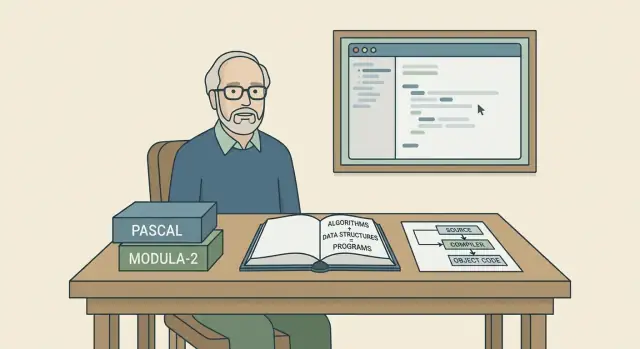
Why Wirth’s languages still matter
Niklaus Wirth was a Swiss computer scientist who cared less about flashy features and more about whether programmers could think clearly in code. He designed languages like Pascal and later Modula-2 with a deliberate goal: make the “right” way of writing programs easy to learn, easy to read, and hard to subtly mess up.
That focus still matters because many software failures aren’t caused by a lack of power—they’re caused by complexity, unclear intent, and code that’s difficult to reason about. Wirth’s languages were built to push developers toward structure, explicitness, and disciplined decomposition. Those habits show up everywhere today: in how teams review code, how systems are designed as modules, and how we value correctness and maintainability alongside speed.
The core idea: simplicity that teaches
Pascal and Modula weren’t trying to be everything to everyone. They were intentionally constrained so that learners practiced:
- writing programs with clear control flow (structured programming)
- using strong typing to catch mistakes early
- organizing code so it can be understood by someone else later
Teaching goals that shaped engineering outcomes
Because these languages were used heavily in education, they influenced generations of developers. The result wasn’t just people who “knew Pascal,” but people who expected compilers to help, types to mean something, and programs to be readable by design—not by convention.
What this article covers (and who it’s for)
This piece is for engineers, educators, and curious learners who want to understand why Pascal/Modula mattered beyond nostalgia. We’ll look at the problems Wirth was solving, the design choices he made, how compilers fit into the teaching story, and where these ideas still echo in modern software engineering.
The problem Pascal set out to solve
Before Pascal became a staple in education, many students encountered programming through languages and habits that made programs hard to read and harder to trust. Code often leaned on global state, cryptic conventions, and control flow that could jump around unexpectedly. Beginners could “get it to run” without really understanding why it worked—or why it broke.
Messy control flow, unclear thinking
A major pain point was how easy it was to write tangled logic. When a program’s execution path can hop unpredictably, the programmer stops reasoning in steps and starts patching symptoms. That style didn’t just frustrate learners; it also made maintenance expensive for teams.
Pascal was created to support the push for structured programming: programs built from clear, nestable blocks (sequence, selection, repetition) rather than ad-hoc jumps. The goal wasn’t to restrict creativity—it was to make the code reflect the way people explain solutions.
Readability as a primary feature
Wirth treated readability as a design goal, not an afterthought. Pascal encouraged:
- explicit structure (
begin/endblocks) - meaningful data definitions (types and records)
- predictable control flow (clear loops and conditionals)
That meant students could learn by reading, not only by trial and error. It also meant instructors could grade understanding, not just output.
Why it spread so quickly
Universities and textbooks amplified these ideas. Pascal was small enough to teach in a course, consistent enough to fit into clear curricula, and disciplined enough to reward good habits. Once adopted in classrooms, it shaped a generation’s expectations: that programs should be understandable by someone other than the original author—and that language design can actively encourage that outcome.
Pascal’s design philosophy: simplicity with purpose
Pascal wasn’t “small” by accident. Wirth designed it to make good habits easy and bad habits inconvenient. Instead of offering many ways to express the same idea, Pascal pushes you toward a single, readable path—useful both for beginners and for teams trying to keep code understandable over time.
Fewer concepts, used consistently
Pascal’s syntax stays tight and predictable. The language leans on a limited set of building blocks—blocks, procedures/functions, and a handful of core statements—so you spend less time memorizing special cases and more time learning how to structure programs.
That consistency matters: when a language has one clear way to declare, organize, and scope code, readers can often infer what unfamiliar code does without hunting for hidden rules.
Learning-first structure, not “magic”
Pascal encourages explicit structure: a program has a clear beginning, a clear end, and named parts in between. Strong defaults (like explicit variable declarations) force you to think about what exists and what type it is before you use it.
This reduces “spooky action” where values appear implicitly or change type silently—features that can make early progress feel fast, but often create confusion later.
Control flow you can reason about
Pascal emphasizes clear control structures—if, while, and for—and expects you to express logic directly. You can read a routine top-to-bottom and understand the paths it may take, which supports structured programming and makes debugging more systematic.
Types as a safety rail
In Pascal, types aren’t decoration; they’re a tool for preventing mistakes. By making the shape of data explicit, the language helps catch mismatches early and rewards disciplined style: define your data carefully, then let the compiler enforce the contract.
What Pascal teaches by design
Pascal isn’t “teaching-oriented” because it hides reality. It’s teaching-oriented because the language nudges you toward habits that stay useful long after the first course: clear structure, deliberate naming, and code you can explain out loud.
Block structure and scope as a mental model
In Pascal, blocks (begin ... end) and nested scopes make program structure visible. Beginners quickly learn that where something is declared matters, and that variables don’t have to be global “just because.” That simple rule builds a mental model of containment: a procedure owns its local data, and the rest of the program can’t casually depend on it.
Decomposition through procedures and functions
Pascal encourages breaking work into procedures and functions with explicit parameters. That naturally teaches:
- separating “what this step does” from “how the whole program works”
- small, testable units of logic
- clearer boundaries between input, processing, and output
Over time, this turns into a default approach: if something feels hard to explain, extract it.
Strong typing that prevents “mystery behavior”
Pascal’s type checking reduces ambiguity. Mixing incompatible values is difficult, not convenient. The payoff for learners is immediate: fewer hidden bugs caused by unintended conversions or sloppy assumptions.
Declarations that support maintenance
Pascal’s readable declarations front-load intent: names, types, and interfaces are explicit early. In day-to-day engineering, this is the same trade-off teams still make—spend a bit more effort defining data cleanly so the next hours of reading and changing are safer.
Teaching-oriented design, here, means the language rewards careful thinking—and then makes that care visible in the code.
Compilers as part of the teaching toolchain
Wirth didn’t treat the compiler as a hidden implementation detail. For Pascal (and later Modula-2), the compiler was a central part of the learning environment: it enforced rules, explained mistakes, and encouraged students to think in terms of clear structure rather than trial-and-error hacks.
Discipline through errors and warnings
A teaching-oriented compiler does more than reject incorrect programs. It nudges learners toward good habits:
- Strong typing turns vague intent into explicit declarations, so mismatches are caught early.
- Structured control flow makes “what happens next” legible, and the compiler can flag unreachable code or malformed blocks.
- Clear scoping rules reduce accidental name clashes and make “where does this variable come from?” a question the compiler can answer quickly.
That feedback loop matters in classrooms: students learn to interpret diagnostics and refine their thinking step by step, instead of debugging mysteries at runtime.
Building a compiler as a learning tool
Wirth also promoted compiler construction as an educational exercise. A smaller, well-specified language makes it realistic for students to build a working compiler (or parts of one) within a course. That changes how people understand programming: you stop seeing a language as magic and start seeing it as a set of carefully chosen trade-offs.
Simplicity enables faster feedback
Simple languages enable simpler compilers. Simpler compilers tend to compile quickly, run predictably, and produce more understandable error messages—crucial when learners are iterating constantly. The constraints aren’t just limitations; they steer attention toward decomposition, naming, and correctness.
What modern tooling inherits
Modern IDEs, linters, and continuous integration pipelines extend the same idea: quick, automated feedback that teaches as it enforces. Today’s tools may feel more sophisticated, but the core pattern—tight loop, clear diagnostics, and rules that shape habits—matches the teaching toolchain Wirth helped normalize.
Pascal in practice: strengths and limits
Pascal wasn’t meant to be everything to everyone. In practice, its biggest value showed up when the goal was to learn clean program structure and to express algorithms clearly—without getting distracted by low-level details.
Where Pascal fit well
Pascal shines when you want code that reads like a carefully written plan. Its emphasis on structured control flow and explicit types encourages you to think about what data is, how it changes, and where it’s allowed to change.
Commonly strong use cases included:
- Learning programming fundamentals (variables, control flow, procedures/functions)
- Writing and discussing algorithms in a way that’s easy to trace
- Building small-to-medium programs where clarity matters more than squeezing every last system feature into one file
Common criticisms
As projects grew, people often hit the edges of the language and its standard tooling. Compared with languages used for operating systems and hardware-near work, Pascal could feel constrained.
Typical pain points:
- Limited access to low-level operations in standard Pascal (useful in systems programming)
- Friction when building very large programs with evolving boundaries
- A sense that “doing the safe thing” sometimes required extra ceremony
Variants and extensions (carefully)
Because Pascal was widely used, multiple implementations extended it in different directions—often to support better tooling, faster compilation, or additional language features. Examples you may hear mentioned include UCSD Pascal, Turbo Pascal, and later Object Pascal-style extensions. The important takeaway isn’t which variant “won,” but that many teams wanted Pascal’s clarity plus more practical power.
Why “simple” can feel restrictive
Simplicity is a design choice: it reduces the number of ways to do something. That helps learning and code review—but when requirements expand (systems integration, concurrency, massive codebases), fewer built-in escape hatches can push teams toward extensions, conventions, or a different language altogether.
From Pascal to Modula: scaling the same ideals
Pascal was built to teach: it encouraged clear control flow, strong types, and readable programs that fit in a student’s head. But once those students started building real tools—editors, compilers, operating-system components—the “teaching language” boundaries showed. Large programs needed clearer structure than “one big program with procedures,” and teams needed a way to divide work without stepping on each other.
Why Wirth moved beyond a teaching language
Wirth’s shift from Pascal to Modula wasn’t a rejection of simplicity—it was an attempt to preserve it as software grew. The goal changed from “help someone learn programming” to “help people build systems without losing control of complexity.”
The key shift: modules as first-class organization
Modula’s headline idea is the module: a named unit that groups related data and operations. Instead of relying on conventions (“these procedures belong together”), the language supports that organization directly.
This matters because structure becomes part of the program’s shape, not just documentation. A reader can understand the system as a set of components with responsibilities, not a long list of unrelated functions.
Interface vs. implementation: learning and scaling
Modula formalizes separation between what a module promises (its interface) and how it works (its implementation). For learners, this teaches a powerful habit: use a component through its contract, not by poking at its internals.
For larger codebases, it also supports change. You can improve the inside of a module—performance, data structures, safety checks—without forcing everyone else to rewrite their code.
Modularity supports teamwork
When modules define boundaries, collaboration gets easier. Teams can agree on interfaces, work in parallel, review changes in smaller units, and reduce accidental coupling. In practice, that’s how Wirth’s original ideals—clarity, discipline, and simplicity with purpose—scale from classroom exercises to serious systems.
Modula-2 and the case for modular design
Pascal taught clarity inside a single program. Modula-2 adds the next lesson: clarity between parts of a program. Wirth’s bet was simple—most software problems aren’t solved by smarter individual statements, but by organizing code so people can work on it safely over time.
What a “module” means (without jargon)
A module is a named box of code that owns a specific job—say “reading configuration” or “talking to the printer.” The key is that other parts of the program shouldn’t need to know how the module does its job, only what it can do.
Encapsulation: hiding details to prevent accidental misuse
Modula-2 encourages a separation between a module’s public surface and its private internals. That “hiding” isn’t secrecy; it’s protection. When internal data structures are private, other code can’t poke at them in surprising ways, which reduces bugs that come from unintended side effects.
Interfaces as contracts that support refactoring
Modula-2’s definition modules act like contracts: they list the procedures and types the module promises to provide. If you keep that contract stable, you can rewrite the implementation module—optimize it, simplify it, fix a bug—without forcing changes everywhere else. That’s refactoring with guardrails.
From modules to modern packages
If you’ve used packages in Go, crates in Rust, namespaces in C#, or libraries in Python, you’ve felt the same modular thinking: clear boundaries, exported APIs, and internal details kept internal.
Teach modularity early, not as an afterthought
Many developers learn structure only after wrestling with large codebases. Modula-2 argues for the opposite: teach boundaries from the start, so “where should this code live?” becomes a habit—not a rescue mission later.
Safety and concurrency: careful power, not complexity
Concurrency is where “simple languages” often get tempted into piling on features: threads, locks, atomics, memory models, and a long list of edge cases. Wirth’s instinct was the opposite—give programmers a small, explicit mechanism that teaches coordination without turning every program into a synchronization puzzle.
Simple, explicit concurrency ideas (high-level)
Modula-2 is a good example of this restraint. Instead of centering the language around preemptive threads, it offered coroutines: a cooperative way to structure tasks where control is transferred deliberately. The point isn’t raw parallel speed; it’s clarity. You can show “two activities” progressing step-by-step without introducing timing surprises as the first lesson.
Alongside coroutines, Wirth’s familiar safety tools still matter in concurrent code: strong typing, explicit interfaces, and modular boundaries. Those don’t magically prevent race conditions, but they do prevent a lot of accidental complexity—like passing the wrong kind of data across components, or letting internal state leak into places it shouldn’t.
Teaching safe coordination influenced later thinking
When concurrency is taught as coordination with rules (not as “sprinkle locks until it stops failing”), students learn habits that transfer directly to real systems: define responsibilities, isolate state, and make interactions explicit. That mindset anticipates later best practices—structured concurrency, actor-style messaging, and “own the data you mutate”—even when the underlying runtime is far more sophisticated.
Small primitives, clear rules → reliable engineering
The recurring pattern is: few primitives, clearly defined behavior, and designs that make illegal states hard to represent. In production engineering, that translates into fewer heisenbugs, simpler debugging, and systems that fail in understandable ways—because the code was written to be reasoned about, not just executed.
How Wirth’s principles show up in modern engineering
Wirth’s languages weren’t just “nice to read.” They treated readability, structure, and correctness as engineering constraints—much like performance budgets or security requirements. Those constraints show up daily in how modern teams build and maintain software.
Readability as an engineering practice
Many teams now encode readability into their workflow: style guides, linters, and “make it boring” conventions. That mindset mirrors Pascal/Modula’s goal of making the default code understandable. In practice, this looks like preferring clear control flow, small functions, and naming that communicates intent—so changes can be reviewed quickly and safely.
Strong typing as communication
Strong typing isn’t only about preventing mistakes; it’s documentation that the compiler can verify. Modern statically typed ecosystems (and typed layers like TypeScript) lean on the same idea: types express what a function expects and promises. Code reviewers often treat types as part of the API contract—catching mismatched assumptions before they become production bugs.
Simplicity to reduce bugs and onboarding time
Wirth’s emphasis on simple, orthogonal features maps cleanly to today’s “minimize cleverness” culture. Teams that limit metaprogramming, avoid overly generic abstractions, and keep dependencies tidy are applying simplicity as a strategy: fewer edge cases, fewer surprise interactions, and faster onboarding for new engineers.
Module boundaries for change over time
Modern modular design—packages, services, and well-defined interfaces—echoes Modula’s insistence on explicit boundaries. Clear module ownership and stable public APIs help teams evolve internals without breaking everything downstream, a practical way to manage change rather than fear it.
Where this appears in code review culture
Good reviews often ask Wirth-like questions: “Is this easy to follow?”, “Can the type system express this invariant?”, “Are responsibilities separated?”, “Does this boundary make future changes safer?” These are language principles turned into everyday engineering habits.
A measured look at Pascal/Modula’s influence
Talking about “influence” can get fuzzy. Pascal and Modula-2 didn’t “win” by becoming the default production languages everywhere. Their influence is better understood as a set of ideas—about clarity, structure, and tool-supported discipline—that others adopted, adapted, and sometimes softened.
Pascal’s quiet impact on how people learned to code
For many developers, Pascal was their first serious language. That mattered. It trained habits that stuck:
- write programs top-down, in small procedures
- use explicit types and meaningful data definitions
- treat readability as part of correctness, not decoration
Even when those students later moved to C, C++, Java, or Python, the mental model of “program as a set of well-defined parts” often came from Pascal-era teaching.
Modula-2’s modularity, echoed widely
Modula-2 pushed a separation that now feels normal: defining an interface separately from an implementation. You see close relatives of that idea in many places—headers vs. source files, modules vs. packages, public APIs vs. private internals. The details differ, but the goal is consistent: make dependencies explicit and keep a system understandable as it grows.
That same attitude shows up in later language features: namespace-like organization, controlled visibility, and compilation units that encourage teams to draw clean boundaries.
A brief line to Oberon and later Wirth work
Wirth’s later languages (like Oberon) continued the theme: reduce surface area, keep the rules consistent, and make the compiler a partner in maintaining code quality. Not every specific feature traveled, but the preference for small, coherent designs continued to inspire educators and language designers.
What “influence” really means here
Pascal/Modula’s influence is less about copying syntax and more about normalizing certain expectations: strong typing as a teaching aid, structured control flow over clever tricks, and modular design as a practical way to manage complexity. Those expectations became part of mainstream software engineering culture—even in ecosystems that look nothing like Pascal on the surface.
Practical takeaways for teams and learners
Wirth’s enduring lesson isn’t “use Pascal again.” It’s that a system becomes easier to build and teach when its core ideas are few, consistent, and enforced by tooling.
When to prioritize a small, teachable core
If your codebase has multiple ways to do the same thing, you pay for it in onboarding time, review debates, and subtle bugs. A “small core” is worth prioritizing when:
- You have many contributors (or frequent turnover).
- You’re building foundational services that others depend on.
- You’re seeing repeated defects caused by inconsistent patterns.
In practice, this means standardizing on a limited set of approved patterns (error handling, logging, configuration, concurrency primitives) and being explicit about “one obvious way” to solve common tasks.
Use types and modules to prevent common mistakes
Pascal and Modula emphasized that the compiler can be a teammate. Modern equivalents:
- Strengthen your type boundaries: prefer distinct domain types (e.g.,
UserIdvsOrderId) over “everything is a string.” - Design modules with clear responsibilities: keep APIs small, hide internals, and avoid “utility” modules that become dumping grounds.
- Make invalid states hard to represent: use enums, sealed unions, non-nullable fields, and validated constructors.
Teaching the principles on a team
Good engineering cultures teach by repetition and examples:
- Style guides that explain why, not just what.
- Code reviews that point to a canonical pattern (“Do it like in module X”).
- Tiny reference projects and templates that embody your preferred structure.
Where these ideas matter even in AI-assisted development
Even when you build software through a chat-first workflow, Wirth’s principles still apply: the output has to be readable, modular, and easy to verify. For example, platforms like Koder.ai (a vibe-coding environment that generates full web, backend, and mobile apps from chat) lean heavily on the same “teachable core” concept: planning mode to make intent explicit, clear module boundaries in generated code, and fast feedback loops.
Practical ways to keep Wirth-like discipline when using an LLM to accelerate delivery:
- Use a short “interface-first” prompt: define APIs, types, and module responsibilities before asking for implementations.
- Prefer small iterations with checkpoints—Koder.ai’s snapshots and rollback are useful here—so you can review changes like you would in a structured code review.
- Keep exports/deployment reproducible: the ability to export source and host with a custom domain helps treat generated code as a maintainable codebase, not a one-off artifact.
A checklist for simple, maintainable code (without being simplistic)
- Can a new teammate explain this module’s purpose in one sentence?
- Are public interfaces smaller than the implementations behind them?
- Do types encode key rules, or is correctness left to comments?
- Is there one clear path for common tasks (not five competing patterns)?
- Are dependencies minimal and directional (no tangles)?
If you want more pragmatic guidance, see /blog/programming-best-practices. If you’re evaluating tooling that enforces conventions (linters, CI checks, review automation), /pricing may help frame the options.
FAQ
Why do Wirth’s languages still matter if most teams don’t ship Pascal or Modula-2 today?
Wirth optimized for clarity and disciplined structure, not maximum feature count. That matters because many real-world failures come from code that’s hard to reason about—unclear intent, tangled control flow, and accidental coupling—rather than from missing language power.
What problem was Pascal trying to solve with structured programming?
Structured programming pushes you toward sequence, selection, and repetition (clear blocks, loops, and conditionals) instead of ad-hoc jumps. Practically, it makes code easier to trace, review, and debug because you can read routines top-to-bottom and understand the possible execution paths.
How does Pascal’s strong typing help, and what’s the modern equivalent?
Strong typing makes data shapes and assumptions explicit and compiler-checkable. To apply the same idea today:
- Prefer domain types over generic primitives (e.g.,
UserIdvsstring). - Avoid implicit conversions where possible.
- Encode invariants in types (enums, sealed unions, non-nullable fields).
What does Pascal teach about scope and why does it matter in large codebases?
Pascal’s block structure makes scope visible: variables live where they’re declared, and locals stay local. A practical takeaway is to minimize global state and keep mutable data inside the smallest responsible unit (function/module), which reduces hidden dependencies and side effects.
How did Pascal encourage decomposition, and how can teams apply that habit today?
By encouraging procedures/functions with explicit parameters, Pascal nudges you to split work into small, explainable units. In practice:
- Extract a function when a step is hard to describe in one sentence.
- Pass dependencies explicitly rather than reading/writing shared globals.
- Keep each routine responsible for one coherent task.
Why did Wirth treat compilers as part of the learning toolchain?
A teaching-oriented compiler provides fast, precise feedback—especially about types, scoping, and malformed structure—so you learn by tightening intent, not by runtime guessing. Modern parallels include IDE diagnostics, linters, and CI checks that reject ambiguous patterns early.
What did Modula-2 add that Pascal struggled with as programs grew?
Modula-2 made modules a first-class unit: a component owns related data/operations and exposes a small public surface. The practical benefit is safer change over time—if the interface stays stable, you can refactor the implementation without breaking downstream code.
What’s the real value of “interface vs. implementation” beyond theory?
It formalizes interface vs. implementation: define what a module promises, then hide internal details. To mirror this today:
- Keep public APIs small and intentional.
- Make internals private by default.
- Treat the exported interface as a contract for reviews and versioning.
Why did so many Pascal variants (UCSD, Turbo, Object Pascal) appear?
They kept Pascal’s clarity while adding practical features (tooling, performance, extra constructs). The trade-off is fragmentation: different dialects may behave differently. The useful lesson is that teams often want a simple core plus carefully chosen escape hatches—not unlimited flexibility everywhere.
What are the most practical takeaways for modern teams from Pascal/Modula?
Adopt “simplicity with purpose” as a team policy:
- Standardize on one obvious way for common tasks (errors, logging, config, concurrency).
- Use types/modules to make invalid states hard to represent.
- Reinforce conventions through reviews and automated checks.
For more on practical coding conventions, see /blog/programming-best-practices. If you’re comparing tooling approaches, /pricing can help frame options.