

Nintendo’s Resilient Platform: IP, Co-Design, Ecosystem Control
How Nintendo uses iconic IP, hardware-software co-design, and tight ecosystem control to stay resilient through console cycles and market shifts.
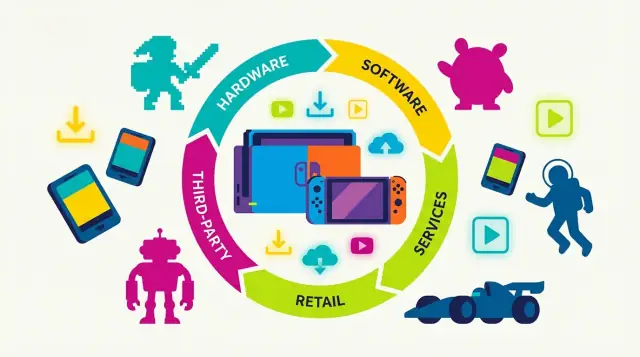
What Makes a Gaming Platform “Resilient” Across Cycles?
A “resilient” gaming platform stays relevant and profitable even as technology shifts and a console generation ends. It doesn’t rely on a single hit year, a temporary hardware advantage, or a momentary trend. Instead, it keeps players (and developers) showing up—generation after generation.
Resilience matters because the console business is cyclical: new hardware launches create spikes, then attention drifts, then the next cycle begins. Platforms that endure find ways to carry their audience forward rather than needing to “re-win” them from scratch every time.
The three pillars behind resilience
This article breaks Nintendo’s platform strategy into three repeatable pillars:
- IP (characters and worlds): Familiar, trusted franchises reduce the risk of trying something new on the hardware side.
- Hardware–software co-design: Hardware is built around specific kinds of play, and games are designed to make that hardware feel essential.
- Ecosystem control: A consistent store, account system, parental controls, and quality standards help maintain predictable value for players and partners.
Strategy patterns, not insider secrets
This isn’t a behind-the-scenes report. It’s a practical look at observable patterns: what Nintendo repeatedly prioritizes, what it avoids, and how those choices compound over time.
Why Nintendo doesn’t fight a pure specs war
Many competitors lean on power, resolution, and performance as the headline. Nintendo often competes through distinct play experiences and recognizable IP, then reinforces them with an ecosystem that feels familiar from one device to the next.
What you’ll learn (and how to apply it elsewhere)
By the end, you’ll have a simple way to evaluate any product ecosystem—gaming or not—by asking:
- What carries trust across cycles?
- What’s uniquely enabled by the product design?
- What keeps the experience consistent enough that people stick around?
IP as a Long-Term Asset: Why Characters and Worlds Matter
“IP” (intellectual property) is more than a logo on a box. For Nintendo, it includes characters (Mario, Zelda, Pikachu), entire worlds and rulesets, long-running game series, recognizable music and visual style, and—crucially—brand trust that the experience will be approachable and polished.
Why IP de-risks new hardware
Launching a new console is expensive and uncertain: consumers don’t know the games yet, and developers don’t know the audience size. Strong IP narrows that uncertainty. When people see a new Mario Kart or mainline Zelda attached to a new device, they can predict the “kind of fun” they’ll get.
That confidence makes early adoption easier, which then attracts more developers, which then improves the library—a practical way to reduce the risk of a slow start.
System sellers and the first purchase decision
Nintendo’s “must-play” first-party titles function as system sellers: games that justify buying the hardware. These aren’t just popular releases; they’re cultural moments that cut through choice overload. Even players who own other platforms will make room for the one device that hosts the next tentpole entry.
Family-friendly positioning expands the audience
Nintendo’s IP tends to be readable, playful, and welcoming. That family-friendly positioning isn’t only about age ratings—it signals low friction: easy to share, easy to understand, and safe to gift.
Broad appeal smooths sales across boom-and-bust cycles because demand isn’t limited to one hardcore segment.
Nostalgia plus novelty
Nostalgia brings people back, but new entries keep the brand alive. Remakes, cameos, and familiar themes create continuity, while fresh mechanics and new characters prevent the series from feeling stuck.
The result is a reinforcing loop: older fans return, new players join, and each group increases the value of the other.
Hardware–Software Co-Design: Designing for a Specific Kind of Fun
Nintendo often treats hardware and software as one product, not two separate bets. Instead of building a console first and then asking studios to “make it work,” the hardware is shaped around the kinds of play the company wants to make easy, repeatable, and distinct.
Co-design, in plain terms
Co-design means hardware features exist to serve specific game experiences. The controller layout, input methods, and system behavior are chosen with particular play patterns in mind—so developers can rely on them, and players feel the point immediately.
Why not just chase specs?
A pure “specs race” can be a weak differentiator because competitors can often match (or exceed) raw performance within a cycle. Higher specs help, but they don’t automatically answer the buyer’s real question: “What can I do on this device that feels meaningfully different?”
Co-design aims to make the answer obvious without a comparison chart.
Feature-led play patterns (without the hype)
You can see this approach in how Nintendo leans into patterns like hybrid play (switching between TV and handheld sessions), motion-based input when it fits the design, and local multiplayer that’s quick to start.
Not every game uses every feature, but the platform nudges developers toward experiences that feel “native” to the device.
Constraints that guide creativity
When hardware is designed around a clear experience, constraints become productive. Teams can target stable performance goals, design around consistent inputs, and spend more effort on gameplay feel, readability, and iteration—rather than constantly adapting to wildly different setups.
For buyers, co-design becomes clearer value: you’re not just buying a box with power; you’re buying a particular style of play that the whole system is built to deliver.
The Hybrid Advantage: One Device, More Moments to Play
A hybrid console changes the core “when can I play?” equation. Instead of competing only for the living-room TV slot, it also wins the small pockets of time that happen throughout a week—commutes, travel, lunch breaks, waiting rooms, or simply moving from room to room at home.
More use cases, more total play time
When one device comfortably supports both docked play and handheld play, it expands the number of moments where gaming is the easiest option. That doesn’t just increase hours; it increases frequency.
Players can progress a little at a time, which makes it easier to stay engaged with a game over months.
One platform simplifies decisions—for players and developers
A unified platform reduces “Which version should I buy?” anxiety. There isn’t a separate portable ecosystem and a separate home ecosystem to choose between; your purchase follows you.
For developers, focus is similarly simplified. Rather than splitting teams and budgets across two different hardware targets, they can optimize for one audience and one set of capabilities—then rely on the hardware’s different modes to create variety in how people experience the same game.
The “one library” effect extends the lifecycle
A single, growing library creates momentum. Players keep using the system longer because their collection stays relevant across contexts: the same game that fits a quick handheld session can also become an evening activity on the TV.
That continuity encourages buying more games over time, since each new purchase slots into an existing habit.
Designed for short sessions and long play
Hybrid play supports both ends of the spectrum: bite-sized progress (one quest, one race, one puzzle) and longer sit-down sessions. Games that respect both patterns tend to feel more “pick-up-and-play” without sacrificing depth.
Variants and accessories, without fracturing the idea
Over a generation, platform variants and accessories can widen the audience—different price points, form factors, or control options—while keeping the central promise intact: it’s still one system, and it still plays the same library.
Ecosystem Control: Consistency, Safety, and Predictable Value
Nintendo’s platform strength isn’t only about hardware or games—it’s also about how tightly the ecosystem is managed. “Ecosystem control” means owning the end-to-end experience: the Nintendo Account, the storefront and payments, platform policies, game certification, and even how titles are presented and merchandised in the shop.
Why consistency and safety matter
For a mass audience—kids, parents, casual players, and longtime fans—predictability is a feature. A consistent interface, familiar purchasing flow, and clear rules around content and online behavior reduce friction and anxiety.
When people feel confident that “games here are appropriate” (or at least clearly labeled), they’re more willing to buy software and recommend the platform.
Curation and the perception of quality
Nintendo’s certification standards and storefront curation shape what players think the platform is. The upside is obvious: fewer broken releases, fewer misleading listings, and a general sense that games meet a baseline of usability.
The downside is real, too. Curation can become gatekeeping—slower approvals, stricter requirements, and less room for experimental updates or unconventional business models. For some developers, it can feel like extra hoops; for some users, it can feel restrictive.
Predictable launches and reliable visibility
Control also supports launch coordination. When the platform owner sets rules for timing, marketing placements, preloads, and featured slots, big releases can land with consistent messaging and fewer surprises. That predictability helps retailers, press, and players align around key dates—making tentpole launches feel like “events” rather than just another weekly drop.
At the same time, this power to allocate visibility creates winners and losers. A featured carousel slot can make a title; being buried can sink one. Nintendo’s challenge is keeping the storefront trustworthy while still giving smaller games a fair path to discovery.
First-Party Flywheel: Releases That Keep the Platform Moving
Nintendo’s platform strength isn’t only about having famous characters—it’s about when and how those games arrive. A steady first-party cadence acts like a metronome for the whole ecosystem: it creates predictable moments of excitement, keeps players checking back in, and gives retailers and partners clear reasons to talk about the system throughout the year.
Cadence keeps engagement steady
Big platforms often spike at launch and then fade between tentpole releases. Nintendo’s approach is to smooth that curve with a mix of major releases and smaller-but-meaningful drops.
Even when a flagship game isn’t imminent, the calendar can stay active through updates, DLC, party-friendly releases, and family-oriented titles that broaden who the platform is for.
Familiar worlds, new hooks
Sequels, spin-offs, and new IP each do a different job:
- Sequels reward existing fans and signal reliability—people know what they’re buying into.
- Spin-offs let Nintendo explore new genres (racing, sports, tactics, co-op) without needing to “teach” an entirely new universe.
- New IP refreshes the brand and tests new play patterns that can become future pillars.
The balance matters: too much familiarity becomes stale, while too much novelty can fragment attention. A curated mix keeps the platform feeling both comfortable and surprising.
Cross-promotion that compounds attention
Nintendo also treats releases as platform events. Hardware bundles timed with major games, themed accessories, and limited-time promotions turn a single title into a broader on-ramp.
Direct-style showcases and in-game events can amplify this effect, converting interest into coordinated purchasing moments.
Evergreen titles extend the tail
A key advantage is the “evergreen” effect: certain first-party games don’t behave like short-lived launches. They keep selling for years because they’re easy to recommend, simple to pick up at any time, and often become go-to household staples.
That sustained demand helps the platform perform even between blockbuster releases.
Polish and accessibility widen the audience
Nintendo’s emphasis on polish, readability, and welcoming design expands the addressable market. When games are approachable—and feel complete—word-of-mouth stays strong, returns are lower, and the platform earns trust across age groups and skill levels.
Third-Party and Indie Support: Filling the Gaps the Right Way
Nintendo’s first-party slate sets the tone, but third-party and indie games do a different job: they keep the library broad between big releases, serve niche tastes, and turn the hardware into a “something for everyone” device.
Why third parties sign up
Publishers usually follow a few practical signals. A large installed base reduces risk: more potential buyers, clearer forecasting, and a longer tail for sales. Just as important is the audience fit—Nintendo players often show up for family-friendly co-op, party play, and evergreen titles that can keep selling for years.
Portability can also change the math. Some games simply get played more when they’re easy to pick up for 10–20 minutes, making a “good on the go” version valuable even if it’s not the absolute highest-fidelity edition.
Technical fit: smart versions, not perfect ports
Successful third-party support often comes from choosing the right version of a game for the device’s strengths. That might mean optimized visuals, tighter performance targets, smaller open worlds, or feature tweaks that emphasize local multiplayer, motion, or quick sessions—rather than chasing a one-to-one match with more powerful hardware.
Indies, visibility, and the storefront story
Indies thrive when the platform can tell a clear storefront story: curated collections, featured slots, and easy-to-understand categories that help players find “their kind” of game. When discovery works, smaller titles become steady fillers that keep engagement high.
The overcrowding risk
A packed store can cut both ways. More games means more choice—but also more noise. As the catalog grows, discovery becomes critical; otherwise quality titles get buried, and developers see weaker launches even when the audience exists.
Services and Continuity: Extending the Lifecycle Beyond Hardware
A console generation used to feel like a hard reset: new box, new library, and a scramble to rebuild habits. Services and continuity soften that reset.
When players can carry their purchases, preferences, and social connections forward, the platform feels less like a product you replace and more like a place you return to.
The quiet power of updates and digital libraries
Post-launch updates, content drops, and quality-of-life patches can keep a game relevant long after release—especially for family-friendly titles people revisit over years.
Digital libraries also change the value curve: the more you buy, the more switching costs rise, because your collection is tied to your account rather than a shelf.
This doesn’t mean every game becomes a forever-game. It means the platform can keep delivering small reasons to stay engaged between big releases.
Backwards compatibility and account continuity (without assumptions)
Backwards compatibility and account continuity matter because they protect time already invested—money spent, save data, achievements, friend lists, parental settings. Even limited forms of carry-over reduce friction when hardware changes.
It’s worth separating the principle from the promise: specific compatibility policies vary by generation, region, and technical constraints. But strategically, the direction is clear—players reward platforms that respect their history.
Community and events as retention tools
Social play isn’t only about competitive rankings. Seasonal events, in-game collaborations, and community challenges give people a shared calendar.
Local multiplayer and family co-op also function as retention: if a game becomes part of a household routine, it’s harder to replace.
Pricing psychology: evergreen value vs constant discounts
Nintendo often leans into evergreen pricing—keeping first-party hits at stable prices for longer. That can frustrate bargain hunters, but it supports predictable value: buyers feel safer purchasing without waiting for a 70% sale next month.
Other platforms use deeper discounting to drive volume and clear catalogs; both approaches can work, but they create different expectations.
Subscriptions as a complement, not a replacement
Subscription libraries can widen the funnel—helping players try genres, sample classics, and fill gaps between tentpole releases. The key is balance: subscriptions work best when they complement premium sales, not when they train customers to treat big new games as “should be included.”
For a platform built on iconic, long-lived franchises, that balance helps keep both engagement and revenue resilient.
Competing Through Differentiation, Not a Specs Battle
Nintendo’s cycle resilience starts with a simple choice: avoid the graphics arms race and instead ship a distinct kind of value people can immediately feel. When competitors compete on raw performance, the “winner” changes every generation.
When you compete on play patterns—portable + TV, local multiplayer, motion, party play—your proposition is harder to copy and less sensitive to spec comparisons.
Timing: launch when the idea is obvious
Nintendo tends to wait until it can deliver a clear, understandable promise, not just when newer chips exist. A “new box” isn’t the pitch; the pitch is the experience: quick pick-up-and-play sessions, family-friendly living-room moments, and familiar worlds that make the device feel worth owning.
Macro resilience: fun that fits tighter budgets
During leaner periods, people scrutinize discretionary spending. A platform that supports shared, at-home entertainment (kids, roommates, couples) can feel like better value than a premium, single-player-only upgrade.
One purchase can create many “together” hours—without needing the newest TV or expensive add-ons.
Risk management: fewer bets, stronger hits
Differentiation also shapes development risk. Nintendo often makes fewer, higher-confidence releases and extends them longer—supported by reusable internal tools, engines, and proven production pipelines. That lowers the chance of burning huge budgets chasing short-lived technical advantages.
“Fun-first” outlasts the spec curve
Specs date quickly; joyful mechanics and recognizable characters don’t. By optimizing for “this is instantly fun” rather than “this is technically maximal,” Nintendo can stay competitive even when the headline numbers aren’t the highest—because the reason to play isn’t dependent on photorealism.
Where the Strategy Can Strain: Risks and Trade-Offs
A tightly managed, IP-driven platform can be unusually durable—but the same strengths can create pressure points. The goal isn’t to “fix” the model; it’s to understand where costs show up so expectations stay realistic.
Concentration risk: when a few hits carry too much weight
Relying on a small set of evergreen franchises is powerful, but it can narrow room for error. If one major release slips, underperforms, or simply doesn’t land culturally, the gap is felt more sharply than on platforms where third-party blockbusters do more of the heavy lifting.
Innovation fatigue is the other side of the coin: players expect each new generation to feel meaningfully different. Novel input ideas, new hardware concepts, or new play patterns can refresh the brand—yet pushing “new” too hard can confuse buyers or split audiences.
Supply and pricing sensitivity
Hardware-led businesses are exposed to manufacturing realities: component constraints, shipping disruptions, and currency swings can affect availability and margins.
Pricing is delicate, too. If costs rise, passing them to customers can be risky—especially for a family-oriented audience that compares value across phones, tablets, and subscription entertainment.
Online expectations keep rising
Players increasingly assume stable matchmaking, fast downloads, modern social features, and strong account continuity. When these basics feel behind peers, it can limit engagement in multiplayer titles and make services harder to justify—even if the core games are excellent.
Bigger catalogs create discovery and quality-control challenges
As digital catalogs grow, visibility becomes a scarce resource. If store discovery isn’t strong, smaller games struggle to find an audience, and customers can lose trust when they repeatedly run into low-quality releases.
Openness vs. safety and brand consistency
Welcoming creators fuels variety and fills schedule gaps, but more openness can increase moderation burden, IP infringement risks, and inconsistent user experiences.
Tighter control protects the brand, yet it can also frustrate developers if policies feel unpredictable or tools lag behind needs.
A Simple Framework You Can Apply to Any Product Ecosystem
You can reuse Nintendo’s core idea as a three‑pillar model for almost any ecosystem product:
- Signature value (content/IP): the thing people can’t get elsewhere.
- Integrated design (co-design): the product is shaped around delivering that signature value with less friction.
- Controlled distribution (ecosystem control): a consistent, safe, predictable way to buy, use, and return.
Translate it beyond gaming
- Signature value might be a “hero” class, a proprietary dataset, a creator network, a distinctive template library, or a unique service guarantee.
- Integrated design could mean hardware + app, app + workflow, or service + onboarding designed together so the best outcome is the default.
- Controlled distribution is your channel and rules: subscriptions, an app store, certified partners, curated marketplace listings, or tightly managed bundles.
The goal isn’t to lock people in; it’s to make quality and consistency easy to understand and repeat.
If you’re building software ecosystems, the same pillars show up in practice: your “IP” might be reusable components and proven flows; co-design becomes workflow-first product decisions; ecosystem control becomes deployments, access control, and predictable releases. Platforms like Koder.ai are essentially built around that idea—using a chat-based interface and an agent-driven approach to speed up building and iterating web, backend, and mobile apps, while keeping the experience consistent through features like planning mode, snapshots, and rollback.
A practical checklist: what to measure
Track a small set of signals that tell you whether the ecosystem is compounding:
- Retention: do customers come back in 30/90/180 days?
- Attach rate: how many add-ons, services, or complementary items per customer?
- Repeat purchases: how often do they buy again (or renew)?
- Satisfaction: NPS/CSAT, returns, support tickets per customer.
How to start small
Pick one killer experience you can deliver end-to-end (your “system seller”), then design a clear channel strategy around it:
- One primary bundle or plan
- One “best” path to purchase
- One upgrade/add-on that naturally follows
For more frameworks and examples, see /blog/platform-strategy-basics and /blog/product-ecosystem-examples.
Key Takeaways: Why Nintendo Stays Strong Across Generations
Nintendo’s platform strength isn’t mainly about winning on raw specs—it’s about building a repeatable system that keeps working when tastes, technology, and competitors change.
Iconic IP creates demand, hardware–software co-design turns that demand into experiences that feel “made for the device,” and tight ecosystem control keeps the journey consistent. Together, those choices reduce reliance on any single hit, feature, or trend.
What “resilience” feels like for customers
For players and families, resilience shows up as trust and ease. You can buy a Nintendo system and expect a steady stream of recognizable worlds, approachable controls, and games that emphasize “pick up and play” fun.
The platform feels predictable in a good way: setup is straightforward, the UI stays familiar, and the experience is curated to minimize friction—so playing happens more often, in more places, with fewer headaches.
A balanced takeaway (strengths—and limits)
The same strategy that creates consistency can also create constraints. A tightly managed ecosystem can frustrate power users, limit pricing flexibility, or make certain features arrive later than on more open platforms.
And leaning on beloved IP raises the bar: sequels have to feel fresh without losing what people love.
Still, Nintendo’s approach tends to outperform in the areas that matter most to its audience: clear identity, reliable quality, and a platform that stays enjoyable across multiple years—not just at launch.
Next step
If you want more breakdowns of platform strategy you can apply beyond games, subscribe for updates or explore more posts in /blog.
Key terms to remember
- IP-led demand: characters and worlds that pull people in
- Co-design: hardware choices shaped by the games (and vice versa)
- Ecosystem control: consistent rules, UX, and store policies
- Hybrid play: one device enabling more play moments
- Platform resilience: staying valuable across hardware cycles
FAQ
What does it mean for a gaming platform to be “resilient” across console cycles?
A resilient gaming platform stays relevant and profitable across hardware generations by carrying players and developers forward instead of needing to “re-win” them each cycle. It usually has:
- recognizable reasons to buy (e.g., tentpole games)
- a distinct play experience (not just faster specs)
- a consistent account/store/service layer that reduces friction
Why does resilience matter more in gaming than in many other product categories?
Because the console business is cyclical: launches create spikes, mid-cycle attention drifts, and then the next generation resets expectations. Resilient platforms smooth those swings by maintaining trust, engagement, and purchasing habits between peaks—so performance doesn’t depend on a single hit year.
What are the three pillars behind Nintendo’s platform resilience?
The article frames Nintendo’s repeatable strategy as:
- IP-led demand (characters/worlds that reduce purchase risk)
- Hardware–software co-design (features built for specific play patterns)
- Ecosystem control (consistent UX, rules, storefront, and safety)
Together, these make the platform feel familiar and worth returning to over time.
How does Nintendo’s IP reduce the risk of launching new hardware?
Strong IP makes early adoption easier because buyers can predict the “kind of fun” they’ll get from a new entry (e.g., a major Mario or Zelda release). That confidence:
- reduces uncertainty when hardware is new
- helps create “system sellers” that justify buying the device
- attracts developers once an audience forms
Why doesn’t Nintendo focus on winning a pure specs war?
Specs are easy to compare—and easier for competitors to match within a generation. Nintendo often competes by making the value obvious without a chart: distinctive play patterns (hybrid, local multiplayer, motion when it fits) plus recognizable franchises. The differentiator becomes what you do on the device, not just how many pixels it pushes.
What is hardware–software co-design in plain terms?
Co-design means hardware features exist to serve specific game experiences, and games are built to make those features feel essential. Practically, it:
- gives developers stable, predictable inputs to design around
- turns constraints into focused creativity
- makes the system’s “point” clear to buyers
How does hybrid play (TV + handheld) extend a platform’s lifecycle?
A hybrid console expands when gaming fits: short handheld moments plus longer TV sessions. That typically increases frequency of play, which helps retention over months. It also creates a “one library” habit—purchases stay useful across contexts, making the platform feel more valuable over the full cycle.
Why is a unified platform (one device, one library) attractive to players and developers?
It reduces confusion and fragmentation:
- Players don’t have to choose between a “portable version” and a “home version.”
- Developers can focus on one main hardware target and let docked/handheld modes change how people experience the same game.
That simplicity helps both purchasing decisions and production planning.
What does “ecosystem control” mean, and what are its trade-offs?
Ecosystem control is owning the end-to-end experience—account, storefront, payments, policies, certification, and presentation. The upside is predictability and trust (especially for families). The trade-off is that curation can become gatekeeping: slower approvals, stricter rules, and discovery power concentrated in featured slots.
How can I use this Nintendo-based framework to evaluate non-gaming ecosystems?
You can apply the same three-pillar checklist:
- Signature value: What do users get here that feels hard to replace?
- Integrated design: What product choices make that value easy and repeatable?
- Controlled distribution: What keeps buying/using/support consistent and trustworthy?
To make it measurable, track retention, attach rate, repeat purchases/renewals, and support/returns. For more, see /blog/platform-strategy-basics and /blog/product-ecosystem-examples.