

Noam Shazeer and the Transformer Architecture Behind LLMs
Learn how Noam Shazeer helped shape the Transformer: self-attention, multi-head attention, and why this design became the backbone of modern LLMs.
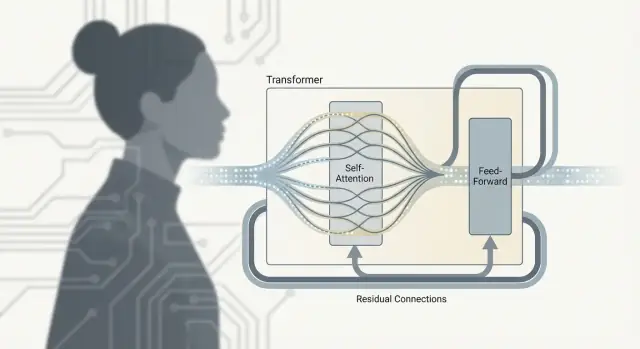
Why the Transformer Still Matters
A Transformer is a way to help computers understand sequences—things where order and context matter, like sentences, code, or a series of search queries. Instead of reading one token at a time and carrying a fragile memory forward, Transformers look across the whole sequence and decide what to pay attention to when interpreting each part.
That simple shift turned out to be a big deal. It’s a major reason modern large language models (LLMs) can hold onto context, follow instructions, write coherent paragraphs, and generate code that references earlier functions and variables.
Why you keep running into Transformers
If you’ve used a chatbot, a “summarize this” feature, semantic search, or a coding assistant, you’ve interacted with Transformer-based systems. The same core blueprint supports:
- Chat and customer support tools that track what you said earlier
- Search and recommendation systems that match meaning, not just keywords
- Summarization that can weigh what’s central vs. side detail
- Coding tools that connect definitions, usage, and intent across files
What you’ll learn in this article
We’ll break down the key parts—self-attention, multi-head attention, positional encoding, and the basic Transformer block—and explain why this design scales so well as models get larger.
We’ll also touch on modern variants that keep the same core idea but tweak it for speed, cost, or longer context windows.
What to expect (and what not to)
This is a high-level tour with plain-language explanations and minimal math. The goal is to build intuition: what the pieces do, why they work together, and how that translates into real product capabilities.
Noam Shazeer’s Role in the Transformer Story
Noam Shazeer is an AI researcher and engineer best known as one of the co-authors of the 2017 paper “Attention Is All You Need.” That paper introduced the Transformer architecture, which later became the foundation for many modern large language models (LLMs). Shazeer’s work sits within a team effort: the Transformer was created by a group of researchers at Google, and it’s important to credit it that way.
What the 2017 paper changed
Before the Transformer, many NLP systems relied on recurrent models that processed text step-by-step. The Transformer proposal showed that you could model sequences effectively without recurrence by using attention as the main mechanism for combining information across a sentence.
That shift mattered because it made training easier to parallelize (you can process many tokens at once), and it opened the door to scaling models and datasets in a way that quickly became practical for real products.
From research idea to product building block
Shazeer’s contribution—alongside the other authors—didn’t stay confined to academic benchmarks. The Transformer became a reusable module that teams could adapt: swap components, change the size, tune it for tasks, and later pretrain it at scale.
This is how many breakthroughs travel: a paper introduces a clean, general recipe; engineers refine it; companies operationalize it; and eventually it becomes a default choice for building language features.
Keeping credit precise
It’s accurate to say Shazeer was a key contributor and co-author of the Transformer paper. It’s not accurate to frame him as the sole inventor. The impact comes from the collective design—and from the many follow-on improvements the community built on top of that original blueprint.
What Came Before: RNNs, LSTMs, and Their Limits
Before Transformers, most sequence problems (translation, speech, text generation) were dominated by Recurrent Neural Networks (RNNs) and later LSTMs (Long Short-Term Memory networks). The big idea was simple: read text one token at a time, keep a running “memory” (a hidden state), and use that state to predict what comes next.
A quick picture of how they worked
An RNN processes a sentence like a chain. Each step updates the hidden state based on the current word and the previous hidden state. LSTMs improved this by adding gates that decide what to keep, forget, or output—making it easier to hold onto useful signals for longer.
Why long-range dependencies were hard
In practice, sequential memory has a bottleneck: a lot of information must be squeezed through a single state as the sentence gets longer. Even with LSTMs, signals from far earlier words can fade or get overwritten.
This made certain relationships difficult to learn reliably—like linking a pronoun to the correct noun many words back, or keeping track of a topic across multiple clauses.
Training and scaling challenges
RNNs and LSTMs are also slow to train because they can’t fully parallelize over time. You can batch across different sentences, but within one sentence, step 50 depends on step 49, which depends on step 48, and so on.
That step-by-step computation becomes a serious limitation when you want bigger models, more data, and faster experimentation.
The motivation for a more parallel-friendly approach
Researchers needed a design that could relate words to each other without marching strictly left-to-right during training—a way to model long-distance relationships directly and take better advantage of modern hardware. This pressure set the stage for the attention-first approach introduced in Attention Is All You Need.
Attention, Explained Without the Math
Attention is the model’s way of asking: “Which other words should I look at right now to understand this word?” Instead of reading a sentence strictly left to right and hoping the memory holds, attention lets the model peek at the most relevant parts of the sentence at the moment it needs them.
The “search and retrieve” idea
A helpful mental model is a tiny search engine running inside the sentence.
- Query: what the current word is looking for (the question)
- Keys: what each other word offers (the labels on potential matches)
- Values: the actual information to pull if there’s a match (the content)
So, the model forms a query for the current position, compares it to the keys of all positions, and then retrieves a blend of values.
Relevance scores → attention weights
Those comparisons produce relevance scores: rough “how related is this?” signals. The model then turns them into attention weights, which are proportions that add up to 1.
If one word is very relevant, it gets a larger share of the model’s focus. If several words matter, attention can spread across them.
A simple example (pronouns and grammar)
Take: “Maria told Jenna that she would call later.”
To interpret she, the model should look back at candidates like “Maria” and “Jenna.” Attention assigns higher weight to the name that best fits the context.
Or consider: “The keys to the cabinet are missing.” Attention helps link “are” to “keys” (the true subject), not “cabinet,” even though “cabinet” is closer. That’s the core benefit: attention links meaning across distance, on demand.
Self-Attention: The Core Mechanism
Self-attention is the idea that each token in a sequence can look at other tokens in that same sequence to decide what matters right now. Instead of processing words strictly left-to-right (as older recurrent models did), the Transformer lets every token gather clues from anywhere in the input.
Tokens attending to tokens
Imagine the sentence: “I poured the water into the cup because it was empty.” The word “it” should connect to “cup,” not “water.” With self-attention, the token for “it” assigns higher importance to tokens that help resolve its meaning (“cup,” “empty”) and lower importance to irrelevant ones.
How context is built
After self-attention, each token is no longer just itself. It becomes a context-aware version—a weighted blend of information from other tokens. You can think of it as each token creating a personalized summary of the whole sentence, tuned to what that token needs.
In practice, this means the representation for “cup” can carry signals from “poured,” “water,” and “empty,” while “empty” can pull in what it describes.
Why training can be parallel
Because each token can compute its attention over the full sequence at the same time, training doesn’t have to wait for previous tokens to be processed step-by-step. This parallel processing is a major reason Transformers train efficiently on large datasets and scale up to huge models.
Why it’s strong at long-range relationships
Self-attention makes it easier to connect distant parts of text. A token can directly focus on a relevant word far away—without passing information through a long chain of intermediate steps.
That direct path helps with tasks like coreference (“she,” “it,” “they”), keeping track of topics across paragraphs, and handling instructions that depend on earlier details.
Multi-Head Attention: Many Views of the Same Sentence
A single attention mechanism is powerful, but it can still feel like trying to understand a conversation by watching only one camera angle. Sentences often contain several relationships at once: who did what, what “it” refers to, which words set the tone, and what the overall topic is.
Why one attention view isn’t enough
When you read “The trophy didn’t fit in the suitcase because it was too small,” you may need to track multiple clues at the same time (grammar, meaning, and real-world context). One attention “view” might lock onto the closest noun; another might use the verb phrase to decide what “it” refers to.
What multiple heads do
Multi-head attention runs several attention calculations in parallel. Each “head” is encouraged to look at the sentence through a different lens—often described as different subspaces. In practice, that means heads can specialize in different patterns, such as:
- Local syntax (e.g., adjective → noun)
- Long-range links (e.g., subject ↔ verb across a clause)
- Coreference (e.g., pronoun → entity)
- Topical signals (words that set the subject or sentiment)
How the heads are combined
After each head produces its own set of insights, the model doesn’t choose just one. It concatenates the head outputs (stacking them side by side) and then projects them back into the model’s main “working space” with a learned linear layer.
Think of it as merging several partial notes into one clean summary the next layer can use. The result is a representation that can capture many relationships at once—one of the reasons Transformers work so well at scale.
Positional Encoding: Teaching the Model Word Order
Self-attention is great at spotting relationships—but by itself it doesn’t know who came first. If you shuffle the words in a sentence, a plain self-attention layer can treat the shuffled version as equally valid, because it compares tokens without any built-in sense of position.
Positional encoding solves this by injecting “where am I in the sequence?” information into the token representations. Once position is attached, attention can learn patterns like “the word right after not matters a lot” or “the subject usually appears before the verb” without having to infer order from scratch.
How positional encodings add order
The core idea is simple: each token embedding is combined with a position signal before it enters the Transformer block. That position signal can be thought of as an extra set of features that tag a token as 1st, 2nd, 3rd… in the input.
There are a few common approaches:
- Absolute (fixed) positions: Classic Transformers used deterministic, sinusoidal patterns. These don’t add new parameters and can generalize to lengths beyond what was seen during training (to a point).
- Learned absolute positions: The model learns a vector for “position 1,” “position 2,” etc. This can work very well, but it often ties the model to a maximum context window it was trained with.
- Relative positions: Instead of encoding “this is token 57,” the model focuses on distances like “this token is 3 steps before that one.” Modern variants (including rotary-style methods) often fall into this family.
Why it matters for long-context tasks
Positional choices can noticeably affect long-context modeling—things like summarizing a long report, tracking entities across many paragraphs, or retrieving a detail mentioned thousands of tokens earlier.
With long inputs, the model isn’t just learning language; it’s learning where to look. Relative and rotary-style schemes tend to make it easier to compare far-apart tokens and preserve patterns as context grows, while some absolute schemes can degrade more quickly when pushed beyond their training window.
In practice, positional encoding is one of those quiet design decisions that can shape whether an LLM feels sharp and consistent at 2,000 tokens—and still coherent at 100,000.
The Transformer Block: Attention + MLP + Stabilizers
A Transformer isn’t just “attention.” The real work happens inside a repeating unit—often called a Transformer block—that mixes information across tokens and then refines it. Stack many of these blocks and you get the depth that makes large language models so capable.
After attention: what the FFN/MLP does
Self-attention is the communication step: each token gathers context from other tokens.
The feed-forward network (FFN), also called an MLP, is the thinking step: it takes each token’s updated representation and runs the same small neural network on it independently.
In plain terms, the FFN transforms and reshapes what each token now knows, helping the model build richer features (like syntax patterns, facts, or style cues) after it has collected relevant context.
Why blocks alternate attention and FFN
The alternation matters because the two parts do different jobs:
- Attention moves information between tokens (who should influence whom)
- The FFN processes information within each token (how to convert that context into useful features)
Repeating this pattern lets the model gradually build higher-level meaning: communicate, compute, communicate again, compute again.
Residual connections: the “skip lanes”
Each sub-layer (attention or FFN) is wrapped with a residual connection: the input is added back to the output. This helps deep models train because gradients can flow through the “skip lane” even if a particular layer is still learning. It also lets a layer make small adjustments instead of having to relearn everything from scratch.
Layer normalization: keeping signals stable
Layer normalization is a stabilizer that keeps activations from drifting too large or too small as they pass through many layers. Think of it as keeping the volume level consistent so later layers don’t get overwhelmed or starved of signal—making training smoother and more reliable, especially at LLM scale.
Encoder–Decoder vs Decoder-Only: Which Powers LLMs?
The original Transformer in Attention Is All You Need was built for machine translation, where you convert one sequence (French) into another (English). That job naturally splits into two roles: reading the input well, and writing the output fluently.
Encoder–Decoder: “Read, then Write”
In an encoder–decoder Transformer, the encoder processes the entire input sentence at once and produces a rich set of representations. The decoder then generates the output one token at a time.
Crucially, the decoder doesn’t rely only on its own past tokens. It also uses cross-attention to look back at the encoder’s output, helping it stay grounded in the source text.
This setup is still excellent when you must tightly condition on an input—translation, summarization, or question answering with a specific passage.
Decoder-Only: One Model That Just Keeps Predicting
Most modern large language models are decoder-only. They’re trained to do a simple, powerful task: predict the next token.
To make that work, they use masked self-attention (often called causal attention). Each position can attend only to earlier tokens, not future ones, so generation stays consistent: the model writes left-to-right, continually extending the sequence.
This is dominant for LLMs because it’s straightforward to train on massive text corpora, it matches the generation use-case directly, and it scales efficiently with data and compute.
Where Encoder-Only Models Fit
Encoder-only Transformers (like BERT-style models) don’t generate text; they read the whole input bidirectionally. They’re great for classification, search, and embeddings—anything where understanding a piece of text matters more than producing a long continuation.
Why Transformers Scale Into Large Language Models
Transformers turned out to be unusually scale-friendly: if you give them more text, more compute, and bigger models, they tend to keep improving in a predictable way.
A big reason is structural simplicity. A Transformer is built from repeated blocks (self-attention + a small feed-forward network, plus normalization), and those blocks behave similarly whether you’re training on a million words or a trillion.
Parallel training is the hidden superpower
Earlier sequence models (like RNNs) had to process tokens one-by-one, which limits how much work you can do at once. Transformers, by contrast, can process all tokens in a sequence in parallel during training.
That makes them a great fit for GPUs/TPUs and large distributed setups—exactly what you need when training modern LLMs.
The “context window” and why it matters
The context window is the chunk of text the model can “see” at one time—your prompt plus any recent conversation or document text. A larger window lets the model connect ideas across more sentences or pages, keep track of constraints, and answer questions that depend on earlier details.
But context is not free.
The key constraint: attention cost grows with length
Self-attention compares tokens with each other. As the sequence gets longer, the number of comparisons grows quickly (roughly with the square of the sequence length).
That’s why very long context windows can be expensive in memory and compute, and why many modern efforts focus on making attention more efficient.
Scaling unlocked general-purpose behavior
When Transformers are trained at scale, they don’t just get better at one narrow task. They often start to show broad, flexible capabilities—summarizing, translating, writing, coding, and reasoning—because the same general learning machinery is applied across massive, varied data.
Modern Variants Built on the Same Blueprint
The original Transformer design is still the reference point, but most production LLMs are “Transformers plus”: small, practical edits that keep the core block (attention + MLP) while improving speed, stability, or context length.
Common improvements you’ll see
Many upgrades are less about changing what the model is and more about making it train and run better:
- Better positional methods: Alternatives to classic sinusoidal positions (often rotary or relative-style approaches) can make long-range text handling smoother.
- Attention optimizations: Implementations that reduce memory use and increase throughput (for example, fused kernels or more efficient attention calculations).
- Normalization tweaks: Variations in where and how normalization is applied can improve training stability and reduce sensitivity to hyperparameters.
These changes usually don’t alter the fundamental “Transformer-ness” of the model—they refine it.
Long-context approaches (high level)
Extending context from a few thousand tokens to tens or hundreds of thousands often relies on sparse attention (only attend to selected tokens) or efficient attention variants (approximate or restructure attention to cut computation).
The trade-off is typically a mix of accuracy, memory, and engineering complexity.
Mixture-of-Experts (MoE): more capacity without linear cost
MoE models add multiple “expert” sub-networks and route each token through only a subset. Conceptually: you get a larger brain, but you don’t activate all of it every time.
This can lower compute per token for a given parameter count, but it increases system complexity (routing, balancing experts, serving).
How to evaluate variant claims
When a model touts a new Transformer variant, ask for:
- Benchmarks relevant to your tasks (not just headline scores)
- Latency (time-to-first-token and tokens/sec)
- Cost (training and inference), including memory and hardware needs
Most improvements are real—but they’re rarely free.
What This Means for Teams Building with LLMs
Transformer ideas like self-attention and scaling are fascinating—but product teams mostly feel them as trade-offs: how much text you can feed in, how quickly you get an answer back, and what it costs per request.
Choosing a model or provider: the four trade-offs
Context length: Longer context lets you include more documents, chat history, and instructions. It also increases token spend and can slow responses. If your feature relies on “read these 30 pages and answer,” prioritize context length.
Latency: User-facing chat and copilot experiences live or die on response time. Streaming output helps, but model choice, region, and batching also matter.
Cost: Pricing is usually per token (input + output). A model that’s 10% “better” may be 2–5× the cost. Use pricing-style comparisons to decide what quality level is worth paying for.
Quality: Define it for your use case: factual accuracy, instruction-following, tone, tool-use, or code. Evaluate with real examples from your domain, not generic benchmarks.
When embeddings beat generation
If you mainly need search, deduplication, clustering, recommendations, or “find similar”, embeddings (often encoder-style models) are typically cheaper, faster, and more stable than prompting a chat model. Use generation only for the final step (summaries, explanations, drafting) after retrieval.
For a deeper breakdown, link your team to a technical explainer like /blog/embeddings-vs-generation.
Where this shows up in real shipping workflows
When you turn Transformer capabilities into a product, the hard part is usually less about the architecture and more about the workflow around it: prompt iteration, grounding, evaluation, and safe deployment.
One practical route is using a vibe-coding platform like Koder.ai to prototype and ship LLM-backed features faster: you can describe the web app, backend endpoints, and data model in chat, iterate in planning mode, and then export source code or deploy with hosting, custom domains, and rollback via snapshots. That’s especially useful when you’re experimenting with retrieval, embeddings, or tool-calling loops and want tight iteration cycles without rebuilding the same scaffolding each time.
A practical adoption checklist
- Write a one-page spec: user goal, failure modes, and what “good” looks like.
- Decide what must be grounded in your data (RAG, citations, or tool calls).
- Set budgets for tokens, latency, and monthly spend; measure them in staging.
- Add safety rails: refusals, redaction, and “I don’t know” behavior.
- Build evaluation early: golden prompts, regression tests, and human review.
- Plan for model swaps: keep prompts and routing configurable.
FAQ
What is a Transformer in plain language?
A Transformer is a neural network architecture for sequence data that uses self-attention to relate every token to every other token in the same input.
Instead of carrying information step-by-step (like RNNs/LSTMs), it builds context by deciding what to pay attention to across the whole sequence, which improves long-range understanding and makes training more parallel-friendly.
Why did Transformers replace RNNs and LSTMs for many NLP tasks?
RNNs and LSTMs process text one token at a time, which makes training harder to parallelize and creates a bottleneck for long-range dependencies.
Transformers use attention to connect distant tokens directly, and they can compute many token-to-token interactions in parallel during training—making them faster to scale with more data and compute.
What is “attention” and how should I think about it?
Attention is a mechanism for answering: “Which other tokens matter most for understanding this token right now?”
You can think of it like in-sentence retrieval:
- a query asks what information is needed
- keys represent what each token offers
- values are the information that gets mixed together
The output is a weighted blend of relevant tokens, giving each position a context-aware representation.
What’s the difference between attention and self-attention?
Self-attention means the tokens in a sequence attend to other tokens in the same sequence.
It’s the core tool that lets a model resolve things like coreference (e.g., what “it” refers to), subject–verb relationships across clauses, and dependencies that appear far apart in the text—without pushing everything through a single recurrent “memory.”
Why do Transformers use multi-head attention?
Multi-head attention runs multiple attention calculations in parallel, and each head can specialize in different patterns.
In practice, different heads often focus on different relationships (syntax, long-range links, pronoun resolution, topical cues). The model then combines these views so it can represent several kinds of structure at once.
If attention looks at everything, how does the model know word order?
Self-attention alone doesn’t inherently know token order—without position information, word shuffles can look similar.
Positional encodings inject order signals into token representations so the model can learn patterns like “what comes right after not matters” or typical subject-before-verb structure.
Common options include sinusoidal (fixed), learned absolute positions, and relative/rotary-style methods.
What’s inside a Transformer block besides attention?
A Transformer block typically combines:
- Attention: moves information between tokens
- FFN/MLP: processes information within each token
- Residual connections: help gradients flow and let layers make incremental edits
- Layer normalization: stabilizes activations for deep stacks
Stacking many blocks yields the depth that enables richer features and stronger behavior at scale.
Encoder–decoder vs decoder-only: which one do LLMs use?
The original Transformer is encoder–decoder:
- the encoder reads the input bidirectionally
- the decoder generates output while using cross-attention to the encoder
Most LLMs today are decoder-only models trained to predict the next token using causal (masked) self-attention, which matches left-to-right generation and scales well on large corpora.
What was Noam Shazeer’s role in the Transformer’s creation?
Noam Shazeer was a co-author on the 2017 paper “Attention Is All You Need,” which introduced the Transformer.
It’s accurate to credit him as a key contributor, but the architecture was created by a team at Google, and its impact also comes from many later community and industry improvements built on that original blueprint.
Why are long context windows expensive, and what can teams do about it?
For long inputs, standard self-attention becomes expensive because comparisons grow roughly with the square of sequence length, impacting memory and compute.
Practical ways teams handle this include:
- choosing models with larger native context windows
- using RAG (retrieve relevant chunks instead of stuffing everything in)
- adopting long-context variants (often sparse/efficient attention)
- measuring trade-offs: latency, token cost, and task accuracy on real workloads