

PayPal’s Defensible Layer: Payments, Risk, and Merchant Networks
Learn how PayPal combines checkout, risk systems, disputes, and a two‑sided merchant network to build trust and a defensible layer for online commerce.
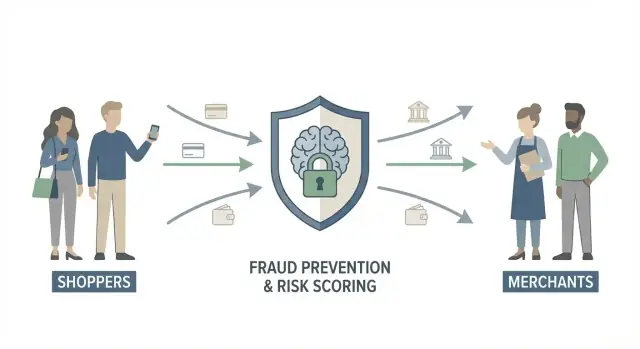
What a “financial layer” really means
When people call PayPal a “financial layer for the internet,” they mean something straightforward: an always-on set of services that helps money move between buyers, sellers, and banks—reliably, quickly, and with enough trust that strangers will complete a transaction.
It’s not just a button on a checkout page. It’s a bundled system: online payment processing, identity and account handling, risk management systems, and the policies and workflows that make transactions feel safe for both sides.
A plain-English definition
A “financial layer” sits between an ecommerce store and the traditional financial system. It helps:
- Consumers pay without re-entering card details everywhere (digital wallets)
- Merchants accept more payment types with less setup
- Both sides handle failures, fraud prevention, and disputes when something goes wrong
When it works well, customers get a fast, familiar checkout. Merchants see fewer abandoned carts and spend less time on payment operations.
Trust, speed, and acceptance beat “more features”
Payments are emotional. Shoppers want confidence they won’t be scammed, and merchants want confidence they’ll actually get paid. In ecommerce, trust is shaped by:
- Speed: authorization and confirmation happen quickly
- Acceptance: it works across many stores, countries, and devices
- Protection: clear handling of fraud, refunds, chargebacks, and disputes
In practice, reducing uncertainty at the moment a buyer is about to click “Pay” matters more than a long feature checklist.
Why payments aren’t typical software
Most software can fail gracefully. Payments usually can’t. A checkout outage immediately becomes lost revenue, and a small increase in fraud can erase margins.
Payment products also depend on external partners—banks, card networks, regulators—so reliability and compliance are part of the core product, not a bolt-on.
What defensibility looks like (without hype)
In payments, defensibility often comes from being hard to replace because you’re embedded in financial workflows: merchants rely on stable conversion, consumers recognize the brand, and risk systems improve as they see more real-world activity. That stickiness is less about novelty and more about consistent checkout outcomes.
How online payments work end to end
Online payments feel instantaneous, but they’re really a coordinated exchange of messages between several parties—each with its own incentives, rules, and failure modes. Understanding that chain makes it clearer why payments can create both friction and risk.
The main actors in a typical checkout
At minimum, a card-style payment involves:
- Shopper: initiates the purchase
- Merchant: sells goods/services and wants certainty the payment will clear
- Issuer: the shopper’s bank (or card issuer) that decides whether to approve
- Acquirer: the merchant’s bank/payment processor that routes the transaction
- Card networks: e.g., Visa/Mastercard rails that carry authorization and settlement messages
- Wallet (optional): a layer like PayPal that can store credentials, add identity signals, and manage funding sources
The key moments: from “Pay” to money in the merchant’s account
-
Authentication: Proving the shopper is who they claim to be (passwords, device signals, 3DS challenges, wallet login). This reduces fraud, but too much friction can lower conversion.
-
Authorization: The merchant (via an acquirer/processor) asks the issuer, “Should we approve this amount?” The issuer checks available funds/credit, fraud models, and account status, then returns approve/decline.
-
Capture: The merchant “captures” the authorized amount (immediately or later, e.g., after shipping). Capturing turns the authorization into a request to actually collect funds.
-
Settlement: Funds move through the rails and net out between banks. Timing varies by method; “instant” at checkout doesn’t mean instant settlement.
Where PayPal sits vs cards and bank transfers
With cards, PayPal can act as the checkout layer: the shopper authenticates with PayPal, and PayPal routes payment over underlying rails (cards, bank debit/ACH, balance). With bank transfers, PayPal may initiate bank funding but still handles identity, risk screening, and merchant-facing confirmation.
Why multiple parties create friction and risk
Every handoff is a chance for mismatched data, delayed signals, or conflicting fraud rules. A payment can be authorized but later disputed, or approved but never captured. Each participant sees only part of the picture—creating gaps that fraudsters exploit and honest shoppers experience as declines or extra verification.
PayPal’s checkout value for consumers and merchants
Checkout is where trust and convenience either convert a sale or lose it. PayPal’s value is that it compresses the work a buyer has to do—and the uncertainty a merchant has to tolerate—into a familiar flow.
Multiple funding sources, one decision
For consumers, PayPal can sit on top of several “funding sources”:
- A PayPal wallet balance
- A linked bank account
- One or more saved debit/credit cards
At checkout, the buyer typically chooses PayPal once, then PayPal handles the underlying method selection and routing. That reduces mental overhead (which card to use, whether it will work, whether a bank transfer will clear quickly enough).
Tokenization and stored credentials (in plain terms)
A key convenience driver is that payment details don’t need to be retyped for every purchase. Instead, PayPal can rely on stored credentials and tokenization.
Conceptually, tokenization means the merchant doesn’t have to handle raw card numbers during checkout. A “token” stands in for sensitive data, so the merchant can initiate payment without exposing full details in their own systems. That lowers friction for consumers and reduces the merchant’s operational burden around sensitive data handling.
One‑touch checkout and less re-entry
Features like one‑touch checkout aim to minimize repeated steps: fewer form fields, fewer passwords, fewer chances to abandon the cart. Even small reductions in re-entry matter on mobile, where typing is slower and interruptions are common.
Why convenience translates into conversion
For merchants, the benefit is not just “another payment option.” It’s a shorter path from intent to purchase. When customers recognize the PayPal button, can pay quickly, and don’t need to share card details with every store, more of them finish the order—often improving checkout conversion while reducing the support burden tied to failed payments.
The risk problem every payment system must solve
Every online payment system has two jobs that constantly conflict: make checkout frictionless for real customers, and stop the small slice of transactions that are trying to steal money.
Unlike in-person commerce, online payments usually don’t include the strongest signals of legitimacy: a physical card, a chip read, a PIN, or a face-to-face interaction. Instead, the “buyer” is a set of digital clues—device details, account history, shipping patterns, and how the checkout session behaves. That makes the internet a higher-noise environment where attackers can test thousands of variations cheaply.
Why online fraud looks different
Fraud online is scalable and remote. Criminals can automate attempts, hide behind bot networks, and rotate identities quickly. Merchants also face a delayed feedback loop: a transaction can look fine today and turn into a chargeback weeks later.
Common patterns include:
- Account takeover (ATO): a real user’s PayPal or merchant account is hijacked, then used for purchases or cash-outs
- Stolen card usage: card details are used without consent, often paired with “tested” devices and addresses
- Friendly fraud: the buyer claims they didn’t authorize the purchase (or says an item never arrived) even when they did
Why “perfect fraud prevention” doesn’t exist
Risk isn’t binary; it’s probability under uncertainty. Some legitimate customers will look unusual (traveling, new device, unusual cart), and some bad actors will mimic normal behavior.
That leads to the central tradeoff: block too aggressively and you lose good sales (and annoy customers); approve too liberally and you absorb losses through fraud, disputes, and operational costs. The best payment platforms try to find the moving “sweet spot” where approval rates stay high while loss rates remain acceptable.
How risk systems decide: signals, scoring, and tradeoffs
Every payment network has the same core job at checkout: approve good transactions quickly and stop bad ones without frustrating real customers. PayPal’s risk management systems try to do this in real time, often in the few seconds between “Pay now” and “Order confirmed.”
The signals behind a decision
A single transaction may look simple, but risk models can draw on many lightweight clues:
- Device signals: browser and OS details, device IDs, whether the device is new or familiar for this account
- Behavior signals: typing speed, navigation patterns, checkout “hesitation,” and sudden changes from normal purchasing habits
- Account and transaction history: past successful purchases, prior disputes, funding source patterns, and how long the account has been active
- Location signals: IP and GPS patterns (when available), distance from usual locations, and mismatch between shipping, billing, and device location
- Network patterns: connections across merchants, emails, cards, devices, and shipping addresses that may indicate coordinated fraud
No single signal “proves” fraud. The goal is to combine many imperfect clues into a confident decision.
What happens at checkout (high level)
At the moment of payment, the system typically:
- Collects signals from the session and the transaction details
- Assigns a risk score or category (safe, review, block) based on learned patterns
- Chooses an action: approve, decline, request a step-up check (like a confirmation), or route for additional review
The tradeoff: false positives vs. false negatives
- A false positive blocks a legitimate buyer. That hurts conversion and customer trust.
- A false negative approves a fraudulent purchase. That increases losses, disputes, and long-term merchant risk.
Risk teams constantly tune where to draw the line. Tightening rules can reduce loss rates but also lower approval rates and add friction. Loosening rules can boost conversion but may increase chargebacks and operational costs.
For merchants, the best risk outcomes aren’t just “less fraud.” They’re the right balance of approval rate, loss rate, and a smooth customer experience—because each one affects revenue in a different way.
Disputes, chargebacks, and why they shape trust
Disputes are the stress test for any payment experience. Checkout is the happy path; disputes show what happens when something goes wrong—an item doesn’t arrive, a cardholder doesn’t recognize a charge, or a buyer claims the product wasn’t as described. How a platform handles that moment heavily influences whether customers feel safe paying again and whether merchants feel safe selling.
What happens after a complaint or chargeback
A buyer might first file a complaint directly in the wallet or payment platform. If it can’t be resolved, the buyer (or cardholder) may escalate through their card issuer, triggering a chargeback. Chargebacks are costly: they can reverse revenue, add fees, and increase a merchant’s risk profile.
Dispute workflow: evidence, timelines, outcomes
While details vary by payment method and region, the flow is generally:
- Case opened: the buyer submits a claim (non-receipt, unauthorized, not-as-described, etc.)
- Merchant response window: the merchant is asked for evidence—tracking numbers, delivery confirmation, order notes, customer messages, refund history, and policies
- Review and decision: the platform and/or the card network evaluates evidence against rules and deadlines
- Outcome: refund to the buyer, seller protection (merchant keeps funds), or a partial/negotiated resolution
Timing matters. Fast, clear notifications and structured evidence collection can be the difference between a recoverable case and an automatic loss due to missed deadlines.
Why dispute handling is product quality
For merchants, the dispute experience affects cash flow predictability, support workload, and the ability to scale. For buyers, it determines whether “trust in ecommerce” feels real.
How better resolution reinforces trust
When resolution is transparent, consistent, and responsive, buyers feel safer purchasing and merchants feel the rules are understandable—both of which increases long-term willingness to transact.
Merchant networks and defensibility: the two-sided effect
Payment networks are two-sided: they only feel “inevitable” when both buyers and merchants show up. PayPal’s defensibility isn’t just about processing payments—it’s about being widely accepted and repeatedly used, which reinforces itself over time.
The two-sided loop
When more consumers have PayPal accounts (and trust them), merchants see a clear reason to add PayPal at checkout. Once many merchants accept PayPal, consumers get more value from keeping PayPal enabled—because it works in more places. That loop can compound quietly: the network becomes a default choice rather than an actively reconsidered one.
Why “acceptance” becomes a moat
Acceptance is a kind of distribution. A checkout method that’s embedded across thousands of sites earns “top-of-mind” placement on checkout pages and in payment settings. For shoppers, seeing a familiar button reduces hesitation. For merchants, a widely recognized option can feel like table stakes—especially if competitors already offer it.
Saved accounts and repeat purchasing loops
The strongest network effects show up in repeat behavior. When a shopper has a saved PayPal account, the next purchase can take fewer steps. Fewer steps often means fewer drop-offs. That creates a reinforcement loop: merchants keep PayPal because it converts; shoppers keep using PayPal because it’s convenient.
This also applies beyond the button itself: stored preferences, recurring payments, and quick re-authentication can all increase the stickiness of the experience.
Limits to network effects
Network effects aren’t unlimited. Acceptance can be uneven by:
- Geography: local bank transfers or domestic wallets may dominate
- Category: some verticals prioritize other methods (e.g., BNPL, invoicing, or card-on-file)
- Merchant size: large enterprises may negotiate custom stacks and promote their own preferred options
So the moat is real, but it’s strongest where PayPal is already common, trusted, and prominently offered at checkout.
Scale advantages: learning loops in payments and risk
Scale matters in payments for a simple reason: every transaction is both a business event and a new piece of evidence. When a system processes more checkouts across more merchants, countries, devices, and use cases, it sees a wider variety of “normal” behavior—and a wider variety of attacks. That variety helps risk models generalize rather than overfitting to one store or one fraud trend.
Why more volume can mean lower fraud cost
Fraud is often measured as losses per dollar processed. At small volumes, a handful of successful scams can meaningfully raise your loss rate. At large volumes, two things tend to happen conceptually:
- Patterns are detected earlier (fewer bad transactions slip through before a rule/model is updated)
- Each improvement spreads across a larger base, lowering the average loss per transaction over time
This doesn’t mean “big” automatically equals “safe.” It means that when detection improves, the savings compound because they apply broadly.
Data isn’t the moat—feedback loops are
Raw transaction data is useful, but it’s not sufficient on its own. What strengthens risk performance is a fast feedback loop:
- A transaction is approved or declined
- Later signals arrive (authentication outcomes, delivery outcomes, disputes, chargebacks, confirmed fraud)
- Models and rules are updated based on what was actually good or bad
The speed and quality of outcomes matter. If outcomes are delayed, mislabeled, or disconnected from the original payment context, learning slows and mistakes persist.
Operational scale: the less-visible advantage
Beyond algorithms, scale enables the human and process layer around risk:
- 24/7 monitoring to spot spikes in attacks or merchant-specific anomalies
- Continuous rules tuning (tightening during active fraud waves, loosening when false declines rise)
- Specialized support and review processes that resolve edge cases without blocking legitimate customers
When these loops run well, customers see fewer frustrating declines, merchants see fewer losses, and the checkout experience becomes more trustworthy.
Integrations and switching costs for merchants
For most merchants, payments aren’t a “choose once” decision—they’re embedded into everything that touches an order: the cart, the confirmation email, the accounting export, and the support workflow. That’s why integrations matter as much as pricing.
When PayPal is available as an API, a hosted checkout, and a pre-built plugin, it lowers time-to-launch and becomes part of the store’s day-to-day operations.
Distribution through platforms (not just direct sales)
A large share of adoption happens inside ecosystems: ecommerce platforms, website builders, marketplaces, subscription tools, and POS providers. If PayPal is a default option in those environments—already vetted, already supported, already in the “payments” settings—merchants are more likely to turn it on early and keep it on.
Defaults matter because merchants optimize for speed and certainty. A one-click integration reduces developer work, avoids custom maintenance, and makes it easier to follow platform updates without breaking checkout.
What makes switching expensive
Replacing a payment provider can look simple (“just swap the button”), but the real cost shows up in operations:
- Retraining and procedures: staff learn new dashboards, refunds, payout timing, and support flows
- Reconciliation changes: settlement reports, payout descriptors, and accounting mappings often need to be rebuilt
- Dispute operations: evidence templates, response deadlines, and the internal playbook for chargebacks must be updated
Reliability and reporting reduce the urge to switch
When a provider is consistently available and reporting is easy to audit—transaction details, fees, refunds, and payout tracking—merchants feel less pressure to “try something new.” Stability turns payments into background infrastructure, which is exactly where merchants want it.
Building payment tooling faster (where Koder.ai can help)
Even if you’re not a payment provider, you still end up building software around payments: reconciliation dashboards, dispute evidence collection, internal admin panels, or experimentation tooling for checkout conversion.
Platforms like Koder.ai can be useful here because they let teams prototype and ship these “payments-adjacent” apps via a chat-driven workflow—often faster than starting from scratch—while still producing real code (commonly React on the frontend and Go + PostgreSQL on the backend) that you can export and maintain.
Compliance and regulation: necessary, not optional
Payments aren’t just software. They sit inside a regulated system designed to reduce crime, protect consumers, and keep money moving safely. For a provider like PayPal, compliance is a core part of the product—because without it, you can’t reliably offer accounts, move funds, or support merchants at scale.
Regulatory expectations (KYC/AML in plain English)
Two common requirements are:
- KYC (Know Your Customer): verifying who is using the service (for both consumers and businesses). That can include identity checks, business ownership verification, and ongoing account reviews.
- AML (Anti–Money Laundering): monitoring for suspicious activity—unusual transaction patterns, risky counterparties, or behavior that looks like fraud, laundering, or sanctions evasion.
These checks are not one-time hurdles. As transaction volume grows, the monitoring, documentation, and escalation processes must grow with it.
Privacy and data handling (non-legal overview)
Compliance often requires collecting and retaining sensitive data. That increases responsibility: strict access controls, audit trails, secure storage, and careful sharing with banks, card networks, and regulators. Privacy rules can also limit how data is reused internally, shaping how risk and marketing teams operate.
Why compliance creates fixed costs
Even before you process a single payment, you need trained teams, tooling, vendor relationships, policies, reporting, and incident response. Those fixed costs make “starting a payments company” expensive, and mistakes can lead to fines, forced remediation, or loss of key partnerships.
Barriers—without guarantees
Regulation can raise the barrier to entry, but it doesn’t guarantee success. You still need a great checkout experience, strong fraud prevention, and merchant trust. Compliance is table stakes: necessary to compete, not sufficient to win.
Measuring impact: what merchants should track
Payments can feel like a utility—until a small change moves revenue. The right way to judge any checkout option (including PayPal payments) is to track a few metrics consistently, then compare performance by device, geography, and customer type (new vs. returning).
Key merchant metrics
Start with a simple funnel view:
- Authorization rate: of all attempted card/wallet payments, what percentage get approved by issuers? A 1–2 point lift can be meaningful at scale.
- Checkout conversion: completed orders divided by checkout starts. Separate “payment method shown” from “payment method used” if you can.
- Fraud rate: confirmed fraud orders as a share of total orders or total payment volume. Track both attempted and successful fraud when possible.
- Chargebacks and disputes: monitor count and rate, plus win rate and time to resolution.
Cost drivers to quantify
Headline processing fees are only one part of cost. Build a “true cost per order” view that includes:
- Processing fees (blended rate by payment type)
- Loss rates (fraud losses, dispute losses, refunds that can’t be recovered)
- Operational overhead (support tickets, manual review hours, time spent compiling evidence)
Evaluating a payment partner beyond pricing
Compare partners on approval lift, conversion impact, dispute tooling, reporting quality, and how clearly they explain declines and risk decisions. A slightly higher fee can be cheaper if it increases approvals or reduces dispute losses.
Onboarding questions to ask
Ask upfront:
- What reporting do we get for declines (reason codes, issuer vs. risk declines)?
- How are disputes handled—what evidence is needed, and what’s the typical win rate?
- Can we A/B test payment methods and measure conversion/authorization changes?
- What controls do we have (3DS settings, fraud rules), and what’s managed for us?
- What are the settlement timelines, reserves, and rolling holds (if any)?
What could weaken or strengthen the moat over time
PayPal’s moat isn’t a single feature—it’s a set of advantages that reinforce each other: checkout familiarity, merchant acceptance, and risk controls that keep loss rates low without blocking good customers. Over time, that flywheel can either compound or erode depending on how the market changes.
New threats to watch
Fraud is an arms race. As scammers adopt AI-generated identities, faster account takeovers, and more convincing friendly-fraud narratives, any checkout brand must prove it can keep approvals high without letting losses spike. If fraud innovation outpaces detection, merchants may see higher dispute costs and lower net conversion.
Payment methods are also fragmenting. More wallets, bank-to-bank options, and “super-app” checkouts can reduce the share of transactions where PayPal is the default. Platform power matters too: marketplaces, app stores, and large commerce platforms can steer users toward native payment rails, limiting where PayPal can sit in the flow.
Where the moat can strengthen
Better identity is the clearest lever. Stronger account verification (without adding friction) makes it easier to approve more legitimate buyers while stopping stolen credentials and synthetic identities. Smarter risk models—using more signals and carefully managing false positives—can directly improve the metric merchants care about: successful, profitable sales.
Cross-border is another opportunity. Smoother currency handling, clearer fees, localized payment options, and better dispute handling across countries can make PayPal more valuable for merchants selling internationally—especially smaller businesses that can’t build those capabilities themselves.
If consumer habits shift
If shoppers move away from stored-wallet checkout toward bank-based payments or device-native methods, defensibility looks different. The moat would depend less on the PayPal button and more on risk infrastructure, merchant tooling, and being available wherever consumers already are (platform checkouts, subscriptions, invoicing, recurring billing).
Practical takeaways for merchants
When choosing a payment stack, focus on outcomes—not brand narratives. Track checkout conversion, authorization rate, dispute/chargeback rate, and net revenue after fees and losses. Run A/B tests where possible, keep an exit plan (portable tokens, clean reporting, documented integrations), and diversify providers if concentration risk is high.
If you’re building internal systems to measure those outcomes—dashboards, ops tooling, or experiment frameworks—tools like Koder.ai can help you move faster from idea to working app, with features like planning mode, snapshots, and rollback that are useful when shipping changes tied to revenue-critical checkout flows.
FAQ
What does it mean to call PayPal a “financial layer for the internet”?
A “financial layer” is the always-on infrastructure between an online store and the traditional financial system. It helps customers pay easily, helps merchants accept payments reliably, and handles the messy parts like authentication, fraud screening, disputes, and settlement timing.
Why are trust and speed more important than having lots of payment features?
Because the buyer is deciding in seconds whether the checkout feels safe and familiar. Faster authorization, broad acceptance, and clear buyer/seller protections reduce hesitation at the exact moment someone is about to click “Pay,” which often matters more than extra features.
Why aren’t payments like typical software products?
Payments have hard failure modes: a checkout outage instantly becomes lost revenue, and small fraud increases can wipe out margin. They also rely on banks, card networks, and regulations, so reliability and compliance are part of the product—not optional add-ons.
Who are the main actors in an online card payment?
A typical card-style checkout involves:
- Shopper (initiates purchase)
- Merchant (requests payment)
- Issuer (shopper’s bank approves/declines)
- Acquirer/processor (routes the transaction for the merchant)
- Card networks (carry authorization/settlement messages)
- Optional wallet (e.g., PayPal) that adds identity, stored credentials, and risk controls
What are the steps from clicking “Pay” to the merchant receiving money?
Generally:
- Authentication: prove the user is who they claim to be (login, device signals, 3DS).
- Authorization: issuer approves or declines the requested amount.
- Capture: merchant confirms they want to collect the authorized funds (immediate or later).
- Settlement: money moves and nets out between financial institutions.
“Instant checkout” usually refers to authorization, not necessarily settlement.
Where does PayPal sit compared with cards and bank transfers?
PayPal can sit on top of underlying rails (cards, bank debit/ACH, wallet balance). The shopper authenticates with PayPal, and PayPal handles credential storage, risk screening, and confirmation to the merchant while funding the payment via the chosen source behind the scenes.
What is tokenization and why does it matter for merchants?
Tokenization means the merchant doesn’t need to store or handle raw card numbers during checkout. Instead, a token stands in for sensitive data, which can reduce exposure, lower compliance burden, and make repeat purchases smoother for customers.
What kinds of fraud are most common in online payments?
Common types include:
- Account takeover (ATO): hijacking a real account to make purchases or cash out.
- Stolen card usage: using compromised card data with optimized devices/addresses.
- Friendly fraud: a buyer disputes a legitimate purchase (e.g., “unauthorized” or “item not received”).
Online fraud scales because attackers can automate attempts and feedback can arrive weeks later via chargebacks.
How do payment risk systems decide whether to approve or block a transaction?
Risk decisions combine many imperfect signals into a score/action in seconds, such as:
- device and login history
- behavior patterns during checkout
- prior disputes and transaction history
- location mismatches
- network connections across emails, cards, and addresses
Platforms constantly balance false positives (blocking good buyers) vs false negatives (approving fraud).
What metrics should merchants use to evaluate PayPal (or any payment option)?
Track outcomes, not just fees:
- Authorization rate (issuer approvals)
- Checkout conversion (starts → completed orders)
- Fraud rate (attempted and successful)
- Dispute/chargeback rate, win rate, and time to resolution
- True cost per order (processing fees + losses + operational overhead)
Segment results by device, geography, and new vs returning customers to spot where performance changes.