

How PDD Built a Social Commerce Growth Loop with Price Discovery
A practical breakdown of how PDD used group buying, sharing incentives, and price discovery to create a repeatable growth loop—and what marketers can learn.
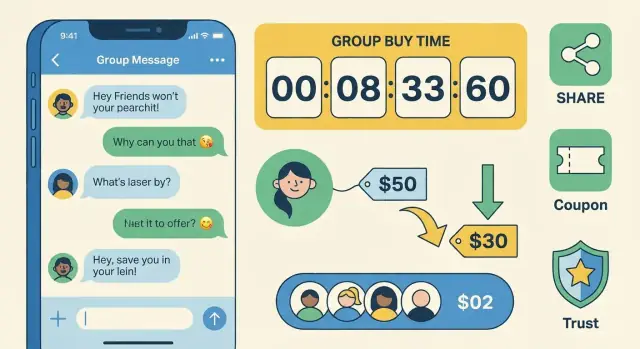
What PDD Is and Why Its Model Matters
PDD (Pinduoduo) is a Chinese e-commerce platform that grew by serving shoppers who wanted everyday goods at noticeably lower prices—often people outside the biggest, wealthiest cities, and families who were highly price-sensitive. Early on, it wasn’t trying to out-Amazon Amazon. It focused on making shopping feel like a shared activity with a clear payoff: “Bring others, pay less.”
Social commerce, explained simply
“Social commerce” means shopping designed to spread through social interactions. Instead of a store hoping you return on your own, the product page nudges you to involve other people—friends, relatives, coworkers, group chats—so the purchase travels through conversations.
For PDD, that wasn’t a side feature. Sharing was part of the checkout logic. The act of buying could naturally create the next buyer.
Price discovery, in plain terms
“Price discovery” is how buyers and sellers learn what the real acceptable price is.
- For shoppers, it’s finding a deal that feels “worth it” without guessing or overpaying.
- For sellers, it’s seeing how demand changes as the price changes—what moves volume, what stalls, and which products become repeat buys.
PDD made discounts dynamic and measurable by tying them to group formation, promotions, and demand signals.
The simple growth loop preview
The core loop looks like this: share → a group forms → the price drops → more people feel confident buying → they share again.
That loop matters because it blends marketing and purchasing into one motion, turning a discount into both a conversion tool and a feedback system about demand.
The Customer Problem PDD Solved First
PDD didn’t start by asking people to change how they shop. It started by recognizing why many people couldn’t shop the way big e-commerce platforms assumed.
The core pain: price sensitivity and limited retail access
A huge slice of consumers in lower-tier cities and rural areas were intensely price-sensitive and had fewer convenient retail options. Offline stores often meant limited selection, weaker price competition, and time-consuming trips. Online marketplaces existed, but “cheap” online wasn’t always cheap enough to justify uncertainty around delivery, quality, and returns.
PDD’s first win was making value feel immediate and obvious: a single product page that clearly framed “normal price” versus “group price,” with a concrete path to unlock the better deal.
Why “shopping with friends” reduces hesitation
For a cautious buyer, purchasing alone carries all the risk—wasting money, choosing the wrong item, or feeling fooled. Group buying reframed the decision as shared: “If others are joining, this might be legit,” and “I’m not the only one chasing this deal.” Social proof lowered hesitation, especially for inexpensive everyday goods where saving a few yuan still matters.
Mobile-first behavior enabled fast sharing
PDD was built around the reality that many users lived on their phones and communicated through messaging apps all day. Inviting others didn’t require learning a new behavior; it fit existing chat habits, making “forming a group” feel as simple as forwarding a message.
What made the offer worth inviting others
The invitation wasn’t just “help me.” It was a tangible, self-interested offer: join this group and you also get the discount. That symmetry—everyone benefits—made sharing feel natural rather than awkward, turning price sensitivity into a social action.
Group Buying Mechanics: Turning Demand into Distribution
PDD’s core trick wasn’t just “discounts for groups.” It was a checkout flow designed to require sharing to reach the best price—so distribution was built into the purchase.
How the deal flow works
A typical group deal has three steps:
- Start a group: A shopper sees two prices—buy solo now, or start a group for less.
- Invite others to join: After choosing the group price, the app immediately prompts the buyer to share the deal to friends or group chats.
- Unlock the price: When enough people join within the time window, everyone gets the lower price (and the order proceeds automatically).
That “invite → join → unlock” sequence turns a private intent (“I want this”) into a public action (“Help me complete this deal”).
Why it turns buyers into distributors
Most referral programs feel like extra work. PDD makes sharing the shortest path to the best outcome: a lower price right now. The buyer isn’t promoting a brand for points; they’re trying to complete their own purchase. Each shopper becomes a temporary salesperson with a clear script: “Join my group so we both pay less.”
Urgency without overhyping
Timers and limited slots add pressure, but the effective version is practical rather than sensational:
- A clear countdown nudges quick sharing.
- A visible “1 spot left” reduces procrastination.
- Fast feedback (“Your group is 2/3 complete”) keeps people engaged.
Urgency works best when it’s transparent and consistent—so users trust the rules won’t change mid-deal.
Where group buying fits best
Group buying is strongest for low-consideration, repeatable items: snacks, household supplies, small accessories, everyday apparel basics. These products are easy to recommend, easy to decide on in a chat, and cheap enough that friends will join without deep research.
It’s much weaker for high-risk, high-price purchases where buyers need time, specs, and confidence.
Built-In Sharing: The Social Graph as a Sales Channel
PDD didn’t treat sharing as an optional “invite a friend” widget. It made sharing feel like a normal part of checkout—because the best price often required it.
Sharing is embedded in the purchase flow
On many products, the interface naturally offers two paths: buy now at a higher price, or unlock the lower group price by sharing. That framing matters. Sharing isn’t a marketing task; it’s the practical step to get the deal.
Social proof reduces perceived risk
When you see that friends (or people in your chat group) have already joined, uncertainty drops. For low-priced, unfamiliar brands, that reassurance is huge. The “others are buying this too” signal acts like a lightweight trust layer—especially when product quality may be uneven.
Lightweight channels win: fast, familiar, low effort
PDD’s sharing works best in places people already use all day:
- Chat apps and group chats (where decisions are made in real time)
- Contact lists (one-tap reach to likely participants)
- QR codes (easy sharing offline or across devices)
The point isn’t novelty. It’s minimizing friction between “I want this deal” and “I’ve asked others to join.”
Repeated sharing builds habit, not just referrals
Because group buying can happen frequently—daily, even—sharing becomes routine. Users learn a simple loop: spot a bargain, drop it in a chat, wait for one or two joins, purchase.
That repetition turns sharing from a one-off referral event into a behavioral default, effectively converting the social graph into a consistent distribution channel rather than an occasional acquisition spike.
Price Discovery: How Discounts Became a Feedback System
PDD treated pricing less like a fixed label and more like a live conversation with shoppers. The “deal” wasn’t only a conversion tactic—it was also a way to learn what people would buy, in what quantities, and under which social conditions.
Variable pricing made demand visible
Instead of one static price, the same item could shift depending on context:
- Group size: a larger group could unlock a lower per-item price.
- Timing: limited windows pushed shoppers to decide now vs. later.
- Promotions: platform coupons, merchant discounts, or category campaigns created many price points for the same product.
These variations produced a steady stream of experiments. Each price point was effectively a test: “At what discount does this product become share-worthy?”
“Compare and wait” can increase engagement
Traditional e-commerce tries to eliminate hesitation. PDD often leaned into it. When users see prices moving—based on joining a group, inviting friends, or waiting for a campaign—they’re more likely to:
- check back to see if a better deal appears,
- ask friends if they want in,
- save items and monitor them like a watchlist.
That behavior extends the relationship beyond a single session. The product stays in the user’s mind (and in their chats) while the platform gathers more signals.
Discounts as a feedback system for merchants
Those signals aren’t just “did it sell?” They include:
- how fast a group fills at different discounts,
- which share messages lead to completed orders,
- what regions respond to which price points,
- how demand changes when shipping speed or guarantees improve.
Merchants can adjust assortment, packaging, or even product specs based on what converts at specific prices—turning discounting into a learning loop rather than a margin leak.
The risks: confusion, distrust, and deal fatigue
Dynamic deals can backfire if users feel tricked. If pricing rules aren’t clear, shoppers may suspect bait-and-switch. If every visit is a promotion, discounts stop feeling special and people tune out.
The fix is clarity: explain why a price is lower (group threshold, time limit, coupon), show the “regular” price consistently, and avoid flooding users with nonstop “urgent” countdowns. Price discovery works best when it feels fair, legible, and repeatable.
The Growth Loop, Step by Step
PDD’s engine wasn’t a single hack—it was a repeatable loop where every purchase had a built-in chance to create the next purchase:
attention → conversion → sharing → more attention
Each step was designed to feed the next without constant paid traffic to restart the cycle.
1) Attention: start with a reason to look
Attention often began with an offer that was easy to understand: “Buy alone for X, or pay less if you form/join a group.” That price gap wasn’t subtle—it was meaningful enough to make people pause.
The key input here is incentive: the offer has to feel like a real win, not a token discount.
2) Conversion: remove friction at the moment of decision
Once someone clicked, the page was optimized around a single question: “How do I get the cheaper price?” PDD minimized steps, clarified what happens next, and made joining a group feel safe and fast.
The key input here is friction: every extra step (confusing rules, slow checkout, uncertainty) reduces the chance the user moves forward.
3) Sharing: make distribution part of the purchase
The purchase didn’t end at checkout. Users were nudged to invite others to complete the group or unlock a better price. Sharing wasn’t “tell your friends about us,” it was “finish this deal you already started.”
The key input here is motivation: sharing works best when it’s tied to a concrete outcome (save money, close the group) rather than abstract rewards.
4) More attention: new users enter via a trusted doorway
Invites land inside existing social relationships, which lowers skepticism and raises click-through rates. Each completed group creates multiple touchpoints—one buyer can pull in several new viewers.
The loop stalls when any step weakens:
- Too much friction (people drop before checkout)
- Weak value (the discount isn’t compelling)
- Low trust (users hesitate to pay or invite friends)
Mapping the loop with simple metrics
You can diagram the loop with a few practical numbers:
- Invite rate: % of buyers who send at least one invite
- Join rate: % of invite recipients who click and join/buy
- Repeat rate: % of buyers who purchase again within a set window
Improving one metric helps, but the real compounding happens when all three move together—because the loop starts to power itself.
Subsidies and Promotions: Buying Learning, Not Just Volume
PDD’s early discounts weren’t only about moving units. They functioned like paid experiments: a way to buy learning about what products convert, which price points trigger sharing, and what experience turns first-time buyers into repeat shoppers.
Why a “subsidy” can be a growth investment
A subsidy lowers the cost of trying something new. For a shopper, it reduces risk (“Is this app legit?” “Will this product match the photos?”). For PDD, it increases the number of first transactions—giving the platform data on demand, supplier performance, refund behavior, and which offers naturally spread through group buying.
That’s different from a generic sale on an established store. Here, the goal is to accelerate trial and shorten the time it takes for a user to internalize the mechanic: “Invite friends → unlock a better price → receive the order.”
Subsidies as a shortcut to habit formation
If the first purchase is smooth and meaningfully cheaper, users are more likely to repeat the loop. Promotions can also create “reasons to return” (time-bound deals, category-specific coupons), which helps turn an occasional bargain hunt into a weekly routine.
Subsidies also teach behavior:
- Shoppers learn that forming a group is worth it.
- Suppliers learn which bundles and price points trigger volume.
- The platform learns where to invest next (categories, regions, fulfillment options).
The trade-offs: margin pressure and expectation-setting
Heavy promotions compress margins and can attract deal-only users. Over time, constant discounting trains customers to wait for the next coupon and makes “full price” feel unfair.
The challenge isn’t just acquiring users cheaply—it’s avoiding a permanent dependency on subsidies.
Tapering incentives without losing users
A clean approach is to shift from broad discounts to targeted value:
- Bundles and multi-buy offers: keep savings while raising average order value.
- Loyalty perks: small, earned benefits (free returns, member-only deals) instead of blanket price cuts.
- Personalized coupons: focus incentives on categories a user is likely to repurchase.
- Supplier-funded promos: gradually move funding from platform cash to merchant marketing budgets, tied to performance and quality.
Done well, promotions stop being a blunt instrument and become a controlled way to move users from “try it once” to “I shop here by default.”
Gamification That Increased Frequency and Sharing
PDD didn’t rely only on lower prices to build habits. It layered in simple game mechanics that gave people a reason to open the app frequently—and a reason to bring friends along.
Simple game elements that don’t need instructions
Most of PDD’s “games” are easy to grasp in seconds: daily rewards, check-in streaks, mission lists (“browse 3 items,” “join 1 group”), and spin/lottery-style formats. The point isn’t deep gameplay—it’s a clear, quick action that feels like progress.
Because rewards are small and frequent, users don’t need to plan a big shopping trip to justify opening the app. A tiny coupon, a few points, or a limited-time deal creates a low-friction trigger: “I might as well check.” More sessions means more product exposure, more chances to join a group, and more opportunities to convert.
Gamification + sharing: the multiplier
PDD stands out by pairing games with social tasks. Many missions naturally encourage invites: “team up to unlock a lower price,” “help me finish this,” or “invite one new user to get an extra spin.” Team goals make sharing feel less like advertising and more like cooperation.
This also reduces the psychological cost of sharing. You’re not just forwarding a product link—you’re asking someone to participate in a small, time-bound activity with a clear benefit.
Guardrails to avoid a manipulative feel
Gamification works best when rewards are understandable, rules are stable, and the user can tell what they’re getting. If odds, terms, or progress are unclear, the mechanic stops feeling like a bonus and starts feeling like a trick—hurting trust and long-term retention.
Supply, Logistics, and Quality: Making Low Prices Real
Low prices don’t happen just because an app shows a discount. They happen when the supply side can reliably produce, pack, and ship at a lower total cost—and when customers believe the deal won’t backfire.
Aggregating demand changes supplier economics
PDD’s group-buying model didn’t just “sell more.” It bundled scattered, uncertain demand into larger, more predictable waves. For factories and merchants, that can mean longer production runs, fewer changeovers, and better utilization of labor and materials. When order volumes are steadier, suppliers can negotiate inputs, plan shifts, and cut waste—savings that can legitimately fund lower prices.
Aligning factories, merchants, and logistics
The model only works if logistics can match the cadence of demand. As volumes cluster, fulfillment can be organized around batch picking, consolidated line-hauls, and predictable pickup schedules. That reduces per-parcel handling costs and avoids the expensive “rush” behavior that shows up when orders are sporadic.
Just as important: merchants need clear expectations—how quickly they must ship, what packaging standards apply, and what happens when they miss targets. Tight rules turn a discount promise into an operational plan.
Predictable demand is the real discount engine
Predictability is what lets everyone commit: factories commit inventory, carriers commit capacity, and platforms can forecast service levels. Without it, discounts become marketing spend instead of structural savings.
Quality control, returns, and trust (and what can go wrong)
At very low price points, quality issues can erase growth by increasing refunds, complaints, and churn. Returns policies, merchant penalties, and “received as described” standards act as trust builders.
If enforcement is weak—or if incentives push sellers to cut corners—customers learn to treat the platform as risky. Once that perception sets in, the cheapest price stops being persuasive.
Trust and Risk: The Hidden Cost of Fast Growth
Fast growth in social commerce has a downside: when people buy in groups, they also talk in groups. A single bad order doesn’t just lose one customer—it can kill future sharing, weaken conversion, and raise the “is this legit?” feeling across the whole loop.
Trust signals that reduce hesitation
Marketplaces need fast, simple proof that a deal is real. The basics matter more than clever tactics:
- Ratings and reviews that reflect verified purchases (not generic comments) help buyers separate “cheap” from “risky.”
- Seller performance indicators (delivery speed, complaint rate) turn trust into something measurable.
- Consistent photo and spec standards make items comparable, so users don’t feel tricked by presentation.
When these signals are weak, users stop inviting friends—because recommending a purchase becomes a social risk.
Complaints, refunds, and counterfeits are growth constraints
Refunds and disputes aren’t just support costs; they’re conversion costs. If returns are hard, customers compensate by buying less often or only from “known” sellers—shrinking the long tail that group buying relies on.
Counterfeits and misleading listings are especially dangerous in bargain-driven platforms because low prices can look like a warning sign. The fix is rarely one big policy; it’s repeatable enforcement (takedowns, penalties, and tighter categories) plus clear buyer protection.
Why customer service speed matters in social buying
In social commerce, delays create public doubt. Quick resolution—status updates, instant refunds where appropriate, clear timelines—prevents a complaint from becoming a screenshot shared in group chats.
Clear product pages and honest expectations
Trust often breaks at the expectation gap: size, materials, shipping time, “what’s included.” Plain-language titles, accurate photos, and upfront delivery estimates reduce refund rates and protect the sharing loop from disappointment.
User Acquisition Channels: Organic Loops vs. Paid Traffic
PDD’s acquisition advantage wasn’t a secret ad trick—it was that the product itself carried distribution. Paid traffic can buy attention, but PDD designed a system where each purchase could generate the next purchaser.
Organic loops: distribution built into the transaction
On many e-commerce apps, checkout is the end. On PDD, checkout often required a social action (join a group, invite others, or share to unlock a better price). That turns users into a channel, keeping CAC low because “marketing” is bundled into the buying experience.
This works best in categories where the value proposition is easy to explain in one message:
- Fresh goods: urgency and repeat needs make sharing feel useful (“let’s buy fruit together”).
- Household items: low-risk, practical, and price-sensitive.
- Impulse buys: novelty plus a discount creates fast decisions.
Higher-consideration categories (expensive electronics, luxury, services) usually need more trust-building than a quick share can provide.
Friend-to-friend sharing vs. affiliate-like incentives
PDD leaned heavily on friend-to-friend sharing because it has a different conversion dynamic than classic affiliate traffic:
- Friend sharing carries social trust and feels like a “deal tip.”
- Affiliate-like incentives (cash rewards, commissions) scale reach but can attract low-intent clicks and spammy distribution.
A healthy mix uses incentives as a boost, while preserving the core “this is genuinely a good deal” motivation.
Where influencers and creators help (and where they don’t)
Creators are most effective when they reduce uncertainty: demonstrating product quality, showing real use, comparing prices, or curating “worth it” bundles. They’re less useful when the product is already self-explanatory and cheap—then the creator fee can overwhelm margin, and the creator becomes a costly middle layer.
Paid traffic: support, not the engine
Paid channels can accelerate new category launches, retarget hesitant users, or seed new geographies. But PDD’s edge came from treating ads as ignition—while the growth loop (sharing + price incentives + repeatable categories) did the compounding.
What Other Businesses Can Learn (Without Copying Blindly)
PDD’s tactics worked because they fit the product, the audience, and the economics. The goal isn’t to “add group buying,” but to borrow principles that create a measurable loop: a customer action that naturally brings the next customer.
A quick checklist: can you support a sharing loop?
Before building anything viral, sanity-check the basics:
- Clear social value: Sharing helps friends save money, discover something useful, or join a moment (not just “support me”).
- Fast payoff: The benefit appears within minutes or hours, not weeks.
- Repeatability: Customers can do it again without feeling spammy.
- Unit economics headroom: You can fund incentives and still learn profitably.
- Fulfillment reliability: If delivery/quality disappoint, sharing becomes negative word-of-mouth.
Design patterns you can adapt
- Group deals: A price that unlocks when 2–5 people join. Keep the rules simple and visible.
- Referral credits: Reward both sides, with clear limits (e.g., first purchase only).
- Timed unlocks: “Unlock by tonight” can work—if the timer reflects real constraints (inventory, shipping cutoff).
Pricing patterns (with transparency)
- Tiers: “Solo price” vs. “team price,” shown side-by-side.
- Bundles: Make the value obvious (“2-pack saves 15%”) and avoid hidden add-ons.
- Limited promos: Explain why it’s limited (supplier batch, seasonal clearance) to build trust.
Run a small pilot before scaling
Pick one category and one mechanic for 2–4 weeks. Measure:
- Share rate (shares per purchaser)
- Invite-to-join conversion
- Incremental orders vs. cannibalization
- Repeat purchase and refund rate
If the loop increases orders and doesn’t degrade trust metrics, expand gradually. If it only grows volume through discounts, pause and revisit the core value—not the gimmick.
Prototype and iterate faster (a practical note)
One underappreciated advantage in building “PDD-like” mechanics is speed: the teams that win often ship many small experiments (pricing tiers, group thresholds, invite flows, coupon logic) and keep what improves the loop.
If you’re building these kinds of features, a vibe-coding platform like Koder.ai can help you prototype and iterate quickly from a chat interface—spinning up a React web app with a Go + PostgreSQL backend, testing variants, and using snapshots/rollback to move fast without breaking production. It’s especially useful for running short pilots where you need real flows (checkout, invites, analytics events) rather than static mockups, and you can export the source code when you’re ready to take it further.
FAQ
What is PDD (Pinduoduo) and what makes its model different from typical e-commerce?
PDD (Pinduoduo) is a Chinese e-commerce platform that popularized social commerce by making sharing part of how you unlock the best price. Instead of “shop alone and maybe refer a friend later,” the flow is often “start a group → invite others → price unlocks,” so distribution is built into the transaction.
What does “social commerce” mean in PDD’s context?
Social commerce is shopping designed to spread through social interactions (friends, group chats, contacts). In PDD’s case, sharing isn’t just a button—it’s often the path to the lowest price, so normal conversations become a sales channel.
What customer problem did PDD solve first?
PDD first served shoppers who were highly price-sensitive and often had limited retail access (lower-tier cities and rural areas). The platform made value obvious by showing a clear “solo price vs. group price” and giving a simple way to unlock the better deal.
How does PDD’s group buying mechanism work step by step?
A typical group deal works like this:
- Choose solo price or group price.
- If you pick group price, you’re prompted to share immediately.
- When enough people join within the time window, the lower price applies to everyone and the order proceeds.
The key is that sharing is the shortest path to the desired outcome (saving money now).
Why does “shopping with friends” reduce buyer hesitation?
It reduces hesitation through social proof: “others are joining, so it’s probably legit.” It also spreads risk psychologically—people feel less alone in the decision, especially for low-priced items where small savings still matter.
How does PDD use urgency (timers and slots) without breaking trust?
Good urgency is transparent and helps people act, not panic. Practical elements include:
- Clear countdowns that match real deal rules
- Visible remaining slots (e.g., “1 spot left”)
- Progress feedback (e.g., “2/3 joined”)
If rules feel inconsistent, urgency turns into distrust and hurts repeat usage.
What is “price discovery,” and how does PDD turn discounts into a feedback system?
Price discovery is the process of learning the “acceptable price” through real demand signals. PDD creates many price points via:
- Group size thresholds
- Time windows
- Coupons and promotions
Each variant functions like an experiment: at what discount does an item become share-worthy and convert reliably?
Why can “compare and wait” behavior be beneficial on PDD?
It can increase engagement when users:
- check back for better prices,
- ask friends if they want in,
- save items and watch them.
That behavior keeps products circulating in chats and gives the platform/merchants more data—as long as the pricing rules stay clear and consistent.
Which product categories fit group buying best (and which don’t)?
Group buying works best for low-consideration, repeatable products where friends can decide quickly (snacks, household supplies, small accessories, basics). It’s weaker for high-price, high-risk purchases that require specs, deep trust, and longer decision cycles.
What metrics best describe a social commerce growth loop like PDD’s?
A simple loop to track is:
- Invite rate: % of buyers who send at least one invite
- Join rate: % of invite recipients who click and join/buy
- Repeat rate: % of buyers who purchase again within a set window
The compounding effect happens when you improve all three without damaging trust metrics like refunds, complaints, or delivery delays.