

Perishable shipping windows: zones, cut-offs, and holds
Set perishable shipping windows with delivery zones, dispatch cut-offs, and inventory holds so food orders stay fresh and arrive on time.
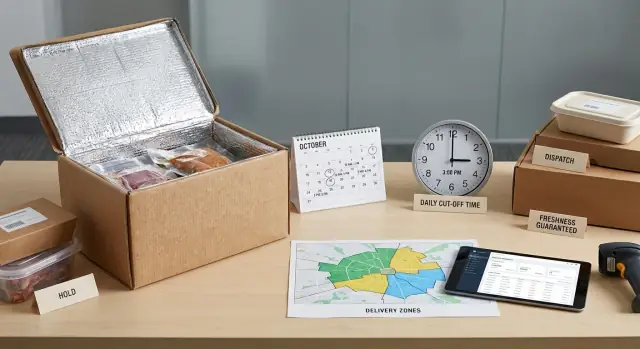
Why perishables need stricter shipping rules
Shipping rules for perishables aren't a nice-to-have. They decide whether food arrives safe and fresh, or late, warm, and headed for the trash. Most failures come from the same three pressures: time in transit, temperature exposure, and the number of handoffs between you and the customer.
Time is obvious. A two-day delay can turn a chilled item into a refund. Temperature is trickier. Even when a carrier hits the promised speed, a box can sit on a hot truck, a sunny porch, or a warehouse dock long enough to ruin the order. Handoffs multiply the risk, because every transfer adds waiting, scanning, and the chance the package ends up on the wrong route.
When rules are too loose, the symptoms are predictable: late deliveries that miss weekends or holidays, melted or thawed items, “it arrived warm” complaints, expensive reships, and reviews that warn others not to order. Often the root cause isn't packaging. It's that the order was allowed to ship when it shouldn't have been accepted.
Three controls carry most of the load: delivery zones (where you can safely ship), dispatch cut-off times (when orders must be placed), and inventory holds (so you don't oversell what must ship today). Set those well and everything else gets easier. Packing teams know what must go out, customers see realistic delivery options, and waste drops. The goal is simple: only accept orders you can deliver fresh, even on the worst reasonable day.
Start with freshness rules you can measure
Before you draw maps or pick cut-off times, write down what “fresh enough” means for each product. If you can't measure it, you can't keep the promise.
Start by grouping items by risk. Risk is about how quickly a product becomes unsafe or unpleasant, not how expensive it is.
Build a small rule table
Most shops can start with a simple set of categories and a maximum transit time for each:
- Shelf-stable: about 3 to 7 days in transit (still protect from heat)
- Refrigerated: 1 to 2 days maximum
- Frozen: 1 day maximum unless packaging is proven for 2 days
- Prepared (ready-to-eat, baked, meal kits): same-day or next-day only
- Specialty “fragile” (chocolate, soft fruit): depends on temperature, often next-day
Use transit time, not just distance. Two nearby cities can still take two days if the route is slow or weekend delivery is inconsistent. These limits become the backbone of your perishable shipping windows.
Decide what happens when a rule fails
Rules need a default action so staff don't improvise at the last minute. Pick one approach per category and apply it consistently: block checkout for that address and date, delay the ship date to the next valid dispatch day, require a faster method to meet the transit limit, or restrict certain items to local pickup during hot weeks.
Document the assumptions behind each rule so everyone is working from the same reality. Examples: “Refrigerated items ship Mon to Wed only,” “We assume no Sunday delivery,” or “Frozen items require insulated packaging plus ice packs.”
A practical example: cookies might be fine with 2-day shipping, but cream-filled pastries are often next-day only. A frozen berry pack might be allowed for 2 days only if your past orders arrive still frozen and you track complaints by lane and season.
Shipping windows: what to offer and how to phrase it
Shipping windows are what customers remember, because it's the promise you make in plain language. For perishables, fewer options usually work better, as long as each one matches your packing time and your carrier or courier schedule.
Separate “delivery day” from “delivery time.” Many businesses can only control the day. If you can't predict the hour, don't imply you can.
Choose windows that match your real week
Your best windows often change by day of week. Monday can be harder due to weekend backlog, while midweek is smoother. Holidays also need special handling. If carriers don't move, you shouldn't offer a fresh delivery promise.
Keep the window length honest. Shorter windows reduce missed deliveries only if you can hit them consistently. If a courier route regularly slips by an hour, a 2-hour window can create more support tickets than it prevents. For national carriers, “by end of day” is usually safer than “10am-12pm.”
Same-day works when the product is made or packed early and you have reliable local coverage. Next-day is safer when orders come in later, packing takes longer, or the product needs time to chill before it can travel.
At checkout, keep the choices limited and clear, for example:
- Today (2pm-6pm) for local courier areas
- Tomorrow (9am-6pm)
- Choose a day (Tue-Fri)
- No delivery on Sundays and major holidays
A good test: if your team can't explain the window in one sentence, it's too complicated to keep.
Delivery zones: practical ways to draw the map
Delivery zones turn a freshness promise into something you can hit every day. Group addresses by how long delivery really takes, then only offer options that keep the product safe.
Pick a zone model you can maintain
Start with the simplest method your team can keep up to date.
Postal codes work well when carrier pricing is postcode-based or you already have a service list. A radius can work for local courier delivery, but it needs to be checked against real drive times. Named areas can help when customers recognize them (for example, “Downtown” or “Northside”) and you want clarity at checkout.
Keep the number of zones small at first. Three is often enough. You can split a zone later when your data shows you need it.
Build tiers that match freshness risk
A practical setup is:
- Local: same-day or next-day with minimal time out of refrigeration
- Regional: next-day with insulated packaging
- National: only items that tolerate longer transit
Make each tier come with its own allowed shipping methods and fees, so checkout options are honest, not optimistic.
If an item is truly high-risk (cream cakes, raw seafood, fresh-cut fruit), block it from higher-risk zones instead of letting people order and hoping the carrier is fast. Customers accept “not available to your address” more easily than a spoiled delivery.
Watch for special cases. Islands can add a day even when they look close on a map. High-rises can fail delivery if couriers can't access the building. Remote addresses often see fewer scans and more delays. For these, require a safer method (faster service, signature, pickup point) or exclude the product.
Example: a deli offers fresh pasta locally, fresh pasta plus gel packs regionally, and only dried goods nationally. That one decision prevents most temperature complaints before they happen.
Dispatch cut-offs: set times you can actually meet
A dispatch cut-off is the latest time a customer can place an order and still have it packed and handed to the carrier the same day. If you promise same-day dispatch but can't hit it consistently, you end up with warm boxes, missed pickups, and refunds.
Work backward from reality. Start with the carrier pickup time (or your driver departure), then subtract the time you need to safely prep the order. For chilled and frozen items, include the slow steps people forget: conditioning ice packs, insulating, staging in a cold area, and printing labels without leaving a box sitting on a table.
Cut-offs shouldn't be one-size-fits-all. A nearby zone can often tolerate a later cut-off because delivery is shorter. A farther zone needs earlier dispatch to avoid extra nights in transit. Product risk matters too: shelf-stable goods can tolerate later cut-offs than seafood, dairy, or fresh bakery items.
A simple setup is to define cut-offs by zone and product group. Keep weekend rules stricter to avoid boxes sitting in depots, and adjust for low-staffing days.
Customer messaging should be outcome-focused. Instead of showing an internal time rule, show the promise: “Order by 1:00 pm for delivery on Wednesday.” If you support perishable shipping windows, checkout should update that message when the shopper changes address or cart contents.
Example: a deli ships smoked fish (high-risk) and gift boxes (shelf-stable). Carrier pickup is 4:30 pm. If safe fish packing takes 75 minutes and you want a 15-minute buffer, the cut-off is 3:00 pm for local Zone A. For Zone B, you set it to 12:00 pm to protect freshness and reduce the chance of an extra night in transit.
Inventory holds: stop overselling and protect cold items
Inventory holds are the guardrails that stop you from selling the same last carton twice, and they protect items that can't sit warm while you sort out logistics.
The safest rule is straightforward: reserve stock at checkout, not at packing time. Packing is too late, especially during peaks.
When to place a hold (and why)
Use holds when the product is “committed” but still at risk of slipping. Common moments include a paid order waiting to be packed, the time an item sits staged in a chilled area while the rest of the order is picked, and the window between labeling and courier handoff.
Each hold should have a clear purpose. For example: a stock reservation hold prevents overselling, a temperature staging hold limits how long chilled items can sit, a compliance check hold blocks dispatch until required labels or paperwork are confirmed, and a courier handoff hold marks the order as no longer editable.
Expirations, alerts, and release rules
Every hold needs a timer. If a chilled order sits too long, you're not just late, you're risking quality. Set hold durations based on product risk (ice cream minutes, chilled meals hours, shelf-stable days) and alert someone before the time runs out so they can pack, re-chill, or reschedule.
Release rules matter just as much. Return stock automatically when payment fails, fraud checks fail, or an order is canceled. If the delivery date changes, choose a consistent path: keep the reservation only if you can still meet freshness, or release and require the customer to rebook.
If you're building internal tooling, a simple approach is to model order states (for example, Reserved, Staged-Cold, Ready, Handed-Off) and attach time limits and actions to each state so inventory moves back when an order can't ship. Platforms like Koder.ai (koder.ai) are designed for building app workflows quickly from a chat interface, which can be useful when you need to test rule changes without rewriting your whole system.
Prep and packing workflow that matches your promises
Shipping promises only work if your team shares one definition of when an order is actually ready. Set a single “ready time” for every order: prep complete, packed, labeled, and sitting in the correct temperature zone (ambient, chilled, frozen). That timestamp should drive your cut-offs and pickups, not when an order was printed.
Build buffers on purpose. Peak days, new staff, and delayed ingredient deliveries happen. Add a realistic cushion (often 20 to 40 minutes) between “expected ready time” and “carrier handoff” so you aren't packing in panic.
Batching helps keep cold items cold and reduces missed windows. Batch by what affects operations: delivery zone or route, carrier or service level, temperature needs (chilled/frozen packed last), special handling, and earliest cut-off first.
Edits are where freshness rules quietly break. Decide in advance what you'll accept after picking starts. A practical rule is: changes are allowed only until the order is marked “in prep”; after that, you either cancel and re-place, or approve a substitution that doesn't add time.
When an order misses readiness, avoid the vague “someone will handle it.” Use an escalation path: the packer flags it, a lead decides quickly whether to upgrade shipping, switch to local delivery, or hold for the next window, and support sends one clear message.
Shipping method rules: match speed to product risk
Shipping rules work best when each product has a clear risk level. A shelf-stable sauce can handle longer routes. Fresh fish, frozen desserts, and live cultures can't.
Block combinations that predict trouble, even if they look fine on paper. The classic failure is a frozen item going to a far zone on an economy method. It might arrive, but not in a condition you can stand behind.
Rules that prevent spoiled deliveries
Keep method rules concrete and easy to enforce. For example: block frozen + slow method + far zone (force faster shipping or disallow), tighten “leave at door” for high-risk items during hot weather, require insulation and gel packs above a set risk threshold, and apply stricter summer limits when destination temperatures rise.
Write temperature handling notes like packing instructions, not policy text. Example: “Frozen: insulated mailer + 2 gel packs per 1 kg, add one extra pack June to September.” If you don't trust summer delivery performance, limit those items to local zones or express only.
Signature required is often safer for expensive or highly perishable orders because it reduces time on a porch. Leave-at-door can be better for low-risk foods because it avoids missed deliveries and extra days in transit.
When carriers delay
Decide your “late arrival” rule before it happens and apply it consistently. High-risk perishables often need a re-ship or refund. Medium-risk items might warrant a partial refund or store credit if quality is reduced. Low-risk items can follow your standard carrier claim flow.
Common mistakes that cause spoiled deliveries
Most spoilage problems aren't about the carrier. They start with promises made at checkout that your team can't realistically keep.
A few patterns show up again and again:
- Setting a dispatch cut-off based on pickup time, but forgetting prep time and the true bottleneck (often the cold pack-out table).
- Using one cut-off for every zone even though Zone A delivers next day and Zone C takes two days.
- Holding inventory only after payment capture or after the label prints.
- Offering too many checkout choices without clear rules. Customers will pick the cheapest option even when it's unsafe.
- Forgetting exceptions: holidays, heat waves, storms, or a missed carrier scan.
A common scenario: you cut off at 3 pm because the truck comes at 5 pm, but your team can't finish cold packing until 4:30 pm on busy days. Late orders sit warm while waiting. If the carrier misses a scan, they can spend an extra night in transit. The fix is simple: set the cut-off based on the moment the box is sealed and staged cold, not the pickup time.
Quick checklist before you turn rules on
Before you switch on perishable shipping windows, run a few real orders through your rules and see where they break. Every accepted order should have a believable path from checkout to the customer, inside your freshness limits.
Test with a few addresses and products that represent your typical week: one nearby, one far, one risky item (like fresh fish), and one stable item (like chocolate). Then check:
- Zone eligibility: can this address receive this product today, based on your zone setup and the days you actually deliver there?
- Window within freshness: is there at least one delivery date that stays inside your freshness rules (including weekends and holidays)?
- Dispatch cut-off reality: if the order is placed at 10:55 vs 11:05, does it land on the correct dispatch day, and does that keep the product safe?
- Inventory holds for perishables: is stock reserved immediately at checkout so you don't sell the same units twice?
- Shipping method and fallback: is the selected speed fast enough, and what happens if a check fails (hide the option, delay the date, suggest pickup, or block checkout)?
A quick scenario: a customer in Zone B adds fresh ravioli with a 48-hour limit at 2:30 pm. If your cut-off is 2:00 pm, the next ship day might push delivery outside the limit. Your fallback could be to remove that date, show a later date only for shelf-stable items, or block the ravioli for that address.
Example: putting zones, cut-offs, and holds together
Picture a small specialty shop that sells three groups: frozen desserts (high risk), fresh pasta (medium risk), and pantry items like olive oil and spice blends (low risk). The goal is to match delivery promises to what stays safe and tasty.
They set up three delivery zones that customers can understand at checkout. Local customers get a same-day option for frozen desserts and fresh pasta. Regional customers get next-day for frozen desserts and fresh pasta. National shipping is pantry-only, because it's the only category that can handle longer travel without ice packs and tight timing.
Cut-offs are set to times the team can meet consistently. Same-day orders must be placed by 11:00 so there's time to pick, pack with cold materials, and hand off to the courier. Next-day dispatch has a 15:00 cut-off so orders can be packed before the end of the shift and collected on time.
Inventory holds are the safety net that stops overselling, especially for frozen stock and limited fresh pasta batches. The store reserves items at checkout, but releases the hold if the delivery date changes to a window where that item isn't allowed (for example, a customer switches from local same-day to national shipping).
Here is how the rules read as plain statements:
- Frozen desserts: local same-day (order by 11:00) or regional next-day (order by 15:00). No national shipping.
- Fresh pasta: local same-day (order by 11:00) or regional next-day (order by 15:00). No national shipping.
- Pantry items: all zones, standard dispatch by 15:00.
- If your delivery date changes, held items may be released and you will be asked to confirm substitutes.
Write your rules exactly like the statements above, then build them into checkout and operations. If you're implementing the workflow in software, using a tool that supports planning, testing, and rollback (such as Koder.ai's Planning Mode with snapshots and rollback) can make it safer to adjust zone logic or dispatch cut-off times without breaking checkout during a busy week.
FAQ
What exactly is a “perishable shipping window”?
Start with a simple transit-time limit per product group (for example: refrigerated 1–2 days, frozen 1 day unless proven for 2). Then only offer delivery dates and methods that stay inside that limit, including weekends and holidays.
If you can’t confidently keep an item safe on a “worst reasonable day,” block that option at checkout.
How do I decide what “fresh enough” means for each product?
Use what you can measure and enforce:
- Maximum transit time (days in carrier network)
- Allowed ship days (for example, Mon–Wed only)
- Packaging requirement (insulation, gel packs, etc.)
Avoid vague rules like “fast shipping only” unless you define what “fast” means for each product.
Should I base my rules on distance or transit time?
Transit time is usually the most reliable base rule. Distance can be misleading because nearby routes can still take longer due to depot schedules, weekend gaps, or inconsistent service.
Treat “2-day delivery” as a promise about time in transit, not miles on a map.
What’s the simplest way to set up delivery zones?
Pick the simplest model your team will actually maintain:
- Postal/ZIP codes: easiest if your carrier pricing and service levels are zone-based
- Radius: good for local courier, but validate it against real drive times
- Named neighborhoods/areas: great for clarity if customers recognize them
Start with 2–3 zones and split later when your data shows a clear need.
What should happen when an address or date breaks a freshness rule?
Set a default action per product category so staff don’t improvise:
- Hide the option at checkout
- Delay the ship date to the next valid dispatch day
- Force an upgraded shipping method
- Restrict to local delivery or pickup during hot weeks
Be consistent. Customers tolerate “not available” more than spoiled deliveries.
How do I set a dispatch cut-off time that we can actually meet?
Work backward from the handoff time, not the order time:
- Start with carrier pickup/driver departure time
- Subtract real packing time (including cold steps like conditioning packs)
- Add a buffer (often 20–40 minutes) for peaks and variability
If you’re often rushing cold orders at the end of the day, your cut-off is too late.
Do I need different cut-offs for different zones or products?
Yes—because risk and transit time differ.
A practical approach is cut-offs by:
- Zone (farther zones earlier)
- Product risk (seafood earlier than shelf-stable)
- Day of week (stricter near weekends/holidays)
Keep it simple: a small matrix like “Zone A + Frozen” vs “Zone B + Refrigerated” is usually enough.
When should inventory be reserved: checkout or packing?
Reserve at checkout for anything perishable or limited. Packing-time reservation is too late, especially during busy periods.
Also define what happens if payment fails, fraud checks fail, or the delivery date changes—inventory should return automatically when an order can’t ship as planned.
What inventory holds or order states help prevent spoilage?
At minimum:
- Reserved (stock committed)
- Staged-Cold/Frozen (time-limited holding state)
- Ready (packed, labeled, in correct temperature zone)
- Handed-Off (no more edits)
Attach timers to the cold states, with alerts before expiry so you can re-chill, upgrade shipping, or reschedule.
What’s a good policy when a carrier delays a perishable delivery?
Default to a clear, consistent policy by risk level:
- High-risk (fresh fish, frozen desserts): reship or refund if late and quality is likely impacted
- Medium-risk: partial refund/credit if still usable but not ideal
- Low-risk: follow normal carrier claim process
Decide this before problems happen so support and ops respond the same way every time.