

Pincode-based delivery messaging to cut checkout surprises
Learn how pincode-based delivery messaging shows availability, ETA, and COD early, reducing abandoned carts and support tickets at checkout.
Why checkout surprises happen (and what users expect)
A checkout surprise happens when a shopper feels like the rules changed at the last minute. They pick a product, accept the price in their head, and then checkout adds a new constraint or cost they never saw earlier.
It usually shows up like this:
- Delivery suddenly becomes “not available” for their pincode
- ETA jumps from “2-3 days” to “10-14 days” after they enter the address
- Cash on delivery (COD) is blocked with no clear reason
- Extra fees appear (shipping, handling, remote area fee, minimum order rules)
These surprises are expensive. People abandon carts because they don’t trust what they’re seeing. Some place the order and then cancel or ask for refunds when the promise doesn’t match reality. Support teams get the angry messages: “Why didn’t you tell me earlier?” and “Your app wasted my time.”
The goal is straightforward: confirm serviceability and set expectations before the user commits effort. That means showing key rules early, ideally on the product page or cart, so shoppers can decide quickly.
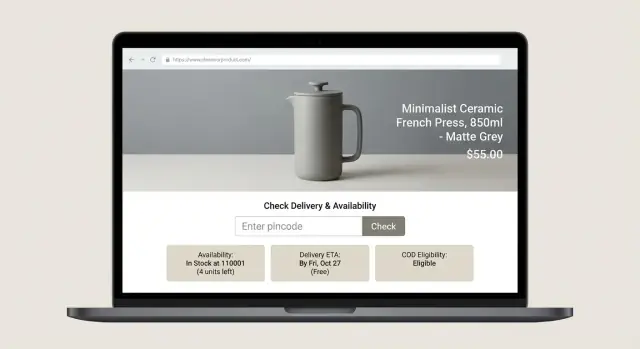
That’s where pincode-based delivery messaging helps. It turns hidden constraints into clear, location-specific answers: can you deliver here, when will it arrive, is COD allowed, and what will the final price look like for this region.
Keep the scope tight and practical. Focus on the four things shoppers care about most: delivery availability by pincode, delivery ETA messaging, COD eligibility check, and region-aware pricing display (including location-based fees or thresholds).
What to show early: availability, ETA, COD, and fees
The fastest way to reduce checkout surprises is to answer the four questions people already have before they add to cart:
Can you deliver to me? When will it arrive? Can I pay cash? What will it cost to ship to my area?
Availability
Start with availability. Don’t stop at “Deliverable” or “Not deliverable.” If there are product-specific limits, say so in plain words.
Good examples:
- “Available in your area, but batteries ship by ground only.”
- “This item can’t be delivered to your pincode due to size restrictions.”
People accept bad news more easily when it’s specific.
ETA
ETA matters next, but only if it’s believable. A tight promise you miss hurts more than a wider range you consistently hit. Prefer ranges like “2 to 4 days,” and add a cutoff note only when it changes behavior, like “Order before 4pm for same-day dispatch.”
If ETA differs by product, reflect that early. Don’t wait until the address step.
COD eligibility
COD eligibility is often the biggest surprise, so be explicit. If COD is not available, say it upfront. If it’s available but limited (maximum order value, blocked categories, first-time buyers, prepaid-only items), mention the rule in one short line.
Fees
Fees are where trust is won or lost. Region-aware pricing display should reflect what actually changes by pincode: shipping fee, COD fee, local taxes where relevant, or a minimum order threshold.
If you can’t calculate exact tax yet, don’t guess. Say “Estimated at checkout” and give a short reason.
A simple presentation that works:
- Deliverable status (plus any restrictions)
- ETA range (plus any cutoff note)
- COD: yes/no (plus the key rule if limited)
- Fees: shipping, COD fees, and any minimum order rule
Only show confidence signals that are true for that region. If returns, exchanges, or installation support vary by area, keep the message accurate. “Free returns in your area” is powerful only when it’s reliably true for that pincode.
Example: a shopper enters their pincode on a product page and sees: “Deliverable. Arrives in 2 to 4 days. COD available up to ₹5,000. Shipping ₹49, free over ₹999.” That removes four reasons to abandon later.
The data you need (and who usually owns it)
Good pincode-based delivery messaging depends less on UI and more on having clean rules behind it. If the data is scattered, you’ll show different answers on the product page, cart, and checkout, and shoppers will stop trusting you.
Core inputs and the usual owners
Most teams already have what they need, but it sits in different places. Align on one “source of truth” for each item:
- Pincode to zone mapping (Logistics or Ops): which pincodes are serviceable, which carrier can deliver, promised delivery speeds, special lanes (metro vs remote). Often lives in a courier tool, shipping aggregator, or an ops-maintained sheet.
- Product constraints (Catalog or Fulfillment): weight and dimensions, fragile or hazmat flags, cold-chain needs, and which warehouse or seller ships it. This turns “serviceable pincode” into “serviceable for this item.”
- Payment rules for COD (Payments or Risk): COD blocked for high-value carts, first-time buyers, certain address types (hostels, PO boxes), past returns, or pincodes with high RTO. These rules should be explicit, not tribal knowledge.
- Pricing inputs (Finance and Growth): shipping slabs by zone and weight, COD fees, region tax rules where relevant, promotions that apply only in some states or cities.
- Inventory and cutoffs (Warehouse Ops): same-day cutoff times, holidays, and capacity constraints that change ETA even when a pincode is serviceable.
A common real-world case: a pincode is serviceable, but a large item is blocked because the assigned carrier for that lane has a size limit. Or COD is disabled because cart value crosses a threshold.
A fallback plan when ETA is unknown
Sometimes you can’t calculate ETA yet (missing weight, no carrier response, mixed cart shipping from two locations). Decide what you’ll show instead so the experience stays consistent:
- “Delivery available to this pincode” without a date
- An ETA range (for example, 3 to 5 days) instead of a single day
- “Enter full address at checkout for exact ETA”
- A clear reason when something is blocked (item restriction, pincode not served, COD not available)
If you build this logic in one shared service (even a simple internal API), it becomes much easier to keep messages consistent across pages.
Where to place the pincode check so people see it
If people only learn about delivery limits at the last step, they feel tricked, even if your rules are fair. The fix is simple: ask for the pincode early, then repeat the same promise all the way to payment.
The highest-impact spot is the product page. Put the pincode field close to the price and the main Buy/Add to Cart button, so it feels like part of the decision, not a hidden condition. If your page has variants, keep the pincode check near the selected variant price as well.
A practical layout that works for most stores:
- Product page: a small “Enter pincode” field with instant results, near price and the primary CTA.
- Sticky header or sticky bar: once confirmed, show “Delivering to 560001” so users don’t wonder what location you’re using.
- Cart: confirm the saved pincode and show one combined summary (ETA, COD, any delivery fee) in a single block.
- Checkout: restate the confirmed promise only. Don’t add new rules here.
In the cart, avoid sprinkling info in three places (one line for shipping, another for COD, another for ETA). Combine it into one clear sentence that’s easy to scan, for example: “Delivery by Tue, COD available, Shipping fee: Rs 49.”
Treat checkout like a contract. You’re restating what was already agreed. If something changes (like stock running out), call it out as a change and ask the shopper to confirm instead of quietly switching options.
Don’t force sign-in for basic checks. Guest users should be able to enter a pincode on the product page and cart, then carry that confirmed location into checkout.
Messaging that builds trust (without overpromising)
Start with a plain prompt: “Enter pincode to check delivery.” It tells shoppers you’re not guessing, and it makes it clear that availability changes by location.
Once you show the result, make it scannable. People should understand the outcome in one glance.
A clean structure after a pincode check:
- Availability: Available / Not available
- Delivery ETA: “Delivers in 2-4 days” (or “Ships in 24 hours” if that’s what you really mean)
- COD: “Cash on delivery: Available / Not available”
- Fees: “Delivery fee: Rs X” or “Free delivery”
If something isn’t possible, say why in plain words. “Not serviceable in this pincode” is better than “Delivery unavailable.” If you know the reason, be specific without blaming the user: “Courier pickup not available for this area” or “This item can’t be shipped to your location.”
Avoid false precision. Exact timestamps like “Arrives Tuesday, 3:15 PM” sound confident, but they backfire if carriers can’t hit them. Ranges usually feel more honest, especially for long-distance shipping, peak seasons, or remote areas. If you show a date, label it as estimated.
Remember the shopper’s pincode across product, cart, and checkout so they don’t re-enter it. But make it easy to change with one click, because people shop for gifts, office addresses, or travel.
Done well, pincode-based delivery messaging reduces surprises without making promises your ops team can’t keep.
Step by step: a simple pincode-based availability flow
Ask for the pincode before the user is emotionally committed to checkout. Put the field on the product page and again in the cart, and validate it lightly (length, digits only). If it looks wrong, say so immediately instead of waiting until checkout.
Once you have a valid pincode, call your serviceability check and save the selection for the session (and optionally the user profile). Treat it as a user preference, not a one-time input, so they don’t have to retype it on every page.
A simple flow that covers most stores:
- Capture and validate pincode early, then remember it across pages.
- Check serviceability and assign a delivery zone for that pincode.
- Build a delivery promise as a range (for example, “Delivers in 2 to 4 days”), using zone plus product constraints like seller SLA, fragile handling, or warehouse cutoffs.
- Decide COD eligibility using pincode plus basket rules (order value limits, category restrictions) and basic risk rules.
- Recalculate region-aware fees and update the order summary so totals match what the user will see at checkout.
Finally, lock the promise when the user starts checkout. Keep the same ETA, fees, and COD decision unless something changes: pincode, cart items, quantity, shipping method, or address type (home vs office). If any of those change, re-check and clearly explain why the message updated.
Example: someone enters 560001 on a product page. You show “Available to 560001” plus an ETA range and whether COD is available. In the cart, if they add a bulky item that ships slower, the ETA updates there, not later at payment.
Edge cases you should decide before you ship
Most delivery and payment rules work fine until the first “almost” case shows up. If you decide edge cases upfront, your pincode-based delivery messaging stays consistent and you avoid last-minute surprises.
Split shipments
Split shipments are the most common. If a cart has items from different warehouses, show the slowest ETA as the default and add a short note that some items may arrive separately. People handle two deliveries better than a missed promise.
Partial availability
If one item can’t ship to a pincode, don’t block the whole cart without explanation. Tell shoppers which item is blocked and why (for example, “Restricted for this region” or “Out of service area”). Then offer a simple next action: remove the item, change pincode, or save for later.
Holidays and cutoffs
Holidays and daily cutoffs can quietly break trust. Decide what you’ll show when a shopper checks after cutoff time or on a holiday. “Ships next business day” is clearer than a date that implies same-day processing.
Address changes
Address changes should trigger a re-check, not just at checkout. When the pincode changes, highlight what changed so it doesn’t feel random. A short summary is enough:
- ETA changed (earlier or later)
- COD eligibility changed (available or not)
- Delivery fee or region fee changed
Returns and replacements
Returns and replacements must match the region promise. If COD isn’t allowed for a pincode, decide how refunds work there (bank transfer, wallet, card reversal) and keep the same rule visible in order details.
Example: a shopper enters 560001 and sees “Delivery by Tue, COD available.” They add a heavy item that ships from another location. Your message updates to “Delivery by Thu, some items ship separately” and COD flips to “Not available for this cart.” That feels honest because the change is explained.
Common mistakes that create mistrust
Trust drops fast when the product page promises one thing and checkout shows another. Most shoppers don’t mind limits if you tell them early, in plain language, and keep the rules consistent.
A common problem is showing an optimistic ETA like “Delivery in 1 day” for everyone. That’s usually a best-case zone, not the shopper’s actual pincode. If you only have a range, say so. If you have multiple carriers, show the fastest realistic option for that address, not the headline number.
Another trust killer is hiding COD rules until the payment step. People often choose items assuming COD is available, then feel tricked when it disappears. If COD depends on pincode, cart value, product type, or first-time orders, surface the COD eligibility check right after the pincode is entered.
Fee surprises are just as bad. Shipping, handling, and payment fees shouldn’t change at the last screen because region rules were missing or applied late. If exact fees aren’t known yet, show a clear estimate and what could change (for example, a remote area surcharge).
Mistakes that often show up together:
- ETA based on best-case zones instead of the entered pincode
- COD restrictions revealed only at payment
- Fees recalculated at the final step due to late region rules
- No re-check when cart changes (weight, value, restricted items)
- Vague errors like “Something went wrong” with no next action
Keep messages actionable. Instead of a generic error, tell people what to do: “COD is not available for 560001. Choose prepaid or try another address.” Consistency matters more than perfect precision: re-check when the cart updates, and keep the same rules from product page to checkout.
Quick checklist before launch
Do a final pass like a shopper would. Open a product page on mobile, type a pincode with one hand, and see if the promise is clear in under 5 seconds.
Checklist:
- Can shoppers find the pincode check early on both the product page and the cart, without hunting or scrolling far?
- After entering a pincode, do you show the full promise together in one place: in stock or not, an ETA range, COD yes or no, and any delivery fee (or free delivery)?
- When the shopper changes the pincode, does the message update immediately and make the differences obvious (for example, “COD not available” or “Delivery in 5 to 7 days”), instead of quietly swapping text?
- If the area is not serviceable, do you clearly say what happens next (remove from cart, notify when available, switch to prepaid, choose an alternate address) rather than leaving the user stuck?
- Do the same rules appear later in checkout and in the confirmation message, so the promise doesn’t change at the last step?
After the basics pass, test a few real scenarios, not just the happy path. Try a metro pincode, a remote pincode, and one that’s blocked for COD. Add two items that ship from different locations and confirm the ETA and fees stay understandable.
Align wording across teams. If your courier data says “2 to 4 business days,” don’t translate that into “Arrives by Friday” unless you can consistently meet it. The fastest way to lose trust is to show one promise on the product page and a different one at payment.
A realistic example: how one shopper experiences it
Asha lands on a product page for a pair of running shoes. Before she even thinks about “Buy now,” she sees a simple pincode box under the price. She enters 560001.
The page updates instantly: “Delivery in 2-4 days. COD available.” No wall of fine print, no hidden conditions. She now knows the item can reach her, roughly when, and that cash on delivery is an option.
She adds the shoes to her cart, keeps browsing, and adds a second item: a skincare set sold by a different seller. The cart recalculates and shows a small, clear update next to each item. The shoes still say “2-4 days, COD available.” The skincare set says “3-5 days, COD not available.” A short note explains why: “COD not supported for this item in your area.”
Fees update at the same time. The cart shows a delivery fee for the skincare set, and the total changes immediately. Because she can see the full cost and payment options early, she decides to pay online and moves on.
At checkout, nothing changes. The same delivery promises and COD rules appear again, matching what she already saw on the product page and cart. Payment doesn’t get blocked by a last-minute “COD not eligible” message.
That’s the point of pincode-based delivery messaging: set expectations early, keep them consistent, and remove the surprise moments that cause people to abandon right at the end.
Next steps: turn rules into a working experience
Start by turning your ideas into written rules. If the rules live only in people’s heads, the UI drifts, and customers notice. Capture what “serviceable” means, how you pick an ETA, when COD is allowed, and how fees change by region.
A practical way to write it is to separate facts from decisions. Facts are what you look up (carrier coverage, warehouse stock, pin-to-zone mapping). Decisions are what you promise on the page (available or not, ETA range, COD yes/no, extra charges).
Define what is good enough early
You don’t need perfection on the product page. You need fewer surprises. Use ranges when needed (for example, “Delivers in 3-5 days”) and keep the promise consistent with what checkout will show. If the system is unsure, say so clearly (for example, “ETA confirmed at checkout”) instead of guessing.
Measure the moments that matter
Add basic tracking before you ship so you can see where people get confused and where promises fail:
- Pincode entered (and whether it matched a valid format)
- Promise shown (availability, ETA range, COD status, fees)
- Pincode changed after viewing the promise
- Checkout started after seeing the promise
- Checkout blocked due to a rule change (for example, COD removed)
Roll out in phases to reduce risk. Start with “Deliverable + ETA range” because it solves most surprises. Then add the COD eligibility check, then region fees and pricing details. Each phase should ship with a clear fallback for unknown cases.
If you want to build and iterate quickly, a vibe-coding platform like Koder.ai (koder.ai) can help you prototype the flow end to end from a chat interface, including a React UI module for the pincode check and a Go backend with PostgreSQL to store rules. Snapshots and rollback are also useful when you’re adjusting logic against real courier and payment data.
FAQ
What information should I show after a shopper enters their pincode?
Show the four things shoppers care about most, right after they enter a pincode:
- Availability: deliverable or not, plus any item-specific restriction
- ETA: a realistic range (e.g., “2–4 days”)
- COD: available/not available, plus the one key rule if limited
- Fees: shipping/COD fees and any minimum order threshold
If you can’t compute something yet, say what’s confirmed now and what will be confirmed later.
Where should the pincode check live—product page, cart, or checkout?
Put it where it affects the buy decision, not as a hidden condition.
- Product page (highest impact): near price and Add to Cart
- Cart: repeat the same promise in one combined summary
- Checkout: restate only—don’t introduce new rules
Also keep the chosen pincode visible (e.g., “Delivering to 560001”) so people know what location you’re using.
Why do pincode-based messages reduce checkout abandonment?
Because checkout is where users feel most “locked in.” If they learn late that delivery isn’t possible, the ETA is worse, COD disappears, or fees increase, it feels like the rules changed.
Showing pincode-based answers early reduces:
- Cart abandonment
- Post-order cancellations
- “Why didn’t you tell me?” support tickets
How do I show ETA without overpromising?
Default to ranges, not exact dates.
- Prefer “Delivers in 2–4 days” over “Arrives Tuesday”
- Add a cutoff note only if it changes behavior (e.g., “Order before 4pm for same-day dispatch”)
- If you’re uncertain, say “ETA confirmed at checkout” instead of guessing
A slightly wider range you consistently hit builds more trust than a tight promise you miss.
How should I explain COD eligibility without annoying users?
Show COD status immediately after the pincode check and keep it simple:
- “COD available” (optionally add “up to ₹5,000”)
- or “COD not available” + one clear reason/rule (value limit, category restriction, pincode risk)
Avoid revealing COD restrictions only on the payment step—that’s one of the biggest sources of surprise.
How do I display region-based fees without causing fee shock?
Show what truly changes by location and keep it readable:
- Shipping fee (or free shipping threshold)
- COD fee (if any)
- Any remote area surcharge or minimum order rule
If you can’t calculate exact tax/fees yet, don’t invent numbers. Use wording like:
- “Estimated at checkout (final amount depends on address details)”
What should I show if I can’t compute an ETA yet?
Pick a clear fallback and keep the UI consistent:
- Confirm delivery availability without a date, or show a conservative range
- Ask for more input only when necessary (e.g., “Enter full address at checkout for exact ETA”)
- If blocked, show a specific reason (item restriction, pincode not served, COD rule)
The key is to avoid blank states or vague errors that leave the shopper stuck.
What data do I need behind the scenes to make these messages accurate?
Create one shared “source of truth” for each rule so product page, cart, and checkout don’t disagree:
- Pincode → zone/serviceability (Ops/Logistics)
- Product constraints (Catalog/Fulfillment)
- COD rules (Payments/Risk)
- Shipping/COD fees and thresholds (Finance/Growth)
- Inventory and cutoffs (Warehouse Ops)
Even a small internal API that returns availability/ETA/COD/fees for a pincode + cart can prevent inconsistent messaging.
How do I handle split shipments and partial availability in the cart?
Default to clarity and next actions:
- Split shipments: show the slowest ETA as the default and note “Some items may arrive separately.”
- Partial availability: identify the blocked item and offer actions (remove item, change pincode, save for later).
- Holidays/cutoffs: use “Ships next business day” when appropriate.
- Pincode/address changes: re-check and highlight what changed (ETA, COD, fee).
This prevents shoppers from feeling like things changed “randomly.”
What’s the simplest implementation plan for a pincode-based delivery promise?
Build it as one reusable flow so the same promise appears everywhere:
- Validate pincode (digits/length) and store it for the session
- Call a single service to return: availability, ETA range, COD eligibility, fees
- Re-check when the cart changes (items, quantity, value) or when the pincode changes
- “Lock” the promise when checkout starts, and only change it if inputs change
If you’re prototyping, a vibe-coding platform like Koder.ai can help you ship a React UI for the pincode box plus a Go/PostgreSQL rules service quickly, with snapshots/rollback when you adjust logic.