

Plant watering calendar for forgetful people that works
Build a plant watering calendar you set up once, then check off watering daily to see what is due today and avoid common mistakes.
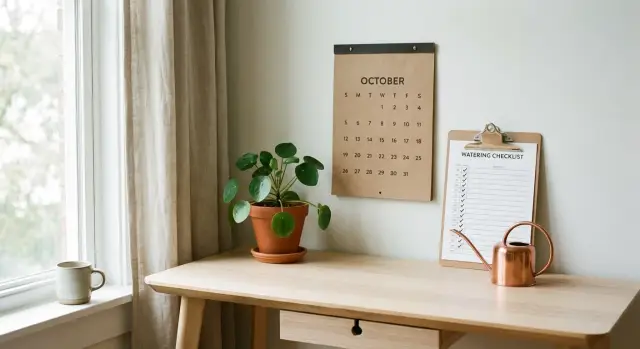
Why forgetful watering causes most houseplant problems
Most houseplant trouble isn’t about “bad plants” or “bad light.” It’s uneven watering: you forget, then overcorrect, then forget again. That swing stresses roots more than being a day early or late.
For forgetful people, the problem shows up in two opposite ways:
- Too dry is obvious: soil pulls away from the pot, leaves droop, edges get crispy, and growth slows.
- Too wet is sneakier: you water “just in case,” the pot stays heavy, fungus gnats show up, and roots start to rot. The plant can still look thirsty because damaged roots can’t drink well, so you water again and make it worse.
A clue you’re watering on feelings instead of a plan is when your reason sounds like a mood, not a check. For example: you water because the top looks dry (without checking deeper), you water every plant when you water one, or you “save” a droopy plant with extra water without asking why it drooped.
A simple plant watering calendar fixes the memory problem. It gives you one place to record what you own, when each plant was last watered, and what’s due today. It also breaks the habit of watering everything at once, which is how many low-light plants get overwatered.
What it can’t do: it can’t see your soil, pot size, or season. It won’t prevent mistakes if the interval is unrealistic or if you never look at the plant before you water. Think of it as a reminder plus a log, not autopilot.
Consistency beats perfect timing. If you usually water your pothos every 7-10 days, hitting “about weekly” with a quick soil check beats trying to water exactly every 8 days.
Example: you miss watering your snake plant for two weeks, then feel guilty and soak it twice in three days. The plant doesn’t need a rescue. It needs a steady rhythm. A calendar helps you return to “check it, water when it needs it, mark it done,” without panic watering.
What a watering calendar is (and what it is not)
A watering calendar answers one question: what needs water today, based on what you did last time. It’s not a promise that every plant gets watered every Sunday, no matter what. Plants don’t read calendars, and your home changes week to week.
It helps to separate three ideas people mix up:
- A calendar tracks what happened and what’s likely due next.
- A reminder nudges you to look, even if nothing is due.
- A strict schedule forces watering on fixed days, even when soil is still wet.
A good plant watering calendar sits in the middle. It gives you a clear “due today” list, but it still expects a quick check before you pour.
Keep tracking small and practical. For each plant, you only need the last watered date, a target interval (like 7 days or 14 days), and a short note (bright window, small pot, dries fast). That’s enough to stop guessing and prevent double-watering.
It also helps with habit. Checking off a task feels finished, and that matters when you’re tired or busy. You don’t need a fancy app. A paper calendar on the fridge, a notes list, or a basic spreadsheet works as long as you actually mark things done.
Think of it this way: the calendar sets the default plan. Your eyes and your finger on the soil make the final call.
Set it up once: your plant list in 10 minutes
The fastest way to stop guessing is to write down every plant you own exactly once. After that, your watering calendar becomes a quick check-in, not a memory test.
Pick a format you’ll actually open when you’re busy: a small notebook on the shelf, a simple spreadsheet, or a basic reminders app. The “best” option is the one you can reach the moment you notice dry soil.
Create one entry per plant. Don’t overthink it. You’re building a list you can trust, not a botany database.
What to record for each plant
Write one line that helps you identify the plant and understand its setup:
- Plant name (or a nickname like “Kitchen pothos”)
- Location (room + window side)
- Pot details (approximate size and whether it has a drainage hole)
- Light level (low, medium, bright - your best guess)
- A quick ID helper (a photo, or a short description like “tall thin leaves, white pot”)
That last part prevents mix-ups when you have similar plants or when you move things around.
Decide where this list “lives” so you see it often. Put the notebook next to the watering can, pin the spreadsheet, or put the app on your home screen. If it takes more than 10 seconds to find, you’ll skip it.
A simple example: if you have two snake plants, label them by place (“Entry snake plant” and “Office snake plant”), not by which one you bought first. When one looks thirsty, you’ll mark the right one and your schedule won’t drift.
Once this list exists, everything else gets easier. You can add watering intervals later without starting over.
Choose realistic watering intervals for each plant
A good plant watering calendar starts with realistic intervals, not perfect ones. Most people fail because they pick one rule for everything (like “water every Sunday”), then feel guilty when it doesn’t match real life.
Start with a baseline by plant type. Use it as a first guess, then adjust after you see how fast the pot actually dries.
Start with a baseline, then adjust for your home
As a starting point, use simple ranges:
- Succulents and cacti: every 14-28 days
- Snake plant, ZZ plant: every 14-21 days
- Pothos, philodendron: every 7-14 days
- Peace lily, ferns: every 4-7 days
- Herbs on a sunny windowsill: every 2-5 days
Then adjust based on drying speed. Small pots dry faster than big ones. Chunky, airy soil dries faster than dense soil. Bright light and warm rooms dry pots faster than low light and cool rooms.
A quick way to adjust is to shift the range, not chase one exact date. If your pothos is in a tiny pot near a heater, “7-14 days” might become “5-10 days.” If it’s in a bigger pot in low light, it might become “10-16 days.”
Use ranges and add “check first” notes
Exact schedules break the first time your week gets busy, the weather changes, or a plant grows. Use ranges like “7-10 days” or “10-14 days.” It gives you room while still showing what’s due.
For plants that hate wet feet (many succulents, snake plant, ZZ plant), add a note: “Check soil first.” A simple rule works well: if the top 2 inches are dry (or the pot feels light), water. If it still feels damp, wait 2-3 days and check again.
Example: you set a peace lily at “4-7 days,” but it lives in low light in a large pot. You notice the soil stays wet for a long time. Update the range to “7-10 days” and add “don’t water if top is still damp.” Your calendar stays useful, and your plant stays healthier.
Daily use: check what is due today and mark it done
A watering calendar only works if it takes less than two minutes to consult. Tie it to something you already do, like making coffee or opening your laptop. The goal is simple: see what’s due, water what needs it, then mark it.
A realistic daily routine:
- Open your calendar or list.
- Look at what’s due today (or sort by next watering date).
- Water the due plants one by one.
- Mark each plant as watered (or skipped) right away.
If several plants are due at once, slow down. Rushing is how you end up giving a splash to everything, which is usually worse than skipping a plant that’s still moist. If you only have five minutes, water the thirstiest ones and leave the rest for tomorrow.
After you water, record just enough to help “future you.” Keep it short: the date (or “done”), how much (light/medium/deep), and a quick note only if something stood out (soil still damp, leaves drooping, moved closer to window).
Sometimes a plant is due on paper, but the soil is still moist. That’s when “skipped” saves your calendar. If the soil feels damp or the pot is still heavy, mark it as skipped and note “still moist, check again in 2 days.” Your schedule stays honest, and you don’t train yourself to ignore it.
The habit to protect: never finish a watering session without marking what happened.
Add quick reality checks so the calendar stays accurate
A plant watering calendar keeps you consistent, but plants don’t read calendars. A 10-second check before you pour helps you avoid the two big problems: watering on autopilot, and waiting too long when conditions change.
Fast checks before you water
Do one or two, not all of them:
- Finger test: push a finger 1-2 inches into the soil. If it’s damp, wait.
- Pot weight: lift the pot. Light usually means dry; heavy usually means there’s still moisture.
- Drainage check: if the saucer often has water, you may be watering too much or the pot drains poorly.
- Plant cues: droopy leaves can mean dry soil or overwatering, so check soil first.
If your calendar says “due” but the soil is still moist, skip it and snooze for 2-3 days. This is common in winter, in low light, after a humid week, or right after repotting into water-holding soil.
Water sooner than planned when the plant is using water faster. A sunny window, a heat wave, a fan or heater nearby, a smaller pot, or a burst of new growth can all speed drying. Example: you normally water your pothos every 7 days, but warm weather plus bright light dries it in 4-5 days. If the pot feels much lighter and the top soil is dry, water now and adjust the next due date.
Add one monthly health check
Once a month, do a quick look-over so your schedule doesn’t hide a problem:
- Check under leaves for pests and sticky residue.
- Scan for yellowing, spotting, or crispy edges.
- Rotate the pot a quarter turn for even light.
- Confirm the pot still drains well (no blocked holes).
These small checks keep your schedule honest and your plants calmer.
Common mistakes that make a watering calendar fail
A plant watering calendar is meant to prevent guesswork, not replace your eyes and hands. Most “failed” schedules don’t fail because calendars are bad, but because one small assumption stays wrong for weeks.
Mistake 1: Watering just because it’s “due”
The quickest way to overwater is to treat the calendar like a command. Use it as a reminder to check, not an automatic watering order. If the soil is still damp or the pot feels heavy, skip or reduce watering and mark it as “checked” instead of “watered.”
Mistake 2: Giving every plant the same interval
A sunny windowsill pothos and a low-light snake plant shouldn’t be on the same rhythm. Light, pot size, soil mix, and plant type all change how fast water is used. One copied interval across your whole collection usually drowns the slow drinkers.
If you need a simple system, group plants by how they behave: fast-drying, medium-drying, slow-drying, and “sensitive roots.” Then adjust intervals within those groups.
Mistake 3: Ignoring seasonal shifts
Many indoor plants need less water in winter and more in summer. A schedule that was perfect in July can be too frequent in January. Adjust by a few days instead of making huge swings.
Mistake 4: Poor drainage, then blaming the schedule
If a pot has no drainage hole, or a saucer stays full, water sits around the roots and the calendar gets blamed. A schedule can’t fix a container that traps water.
Mistake 5: Not updating after changes
Repotting, moving a plant to a new window, or switching soil can change drying time quickly. Any time you change a plant’s setup, reset the interval and do a few extra “check-only” days to relearn its pace.
A quick watering checklist you can follow every time
A calendar is only useful if your “done” checkmark means the same thing each time.
Before you water, take 20 seconds to confirm the plant actually needs it. A due date is a reminder, not a command:
- Check the topsoil with a finger. If the top 1-2 inches still feel damp, wait.
- Lift the pot. A light pot usually means the mix is dry enough to water.
- Look at the saucer. If there’s leftover water sitting there from last time, don’t add more.
- Water thoroughly until you see water come out the drainage holes.
- Let it drain, then empty the saucer so the roots aren’t soaking.
After watering, do one admin step: mark it done. Add a note only when something is off (for example: “soil still damp, skipped,” “leaves droopy but soil wet,” “fungus gnats noticed,” or “moved closer to window”).
Once a week, do a two-minute review. If plants are always overdue, your reminder timing is wrong or you’re trying to water too often. If you keep skipping the same plant, it likely needs a longer gap, less water per watering, or more light.
Example: a busy week with several plants and uneven light
Picture this: you have eight plants spread across your place, and your week is packed.
- Living room (bright window): pothos, rubber plant
- Bedroom (medium light): peace lily, spider plant
- Kitchen (warm, dries fast): herbs, small succulent
- Bathroom (humid, low light): fern
- Office (shade, easy to forget): ZZ plant
On weekdays, you leave early and get home late. Weekends you’re around and tend to “make up for it.” This is where a watering calendar helps most.
On Monday you check what’s due, water only those, and mark them done. If you forget Wednesday, the calendar doesn’t push you to “water extra” on Thursday. It simply shows what’s due now. That alone prevents a common mistake: doubling up after a missed day.
A realistic week: pothos and herbs are due Monday. Peace lily shows due Tuesday. You miss Tuesday. On Wednesday the calendar shows peace lily overdue by one day, plus herbs are due again. You water those two and check them off. You don’t also water the pothos just because you’re holding the watering can.
Now the tricky one: the fern is always showing “due,” but when you touch the soil it’s still wet. Treat that as a signal, not a failure. Skip watering and adjust the interval (or the room). Maybe the bathroom stays moist, so the fern needs a longer gap than you first thought.
For a 10-day trip, keep it simple. Two days before you leave, water only the plants that are actually due. The day you leave, do a quick soil check and top up just the fast dryers (often herbs and the brightest-window plants). Ask a friend to do one mid-trip check with a short note: “Water only if the top inch is dry, and only the ones marked due.” When you return, don’t flood everything. Check what’s due today, feel the soil, then water and mark it done.
Next steps: keep it simple, then automate only if needed
Pick one format and start today. A notes app, a paper page on the fridge, or a simple spreadsheet can all work if the steps stay the same: see what’s due, check the soil, water, then check it off.
Give your first version two weeks before you judge it. During that time, don’t chase perfect intervals. Just record what you did and what you noticed (soil still wet, leaves droopy, pot feels light). Two weeks is usually enough to spot plants that dry faster in bright windows and plants that stay wet longer in cooler corners.
After that, adjust in small moves. If a plant was still damp on its due day, add 2-3 days. If it was bone dry early, subtract 1-2 days. The goal is a schedule you can follow without constant second-guessing.
If you do want to build a tiny tracker app, keep it focused on check-offs and a “due today” view. Koder.ai (koder.ai) can help you create a simple web or mobile tracker from chat and refine it as you use it. Snapshots and rollback are useful if you want to try changes without worrying you’ll break your setup.
Keep it boring on purpose. A simple system you use beats a perfect system you avoid.
FAQ
How do I pick the right watering interval for each plant?
Pick a baseline range for that plant type, then adjust after two or three watering cycles. If you keep finding the soil damp on the due day, extend the interval by a few days; if it’s very dry before the due day, shorten it slightly.
What if my calendar says a plant is due, but the soil is still wet?
Treat “due” as a reminder to check, not an order to pour. If the soil still feels damp 1–2 inches down or the pot still feels heavy, skip watering and set the next check for a couple of days later.
I missed watering for a week—should I double-water to catch up?
Don’t “make up” by watering extra. Check the soil, water only if it’s actually dry enough, then mark the real date you watered so your log stays accurate.
What’s the fastest way to tell if a plant truly needs water?
Use one quick check you’ll actually do every time, like the finger test or pot-weight test. Plant droop alone isn’t reliable because overwatered roots can make a plant look thirsty, so confirm with the soil before watering.
How do I adjust my watering calendar for winter or seasonal changes?
Most indoor plants use water more slowly in winter and faster in summer. If you’re skipping the same plant repeatedly because it’s still damp, lengthen its interval by a few days and reassess when light and temperature change again.
Can a watering calendar help if my pots don’t have drainage holes?
If a pot has no drainage hole or the saucer stays full, water can sit around the roots and cause rot even with a “good” schedule. Either switch to a draining pot or water much more cautiously and never leave standing water.
How do I track two similar plants without mixing them up?
Record a separate entry for each one with a location-based name, like “Entry snake plant” and “Office snake plant.” That prevents you from marking the wrong plant and slowly drifting your schedule without noticing.
What should I do after repotting or moving a plant to a new spot?
Reset expectations and do more soil checks for a couple of cycles, because drying speed often changes after a move or new soil. Update the interval based on what you observe instead of forcing the old schedule to fit.
How should I handle watering when I’m traveling?
If you’ll be gone, water only the plants that are truly due right before you leave and avoid soaking everything “just in case.” If someone is helping, give them one simple rule: water only if the top inch is dry and the plant is due in your notes.
Do I need an app, or is a paper calendar enough?
Paper, notes, or a spreadsheet works if you actually open it and mark things done immediately after watering. If you want a simple “due today” app you can customize to your routine, you can build a lightweight tracker with Koder.ai and refine it as you learn your plants.