

Rasmus Lerdorf and PHP: From Personal Tool to Web Staple
The story of Rasmus Lerdorf and PHP—how a small set of web scripts became a widely used platform, and why PHP still powers many sites today.
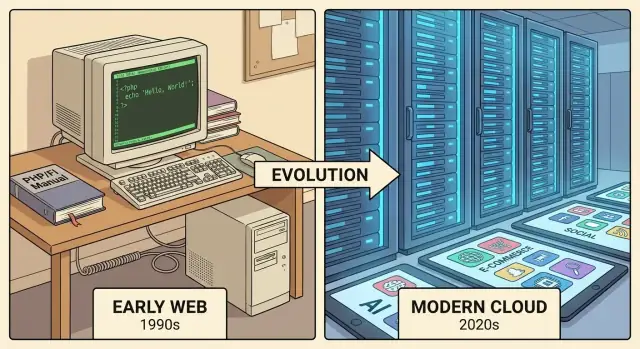
Why PHP’s origin story still matters
PHP didn’t start as a grand platform or a carefully designed language. It began because Rasmus Lerdorf wanted to solve a concrete problem: maintain a personal website without doing repetitive manual work.
That detail matters because it explains a lot about why PHP feels the way it does—even today.
Who Rasmus Lerdorf is (and what he was trying to solve)
Lerdorf was a developer building for the early web, when pages were mostly static and updating anything beyond plain HTML quickly became tedious. He wanted simple scripts that could track visitors, reuse common page parts, and generate content dynamically.
In other words: he wanted tools that helped him ship changes faster.
What “personal tools” meant for early web builders
“Personal tools” wasn’t a brand name—it was a mindset. Early web builders often wrote small utilities to automate the boring parts:
- print the same header/footer across pages
- read data from forms and display results
- connect to a database without rewriting everything each time
PHP’s earliest versions were shaped by that practical, get-it-done approach.
Why this origin matters for understanding PHP’s design
Once you know PHP’s roots, many of its traits make more sense: the focus on embedding code directly into HTML, the large standard library aimed at common web tasks, and the preference for convenience over academic purity.
These choices helped PHP spread quickly, but they also created trade-offs we’ll cover later.
What you’ll learn in this guide
This article walks through how PHP grew from Lerdorf’s scripts into a community-driven language, why it fit hosting and the LAMP stack so well, how ecosystems like WordPress amplified it, and what modern PHP (7 and 8+) changed—so you can judge PHP today based on reality, not nostalgia or hype.
The web problem PHP was born to fix
The mid-1990s web was mostly static HTML. If you wanted anything dynamic—processing a form, showing a hit counter, customizing a page per visitor—you typically reached for CGI scripts, often written in Perl.
That worked, but it wasn’t smooth.
CGI and Perl were flexible, but awkward for everyday sites
CGI programs ran as separate processes for each request. For simple tasks, that meant a lot of moving parts: a script file with careful permissions, server configuration, and a mental model that didn’t feel like “writing a web page.” You weren’t just mixing a little logic into HTML; you were building a tiny program that output HTML as text.
For hobby sites and small businesses, the common needs were repetitive and practical:
- Forms: receive input, validate it, send an email, store it somewhere.
- Counters and simple stats: track page hits without breaking under load.
- State: keep a user “session” across clicks (even before the concept was standardized).
- Database access: fetch and display data without writing everything from scratch.
Hosting constraints shaped the kind of tools people wanted
Most people were on shared hosting with limited CPU, memory, and little control over server settings. Installing custom modules or long‑running services wasn’t realistic. What you could do was upload files and run simple scripts.
These constraints pushed toward a tool that:
- made dynamic output feel like editing HTML,
- reduced boilerplate for routine web tasks,
- ran efficiently on shared servers,
- and lowered the barrier from “programming” to “building a working website.”
That gap—between static pages and heavyweight scripting—was the everyday web problem PHP set out to solve.
Rasmus Lerdorf’s first version: practical scripts for a personal site
Rasmus Lerdorf didn’t set out to invent a programming language. He wanted something much more ordinary: a better way to run his own website.
The earliest “PHP” work began as a collection of small C programs he used to track visits to his online resume, plus a few utilities to handle basic site tasks without constantly hand‑editing pages.
The initial goal: measure traffic, reduce manual work
At the time, knowing who was visiting your site (and how often) wasn’t as simple as dropping in an analytics snippet. Lerdorf’s scripts helped log and summarize requests, making it easier to understand traffic patterns.
Alongside that, he built helpers for common website chores—simple templating, small bits of dynamic output, and form handling—so the site could feel “alive” without becoming a full custom application.
Early features that outgrew the original website
Once you have tools for request tracking, form processing, and reusing page components, you’ve accidentally built something other people can use too.
That’s the key moment: the functionality wasn’t tied to one layout or one page. It was general enough that other site owners could imagine copying the approach for their own projects.
A “small toolbox” mindset shaped PHP’s feel
Because it started as a toolbox, the ergonomics were practical: do the common thing quickly, don’t over‑design, and keep the barrier to entry low.
That attitude—usefulness first, polish later—helped PHP feel approachable from the beginning.
The takeaway is simple: PHP’s roots weren’t academic or theoretical. They were problem‑driven, aimed at getting a real website working with less friction.
PHP/FI: the first public release and its killer features
PHP didn’t start as a “language” in the way people think of it today. The first public milestone was PHP/FI, which stood for “Personal Home Page / Forms Interpreter.”
That name is revealing: it wasn’t trying to be everything. It was meant to help people build dynamic pages and process web forms without writing a full custom program for every task.
What PHP/FI included (and why it felt powerful)
PHP/FI bundled a few practical ideas that, together, made early web development much less painful:
- Server-side scripting embedded in pages, so you could generate HTML on the fly.
- Built-in helpers for common web tasks, especially working with form fields.
- Database access features (primitive by modern standards, but a big deal at the time).
- A simple “drop it in” deployment model that fit shared hosting realities.
It wasn’t polished, but it reduced the amount of glue code people had to write just to get a page working.
Form handling: the “FI” that won people over
Early websites quickly hit a wall: as soon as you wanted feedback forms, guestbooks, sign-ups, or basic search, you needed to accept user input and do something with it.
PHP/FI made form handling a core use case. Instead of treating forms as an advanced feature, it leaned into them—making it easier to read submitted values and generate a response page.
That focus matched what everyday site owners were trying to build.
Early templating: mixing markup and server code
One of PHP/FI’s most influential ideas was its templating style: keep HTML as the main document, and weave in small pieces of server logic.
<!-- HTML-first, with small dynamic pieces -->
<p>Hello, <?php echo $name; ?>!</p>
To designers and tinkerers, this felt natural: you could edit a page and add “just enough” dynamic behavior without adopting a totally separate system.
Why it spread fast—even with rough edges
PHP/FI wasn’t elegant, and it didn’t aim to be. People adopted it because it was:
- Accessible (easy to understand in small steps)
- Convenient (quick to install and run on typical hosting)
- Practical (solved real problems like forms and dynamic pages immediately)
Those “killer features” weren’t flashy—they were exactly what the early web needed.
From personal tool to community project
Rasmus Lerdorf’s early PHP scripts were built to solve his own problems: track visitors, reuse common page elements, and avoid repeating work.
What turned that small set of utilities into “PHP” as most people recognize it wasn’t a single big rewrite—it was a steady pull from other developers who wanted the same convenience for their own sites.
When other people started shipping the code
As soon as PHP was shared publicly, users began sending fixes, small features, and ideas. That feedback loop mattered: the project started to reflect the needs of many webmasters instead of one personal site.
Documentation improved, edge cases got patched, and the language began to develop conventions that made it easier to pick up and use.
PHP 3: the rewrite that made it a real platform
A major turning point was PHP 3, which rewrote the core engine and introduced the name “PHP: Hypertext Preprocessor.” This wasn’t just branding.
The rewrite made the language more consistent and easier to extend, which meant PHP could grow without becoming an unmaintainable pile of one‑off scripts.
Extensions and database support changed the stakes
A broader user community also pushed for integrations with the tools they relied on. Extensions started to appear that connected PHP to different databases and services, so you weren’t locked into a single setup.
Instead of “a scripting tool that outputs HTML,” PHP became a practical way to build data‑driven websites—guestbooks, forums, catalogs, and early e‑commerce.
That’s the key shift: community contributions didn’t merely add features. They changed PHP’s role from a helpful toolkit into a shared, extensible platform people could bet real projects on.
Zend and the engine eras: PHP 4 and PHP 5 in plain terms
PHP didn’t become a default choice for so many websites just because it was easy to pick up. A big part of the story is that the “engine” under the hood got a serious upgrade—one that made PHP faster, more consistent, and easier to extend.
What the Zend Engine changed
Zend (founded by Andi Gutmans and Zeev Suraski) introduced the Zend Engine as a new core for PHP. Think of it as replacing the motor while keeping the same car model.
Developers could still write familiar PHP code, but the runtime became better structured internally.
That structure mattered because it enabled:
- Faster execution (especially important as dynamic pages grew heavier)
- Cleaner internals for adding features and extensions
- More predictable behavior across environments
PHP 4: the shared-hosting era
PHP 4 (powered by Zend Engine 1) arrived at the perfect time for the web’s “rent a slice of a server” model.
Shared hosting providers could offer PHP broadly and cheaply, and many did. This availability became a growth loop: more hosts supported PHP, so more people used it; more usage pushed hosts to keep supporting it.
In practical terms, PHP 4 was “good enough, everywhere.” That ubiquity mattered as much as any language feature.
PHP 5: a more grown-up programming model
PHP 5 (Zend Engine 2) pushed PHP forward for teams building larger codebases. The headline change was stronger object‑oriented programming: better class handling, improved visibility rules, and a foundation for more modern patterns.
It wasn’t about making PHP academic—it was about making it easier to organize real projects, reuse code, and maintain applications over time.
Compatibility expectations start to form
As PHP spread, a new pressure emerged: people began to expect old code to keep running. Hosting companies, CMS platforms, and agencies depended on stability.
From this point on, PHP’s evolution wasn’t just “add features”—it was also “don’t break the internet.”
Why PHP spread so fast: simplicity, hosting, and convenience
PHP didn’t win because it was the most elegant language on paper. It won because it made building useful web pages feel immediate.
For early web developers—often designers, hobbyists, or small businesses—PHP lowered the time‑to‑first‑working‑thing more than almost any alternative.
A low barrier that rewarded curiosity
With PHP, the feedback loop was almost frictionless: upload a file, refresh the page, see results. That sounds trivial, but it shaped a generation of web building.
People could start with a single dynamic page (a contact form, a guestbook, a counter) and grow from there.
Fast iteration for small teams
Early web projects rarely had big engineering departments. They had one developer, maybe two, and a pile of urgent requests.
PHP fit that reality: it reduced the ceremony around deployment and made incremental changes easy to ship.
Hosting everywhere (and deployment that felt simple)
PHP rode a wave of cheap shared hosting. Many providers preinstalled it, so you didn’t need special infrastructure or expensive servers.
Deployment often meant “copy the files over,” which matched how people already published HTML.
A giant pile of “how-to” knowledge
As PHP adoption grew, it became self‑reinforcing. Tutorials, snippets, forums, and copy‑paste examples were everywhere.
That community memory made PHP feel approachable—even when the underlying web problems were anything but.
The LAMP stack effect: PHP’s home-field advantage
PHP didn’t just succeed because the language was easy to pick up—it succeeded because it had a “default home” on the early web.
That home was the LAMP stack: Linux + Apache + MySQL + PHP. For years, this combo was the standard recipe for running dynamic websites, especially for small businesses and personal projects.
Why LAMP made PHP the obvious choice
Linux and Apache were widely available and inexpensive to run. PHP fit neatly into Apache’s request/response model: a visitor hit a URL, Apache handed the request to PHP, and PHP generated HTML on the fly.
There was no separate application server to manage, which kept deployments simple and cheap.
MySQL completed the picture. PHP’s built‑in database extensions made it straightforward to connect to MySQL, run queries, and render results in a webpage.
That tight integration meant a huge percentage of “database-backed sites” could be built with the same familiar tools.
Shared hosting and one-click installers
A major accelerant was shared hosting. Many hosts offered accounts where PHP and MySQL were already configured—no system administration required.
With control panels like cPanel, users could create a MySQL database, manage tables in phpMyAdmin, upload PHP files over FTP, and go live quickly.
Then came one‑click installers (often for WordPress, forums, and shopping carts). These installers normalized the idea that “a website is a PHP app + a MySQL database,” making PHP the path of least resistance for millions of site owners.
How LAMP shaped “classic” web development
The stack encouraged a practical workflow: edit a .php file, refresh the browser, tweak SQL, repeat.
It also shaped familiar patterns—templates and includes, form handling, sessions, and CRUD pages—creating a shared mental model for web building that lasted well beyond LAMP’s peak.
Ecosystems that made PHP huge: CMS, e-commerce, and beyond
PHP didn’t become “everywhere” purely because of its syntax. It became a default choice because complete, installable products formed around it—tools that solved real business problems with minimal setup.
CMS: the distribution engine
Content management systems turned PHP into a one‑click decision. Platforms like WordPress, Drupal, and Joomla bundled the hard parts—admin panels, logins, permissions, themes, plugins—so a site owner could publish pages without writing code.
That matters because each CMS created its own gravity: designers learned theme building, agencies built repeatable offerings, and plugin marketplaces grew.
Once a client’s site depended on that ecosystem, PHP was “chosen” again and again—sometimes without the client even knowing.
E-commerce and forums: PHP’s long-time sweet spots
Online stores and community sites were early web essentials, and PHP fit the shared-hosting reality of the time.
Software like Magento (and later WooCommerce on WordPress), plus forum apps such as phpBB, gave people ready-made solutions for catalogs, carts, accounts, and moderation.
These projects also normalized a workflow where you install an app, configure it in a browser, and extend it with modules—exactly the kind of development that helped PHP thrive.
APIs and back-office tools: less visible, still common
Not all PHP is public‑facing. Many teams use it for internal dashboards, admin tools, and straightforward APIs that connect payments, inventory, CRM systems, or analytics.
These systems don’t show up in “what CMS is this?” scans, but they keep PHP in day‑to‑day use.
Why “powers many sites” is mostly an ecosystem story
When a large share of the web runs on a few massive products (especially WordPress), the language underneath inherits that footprint.
PHP’s reach is, in large part, the reach of the ecosystems built on top of it—not just a reflection of the language itself.
The trade-offs: criticism, security, and legacy baggage
PHP’s success has always been tied to pragmatism—and pragmatism often leaves rough edges.
Many critiques are rooted in real history, but not all of them reflect how PHP is used (or written) today.
Common criticisms (and why they exist)
A frequent complaint is inconsistency: function names that follow different patterns, parameters ordered differently, and older APIs living alongside newer ones.
That’s not imagined—it’s the result of PHP growing quickly, adding features as the web changed, and keeping older interfaces working for millions of existing sites.
PHP also supports multiple programming styles. You can write simple “just get it done” scripts, or more structured, object‑oriented code.
Critics call this “mixed paradigms”; supporters call it flexibility. The downside is that teams can end up with uneven code quality if they don’t set standards.
Security: misconception vs. real risk
“PHP is insecure” is an oversimplification. Most PHP security incidents come from application mistakes: trusting user input, building SQL queries by string concatenation, misconfiguring file uploads, or forgetting access checks.
PHP’s historical defaults didn’t always steer beginners toward safe patterns, and its ease of use meant many beginners deployed public‑facing code.
The more accurate take: PHP makes it easy to build web apps, and web apps are easy to get wrong without basic security hygiene.
Backward compatibility: blessing and burden
PHP has carried a heavy responsibility: don’t break the web.
This backward compatibility keeps long‑lived apps running for years, but it also means legacy code sticks around—sometimes far past its “best by” date. Companies may spend more effort maintaining old patterns than adopting better ones.
A balanced view
Fair critique: inconsistency, legacy APIs, and uneven codebases are real.
Outdated critique: assuming modern PHP projects must look like early‑2000s PHP, or that the language itself is the primary security weakness.
In practice, the difference is usually the team’s practices, not the tool.
Modern PHP: what changed with PHP 7 and PHP 8+
PHP’s reputation is often tied to code written years ago: mixed HTML and logic in one file, inconsistent styles, and “it works on my server” deployment habits.
PHP 7 and 8+ didn’t just add features—they nudged the ecosystem toward cleaner, faster, more maintainable work.
PHP 7: speed became a real selling point
PHP 7 delivered major performance improvements by redesigning key internals (the Zend Engine update).
In plain terms: the same app could handle more requests on the same hardware, or cost less to run at the same traffic.
That mattered for shared hosting, busy WordPress sites, and any business that measured “page load time” in lost sales. It also made PHP feel competitive again against newer server-side options.
PHP 8+: modern language features without the jargon
PHP 8 introduced features that make large codebases easier to reason about:
- Union types let you declare that a value can be one of a few specific types (for example,
int|string). This reduces guesswork and improves tooling support. - Attributes provide a structured way to attach metadata to classes and methods (often used by frameworks for routing, validation, or ORM configuration).
- JIT (Just-In-Time compilation) can speed up certain CPU-heavy workloads. For many typical web apps, the bigger day‑to‑day win still comes from general engine improvements and better code practices.
Composer changed how PHP projects are built
Modern PHP projects usually rely on Composer, the standard dependency manager.
Instead of copying libraries by hand, teams declare dependencies in a file, install predictable versions, and use autoloading. This is one reason contemporary PHP feels far more “professional” than the old copy‑paste era.
“Old PHP” vs modern PHP in one sentence
Old PHP often meant ad‑hoc scripts; modern PHP tends to mean versioned dependencies, frameworks, typed code, automated testing, and performance that holds up under real traffic.
Choosing PHP today: practical guidance without hype
PHP isn’t a nostalgia pick—it’s a practical tool that still fits many web jobs extremely well.
The key is matching it to your constraints, not your ideology.
Where PHP is still a strong choice
PHP shines when you’re building or running:
- CMS-driven sites: WordPress, Drupal, and many content platforms are PHP-first, which means plugins, themes, and hiring pools are plentiful.
- Content-heavy marketing sites: publishing workflows, SEO tooling, and editor-friendly setups are well-supported.
- E-commerce: platforms like Magento (and many custom storefronts) have mature PHP ecosystems.
- Internal tools: admin dashboards, CRUD apps, and lightweight portals—especially when you want straightforward deployment on common hosting.
If your project benefits from “many developers already know this, and hosting is everywhere,” PHP can reduce friction.
When another stack may be better
Consider alternatives if you need:
- Highly specialized real-time systems (low‑latency multiplayer, complex streaming pipelines, custom WebSocket-heavy backends at massive scale)
- Uniform, single-language teams where the frontend and backend must share code tightly (some organizations prefer a full JavaScript/TypeScript stack)
- Heavy data/ML workloads embedded directly into the web backend (often better served by platforms built around those ecosystems)
It can also be worth choosing a different stack when you’re building a brand-new product and want strong defaults for modern architecture (typed APIs, structured services, and a clearer separation of concerns).
A practical evaluation checklist
Ask these before choosing:
- Team skills: Do you already have PHP experience, or would you be learning from scratch?
- Hosting and operations: Are you deploying to shared hosting, a managed platform, or containers? PHP is flexible, but your ops setup matters.
- Existing codebase: Are you extending a PHP system (CMS, legacy app)? Rewrites are expensive—incremental wins are real.
- Performance needs: Do you need “fast enough,” or do you need extreme real-time guarantees?
- Plugin/ecosystem requirements: Are you relying on WordPress/Magento modules that effectively lock in PHP?
A modern way to test the decision quickly
One lesson from PHP’s origin story is timeless: the winning tools shrink the gap between idea and working software.
If you’re evaluating whether to keep investing in PHP or to build a new service alongside it (for example, a React frontend with a Go API), a fast prototype can remove a lot of guesswork. Platforms like Koder.ai are built for that “ship-first” workflow: you can describe an app in chat, generate a working web or backend project (React + Go with PostgreSQL), and iterate rapidly with features like planning mode, snapshots, and rollback—then export the source code when you’re ready.
For more practical guides, browse /blog. If you’re comparing deployment or service options, /pricing can help frame costs.
FAQ
Why did Rasmus Lerdorf create PHP in the first place?
Rasmus Lerdorf built a set of small C-based utilities to maintain his personal site—tracking visitors, reusing page parts, and handling simple dynamic output.
Because the goal was to remove repetitive web chores (not to design a “perfect” language), PHP kept a practicality-first feel: quick to deploy, easy to embed in HTML, and packed with web-focused helpers.
What web problem was PHP originally trying to solve?
In the mid-1990s, most pages were static HTML. Anything dynamic (forms, counters, per-user content) often meant CGI scripts—commonly in Perl.
That worked, but it was awkward for everyday site updates because you typically wrote a separate program that printed HTML, rather than editing an HTML page with small bits of server logic.
Why did CGI/Perl feel clunky compared to PHP for simple sites?
CGI programs usually ran as separate processes per request, and required more setup (permissions, server config, and a different mental model).
PHP made dynamic output feel closer to “editing a web page”: write HTML, add small server-side snippets, upload, refresh.
What was PHP/FI, and why was it important?
PHP/FI stood for “Personal Home Page / Forms Interpreter.” It was an early public version focused on building dynamic pages and processing forms.
Its “killer” idea was being able to embed server-side code directly in pages while also providing built-in conveniences for common web tasks (especially forms and basic database access).
How did embedding PHP into HTML influence how people built websites?
It lowered the barrier for non-specialists: you could keep HTML as the main document and insert small dynamic pieces (like outputting a name or looping through results).
This approach matched how people built sites on shared hosting—incrementally—without adopting a completely separate templating system upfront.
How did PHP turn from a personal tool into a community platform?
As soon as PHP was shared publicly, other developers began contributing fixes, features, and integrations.
That shifted PHP from “one person’s toolbox” into an ecosystem-driven project, where real-world webmaster needs (databases, extensions, portability) shaped the language’s direction.
What changed with PHP 3, and why was it a turning point?
PHP 3 was a major rewrite that made PHP more consistent and easier to extend, and it introduced the name “PHP: Hypertext Preprocessor.”
Practically, it marked the point where PHP became a more stable, extensible platform instead of a growing pile of one-off scripts.
What did the Zend Engine do for PHP 4 and PHP 5?
The Zend Engine (used prominently in PHP 4 and PHP 5) improved PHP’s runtime internals—better structure, better performance, and a clearer path for extensions.
That mattered because hosting providers could offer PHP broadly and cheaply, and teams could build larger codebases with more predictable behavior.
Why did the LAMP stack give PHP a “home-field advantage”?
LAMP (Linux, Apache, MySQL, PHP) became a default recipe for dynamic sites, especially on shared hosting.
PHP fit Apache’s request/response model well, and its database connectivity made MySQL-backed pages straightforward—so millions of sites standardized on the same stack and workflow.
Is PHP still a good choice today, and what should you consider before choosing it?
Modern PHP (7 and 8+) brought big performance gains and more maintainable language features, while Composer standardized dependency management.
To evaluate PHP today, focus on your constraints:
- Are you building on WordPress/Drupal/Magento ecosystems?
- Do you need cheap, ubiquitous hosting and simple deployments?
- Can you keep security strong with good input handling and safe DB access?
If you’re extending an existing PHP system, incremental modernization is often cheaper than a rewrite.