

Ray Kurzweil's AGI Timeline: How He Forecasts Decades Ahead
Ray Kurzweil's AGI timeline links accelerating compute to human-level AI. Examine his dates, evidence, assumptions, critiques, and planning signals.
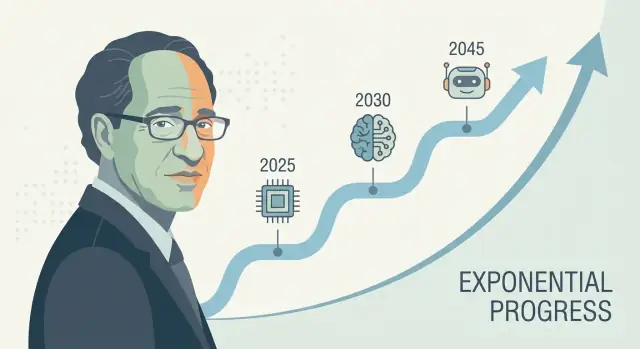
Why Kurzweil's AGI predictions matter
Kurzweil's AGI predictions matter because they turn a broad belief in artificial intelligence progress into a dated, testable sequence of claims. Investors, researchers, journalists, and business leaders can argue about a specific forecast more productively than they can argue about whether intelligent machines will arrive someday.
His approach also offers a coherent explanation for why progress might accelerate. Better computers help researchers design better computers. More capable software helps create, test, and operate the next generation of software. Falling costs allow more organizations to experiment, which produces knowledge and demand for further investment.
That structure does not make the dates correct. It makes the reasoning visible. A reader can inspect the measurements, question the assumptions, and identify evidence that would strengthen or weaken the forecast.
The distinction matters because long-range technology forecasting combines several different predictions. Hardware must improve. Algorithms must convert resources into useful capability. Training data or alternative learning methods must remain available. Systems must perform reliably outside demonstrations. Organizations and governments must permit deployment. A failure at any layer can move an AGI timeline without stopping AI progress altogether.
Kurzweil's forecast has gained relevance as general-purpose AI systems have learned to generate text, write software, interpret images, call tools, and work across multiple domains. Those abilities make the discussion less hypothetical, but they do not settle it. Broad competence in a controlled interface is not the same as dependable general intelligence in an open environment.
The useful question is therefore not whether Kurzweil is an optimist or a pessimist. It is whether his model connects measurable inputs to the capabilities implied by AGI, and whether that connection survives contact with engineering, economics, and human behavior.
Who Ray Kurzweil is
Ray Kurzweil is an American inventor, author, entrepreneur, and futurist whose forecasts grew out of decades spent building speech, reading, and music technologies.
His work before the AGI debate
Kurzweil built his reputation through practical systems rather than prediction alone. His companies worked on optical character recognition, text-to-speech synthesis, speech recognition, electronic musical instruments, and reading technology for people with visual impairments. These fields required progress in both computing hardware and pattern recognition, two subjects that later became central to his forecasting method.
His career also exposed him to the difference between a laboratory result and a product. Recognition accuracy, component prices, processing speed, distribution, and user demand all affect when an invention becomes useful at scale. That experience helps explain his focus on price-performance curves instead of isolated technical demonstrations.
Kurzweil joined Google in 2012 to work on machine intelligence and natural-language understanding. The move placed him inside an organization investing heavily in large-scale computing and AI research, although his central predictions predate that role.
The books behind the timeline
Kurzweil developed the argument across several books. The Age of Intelligent Machines examined the direction of computer intelligence. The Age of Spiritual Machines, published in 1999, organized predictions around future dates and described increasingly intimate interaction between people and computers. The Singularity Is Near, published in 2005, presented the best-known version of his accelerating-returns thesis.
How to Create a Mind, published in 2012, focused more closely on cognition and proposed that pattern-recognition mechanisms could help explain the neocortex. The Singularity Is Nearer, published in 2024, revisited the earlier forecasts after the rise of modern generative AI and retained his headline dates rather than replacing them with a new schedule.
These books do not all define intelligence in exactly the same way, but they share one argument: information technology improves through compounding processes, and those processes will eventually make machine intelligence comparable to human intelligence.
The terms need separate definitions
Three terms are often blended together even though they describe different claims:
- Artificial general intelligence is a system able to learn, reason, and apply knowledge across a broad range of unfamiliar tasks rather than operating within one narrow specialty.
- Human-level AI means performance comparable to people, but any claim using the phrase must specify which people, which tasks, how much assistance is allowed, and what error rate counts as comparable.
- The technological singularity is Kurzweil's proposed period of extremely rapid change after machine intelligence and human technology become powerful enough to transform society faster than conventional forecasting can follow.
A machine could satisfy one operational definition of human-level AI without meeting a demanding definition of AGI. AGI could also emerge before society experiences anything resembling the singularity. Treating the terms as synonyms makes the timeline appear more precise than it is.
Kurzweil's actual AGI timeline
Kurzweil's headline forecast places human-level machine intelligence around 2029 and the technological singularity around 2045.
What the 2029 prediction says
Kurzweil has associated 2029 with a machine passing a valid Turing test and reaching human-level intelligence. In a Turing-style evaluation, a human judge communicates with an unseen participant and tries to determine whether that participant is human or artificial.
The word valid carries much of the burden. Short conversations with unprepared judges are weak evidence because a system can imitate human language while failing at planning, factual consistency, or unfamiliar work. A stronger test would involve skilled evaluators, sustained interaction, adversarial questions, and controls against memorized answers or hidden human assistance.
Even a rigorous Turing test would measure behavioral imitation through conversation. It would not by itself prove dependable autonomy, physical competence, consciousness, or the ability to master any intellectual task. Kurzweil's broader writing implies more than a convincing chatbot, so evaluating the forecast requires a wider set of milestones.
What the 2045 prediction says
Kurzweil associates 2045 with a much larger transition in which machine intelligence has increased dramatically and technology has become deeply integrated with human life. His reasoning includes rapid AI-assisted research, continued gains in computing, and closer connections between biological and nonbiological cognition.
The date is therefore not simply a prediction that computers will become faster. It depends on intelligence producing further technological progress at an exceptional rate. Better AI would need to help improve algorithms, hardware, medicine, manufacturing, and scientific discovery. Those improvements would then need to feed back into the systems producing them.
A feedback loop can accelerate progress without becoming unlimited. Experiments still take time, factories have construction schedules, physical processes have limits, and institutions review consequential changes. The strength of each constraint determines whether improvement looks explosive, merely fast, or uneven across different fields.
Milestones make the forecast testable
Several observable capabilities would provide stronger evidence than a single conversational test:
- Rapid transfer to unfamiliar tasks with little task-specific training
- Reliable planning and recovery across long sequences of actions
- Continual learning without erasing previously acquired skills
- Accurate tool use under changing real-world constraints
- Broad economic usefulness without constant expert supervision
These milestones preserve the central promise of the forecast while avoiding a binary debate over one date. They also make partial progress visible. A system might master tool use while remaining poor at continual learning, or perform well in software while struggling with physical environments.
Kurzweil's forecasting record
Kurzweil's record includes notable successes, broad directional calls, and misses that become visible when predictions are judged by their original wording and deadlines.
A clear success in computer chess
One of his most cited successes concerns chess. In 1990, Kurzweil predicted that a computer would defeat the human world chess champion by 1998. IBM's Deep Blue defeated Garry Kasparov in a match in 1997.
This example is unusually strong because the event, opponent, and deadline were identifiable. It also concerned a formal domain with fixed rules, measurable performance, and heavy incentives to improve specialized hardware and search algorithms. Those conditions made chess easier to forecast than open-ended intelligence.
The result demonstrated that machines could exceed elite human performance on a demanding intellectual task. It did not show that the same system could transfer its ability to a different problem. The difference between exceptional narrow performance and general competence remains central to the AGI debate.
Predictions that were directionally right
Kurzweil anticipated widespread portable computing, wireless access, digital documents, consumer speech technology, and AI systems outperforming people in selected pattern-recognition tasks. The broad direction of these predictions matched later developments.
The details were less uniform. Portable computing became dominant mainly through smartphones and laptops rather than the exact collection of wearable devices described in some scenarios. Speech recognition became widely available, but continuous dictation did not replace keyboards as the standard way most people created text by 2009. Digital media expanded rapidly while paper persisted in offices, education, government, and personal use.
A forecast deserves partial credit when the underlying transition occurs through a different product or adoption pattern. It should not receive full credit if the original claim included a missed date, level of prevalence, or form factor. Direction and timing answer different questions.
Predictions that arrived slowly or remain unsettled
Some scenarios expected routine immersive virtual environments, highly convincing machine conversation, and much closer integration between bodies and computers earlier than ordinary use delivered them. Elements of those ideas appeared through virtual reality, assistive devices, medical implants, and generative models, but availability is not the same as widespread adoption.
Social preference can also defeat a technically feasible forecast. People may reject a device because it is uncomfortable, expensive, distracting, socially awkward, difficult to repair, or invasive. A curve measuring component performance does not capture those objections.
Why an accuracy percentage can mislead
Kurzweil conducted a retrospective evaluation of predictions from his earlier work and reported a high success rate under his scoring method. That review was not a blinded, independent audit, and many claims allowed categories such as essentially correct or directionally correct.
Any fair review should record four properties separately:
- The exact outcome that was predicted
- The deadline and any acceptable tolerance
- The measurable threshold for success
- Whether the evaluator chose the criteria before seeing the result
A prediction about transistor price is easier to score than a prediction that computers will become invisible or that machine conversation will feel normal. Combining both into one percentage hides large differences in specificity and difficulty.
How the law of accelerating returns produces the forecast
The law of accelerating returns produces Kurzweil's timeline by treating technological improvement as a compounding process in which each generation of tools contributes to the next.
Linear and exponential change
A linear process adds the same amount during each period. If a system gains 10 units of capacity every year, it moves from 10 to 20, then 30, then 40. An exponential process multiplies by a consistent factor. Five doublings turn 10 units into 320.
The early stages of exponential growth can look modest because the absolute changes are small. Later stages feel abrupt even when the multiplication rate has not changed. Kurzweil argues that human intuition often expects linear change and therefore underestimates compounding information technologies.
Real technical curves rarely follow a perfect exponential. Growth rates vary, measurements contain noise, and individual methods reach limits. The claim is that the broader price-performance trend can continue through successive methods even when one method slows.
Price-performance matters more than raw capacity
A capability confined to an expensive research system has limited reach. When the cost falls, universities, startups, established companies, and individuals can run more experiments. Wider use creates demand for infrastructure, reveals failure modes, and supports businesses that finance further development.
This is why Kurzweil frequently examines computations per unit of cost. A new processor that is faster but proportionally more expensive may not expand access. A system that completes the same work with fewer chips, less energy, or a smaller model can change adoption without setting a raw performance record.
For AI, the relevant denominator is increasingly the cost of a verified result rather than the cost of one operation or token. A cheap model that requires extensive correction may cost more per completed task than a more expensive model with a lower error rate.
Paradigm shifts extend the curve
Kurzweil's argument is broader than a permanent continuation of transistor scaling. Mechanical calculators, relays, vacuum tubes, transistors, integrated circuits, specialized accelerators, and distributed systems can be treated as successive ways of providing computation.
When one approach encounters physical or economic limits, investment may move to another. The historical curve can therefore continue across changes in mechanism. This is a stronger claim than Moore's law, but it is also harder to test because the category can expand whenever a particular technology stalls.
Several curves must compound together
Computing alone is insufficient. Memory, communication, software efficiency, model architecture, data quality, and research productivity affect the final capability. Progress can accelerate when improvements reinforce one another, such as better algorithms reducing the hardware needed for a task.
The reverse is also possible. A shortage of high-quality data, limited power delivery, memory bandwidth, or poor evaluation can leave expensive processors underused. Forecasts based on a single rising input miss these interactions.
What the evidence supports and what it does not
The evidence strongly supports continuing improvement in many inputs to AI, but it does not establish a fixed conversion rate between those inputs and general intelligence.
Evidence from computing and algorithms
Long-run records show enormous gains in computing price-performance, storage, network capacity, and software capability. AI has also benefited from specialized processors, distributed training, improved numerical formats, better optimization, and algorithms that achieve a target result with fewer resources.
Scaling laws provide another piece of evidence. Within tested ranges and a given training setup, changes in model size, data, and compute can produce relatively predictable changes in training loss. This predictability helps laboratories plan large training runs and estimate tradeoffs between resources.
A scaling law is not a law of intelligence. Lower training loss does not guarantee truthful answers, coherent goals, causal understanding, or success on a long project. Extrapolating beyond the tested range also assumes that the data distribution, architecture, and evaluation remain meaningful.
Evidence from broad AI capability
General-purpose models can perform tasks that once required separate systems, including writing, translation, image interpretation, software generation, document analysis, and tool calling. A single model can often switch among these activities through instructions rather than retraining.
That breadth is relevant to AGI because it weakens the idea that every intellectual activity requires a separately engineered program. It also demonstrates that capabilities can appear together when models learn from varied data.
The remaining gap concerns dependable performance. Systems may solve a hard problem and then fail on a simpler variation, accept a false premise, invent a source, or lose track of constraints during extended work. Occasional success establishes possibility. General intelligence requires a sufficiently high success rate across unfamiliar conditions.
Why benchmark results need context
Benchmarks are useful when they contain unseen tasks, use clear scoring, resist contamination, and measure behavior connected to real work. They become less informative after training data absorbs their questions or developers optimize directly for their scoring rules.
A credible evaluation program should separate development tests from private final tests, record resource use, repeat trials, and report failure distributions rather than averages alone. It should also compare systems with appropriate human baselines. Matching a novice on one test is different from matching a trained professional under the same time and tool constraints.
Real workflow trials add information that static tests miss. They reveal whether a system asks for missing details, checks its work, recovers after an error, and recognizes when it should stop. Those behaviors matter more to deployment than another small gain on a saturated test set.
Inputs are easier to measure than outcomes
Compute, storage, and bandwidth have stable units. Generality, judgment, adaptability, and common sense do not. Researchers can count processors precisely while disagreeing about whether a completed task demonstrates reasoning or sophisticated pattern matching.
This measurement mismatch gives quantitative forecasts an appearance of precision that the target variable may not support. Better input data narrows only one part of the uncertainty.
Assumptions behind a decades-ahead AGI prediction
Kurzweil's timeline depends on a stack of assumptions, and the date can move substantially if only one of them fails.
Compute remains economically available
The forecast assumes that organizations can keep expanding useful computation through improved chips, larger systems, better utilization, or lower-cost inference. Manufacturing capacity, capital expense, electricity, cooling, memory, networking, and international trade all affect that availability.
Physical limits do not have to stop progress to alter a timeline. A slower improvement rate sustained for several years compounds into a large difference from the original projection.
Algorithms keep turning resources into capability
More computation must continue producing meaningful gains. That can happen through scaling existing methods, discovering more efficient architectures, improving training objectives, or combining learned models with search, memory, tools, and formal verification.
This assumption is stronger than predicting faster hardware. Algorithmic discoveries do not arrive on a regular manufacturing schedule, and their value may differ across domains.
Learning is not blocked by data limits
Future systems need useful experience. That may come from human-created material, multimodal observations, simulations, interaction, synthetic examples, feedback, or experiments conducted by the systems themselves.
Synthetic data is not an automatic substitute for external evidence. If a model generates material from its own errors and receives no corrective signal, training can reinforce those errors. Simulations also transfer poorly when they omit properties that matter in the real environment.
Human cognition is reproducible by machines
Kurzweil assumes that intelligence arises from physical information processes that can be understood and implemented in nonbiological systems. His estimates often compare available computation with models of the brain and treat neuroscience as a source of engineering insight.
That position does not require copying every neuron. It does require confidence that no unknown biological mechanism creates an insurmountable barrier. Brain-based compute estimates vary because researchers count operations, synapses, spikes, biochemical processes, and learning efficiency differently.
Better AI accelerates AI research
The fastest versions of the forecast require AI to contribute materially to its own improvement. Writing code is only one part of that loop. A research system would need to formulate useful hypotheses, design experiments, interpret negative results, and distinguish genuine advances from benchmark overfitting.
Self-improvement also depends on access. A capable model cannot redesign hardware, run large experiments, or deploy a successor unless people provide resources and permission. Intelligence can shorten some steps while leaving external bottlenecks intact.
What could delay or redefine AGI
AGI could arrive later than predicted because reliability, learning, security, and deployment become limiting factors even while model capability keeps rising.
Long tasks multiply small error rates
A system can appear accurate on individual steps and still fail most extended projects. If each step succeeds independently 99 percent of the time, the chance of completing 100 required steps without an error is about 37 percent.
Real failures are often correlated, which can make the result worse. A mistaken assumption near the beginning may contaminate every later action. Progress therefore depends on detecting errors, revising plans, saving state, testing intermediate results, and escalating ambiguous decisions.
This is why autonomous task duration is a more revealing measurement than the quality of a single response. A model that completes a verified eight-hour assignment changes work differently from one that needs correction every few minutes.
Continual learning remains difficult
People acquire new knowledge through experience while preserving much of what they already know. Deployed AI systems often rely on a separation between training and use. Updating them can require new datasets, evaluation, and another training cycle.
An AGI candidate should be able to learn safely from interaction without absorbing malicious instructions, private information, or accidental falsehoods. It should also know which lessons are local to one situation and which can be generalized. Solving this problem involves memory design, access control, provenance, and protection against catastrophic forgetting.
Agency creates security problems
A model that only suggests text has a limited action surface. A system authorized to send messages, modify software, spend money, operate machinery, or manage accounts can cause damage through a small misunderstanding.
More autonomy therefore raises the need for scoped permissions, approval gates, audit logs, isolated execution, and recovery procedures. These controls can slow action, but removing them does not improve intelligence. It transfers the cost of errors to users and bystanders.
Physical competence may lag digital competence
Intelligence expressed through software benefits from fast, repeatable environments. Physical work must handle friction, breakage, uncertain sensors, unusual objects, changing weather, and safety around people.
An AI system could become broadly capable at research, analysis, communication, and software before robots reach comparable flexibility. Whether that situation counts as AGI depends on the definition. Requiring human-level physical adaptation sets a higher bar than requiring general cognitive work through computers.
Institutions may demand stronger proof
Medicine, finance, transport, public administration, and critical infrastructure impose consequences that ordinary benchmark tests do not capture. Insurers, regulators, courts, customers, and professional bodies may require documented performance before allowing autonomous operation.
This delay would not show that the underlying model lacks intelligence. It would show that capability and permission are separate milestones. A forecast about technical feasibility should not silently assume immediate social deployment.
Main critiques of Kurzweil's approach
The main critique of Kurzweil's method is that reliable trends in information technology do not automatically determine the arrival date of a poorly defined cognitive capability.
Trend selection can shape the answer
A long historical curve depends on decisions about which technologies, prices, and performance measures belong in the dataset. Combining successive computing methods may reveal a genuine pattern, but it also gives the analyst flexibility to preserve that pattern after an individual series changes direction.
Starting and ending dates matter as well. A short period of rapid improvement can appear permanently exponential, while a long average can conceal recent slowing. Forecasts should publish the underlying observations and show how results change under alternative windows.
Intelligence may not be one scalable quantity
Performance does not rise uniformly across reasoning, memory, social judgment, perception, motor control, and factual accuracy. A system can improve greatly in one area while remaining unreliable in another.
This unevenness challenges comparisons between machine capacity and an estimated computational capacity of the brain. Matching a numerical operations threshold does not identify the algorithms, representations, developmental experience, or architecture needed to use those operations effectively.
Complex systems experience regime changes
Historical relationships can break when engineering, economics, or policy changes. Manufacturing may shift toward higher costs. Energy demand may meet local grid limits. Regulation may restrict training data or deployment. Consumers may resist products that collect sensitive information.
These changes do not refute compounding progress as a general observation. They weaken confidence in a calendar date derived from the assumption that the earlier rate will persist.
Recursive improvement is not guaranteed to explode
A capable AI researcher might find easy improvements first and then face harder problems. Each generation could produce smaller gains, require more verification, or depend on physical experiments with fixed durations.
Software can sometimes be copied and tested quickly, but chip fabrication, clinical research, construction, and energy infrastructure move on different clocks. The singularity claim needs a model of those limiting processes, not just a model of software intelligence.
Flexible wording weakens falsifiability
Predictions become difficult to disprove when terms such as intelligence, merging, ubiquitous, or human-level remain open to reinterpretation. A conversational model, a medical implant, and a smartphone can all be presented as partial confirmation of broad human-machine integration.
Good forecasting fixes the scoring rule before the deadline. If the original threshold changes after observing the outcome, the exercise measures narrative adaptability rather than predictive accuracy.
How other forecasters estimate AGI timelines
Other forecasters estimate AGI through expert surveys, compute models, capability trends, structured scenarios, and prediction markets, each of which exposes different sources of uncertainty.
Expert surveys
Surveys ask researchers when they assign specified probabilities to human-level machine intelligence or the automation of particular tasks. They capture informed judgment from people working close to the technology and can show how beliefs change after important results.
Their answers depend heavily on sampling and wording. A survey of machine-learning conference authors may differ from one focused on robotics, neuroscience, safety, or economics. Asking when AI can perform most paid work is not equivalent to asking when it can outperform humans on every task.
Probability questions are more informative than demands for one year. A forecaster who assigns 10 percent, 50 percent, and 90 percent dates communicates a distribution instead of hiding uncertainty behind a point estimate.
Compute-based models
Compute models estimate the resources needed to reproduce relevant aspects of human cognition, then forecast when those resources might become affordable. Biological-anchor approaches are one version of this method.
The calculation is transparent enough to revise, but its uncertainty is wide. Researchers must estimate brain computation, training requirements, algorithmic efficiency, hardware prices, and the fraction of cognition that a practical system must reproduce. Multiplying several uncertain estimates can create a broad range of dates.
Capability-based forecasting
Capability forecasts track performance on defined tasks and estimate the rate at which systems are closing gaps. Useful targets include software projects, scientific problem solving, unfamiliar games, research assistance, and operation in interactive environments.
This method stays close to observable output. Its weakness is that benchmark progress may not continue at the same rate, and a collection of task victories may still omit an ability that general operation requires.
Scenario planning and prediction markets
Scenario planning develops several internally consistent futures rather than selecting one. A fast scenario might combine efficient algorithms, abundant infrastructure, and successful AI-assisted research. A slower scenario might include diminishing returns, difficult safety engineering, or limited deployment.
Prediction markets and forecasting platforms add incentives for calibrated estimates and allow beliefs to update after new evidence. Their usefulness depends on clear resolution criteria. A market cannot settle fairly if participants disagree about what event qualifies as AGI.
No method removes definitional uncertainty. Comparing forecasts begins by translating them into the same target, evidence standard, and probability level.
Signals that would strengthen or weaken the forecast
The strongest signals will measure transferable competence, sustained autonomy, learning efficiency, verified economics, and safe deployment rather than publicity around individual demonstrations.
Transfer to genuinely new work
A strong system should perform well on tasks created after its training cutoff and withheld from developers. It should infer unfamiliar rules, ask for missing information, and apply knowledge from one domain to another without a custom training project.
Evaluators should vary wording, tools, data formats, and environmental constraints. Success across these variations provides better evidence of generality than memorizing a familiar test style.
Longer autonomous task horizons
Track the duration and complexity of assignments completed to a defined acceptance standard. The useful measure includes retries, human interventions, verification time, and failures that leave the environment in a worse state.
An increase in maximum demonstration length is less meaningful than an increase in median reliable task length. Repeatable performance across many trials shows whether planning and recovery have improved.
Lower cost per accepted result
Token prices and model size do not measure business value directly. Cost per accepted result includes model use, tools, review, correction, infrastructure, and losses caused by errors.
A falling verified cost across many types of work would support the accelerating-returns argument because it would allow more experimentation and broader adoption. Costs that remain high because of supervision or rework would weaken claims based only on cheap inference.
Safe learning after deployment
Evidence for general intelligence would become stronger if systems could incorporate new experience without unrestricted retraining and without losing earlier competence. Tests should examine whether the system distinguishes trusted evidence from manipulation, preserves privacy boundaries, and can explain where a new belief came from.
Progress here would address a major difference between static models and adaptive workers. Failure would leave organizations dependent on external update cycles even when individual models appear knowledgeable.
Independent operational evidence
Audited deployments can reveal whether AI produces durable gains in software, science, support, operations, and other fields. Useful reports include task definitions, baseline performance, error severity, oversight requirements, and total cost.
Evidence against the fastest timeline would include flat reliable-task duration, persistent failures on simple variations, rising infrastructure costs per accepted result, or an inability to improve safety without sacrificing most of the useful autonomy. These are stronger counter-signals than a temporary pause in one benchmark.
Practical takeaways for planning
The practical response to Kurzweil's forecast is to prepare for faster AI progress without making a business, career, or policy depend on one date.
Separate current capability from AGI
Organizations do not need AGI to benefit from language models, software agents, document analysis, or automated workflows. They do need to match each tool to a bounded task and verify whether it performs that task economically.
Calling every useful system AGI creates poor decisions in both directions. It encourages reckless autonomy when a model is unreliable and unnecessary delay when a limited, supervised application already works.
Use reversible experiments
A sensible implementation process limits the cost of being wrong:
- Define the task, constraints, and acceptance test before selecting a model
- Keep consequential actions behind explicit approval until performance is measured
- Record errors by severity and cause instead of averaging them into one score
- Preserve snapshots, logs, and rollback procedures for recovery
- Compare total verified cost with the existing process
This approach remains useful under fast, uneven, or slow AI progress. It produces evidence that can update strategy without requiring a belief about the exact arrival of AGI.
Koder.ai offers one way to run this type of experiment for software development. Its chat interface can create React web applications, Go services with PostgreSQL databases, and Flutter mobile applications. Planning mode helps define work before implementation, while snapshots and rollback make trials easier to reverse. Source code export, deployment, hosting, and custom-domain support allow a team to test an application and retain practical control over the result.
Those capabilities do not depend on declaring that AGI has arrived. They apply current AI to a specific workflow with inspectable outputs. A founder can prototype a website, CRM, ERP, or mobile product, test it with users, and decide whether further investment is justified.
Plan across three scenarios
A fast-progress scenario assumes agents soon become dependable across long assignments. Preparation should focus on permission design, evaluation capacity, organizational integration, and rapid experimentation.
An uneven-progress scenario assumes strong performance in some domains alongside persistent weaknesses elsewhere. Preparation should focus on task decomposition, routing work to the appropriate system, and preserving human review where error costs are high.
A slow-progress scenario assumes present methods encounter hard limits. Preparation should favor investments that also improve conventional operations, such as better data, clearer processes, modular software, and measurable quality controls.
A decision that works in all three scenarios is more valuable than a large irreversible bet that succeeds only if one forecast is exactly right.
Ask precise questions about every prediction
Before acting on an AGI forecast, determine:
- What observable behavior qualifies as AGI?
- What probability is attached to the stated year?
- Which evidence would cause the forecaster to move the date?
- Which technical or social constraints are excluded from the model?
- How will the prediction be scored if the outcome arrives in a different form?
Kurzweil's timeline is most useful as a hypothesis about compounding technological progress. Its value lies in the measurements and assumptions it invites readers to examine, not in treating a calendar year as a promise. Prepare through bounded experiments, independent evaluation, and reversible decisions, then change course when the evidence changes.
FAQ
What are Ray Kurzweil's main AGI predictions?
Kurzweil gives two headline dates: 2029 for human-level machine intelligence and 2045 for the technological singularity. The first refers to AI matching people in broad intellectual work, while the second describes much faster technological change driven by advanced AI.
Does passing the Turing test prove that an AI is AGI?
No. A Turing test mainly measures whether a system can convincingly communicate as a human. AGI would need to do more: learn unfamiliar work, plan over long tasks, use tools reliably, recover from mistakes, and perform well outside a controlled conversation.
Why does Kurzweil expect AI progress to accelerate?
His forecast relies on the law of accelerating returns. The idea is that cheaper, faster computing and better software let more people build and test new systems, which can speed up the next round of progress. The argument depends on several trends continuing together, not on processor speed alone.
How reliable is Kurzweil's 2029 AGI forecast?
The timeline is a serious hypothesis, not a settled fact. Computing and AI capabilities have improved quickly, but no fixed rule shows how much extra compute turns into general intelligence. Reliability, data, energy, algorithms, security, and deployment rules can all shift the date.
Which Kurzweil predictions came true?
He made some strong calls, including predicting that a computer would beat the world chess champion by 1998. Deep Blue defeated Garry Kasparov in 1997. Other predictions were broadly right in direction but less accurate about timing, adoption, or the exact form products would take.
What evidence would support an AGI timeline?
Better benchmarks matter, but they are not enough on their own. Watch for systems that complete long, verified assignments with little supervision, transfer to tasks created after training, learn safely from new experience, and lower the total cost per accepted result.
Why are long AI tasks harder than single prompts?
A model can succeed on a difficult prompt and still fail during a longer project. Small mistakes compound across many steps, especially when an early false assumption affects later actions. Reliable agents need planning, testing, error detection, recovery, and clear limits on what they can do.
Do businesses need to wait for AGI before using AI?
Current AI can still create useful value without meeting any AGI definition. Organizations can use it for bounded work such as drafting, document analysis, coding support, customer support, and workflow automation, then measure quality, review time, cost, and failure severity.
How should a company test AI safely?
Start with a narrow task, define what an acceptable result looks like, and keep high-impact actions behind human approval. Track corrections, errors, total cost, and time saved. Use logs, snapshots, and rollback options so the team can reverse a bad change quickly.
What is the practical takeaway from Kurzweil's AGI forecast?
Kurzweil's dates are useful prompts for planning, but they should not drive irreversible decisions. Build skills, clean up data, improve evaluation, and run reversible experiments. Those steps help whether AI progress is fast, uneven, or slower than expected.