

REST vs gRPC: Choosing the Right API Style for Your App
Compare REST and gRPC for real projects: performance, tooling, streaming, compatibility, and team fit. Use a simple checklist to choose confidently.
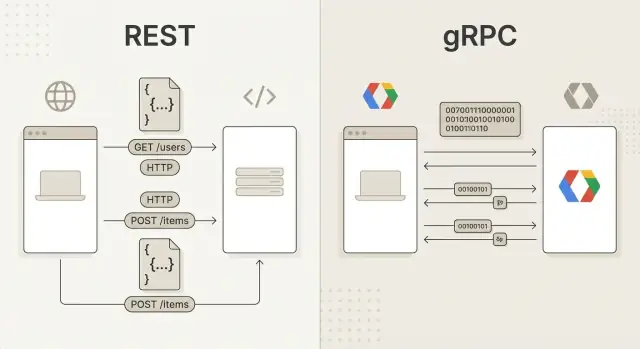
What REST and gRPC are (in plain terms)
When people compare REST and gRPC, they’re really comparing two different ways for software to “talk” over a network.
REST: resource-based HTTP APIs
REST is a style of API design built around resources—things your app manages, like users, orders, or invoices. You interact with those resources using familiar HTTP requests:
- GET to read data (for example,
GET /users/123) - POST to create something (for example,
POST /orders) - PUT/PATCH to update it
- DELETE to remove it
Responses are commonly JSON, which is easy to inspect and widely supported. REST tends to feel intuitive because it maps closely to how the web works—and because you can test it with a browser or simple tools.
gRPC: calling functions on another service
gRPC is a framework for remote procedure calls (RPC). Instead of thinking in “resources,” you think in methods you want to run on another service, like CreateOrder or GetUser.
Under the hood, gRPC typically uses:
- HTTP/2 for efficient connections
- Protocol Buffers (a compact binary format) for messages
- A strongly defined contract (a
.protofile) that can generate client and server code
The result often feels like calling a local function—except it’s running somewhere else.
What this guide will help you decide
This guide helps you choose based on real constraints: performance expectations, client types (browser vs mobile vs internal services), real-time needs, team workflow, and long-term maintenance.
There’s no one-size-fits-all answer. Many teams use REST for public or third-party APIs and gRPC for internal service-to-service communication—but your constraints and goals should drive the choice.
Key decision factors to consider first
Before comparing features, get clear on what you’re optimizing for. REST and gRPC can both work well, but they shine under different constraints.
1) Who will use the API?
Start with clients.
- If your API must be called directly from browsers (including third-party websites) or needs simple “try it in curl” accessibility, REST is usually the safer default.
- If most callers are internal services you control (service-to-service calls in a microservices setup), gRPC often fits better because it’s designed around strongly typed contracts and consistent generated clients.
2) Where will it run: public internet or private network?
On the public internet, you’ll care about proxies, caching layers, and compatibility with diverse tooling. REST over HTTP is widely supported and tends to navigate enterprise networks more predictably.
Inside a private network (or between services in the same platform), you can take advantage of gRPC’s tighter protocol and more structured communication—especially when you control both ends.
3) What are your data and call patterns?
Ask what “normal traffic” looks like:
- Simple CRUD with occasional requests: REST is straightforward and easy to reason about.
- Frequent small calls (chatty interactions) or high-throughput internal traffic: gRPC can reduce overhead and keep client/server code aligned.
- Large payloads: either can work, but be explicit about limits, pagination/chunking, and timeouts.
4) Do you need real-time behavior?
If you need streaming (events, progress updates, continuous feeds), factor that in early. You can build real-time patterns with REST-adjacent approaches, but gRPC’s streaming model is often a more natural fit when both sides can support it.
5) Team constraints and standards
Pick what your team can ship and operate confidently. Consider existing API standards, debugging habits, release cadence, and how quickly new developers can become productive. A “best” protocol that slows delivery or increases operational risk isn’t actually best for your project.
Protocol basics: HTTP, contracts, and how calls work
At the protocol level, REST and gRPC both boil down to “a client calls a server,” but they describe that call differently: REST centers on HTTP resources and status codes, while gRPC centers on remote methods and a strict schema.
REST: HTTP verbs, status codes, and headers
REST APIs typically run over HTTP/1.1, and increasingly HTTP/2 as well. The “shape” of a REST call is defined by:
- URL paths as resources (for example,
/users/123) - HTTP verbs that describe intent:
GET,POST,PUT,PATCH,DELETE - Status codes that communicate outcomes:
200,201,400,401,404,500, etc. - Headers for metadata (auth tokens, caching, content type) and content negotiation (
Accept,Content-Type)
The typical pattern is request/response: the client sends an HTTP request, and the server returns a response with a status code, headers, and a body (often JSON).
gRPC: HTTP/2, methods, metadata, and deadlines
gRPC always uses HTTP/2, but it doesn’t expose “resources + verbs” as the primary interface. Instead, you define services with methods (like CreateUser or GetUser) and call them as remote procedure calls.
Alongside the message payload, gRPC supports:
- Metadata (key/value pairs similar in spirit to headers)
- Deadlines/timeouts as a first-class concept, so clients can say “this call must finish within 200ms” and servers can stop work when the deadline is exceeded
How the call model differs: request/response vs RPC
REST asks: “What resource are you operating on, and which HTTP verb fits?”
gRPC asks: “Which method are you calling, and what typed message does it accept/return?”
That difference affects naming, error handling (HTTP status codes vs gRPC status), and how clients are generated.
What “contract” means in each approach
- REST contract: often documented with OpenAPI plus conventions (endpoints, fields, status codes). It’s flexible, but consistency depends on discipline.
- gRPC contract: a
.protoschema is the contract. It defines services, methods, and strongly typed messages, enabling reliable code generation and clearer compatibility rules as the API evolves.
Performance and efficiency: what you gain and what you trade
Performance is one of the most cited reasons teams consider gRPC—but the win is not automatic. The real question is what kind of “performance” you need: lower latency per call, higher throughput under load, lower bandwidth cost, or better server efficiency.
REST: readable JSON, but more overhead
Most REST APIs use JSON over HTTP/1.1. JSON is easy to inspect, log, and debug, which is a practical kind of efficiency for teams.
The trade-off is that JSON is verbose and needs more CPU to parse and generate, especially when payloads get large or calls get frequent. HTTP/1.1 can also add connection and request overhead when clients make many parallel requests.
REST can also be a performance win in read-heavy architectures: HTTP caching (via headers like ETag and Cache-Control) can reduce repeated requests dramatically—particularly when combined with CDNs.
gRPC: smaller messages and better connection usage
gRPC typically uses Protocol Buffers (binary) over HTTP/2. That usually means:
- Smaller payloads than JSON (less bandwidth)
- Faster serialization/deserialization (less CPU)
- HTTP/2 multiplexing (many calls share one connection)
Those benefits show up most clearly in service-to-service calls with high request volume, or when you’re pushing a lot of data around inside a microservices system.
Latency vs throughput: what to expect
On a quiet system, REST and gRPC can look similarly fast. The differences become more obvious when concurrency increases.
- Latency (time per call): gRPC often improves tail latency because it avoids repeated connection overhead and uses compact payloads.
- Throughput (calls per second): gRPC often scales better on the same hardware under heavy load.
When it matters (and when it doesn’t)
Performance differences matter most when you have high-frequency internal calls, large payloads, tight mobile bandwidth constraints, or strict SLOs.
They matter less when your API is dominated by database time, third-party calls, or human-scale usage (admin dashboards, typical CRUD apps). In those cases, clarity, cacheability, and client compatibility may outweigh raw protocol efficiency.
Streaming and real-time communication
Real-time features—live dashboards, chat, collaboration, telemetry, notifications—depend on how your API handles “ongoing” communication, not just one-off requests.
REST: request/response, plus common async patterns
REST is fundamentally request/response: the client asks, the server answers, and the connection ends. You can build near-real-time behavior, but it usually relies on patterns around REST rather than within it:
- Polling: the client asks “anything new?” every N seconds. Simple, but wastes bandwidth and battery when updates are rare, and adds latency when N is large.
- Long polling: the server holds the request open until there’s an update (or a timeout), then the client reconnects. Less wasteful than polling, but still reconnect-heavy.
- Webhooks: the server calls you when something changes. Great for third-party integrations and event notifications, but requires public endpoints, signature verification, retry handling, and careful idempotency.
(For browser-based real-time, teams often add WebSockets or SSE alongside REST; that’s a separate channel with its own operational model.)
gRPC: streaming is a first-class feature
gRPC supports multiple call types over HTTP/2, and streaming is built into the model:
- Unary: one request, one response (REST-like).
- Server streaming: one request, many responses (server pushes updates).
- Client streaming: many requests, one response (client uploads a stream of data).
- Bidirectional streaming: both sides send messages independently (true real-time conversation).
This makes gRPC a strong fit when you want sustained, low-latency message flow without constantly creating new HTTP requests.
Use cases that benefit from streaming
Streaming shines for:
- Live metrics and logs (devices or services continuously reporting)
- Chat, presence, collaboration cursors (two-way updates)
- Market data / live feeds (server streaming)
- Media or large file uploads (client streaming)
- Fan-out notifications inside microservices (service-to-service event streams)
Operational considerations for long-lived connections
Long-lived streams change how you operate systems:
- Load balancing: you need strategies that work well with sticky, long-lived HTTP/2 connections.
- Timeouts/keepalives: tune them to avoid silent disconnects and to detect dead peers.
- Backpressure: streaming can overwhelm slow consumers; design for flow control and message limits.
- Resource usage: each open stream consumes memory and concurrency; set quotas and monitor saturation.
If “real-time” is core to your product, gRPC’s streaming model can reduce complexity compared to layering polling/webhooks (and possibly WebSockets) on top of REST.
Developer experience, tooling, and maintainability
Choosing between REST and gRPC isn’t just about speed—your team will live with the API every day. Tooling, onboarding, and how safely you can evolve an interface often matter more than raw throughput.
REST: approachable tools and easy troubleshooting
REST feels familiar because it rides on plain HTTP and usually speaks JSON. That means the toolbox is universal: browser devtools, curl, Postman/Insomnia, proxies, and logs you can read without special viewers.
When something breaks, debugging is often straightforward: replay a request from a terminal, inspect headers, and compare responses side-by-side. This convenience is a big reason REST is common for public APIs and for teams that expect a lot of ad-hoc testing.
gRPC: strong contracts, generated clients, fewer surprises
gRPC typically uses Protocol Buffers and code generation. Instead of manually assembling requests, developers call typed methods in their language of choice.
The payoff is type safety and a clearer contract: fields, enums, and message shapes are explicit. This can reduce “stringly-typed” bugs and mismatches between client and server—especially in service-to-service calls and microservices communication.
Learning curve and onboarding
REST is easier to pick up quickly: “send an HTTP request to this URL.” gRPC asks new team members to understand .proto files, code generation, and sometimes different debugging workflows. Teams comfortable with strong typing and shared schemas tend to adapt faster.
Handling API changes in practice
With REST/JSON, change management often relies on conventions (adding fields, deprecating endpoints, versioned URLs). With gRPC/Protobuf, compatibility rules are more formal: adding fields is usually safe, but renaming/removing fields or changing types can break consumers.
In both styles, maintainability improves when you treat the API as a product: document it, automate contract tests, and publish a clear deprecation policy.
Client compatibility: web, mobile, and third parties
Choosing between REST and gRPC often comes down to who will call your API—and from what environments.
REST: the easiest path for “any client”
REST over HTTP with JSON is widely supported: browsers, mobile apps, command-line tools, low-code platforms, and partner systems. If you’re building a public API or expect third-party integrations, REST usually minimizes friction because consumers can start with simple requests and gradually adopt better tooling.
REST also fits naturally with web constraints: browsers handle HTTP well, caches and proxies understand it, and debugging is straightforward with common tools.
gRPC: great for controlled clients, trickier for open ecosystems
gRPC shines when you control both ends of the connection (your services, your internal apps, your backend teams). It uses HTTP/2 and Protocol Buffers, which can be a big win for performance and consistency—but not every environment can adopt it easily.
Browsers, for example, don’t support “full” native gRPC calls directly. You can use gRPC-Web, but that adds components and constraints (proxies, specific content types, and different tooling). For third parties, requiring gRPC can be a higher barrier than providing a REST endpoint.
If you need both: use a gateway
A common pattern is to keep gRPC internally for service-to-service calls and expose REST externally via a gateway or translation layer. That lets partners use familiar HTTP/JSON while your internal systems keep a strongly typed contract.
SDKs and client support: how to think about it
- With REST, SDKs are optional but helpful; many consumers will call you without them.
- With gRPC, generated client libraries are part of the model. That’s a strength (type safety, fewer manual bugs) as long as your consumers can reliably generate and update clients.
If your audience includes unknown third parties, REST is usually the safer default. If your audience is mostly your own services, gRPC is often the better fit.
Security, observability, and operations
Security and operability are often where “nice in a demo” becomes “hard in production.” REST and gRPC can both be secure and observable, but they fit different infrastructure patterns.
Security: transport and authentication
REST typically rides over HTTPS (TLS). Authentication is usually carried in standard HTTP headers:
- OAuth 2.0 / OpenID Connect (Bearer tokens) for user-facing apps
- API keys for simpler partner integrations (often combined with rate limiting)
- Optional request signing (for higher assurance)
Because REST leans on familiar HTTP semantics, it’s easy to integrate with existing WAFs, reverse proxies, and API gateways that already understand headers, paths, and methods.
gRPC also uses TLS, but authentication is commonly passed via metadata (key/value pairs similar to headers). It’s normal to add:
- Service-to-service identity (mTLS, SPIFFE/SPIRE, or mesh-issued certs)
- Tokens in metadata (for example,
authorization: Bearer …) - Per-call deadlines to limit how long a request is allowed to run (a reliability and security win)
Observability: logs, metrics, and tracing
For REST, most platforms have out-of-the-box access logs, status codes, and request timing. You can get far with structured logs plus standard metrics like latency percentiles, error rates, and throughput.
For gRPC, observability is excellent once instrumented, but it’s less “automatic” in some stacks because you’re not dealing with plain URLs. Prioritize:
- Consistent method naming (service/method) in logs
- Metrics for RPC status codes, latency, retries, and message sizes
- Distributed tracing (OpenTelemetry) so one user request can be followed across multiple services
Operations: gateways, ingress, and service meshes
Common REST setups place an ingress or API gateway at the edge, handling TLS termination, auth, rate limiting, and routing.
gRPC works well behind an ingress too, but you’ll often need components that fully support HTTP/2 and gRPC features. In microservices environments, a service mesh can simplify mTLS, retries, timeouts, and telemetry for gRPC—especially when many internal services talk to each other.
Operational takeaway: REST usually integrates more smoothly with “standard web” tooling, while gRPC shines when you’re ready to standardize on deadlines, service identity, and uniform telemetry across internal calls.
Common scenarios and what to choose
Most teams don’t pick REST or gRPC in the abstract—they pick what fits the shape of their users, clients, and traffic. These scenarios tend to make the trade-offs clearer.
When REST is the pragmatic default
REST is often the “safe” choice when your API needs to be broadly consumable and easy to explore.
Use REST when you’re building:
- Public or partner APIs where unknown third parties will integrate
- CRUD-style resource APIs (users, orders, products) that map neatly to GET/POST/PUT/DELETE
- Browser-facing endpoints where JSON over HTTP is the expected norm
- Early-stage products where you want minimal client friction and simple debugging (curl, Postman, logs)
REST tends to shine at the edges of your system: it’s readable, cache-friendly in many cases, and plays nicely with gateways, documentation, and common infrastructure.
When gRPC is a clear win
gRPC is usually the better fit for service-to-service communication where efficiency and strong contracts matter.
Pick gRPC when you have:
- Microservices communication with many internal calls per request
- High call volume or latency-sensitive workflows (recommendations, pricing, fraud checks)
- Streaming needs (server streaming, client streaming, or bidirectional)
- Strictly defined contracts you want to share across teams and languages (via Protocol Buffers)
In these cases, gRPC’s binary encoding and HTTP/2 features (like multiplexing) often reduce overhead and make performance more predictable as internal traffic grows.
When mixing both is sensible
A common, practical architecture is:
- REST at the edge for web/mobile/third-party clients
- gRPC internally for microservices and high-throughput backends
This pattern limits gRPC’s compatibility constraints to your own controlled environment, while still giving internal systems the benefits of typed contracts and efficient service-to-service calls.
Anti-patterns to avoid
A few choices regularly cause pain later:
- “Over-RPC REST”: forcing everything into endpoints like
/doThingand losing the clarity of resource-oriented design. - Premature gRPC adoption: switching to gRPC because it sounds faster, when your real problem is unclear boundaries, chatty services, or missing caching.
- Using gRPC for broad third-party access without a plan for browser support, client libraries, and onboarding.
If you’re unsure, default to REST for external APIs and adopt gRPC where you can prove it helps: inside your platform, on hot paths, or where streaming and tight contracts are genuinely valuable.
A practical decision checklist for your next project
Choosing between REST and gRPC is easier when you start with who will use the API and what they need to accomplish—not what’s trendy.
1) Start from consumers and use cases
Ask:
- Who are the consumers? Browser apps, mobile apps, internal services, external partners.
- What does “easy” mean for them? Simple curl-able requests, codegen clients, stable docs, SDKs.
- How will the API evolve? Frequent changes, strict compatibility, multiple teams releasing independently.
2) Quick checklist (pick what matters most)
Use this as a decision filter:
- Performance needs: Are payload size and latency critical (high QPS, large objects, tight SLAs)?
- Streaming: Do you need server streaming, client streaming, or bidirectional updates (chat, telemetry, live progress)?
- Client compatibility: Must it work directly from browsers without extra gateways? Do third parties need easy access?
- Tooling & workflows: Do your teams want strongly typed contracts and generated clients, or flexible JSON and manual integration?
- Operations: Can your platform reliably run HTTP/2 end-to-end and handle load balancing, retries, timeouts, and versioning rules?
- Observability: Will tracing, logging, and error reporting be straightforward for your existing tools?
3) Pilot plan: implement one endpoint both ways
Pick a representative endpoint (not “Hello World”) and build it as:
- REST (JSON over HTTP)
- gRPC (protobuf over HTTP/2)
Measure:
- Latency (p50/p95), payload size, and server CPU
- Client effort (lines of glue code, time-to-integrate)
- Operational friction (debuggability, proxies/gateways, monitoring)
If you want to move quickly on this kind of pilot, a vibe-coding workflow can help: for example, on Koder.ai you can scaffold a small app and backend from a chat prompt, then try both a REST surface and a gRPC service internally. Because Koder.ai generates real projects (React for web, Go backends with PostgreSQL, Flutter for mobile), it’s a practical way to validate not just protocol benchmarks, but also the developer experience—documentation, client integration, and deployment. Features like planning mode, snapshots, and rollback are also useful when you’re iterating on API shape.
4) Write it down—and revisit
Document the decision, the assumptions (clients, traffic, streaming), and the metrics you used. Re-check when requirements change (new external consumers, higher throughput, real-time features).
FAQ: quick answers to common questions
“Is gRPC faster than REST?”—what affects results
Often, yes—especially for service-to-service calls—but not automatically.
gRPC tends to be efficient because it uses HTTP/2 (multiplexing many calls over one connection) and a compact binary format (Protocol Buffers). That can reduce CPU time and bandwidth compared with JSON-over-HTTP.
Real-world speed depends on:
- Payload size and shape: Large, repetitive JSON fields can be slower than Protobuf.
- Network conditions: Latency and connection setup matter as much as raw throughput.
- Server and client implementation: Framework overhead, middleware, and logging can dominate.
- Caching and proxies: REST benefits from HTTP caching patterns more naturally.
If performance is a key goal, benchmark your specific endpoints with realistic data.
“Can I use gRPC from browsers?”—what’s possible and limitations
Browsers can’t use “full” gRPC directly because they don’t expose the low-level HTTP/2 features gRPC expects.
Your options are:
- gRPC-Web: Works in browsers via a compatible proxy (common in production), but has feature limits compared to native gRPC.
- REST/JSON gateway: Expose a REST endpoint for web clients while keeping gRPC internally.
If you have third-party or browser-heavy clients, REST is usually the simplest default.
“Do I need Protobuf?”—when it helps
gRPC is designed around Protobuf contracts, code generation, and strict typing. You can send other formats, but you’ll lose many benefits.
Protobuf helps when you want clear contracts, smaller payloads, and consistent client/server code.
“How do I version APIs?”—simple guidelines for both
For REST, common approaches are /v1/ in the path or versioning via headers; keep changes backward-compatible when possible.
For gRPC, prefer evolving messages safely: add new fields, avoid renaming, and don’t reuse removed field numbers. When changes are truly breaking, publish a new service or package name (effectively a new major version).
FAQ
When should I choose REST over gRPC?
REST is usually the default for public APIs because almost any client can call it with plain HTTP and JSON.
Pick REST if you expect:
- Browser or third-party integrations
- Easy ad-hoc testing with
curl/Postman - Heavy use of HTTP gateways, caching, and standard web tooling
When is gRPC the better choice than REST?
gRPC is often a better fit when you control both sides of the connection and want a strongly typed contract.
It’s a strong choice for:
- Service-to-service calls in microservices
- High-QPS or latency-sensitive internal traffic
- Streaming use cases (server, client, or bidirectional)
- Multi-language internal teams who benefit from generated clients
Is gRPC always faster than REST?
Not always. gRPC commonly wins on payload size and connection efficiency (HTTP/2 multiplexing + Protobuf), but end-to-end results depend on your bottlenecks.
Benchmark with realistic data because performance can be dominated by:
- Database/IO time
- Middleware and logging overhead
- Network conditions
- Caching (where REST may win for read-heavy traffic)
How do caching and CDNs affect the REST vs gRPC decision?
REST naturally supports HTTP caching with headers like Cache-Control and ETag, plus CDNs and shared proxies.
gRPC is typically not cache-friendly in the same way because calls are method-oriented and often treated as non-cacheable by standard HTTP infrastructure.
If caching is a key requirement, REST is usually the simpler path.
Can I call gRPC directly from a browser app?
Browsers can’t use “native” gRPC directly due to how gRPC relies on HTTP/2 features that browser APIs don’t expose.
Common options:
- Use gRPC-Web (usually with a proxy)
- Expose REST/JSON to browsers while keeping gRPC internally via a gateway
Do I have to use Protocol Buffers with gRPC?
gRPC is designed around a .proto schema that defines services, methods, and message types. That schema enables code generation and clear compatibility rules.
You can technically use other encodings, but you give up many benefits (type safety, compact messages, standardized tooling).
If you want gRPC’s main advantages, treat Protobuf as part of the package.
How is error handling different in REST vs gRPC?
REST typically communicates outcomes via HTTP status codes (e.g., 200, 404, 500) and response bodies.
gRPC returns a gRPC status code (like OK, NOT_FOUND, UNAVAILABLE) plus optional error details.
Practical tip: standardize error mapping early (including retryable vs non-retryable errors) so clients behave consistently across services.
Which is better for real-time updates and streaming?
Streaming is a first-class feature in gRPC, with built-in support for:
- Server streaming (one request, many responses)
- Client streaming (many requests, one response)
- Bidirectional streaming (two-way conversation)
REST is primarily request/response; “real-time” usually requires additional patterns like polling, long polling, webhooks, WebSockets, or SSE.
How should I version and evolve REST and gRPC APIs safely?
For REST, common practices include:
- Versioning via
/v1/...paths or headers - Keeping changes backward-compatible (add fields, avoid breaking response shapes)
For gRPC/Protobuf:
- Add new fields instead of changing/removing existing ones
- Never reuse removed field numbers
- For breaking changes, publish a new service/package version
Is it reasonable to use both REST and gRPC in the same system?
Yes, and it’s a common architecture:
- REST at the edge (public, browser, partner access)
- gRPC internally (service-to-service communication)
A gateway or backend-for-frontend layer can translate REST/JSON to gRPC/Protobuf. This reduces client friction while still getting gRPC’s contract and performance benefits inside your platform.