

Rob Pike’s Systems Pragmatism: Simple Tools, Fast Go Builds
Explore Rob Pike’s practical mindset behind Go: simple tools, quick builds, and concurrency that stays readable—plus how to apply it on real teams.
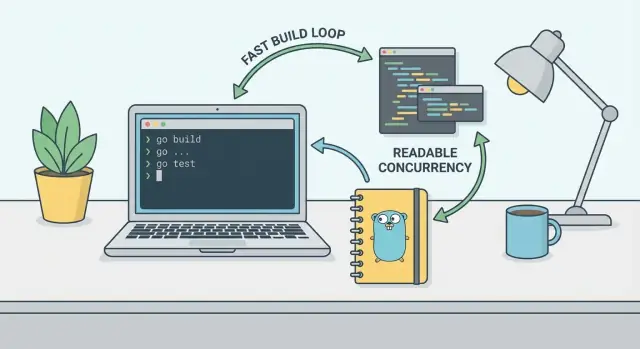
What this post means by “systems pragmatism”
This is a practical philosophy, not a biography of Rob Pike. Pike’s influence on Go is real, but the goal here is more useful: to name a way of building software that optimizes for results over cleverness.
By “systems pragmatism,” I mean a bias toward choices that make real systems easier to build, run, and change under time pressure. It values tools and designs that minimize friction for the whole team—especially months later, when the code is no longer fresh in anyone’s mind.
A plain-language definition
Systems pragmatism is the habit of asking:
- Will this decision make the codebase easier to understand?
- Will it make development faster in ordinary daily work?
- Will it reduce surprises in production?
If a technique is elegant but increases options, configuration, or mental load, pragmatism treats that as a cost—not a badge of honor.
The three pillars we’ll use in this post
To keep this grounded, the rest of the article is organized around three pillars that show up repeatedly in Go’s culture and tooling:
- Simple tooling: fewer moving parts, predictable defaults, and a common workflow.
- Fast builds: quick feedback loops that change how you work every day.
- Readable concurrency: concurrency primitives that encourage code people can reason about.
These aren’t “rules.” They’re a lens for making tradeoffs when you’re choosing libraries, designing services, or setting team conventions.
Who this is for
If you’re an engineer who wants fewer build surprises, a tech lead trying to align a team, or a curious beginner wondering why Go people talk so much about simplicity, this framing is for you. You don’t need to know Go internals—just be interested in how everyday engineering decisions add up to calmer systems.
Simplicity as a feature, not a style preference
Simplicity isn’t about taste (“I like minimal code”)—it’s a product feature for engineering teams. Rob Pike’s systems pragmatism treats simplicity as something you buy with deliberate choices: fewer moving parts, fewer special cases, and fewer opportunities for surprises.
The real cost of complexity
Complexity taxes every step of work. It slows feedback (longer builds, longer reviews, longer debugging), and it increases mistakes because there are more rules to remember and more edge cases to trip over.
That tax compounds across a team. A “clever” trick that saves one developer five minutes can cost the next five developers an hour each—especially when they’re on-call, tired, or new to the codebase.
Optimize for teams, not lone experts
Many systems are built as if the best-case developer is always available: the person who knows the hidden invariants, the historical context, and the one weird reason a workaround exists. Teams don’t work like that.
Simplicity optimizes for the median day and the median contributor. It makes changes safer to attempt, easier to review, and easier to reverse.
A tiny example: confusing vs. clear
Here’s the difference between “impressive” and “maintainable” in concurrency. Both are valid, but one is easier to reason about under pressure:
// Confusing: hard to follow, hidden coordination.
for _, job := range jobs {
	go func() { do(job) }() // also a common closure gotcha
}
// Clear: explicit data flow and ownership.
for _, job := range jobs {
	job := job
	go func(j Job) {
		do(j)
	}(job)
}
The “clear” version isn’t about being verbose; it’s about making intent obvious: which data is used, who owns it, and how it flows. That readability is what keeps teams fast over months, not just minutes.
The Go-era bet: standard tools beat endless choices
Go makes a deliberate bet: a consistent, “boring” toolchain is a productivity feature. Instead of assembling a custom stack for formatting, builds, dependency management, and testing, Go ships with defaults that most teams can adopt immediately—gofmt, go test, go mod, and a build system that behaves the same across machines.
Why “boring” tools are valuable
A standard toolchain reduces the hidden tax of choice. When every repo uses different linters, build scripts, and conventions, time leaks into setup, debates, and one-off fixes. With Go’s defaults, you spend less energy negotiating how to do the work and more energy doing it.
This consistency also lowers decision fatigue. Engineers don’t need to remember “which formatter does this project use?” or “how do I run tests here?” The expectation is simple: if you know Go, you can contribute.
Defaults that help teams collaborate
Shared conventions make collaboration smoother:
- Formatting is settled:
gofmteliminates style arguments and noisy diffs. - Project entry points are predictable:
go test ./...works everywhere. - Dependencies are visible and portable:
go.modrecords intent, not tribal knowledge.
That predictability is especially valuable during onboarding. New teammates can clone, run, and ship without a tour of bespoke tooling.
What “simple tooling” covers in practice
Tooling isn’t just “the build.” In most Go teams, the pragmatic baseline is short and repeatable:
- Formatting:
gofmt(and sometimesgoimports) - Docs:
go docplus package comments that render cleanly - Tests:
go test(including-racewhen it matters) - Dependencies: Go modules (
go mod tidy, optionallygo mod vendor) - Correctness checks:
go vet(and a small lint policy if needed)
The point of keeping this list small is social as much as technical: fewer choices means fewer arguments, and more time spent shipping.
Document conventions without heavy process
You still need team conventions—just keep them lightweight. A short /CONTRIBUTING.md or /docs/go.md can capture the few decisions that aren’t covered by defaults (CI commands, module boundaries, how to name packages). The goal is a small, living reference—not a process manual.
Fast builds as a daily productivity multiplier
A “fast build” isn’t just about shaving seconds off compilation. It’s about fast feedback: the time from “I made a change” to “I know whether it worked.” That loop includes compilation, linking, tests, linters, and the wait time to get a signal from CI.
Fast feedback changes how people work
When feedback is quick, engineers naturally make smaller, safer changes. You’ll see more incremental commits, fewer “mega-PRs,” and less time spent debugging multiple variables at once.
Fast loops also encourage running tests more often. If running go test ./... feels cheap, people do it before pushing, not after a review comment or a CI failure. Over time, that behavior compounds: fewer broken builds, fewer “stop the line” moments, and less context switching.
The hidden tax of slow builds (local and CI)
Slow local builds don’t just waste time; they change habits. People delay testing, batch changes, and keep more mental state in their head while waiting. That increases risk and makes failures harder to pinpoint.
Slow CI adds another layer of cost: queue time and “dead time.” A 6‑minute pipeline can still feel like 30 minutes if it’s stuck behind other jobs, or if failures arrive after you’ve moved on to a different task. The result is fragmented attention, more rework, and longer lead times from idea to merge.
Practical metrics to track (and improve)
You can manage build speed like any other engineering outcome by tracking a few simple numbers:
- Local build time (clean build and incremental build)
- Local test time (unit tests vs. full suite)
- CI queue time (how long jobs wait before starting)
- CI runtime (time from start to green/red)
- Time-to-signal (push to first failing check)
- Flake rate (how often CI fails without code changes)
Even lightweight measurement—captured weekly—helps teams spot regressions early and justify work that improves the feedback loop. Fast builds aren’t a nice-to-have; they’re a daily multiplier on focus, quality, and momentum.
Readable concurrency: why Go’s model resonates
Concurrency sounds abstract until you describe it in human terms: waiting, coordination, and communication.
A restaurant has multiple orders in flight. The kitchen isn’t “doing many things at the same instant” so much as it’s juggling tasks that spend time waiting—on ingredients, on ovens, on each other. What matters is how the team coordinates so orders don’t get mixed up and work doesn’t get duplicated.
Goroutines and channels: tools for clarity
Go treats concurrency as something you can express directly in the code without turning it into a puzzle.
- Goroutines let you say, “do this task concurrently,” without a heavyweight thread setup.
- Channels let you say, “here is how these tasks communicate,” using typed messages.
The point isn’t that goroutines are magic. It’s that they’re small enough to use routinely, and channels make the “who talks to whom” story visible.
“Share memory by communicating” as a practical rule
This guideline is less a slogan and more a way to reduce surprise. If multiple goroutines reach into the same shared data structure, you’re forced to reason about timing and locks. If instead they send values through channels, you can often keep ownership clear: one goroutine produces, another consumes, and the channel is the handoff.
A small scenario: pipeline + worker pool + cancellation
Imagine processing uploaded files:
A pipeline reads file IDs, a worker pool parses them concurrently, and a final stage writes results.
Cancellation matters when the user closes the tab or a request times out. In Go, you can thread a context.Context through the stages and have workers stop promptly when it’s done, rather than continuing expensive work “just because it started.”
The result is concurrency that reads like a workflow: inputs, handoffs, and stopping conditions—more like coordination between people than a maze of shared state.
Patterns that keep concurrent code understandable
Concurrency gets hard when “what happens” and “where it happens” are unclear. The goal isn’t to show off cleverness—it’s to make the flow obvious to the next person reading the code (often future-you).
Make intent visible: naming and tiny functions
Clear naming is a concurrency feature. If a goroutine is launched, the function name should explain why it exists, not how it’s implemented: fetchUserLoop, resizeWorker, reportFlusher. Pair that with small functions that do one step—read, transform, write—so each goroutine has a crisp responsibility.
A useful habit is to separate “wiring” from “work”: one function sets up channels, contexts, and goroutines; worker functions do the actual business logic. That makes it easier to reason about lifetimes and shutdown.
Default to bounded work: queues, timeouts, and context
Unbounded concurrency usually fails in boring ways: memory grows, queues pile up, and shutdown becomes messy. Prefer bounded queues (buffered channels with a defined size) so backpressure is explicit.
Use context.Context to control lifetime, and treat timeouts as part of the API:
- Add a deadline for external calls (network, disk, RPC).
- Make goroutines stop when the context is canceled.
- Ensure every “background” loop has a clear exit path.
Channels vs. mutexes: a practical rule of thumb
Channels read best when you’re moving data or coordinating events (fan-out workers, pipelines, cancellation signals). Mutexes read best when you’re protecting shared state with small critical sections.
Rule of thumb: if you find yourself sending “commands” through channels just to mutate a struct, consider a lock instead.
Escape hatches: sometimes a lock is simpler
It’s fine to mix models. A straightforward sync.Mutex around a map can be more readable than building a dedicated “map owner goroutine” plus request/response channels. Pragmatism here means picking the tool that keeps the code obvious—and keeping the concurrency structure as small as possible.
Common concurrency pitfalls and how to avoid them
Concurrency bugs rarely fail loudly. More often they hide behind “works on my machine” timing and only surface under load, on slower CPUs, or after a small refactor changes scheduling.
Failure modes to watch for
Leaks: goroutines that never exit (often because nobody reads from a channel, or a select can’t make progress). These don’t always crash—memory and CPU usage just creep up.
Deadlocks: two (or more) goroutines waiting on each other forever. The classic example is holding a lock while trying to send on a channel that needs another goroutine that also wants the lock.
Silent blocking: code that stalls without panicking. An unbuffered channel send with no receiver, a receive on a channel that’s never closed, or a select that lacks a default/timeout can look perfectly “reasonable” in a diff.
Data races: shared state accessed without synchronization. These are especially nasty because they can pass tests for months and then corrupt data once in production.
Why reviewers can’t reliably spot them by sight
Concurrent code depends on interleavings that aren’t visible in a PR. A reviewer sees a neat goroutine and a channel, but can’t easily prove: “Will this goroutine always stop?”, “Is there always a receiver?”, “What happens if upstream cancels?”, “What if this call blocks?” Even small changes (buffer sizes, error paths, early returns) can invalidate assumptions.
Practical defenses that pay off
Use timeouts and cancellation (context.Context) so operations have a clear escape hatch.
Add structured logging around boundaries (start/stop, send/receive, cancel/timeout) so stalls become diagnosable.
Run the race detector in CI (go test -race ./...) and write tests that stress concurrency (repeat runs, parallel tests, time-bounded assertions).
PR checklist for concurrent code
- Does every goroutine have a clear, testable shutdown path?
- Are channel ownership rules obvious (who closes, who reads/writes)?
- Can any send/receive block forever? If so, is there a timeout/cancel?
- Are shared variables protected (mutex/atomic/channel confinement)?
- Are error paths and early returns safe (no leaked goroutines, no missed unlocks)?
Tradeoffs: when pragmatism feels restrictive
Systems pragmatism buys clarity by narrowing the set of “allowed” moves. That’s the deal: fewer ways to do things means fewer surprises, faster onboarding, and more predictable code. But it also means you’ll occasionally feel like you’re working with one hand tied behind your back.
Where “less choice” can pinch
APIs and patterns. When a team standardizes on a small set of patterns (one logging approach, one config style, one HTTP router), the “best” library for a specific niche might be off-limits. This can feel frustrating when you know a specialized tool could save time—especially in edge cases.
Generics and abstraction. Go’s generics help, but a pragmatic culture will still be skeptical of elaborate type hierarchies and meta-programming. If you’re coming from ecosystems where heavy abstraction is common, the preference for concrete, explicit code can feel repetitive.
Architecture choices. Simplicity often pushes you toward straightforward service boundaries and plain data structures. If you’re aiming for a highly configurable platform or framework, the “keep it boring” rule may limit flexibility.
How to make exceptions without creating chaos
Use a lightweight test before deviating:
- Is the current standard actually failing (performance, correctness, security, or major maintenance pain), or is this mainly preference?
- Will the new approach reduce total complexity across the team, not just in one component?
- Can we explain it in a page to a new teammate, including when to use it and when not to?
- What’s the exit plan if it doesn’t work out?
If you do make an exception, treat it like a controlled experiment: document the rationale, the scope (“only in this package/service”), and the usage rules. Most importantly, keep the core conventions consistent so that the team still shares a common mental model—even when a few well-justified deviations exist.
From local builds to production: the operational angle
Fast builds and simple tooling aren’t just developer comforts—they shape how safely you ship and how calmly you recover when something breaks.
Build speed affects deployment reliability
When a codebase builds quickly and predictably, teams run CI more often, keep branches smaller, and catch integration issues earlier. That reduces “surprise” failures during deploys, where the cost of a mistake is highest.
The operational payoff is especially clear during incident response. If rebuilding, testing, and packaging take minutes instead of hours, you can iterate on a fix while the context is fresh. You also lower the temptation to “hot patch” in production without full validation.
Readable code helps under pressure
Incidents are rarely solved by cleverness; they’re solved by speed of understanding. Smaller, readable modules make it easier to answer basic questions quickly: What changed? Where does the request flow? What could this affect?
Go’s preference for explicitness (and avoiding overly magical build systems) tends to produce artifacts and binaries that are straightforward to inspect and redeploy. That simplicity translates into fewer moving parts to debug at 2 a.m.
Practical habits that scale
A pragmatic operational setup often includes:
- Small services or well-bounded modules, so rollbacks and redeploys have limited blast radius.
- Clear, structured logs with consistent fields (request IDs, user IDs, error codes), so you can correlate events without guesswork.
- Predictable rollbacks: versioned artifacts, simple deployment steps, and a known-good path back.
None of this is one-size-fits-all. Regulated environments, legacy platforms, and very large orgs may need heavier process or tooling. The point is to treat simplicity and speed as reliability features—not aesthetic preferences.
How to apply this philosophy on your team
Systems pragmatism only works when it shows up in everyday habits—not in a manifesto. The goal is to reduce “decision tax” (which tool? which config?) and increase shared defaults (one way to format, test, build, and ship).
A step-by-step adoption plan (low drama, high leverage)
1) Start with formatting as a non-negotiable default.
Adopt gofmt (and optionally goimports) and make it automatic: editor-on-save plus a pre-commit or CI check. This is the quickest way to remove bikeshedding and make diffs easier to review.
2) Standardize how tests run locally.
Pick a single command people can memorize (for example, go test ./...). Write it into a short CONTRIBUTING guide. If you add extra checks (lint, vet), keep them predictable and documented.
3) Make CI reflect the same workflow—then optimize for speed.
CI should run the same core command(s) developers run locally, plus only the extra gates you truly need. After it’s stable, focus on speed: cache dependencies, avoid rebuilding everything on every job, and split slow suites so fast feedback stays fast. If you’re comparing CI options, keep pricing/limits transparent for the team (see /pricing).
Where Koder.ai fits this “pragmatic default” mindset
If you like Go’s bias toward a small set of defaults, it’s worth aiming for the same feel in how you prototype and ship.
Koder.ai is a vibe-coding platform that lets teams create web, backend, and mobile apps from a chat interface—while still keeping engineering escape hatches like source code export, deployment/hosting, and snapshots with rollback. The stack choices are intentionally opinionated (React on the web, Go + PostgreSQL on the backend, Flutter for mobile), which can reduce “toolchain sprawl” in early stages and keep iteration tight when you’re validating an idea.
Planning mode can also help teams apply pragmatism upfront: agree on the simplest shape of the system first, then implement incrementally with fast feedback.
Measure improvement without heavy process
You don’t need new meetings—just a few lightweight metrics you can track in a doc or dashboard:
- Median time from “fresh checkout” to a green build (local and CI)
- CI duration and failure rate (especially flaky tests)
- PR cycle time (open → first review → merge)
- Number of “style-only” comments in reviews (should drop sharply after formatting is enforced)
Revisit these monthly for 15 minutes. If numbers get worse, simplify the workflow before adding more rules.
Copy/paste: a pragmatism checklist
- One formatter, enforced automatically
- One “default” test command everyone uses
- CI mirrors local commands; no surprise steps
- Fast feedback: keep the critical path under an agreed time budget
- Prefer standard tools over bespoke scripts unless there’s clear payoff
- Concurrency patterns are documented with one or two examples
- When adding a tool, write down what decision it removes
For more team workflow ideas and examples, keep a small internal reading list and rotate posts from /blog.
Key takeaways and next steps
Systems pragmatism is less a slogan than a daily working agreement: optimize for human comprehension and fast feedback. If you remember only three pillars, make them these:
- Simplicity in tools and APIs: prefer a small, consistent set of defaults over endless configuration so the whole team can predict how things behave.
- Fast builds and tight feedback loops: shorten the time between “I changed something” and “I know whether it works,” because that’s where productivity and confidence actually come from.
- Readable concurrency: use a model that makes coordination explicit and reviewable, so parallel work doesn’t turn into parallel confusion.
The real goal
This philosophy isn’t about minimalism for its own sake. It’s about shipping software that’s easier to change safely: fewer moving parts, fewer “special cases,” and fewer surprises when someone else reads your code six months later.
Pick one change to try this week
Choose a single, concrete lever—small enough to finish, meaningful enough to feel:
- Make builds faster (cache dependencies, reduce work in tests, or remove slow generators from the default path).
- Standardize a tool path (one formatter/linter setup everyone runs the same way).
- Simplify concurrency in one module (replace clever synchronization with a clearer goroutine + channel structure, or document the ownership model in comments).
Write down the before/after: build time, number of steps to run checks, or how long a reviewer needs to understand the change. Pragmatism earns trust when it’s measurable.
Further reading
If you want more depth, browse the official Go blog for posts on tooling, build performance, and concurrency patterns, and look up public talks by Go’s creators and maintainers. Treat them as a source of heuristics: principles you can apply, not rules you must obey.
FAQ
What does this post mean by “systems pragmatism”?
“Systems pragmatism” is a bias toward decisions that make real systems easier to build, run, and change under time pressure.
A quick test is asking whether the choice improves day-to-day development, reduces production surprises, and stays understandable months later—especially for someone new to the code.
Why treat simplicity as a product feature instead of a style preference?
Complexity adds a tax to nearly every activity: reviewing, debugging, onboarding, incident response, and even making small changes safely.
A clever technique that saves one person minutes can cost the rest of the team hours later, because it increases options, edge cases, and mental load.
How do Go’s “boring defaults” help teams ship faster?
Standard tools reduce “choice overhead.” If every repo has different scripts, formatters, and conventions, time leaks into setup and debates.
Go’s defaults (like gofmt, go test, and modules) make the workflow predictable: if you know Go, you can usually contribute immediately—without learning a custom toolchain first.
What’s the practical value of enforcing gofmt (and optionally goimports)?
A shared formatter like gofmt eliminates style arguments and noisy diffs, which makes reviews focus on behavior and correctness.
Practical rollout:
- Run formatting on save in editors.
- Add a CI check that fails if files aren’t formatted.
- Keep any extra style rules minimal so formatting doesn’t become a second job.
Why are fast builds more than just “saving a few seconds”?
Fast builds shorten the time from “I changed something” to “I know whether it worked.” That tighter loop encourages smaller commits, more frequent testing, and fewer “mega-PRs.”
It also reduces context switching: when checks are fast, people don’t postpone testing and then debug multiple variables at once.
What build and CI metrics are most useful to measure?
Track a few numbers that map directly to developer experience and delivery speed:
- Local incremental build time and clean build time
- Local unit test time vs. full suite time
- CI queue time and CI runtime
- Time-to-signal (push to first failing check)
- Flake rate (failures without code changes)
Use these to catch regressions early and justify work that improves feedback loops.
What’s a minimal Go tooling baseline a team can standardize on?
A small, stable baseline is often enough:
gofmtgo test ./...go vet ./...go mod tidy
Then make CI mirror the same commands developers run locally. Avoid surprise steps in CI that don’t exist on a laptop; it keeps failures diagnosable and reduces “works on my machine” drift.
What are the most common Go concurrency pitfalls, and how do you defend against them?
Common pitfalls include:
- Goroutine leaks (no shutdown path, blocked sends/receives)
- Deadlocks (cyclic waiting, lock + channel interactions)
- Silent blocking (waiting forever with no timeout/cancel)
- Data races (unsynchronized shared state)
Defenses that pay off:
- Thread
context.Contextthrough concurrent work and honor cancellation. - Add timeouts for external calls.
- Run
go test -race ./...in CI. - Make channel ownership explicit (who closes, who reads/writes).
When should I prefer channels vs. mutexes in Go?
Use channels when you’re expressing data flow or event coordination (pipelines, worker pools, fan-out/fan-in, cancellation signals).
Use mutexes when you’re protecting shared state with small critical sections.
If you’re sending “commands” through channels just to mutate a struct, a sync.Mutex may be clearer. Pragmatism means picking the simplest model that stays obvious to readers.
When is it worth deviating from the “keep it boring” approach?
Make exceptions when the current standard is genuinely failing (performance, correctness, security, or major maintenance pain), not just because a new tool is interesting.
A lightweight “exception test”:
- Will it reduce total complexity for the whole team?
- Can you explain usage rules in about a page?
- What’s the exit plan if it doesn’t work out?
If you proceed, scope it tightly (one package/service), document it, and keep core conventions consistent so onboarding stays smooth.