

Salon color formula app: keep client mixes consistent
Set up a salon color formula app to save mixes per client with dates, photos, and notes, so every retouch and refresh matches what you did last time.
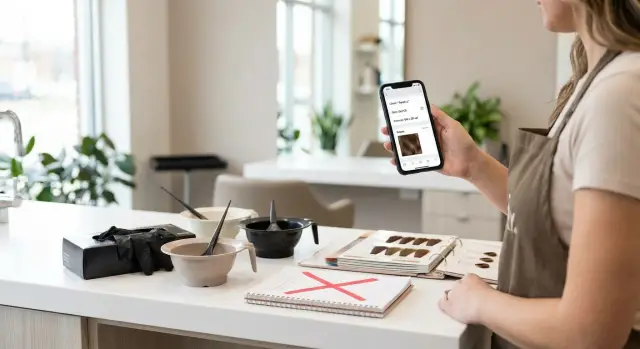
Why your formulas get inconsistent over time
Most color formulas don’t break all at once. They drift a little each visit, until one day the root touch-up looks warmer, darker, or more sheer than last time and nobody can point to a single cause.
Drift usually starts with small, reasonable decisions. Someone swaps developer because that’s what’s on the shelf. A shade runs out and gets replaced with “close enough.” Notes get rushed and turn into “6N + a little 7G.” Next time, you’re not repeating the same mix anymore.
Formula inconsistency usually comes from a few predictable places:
- Shade substitutions (new stock, discontinued lines, “close enough” swaps)
- Different developer strength or brand
- Vague ratios (parts, pumps, scoops, “splash”)
- Timing changes (busy day, interruptions, heat vs no heat)
- Missing context (starting level, porosity, gray percentage)
Paper notebooks make it easier to lose the details that actually matter. Photos end up in a camera roll with no date or formula. Ratios get shortened. Processing time gets skipped. And even when the formula is written clearly, you can’t tell if the result was perfect, slightly too cool, or just looked better under different lighting.
You feel the inconsistency first at the bowl: mixing twice, second-guessing, asking “What did we do last time?” Later it shows up at the chair: extra toning, uneven banding, or a retouch that doesn’t blend into the mids and ends.
A consistent touch-up doesn’t mean identical hair every visit. Hair changes with sun, heat, hormones, and previous services. Consistency means a reliable starting point: same line, same developer, same ratio, same placement, same timing, plus a clear note and photo of the outcome. That’s what a salon color formula app should protect, especially on busy days.
What to record for each client color service
Color history only helps if it’s repeatable. If every stylist records different details, the notes look “full” but still won’t recreate the same result.
Start with what you’ll need to search and verify later:
- Client name plus a short identifier (phone or client ID)
- Date and service type (root touch-up, full color, highlights, toner, gloss)
- Brand and line (be specific when brands have multiple lines)
- Shade codes and exact ratios (example: 6N:6A = 1:1)
- Total amount mixed (grams or oz), so the ratio isn’t just theoretical
Then capture the variables that change the outcome even when the shades stay the same. Write these as simple numbers and clear choices:
- Developer brand/type and strength (example: 20 vol)
- Developer ratio (if relevant)
- Processing time (example: 35 minutes)
- Heat or no heat
Placement is where “same formula, different result” usually begins. Note where each mix went (roots, mids, ends), whether you refreshed anything, and what happened after shampoo (toner, gloss, shadow root). If you repeat a sectioning pattern, define it once and reuse the same wording (example: “4 quadrants, fine diagonal back”).
Photos do more than extra paragraphs, but only if they’re consistent. Keep a small set you can compare over time:
- Before photo (same lighting and angle)
- After photo (same lighting and angle)
- Grow-out photo at the next visit (roots and hairline)
- Close-up of the target area (temples, money piece, hairline)
Finally, add the quick context that prevents mistakes later: gray coverage estimate, porosity/damage notes, and any allergy or patch test info.
Example: If Maya comes in every 6 weeks for a root touch-up, you can recreate the result because you have the exact root mix, 20 vol, 35 minutes, plus a note that her temples are about 60% gray and needed 10 extra minutes.
A simple structure that stays easy to use
The easiest way to keep records clean is to treat each visit as one entry: one appointment, one dated set of formulas, plus a couple of photos. That one rule keeps your salon color formula app from turning into a diary.
A good entry reads like a recipe card. Another stylist should be able to repeat it without guessing.
A simple structure most teams can stick with:
- Service label and date (example: “6-week root touch-up”)
- Starting point: natural level, existing color, gray percentage, banding notes
- Formula(s): brand/line, shade codes, ratio, developer, total grams
- Placement and timing: where it went, how long it processed, heat/no heat
- Photos: before and after in consistent lighting
Multi-step services are where notes fall apart. Keep one entry, but split it into named steps inside that entry (Lighten, Tone, Root melt, Gloss). Each step gets its own formula, developer, timing, and placement. You don’t need a novel, just enough to repeat the result.
Labels matter more than people expect. Pick a small set your salon uses and keep them consistent (for example: “6-week root,” “12-week root + refresh,” “toner refresh”). Consistent labels make searching faster and help you spot patterns like “needs a warmer toner in winter.”
Duplicating a prior entry saves time, but only if you update what actually changed:
- Duplicate when the goal is the same and you’re doing small tweaks (time, grams, one shade shift)
- Start a new entry when you change technique (foils vs balayage, new root melt method)
- Start a new entry when the base changes (major cut, heavy sun fade, box dye)
- Duplicate for maintenance visits, new entry for corrections
If you can’t find an app that matches this structure, some salons prototype a lightweight tracker with tools like Koder.ai so the fields match exactly how the team works.
Features that matter in a color formula notebook app
The best app is the one you’ll use with gloves on, between foils, while the client is talking. If it feels like homework, people skip it and your notes stop being reliable.
Search is the first make-or-break feature. You should be able to find a client by name, phone, or a quick tag your salon agrees on (like gray coverage, balayage, toner refresh). When the book is full, nobody has time to scroll.
Photos are the second. You want multiple photos per visit, kept in order, so you can see before, in-process, and finished results without guessing which photo matches which formula. Short captions help too (example: “natural light,” “after round brush”), because lighting changes everything.
Offline use matters more than it sounds. If reception is spotty in the back room, an app that still opens client color history and saves a new entry prevents “I’ll do it later” from turning into “we never wrote it down.”
Edits should be easy, but history should stay visible. When you adjust a formula later, the previous version should still be readable so you can see what changed and why.
A short checklist that supports real service flow:
- Fast search by name, phone, and a small set of tags
- Multiple photos per appointment, kept in chronological order
- Works with weak signal (view and save without drama)
- Edit without erasing older formulas
- Quick entry for shade, developer, timing, and outcome notes
If your salon needs something more specific, a small custom tracker can be a good fit. A tool like Koder.ai can help you sketch and build a simple internal app from chat so your fields, labels, and screens match your standards.
Before you set it up: agree on standards in the salon
A salon color formula app only helps if everyone logs formulas the same way. If each stylist writes notes in their own style, “history” turns into guesses and touch-ups drift.
Start with one decision and stick to it: units. Pick grams or ounces and use it for every mix. Grams often feel easier because they’re precise on a scale, but the best choice is the one your team will follow.
Next, define a short set of required fields. Keep it small, but non-negotiable.
Your must-have fields
- Date of service and who applied it
- Brand + line + shade codes (exact)
- Developer brand/type and strength, plus processing time
- Placement notes (roots, mids, ends, toner zone)
- One clear photo before and after
Naming rules matter. If one person writes “Wella 7/1” and another writes “Wella Koleston 7-1,” search splits into duplicates. Decide on one format (Brand, line, shade, then add-ons) and keep it visible for the team.
Photo rules also matter. Pick one spot in the salon with steady lighting if you can. Use the same angles each time (back of head, both sides, hairline close-up for root work). Agree on when photos happen: before application, after rinse, and after styling (or just one after if you need it fast).
Keep tags broad and limited. If you create 30 tags, nobody uses them. A few like “root touch-up,” “toner,” and “corrective” usually covers what you’ll filter later.
Step by step: logging a formula in under 2 minutes
Speed comes from using the same order every time. With the right fields, logging becomes quick checkboxes instead of a writing task.
A fast, repeatable flow
- Confirm the client profile basics: preferred tone and key hair notes (gray %, porosity, density, previous lightening, sensitivities).
- Add a new visit entry: date and service type. This keeps client color history clean.
- Enter the formula with the math: brand/line, shade codes, ratio, total grams, developer strength and ratio, plus additives.
- Record application details: placement (roots only, mids refresh, ends glaze), timing, heat/no heat, and any timing splits.
- Attach proof and a plan: a clear before/after photo pair, one sentence on the outcome, and a next-time note.
Keep photos simple: one in consistent salon lighting and one near a window is often enough. If your app supports labels, use short ones like “before roots” and “after dry.”
What to type (and what to skip)
Write what changes the result. Skip long stories.
A good outcome note: “Covers ~70% gray. Slight warmth at the part line after 3 weeks.”
A good next-time plan: “Same formula. Add 5g ash to root mix. Process 5 minutes longer at hairline.”
If you’re building the form yourself, keep it short and use defaults for common developers and typical times. Some salons prototype this kind of tracker with Koder.ai so the team can log formulas on a phone, store photos, and keep the next-time plan visible.
Example: a realistic root touch-up with a small tweak
Client: 6-week grow-out, natural level 5 base, about 40% gray concentrated at the temples. She likes a neutral-warm brunette, but in winter her mids and ends can look a little flat.
Last visit (saved):
Date: Nov 18. Service: root touch-up + refresh on mids/ends.
Roots: 5N + 5G (1:1) with 20 vol. Timing: 35 minutes (start at temples for gray coverage, then the rest). Placement: 1/4 inch past the regrowth.
Mids/ends: 6G demi with 5 vol, 10 minutes at the bowl for tone and shine. Notes: “Client prefers warm but not copper. Temples need extra saturation.” Photos: one in natural light near the window, one under salon lights.
Today (how you replicate it fast):
You open the most recent entry and you’ve got the exact mix, developer, and timing. Photos confirm the result you’re aiming for and where the warmth landed.
Before you mix, you check two notes: “temples first” and “only 1/4 inch past.” That prevents the common drift where roots get pulled too far and darken the overall look.
Small adjustment (seasonal tone shift) while keeping roots the same:
Keep the root formula identical for consistency. Adjust only the mids/ends refresh: switch from 6G to 6G + a small amount of 6N (about 3:1) to keep warmth but add a touch more neutrality. Same low developer, same short processing time.
End the entry with a clear repeat line:
- Roots: repeat Nov 18 exactly (start at temples)
- Mids/ends: winter refresh = 6G + 6N (3:1), 10 min
- Photos: take one window photo after blow-dry
Common mistakes that ruin your color history
A good record lets any stylist recreate the same result weeks later. Most “mystery formulas” happen because notes look complete but miss the details that control the outcome.
A big one is writing shades without the math. “7N + 7A” isn’t a formula unless you also record ratio, total grams, developer brand/type, and strength. Forgetting 10 vol vs 20 vol can easily change depth, warmth, and gray coverage.
Photos can mislead if they aren’t consistent. A quick snap helps, but only if lighting and angle are similar and the photo is labeled (before, after, dry, styled). Bright window light vs overhead salon lights can shift tone enough to “prove” the wrong thing.
Consistency also falls apart when the team uses different units and shorthand. One person writes “1:1,” another writes “equal parts,” someone else writes “30g total,” and nobody says whether that total includes developer. Pick one format and use it every time.
Another mistake is overwriting the last visit. Each appointment should be a new entry with a date, otherwise you lose what changed, why it changed, and which formula wore best.
What usually saves the next retouch:
- Date, service type, and who applied it
- Exact mix (shades, ratio, grams) plus developer brand/type and strength
- Processing time, heat/no heat, plus any toner or glaze steps
- One outcome line (too warm at week 2, perfect gray coverage)
- Photo labeled before/after with lighting notes
If a client lifted more gold because you processed 10 minutes longer, that one line prevents a pointless formula change next visit.
Quick checklist: is your system working?
A color log only helps if it’s faster than guessing. If you have to scroll, squint, or piece together what happened last time, you’ll stop using it. A good system feels boring: you can repeat results without thinking too hard.
Spot check 10 random clients from the last month. If more than two fail, fix the system before you add more entries.
The 10-second test
Open your salon color formula app and pull up the last formula while a client is in your chair. You should find the client, see the most recent entry, and understand it at a glance.
Check:
- Can you find the last entry in under 10 seconds?
- Does every entry show date, shades, ratio, developer, and processing time in plain text?
- Are photos attached and labeled (before, after, and grow-out/root regrowth if needed)?
- Could another stylist repeat the service without texting you?
- Do you have a safety net like backup or export so you don’t lose months of client color history?
What good looks like in real life
If Maria books a root touch-up 8 weeks later, you should instantly see the last root formula, timing, and a grow-out photo. If the note says “5 vol on ends to refresh” but doesn’t say how long or how much, that entry fails. The goal is repeatable, not “close enough.”
If you keep failing this checklist, the fix is usually simple: tighten required fields, label photos, and agree on a short note style everyone follows.
Next steps: keep it consistent and scalable
A system only works if everyone uses it the same way. Once you’ve set up your salon color formula app, lock in a few rules so the notes stay usable as your client list grows.
Set clear access and editing rules
Decide who can view formulas and who can edit them. One careless edit can break a client’s history.
- Owner/manager: can edit anything and enforce naming rules
- Stylists: can add new entries and update their own clients
- Assistants: can view and log basics (like processing time), but not change older entries
- New team members: view-only at first
Write it down and stick to it.
Keep data and photos simple and safe
Store what helps you repeat the service: formula, developer, timing, placement, date, and one clear photo set.
Avoid sensitive personal details in notes. Keep consent simple: ask once, keep it short, and make “no photos” easy.
Do a monthly cleanup (10 minutes)
Small messes turn into a useless database if you ignore them. Once a month:
- Merge duplicate client profiles
- Fix inconsistent shade naming
- Fill missing essentials (developer, timing, grams)
- Remove blurry photos or plan to retake next visit
- Flag entries that need clarification before the next appointment
If off-the-shelf tools stop fitting your workflow, a lightweight custom tracker can be a practical next step. With Koder.ai (koder.ai), you can describe the screens and fields you want in chat and build an internal app that matches how your salon actually records client color history.
FAQ
Why does my client’s root touch-up look different even when I “use the same formula”?
Formula drift usually happens through small substitutions that add up: a different developer, a “close enough” shade replacement, or unclear ratios like “a splash.” The fix is to record the exact brand/line, shade codes, ratios, total amount mixed, developer details, and timing every visit so you can repeat the same starting point.
What are the minimum details I should log for every color service?
Record what makes the service repeatable: date, service type, brand and line, shade codes, exact ratio, total grams/oz mixed, developer brand/type/strength, processing time, and heat or no heat. Add short placement notes (where each mix went) and at least one clear before/after photo so you can verify the result, not just the recipe.
How should I write ratios so another stylist can mix it correctly?
Write ratios as numbers and tie them to a total amount, like “6N:6A = 1:1, 60g color.” That way the next stylist can recreate the same bowl without guessing what “equal parts” meant, and you avoid accidental shifts from using different scoop sizes or pump counts.
Does developer brand and strength really matter enough to track?
Developer changes can shift depth, warmth, and gray coverage even if the shade codes stay the same. Log the developer strength and also the brand/type, because two “20 vol” developers from different systems can behave differently in real services.
What photos actually help with color consistency (and how many do I need)?
Keep photos consistent: similar lighting, similar angle, and a quick label like “before,” “after rinse,” or “after dry.” A good photo set helps you catch issues like warmth at the part line or banding that written notes often miss, especially when lighting can make color look cooler or warmer than it is.
How do I log multi-step services without my notes turning into a novel?
Treat each appointment as one dated entry, then split the entry into named steps like Lighten, Tone, Root melt, and Gloss. Each step gets its own formula, developer, timing, and placement, so you don’t lose the details that make multi-step services hard to repeat.
How do I get my whole team to log formulas the same way?
Pick one unit (grams or ounces) and one naming format for shades and lines, then make a few fields non-negotiable for everyone. Consistency in how you write things is what makes search work and keeps “history” from turning into different personal shorthand that nobody can decode later.
What’s the best way to use tags without creating a messy system?
Keep tags broad and limited, and make them match how you search during a busy day. If you create too many tags, nobody uses them; a small set tied to common services and situations is easier to stick with and still makes filtering useful.
Do I really need offline access in a salon color formula app?
Offline access matters when reception is weak in back rooms, because it prevents the “I’ll log it later” problem. A workable system lets you view the last entry and save the new one immediately, so formulas don’t get reconstructed from memory at the end of the day.
How should I handle privacy and editing so client color history stays safe and accurate?
Store only what helps you repeat the service and keep clients safe: formulas, timing, placement notes, and photos with clear consent. Limit who can edit old entries so one change doesn’t erase history, and avoid sensitive personal details in notes beyond what you truly need for the service.