

Samsung Electronics’ Scale Advantage: Devices to Semiconductors
How Samsung links devices, displays, and semiconductors to scale R&D, manufacturing, and supply chains—powering both consumer products and components.
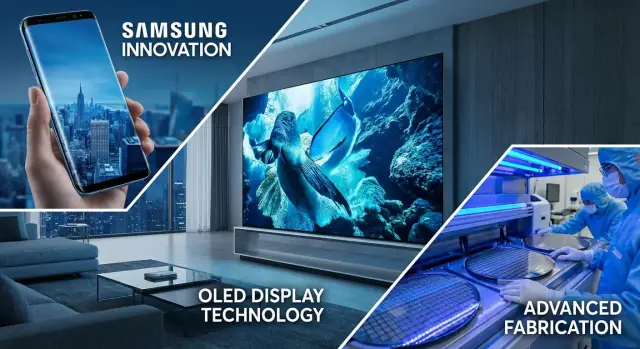
What “End-to-End Superpower” Means at Samsung
Samsung’s “end-to-end” advantage isn’t just about being big. It’s about participating across the full chain that turns an idea into a product you can buy—then repeating that cycle at massive volume.
End-to-end, in Samsung’s case
At a high level, Samsung spans three connected layers:
- Devices (demand): smartphones, TVs, appliances, PCs, wearables—products that create predictable, recurring demand for components.
- Displays (key modules): panels used inside Samsung devices and sold to other brands.
- Semiconductors (core components): memory chips, mobile processors, and foundry manufacturing capacity—again used internally and sold externally.
The “superpower” is that these layers can reinforce each other. A hit smartphone or TV generation doesn’t only drive device revenue; it can also pull through volume for screens and chips—improving costs, sharpening manufacturing know-how, and accelerating the next round of product iteration.
Why scale matters so much in electronics
Electronics manufacturing is dominated by fixed costs (factories, equipment, R&D) and execution quality (yield, defect rates, process tuning). When you spread fixed costs over more units—and improve yield through repetition—unit economics can change dramatically.
That’s why learning curves are strategic: building more of something isn’t only about quantity. It’s also how you discover subtle process improvements, negotiate better terms for materials, and justify the next wave of capital investment.
Scope of this article
This isn’t just a story about consumer products. Samsung also operates as a major component supplier to the wider industry, sometimes selling to companies it competes with in devices.
The sections ahead break down the major business units and the connecting logic between them—from displays and memory to foundry services and the device “demand engine.”
If you want the practical summary at the end, jump to /blog/takeaways-samsung-scale-model.
Devices as the Demand Engine
Samsung’s biggest advantage starts with the most visible products: phones, TVs, and appliances. Those device lines don’t just generate revenue—they create a steady, internally understandable “order book” for key components like displays, memory, cameras, power chips, and connectivity parts.
When you sell millions of units across multiple categories, component demand becomes less of a guess and more of a plan.
Predictable demand across categories
A smartphone cycle might be volatile on its own, but Samsung isn’t betting on a single product. TVs and monitors pull on panels and image processing. Appliances pull on motors, power modules, sensors, and increasingly connectivity.
The mix helps smooth demand: if one category slows, another can keep factories and suppliers running at healthier utilization.
Flagship launches set the component agenda
Flagship launches—especially Galaxy S and foldables—act like internal deadlines that concentrate engineering priorities. If the next premium phone needs a brighter display, faster memory, or new camera features, that requirement can influence what gets developed and qualified first.
Even when Samsung doesn’t make every part itself, its volume and calendar can shape which technologies mature quickly enough to ship at scale.
Breadth as a volume stabilizer
Samsung sells across entry, midrange, and premium tiers. That matters because component planning relies on consistent volume, not just high margins.
Midrange devices, mainstream TVs, and widely sold appliances keep baseline demand intact, while premium models create “pull” for new features that can later trickle down.
Distribution turns plans into real volume
Samsung’s carrier, retail, and regional distribution relationships convert product ambition into shelf space and predictable sell-through. Strong channel reach helps reduce demand shocks—making it easier to commit to component production early, negotiate better terms, and keep the overall machine running smoothly.
Displays: Turning Manufacturing Scale into Differentiation
Samsung’s display business is a good example of how manufacturing scale can translate into product-level differentiation—not just lower costs. Displays are one of the most visible “components” customers experience every time they unlock a phone or watch a movie, so small gains in brightness, power use, or durability quickly become meaningful.
The main display layers (high-level)
At a non-technical level, Samsung operates across several display approaches:
- LCD: a mature, widely used technology that’s efficient to produce at high volumes and still common in many product tiers.
- OLED: where each pixel emits its own light, enabling deep blacks, strong contrast, and thinner designs—especially important for premium smartphones.
- QD-OLED: combines OLED’s contrast with quantum-dot color enhancement, aimed at higher-end TVs and monitors where color volume and peak brightness matter.
Why scale matters in display manufacturing
Large, steady production volumes create three practical advantages.
First, capacity utilization improves—expensive factories deliver more output per dollar when lines run consistently.
Second, teams build process learning faster: every production run generates data that can refine materials, calibration, and inspection.
Third, those two benefits compound into lower defect rates, which matters because a tiny flaw can ruin an entire panel.
Serving Samsung devices—and everyone else
Samsung can feed its own demand engine—Galaxy phones, tablets, TVs, and wearables—while also supplying external customers. That mix helps keep factories loaded across seasons and product transitions, while customer diversity reduces reliance on a single device line’s success.
Product cycles that keep the flywheel turning
Displays evolve in cycles: new form factors (foldables), higher brightness, better efficiency (longer battery life), and improved durability.
Each cycle rewards companies that can scale improvements quickly—because speed from pilot yields to mass production is often the real differentiator.
Semiconductors: Memory, Logic, and Foundry in One Portfolio
Samsung’s semiconductor business is often discussed as “chips,” but it’s really a set of distinct businesses that reinforce each other.
The four big buckets
Memory is Samsung’s best-known category: DRAM (used as working memory in phones, PCs, and servers) and NAND flash (used for storage in everything from smartphones to data centers). Memory is a high-volume, price-sensitive business where tiny cost advantages matter.
Logic refers to chips that process instructions—think application processors and other system-on-chip designs. Logic is closer to “product engineering” than pure scale: performance, power efficiency, and integration features can decide wins.
Foundry services mean Samsung manufactures chips for other companies that design their own silicon. A simple way to think about it: customers bring the blueprint; Samsung provides the factory, process technology, and manufacturing expertise.
Image sensors power smartphone cameras and industrial vision. They sit between consumer electronics and components: design and manufacturing both influence image quality, size, and cost.
Why memory scale is uniquely important
Memory competes on cost per bit. Larger scale can translate into better purchasing terms for materials, more experience driving yields up, and more flexibility to keep fabs running efficiently.
Memory is also cyclical: when prices fall, the lowest-cost producers can endure the downturn and be positioned to benefit when demand recovers.
Why foundry is so expensive
Leading-edge foundry is capital-intensive because advanced nodes require extreme precision tools, complex process steps, and constant R&D. The payoff is strategic: being able to produce top-tier chips for Samsung’s own devices—and sell manufacturing capacity to the broader market.
Serving Samsung—and everyone else
This portfolio lets Samsung supply components into its phones, TVs, and appliances while also selling to external customers. That dual role spreads fixed costs across more volume and reduces dependence on any single product line.
Vertical Integration and Supply Chain Control
Samsung’s scale advantage is easier to understand if you picture its supply chain as a single, simplified chain it can influence end-to-end:
materials → components → assembly → distribution
Many electronics brands operate mainly at the “assembly” and “distribution” ends, buying critical parts from specialists. Samsung, by contrast, participates heavily in the “components” step (and, in some cases, upstream materials and equipment decisions), then feeds those components into its own device businesses.
Why internal sourcing changes the game
When a company can source key parts internally, it can lower costs through tighter planning and less “margin stacking” across multiple suppliers. Just as important, it can improve coordination: engineering teams can align product roadmaps with component capabilities earlier, and operations teams can adjust volumes faster when demand swings.
This helps with speed as well. If a phone launch requires a last-minute tweak to a display driver, memory configuration, or panel spec, having component and device teams under one umbrella can shorten the feedback loop—fewer contract renegotiations, fewer handoffs, and clearer priorities.
Where it matters most: displays and memory
Internal components tend to matter most where supply is tight, specs are differentiating, or costs dominate the bill of materials. Two examples:
- Displays: panel quality, yield, and availability can directly shape a device’s competitiveness and launch timing.
- Memory chips: DRAM and NAND are major cost items; securing supply and pricing can stabilize margins when markets tighten.
The trade-offs Samsung has to manage
Vertical integration also adds complexity. Managing many businesses can create internal competition for capital and attention. There’s also a risk of slower adoption of external innovations if internal teams are prioritized—or if integrating outside parts disrupts internal plans.
Samsung’s challenge is balancing the control benefits with openness to the best technology, whether it’s made inside the company or not.
Purchasing Power, Yield, and Operational Discipline
Samsung’s scale isn’t only about making more units—it changes the economics of how it buys, runs factories, and manages risk.
Scale as negotiating leverage
When you operate high-volume semiconductor fabs and large display lines, you become one of the biggest, most predictable customers for materials, chemicals, wafers, glass, and specialized components. That volume gives Samsung leverage to negotiate better pricing, priority allocation during shortages, and tighter service-level agreements.
It also strengthens Samsung’s position with equipment makers. A single node transition in semiconductors or a new display generation can require many identical tools, installed and qualified in a narrow window. Ordering at scale often means earlier slots on production schedules and more influence over tool customization, training, and on-site support.
Long-term supplier partnerships (and long lead times)
Many critical tools and materials have lead times measured in months (sometimes longer). Samsung’s operational discipline shows up in multi-year planning: aligning capex roadmaps, locking in supply, and coordinating ramp schedules so that equipment arrives when teams and facilities are ready.
These partnerships can lower total cost beyond sticker price—fewer delays, faster qualification, and less downtime once lines are running.
Inventory: buffering without bloating cash
At a high level, Samsung balances two competing goals: buffering enough inventory to keep factories and device launches on track, while avoiding excessive cash tied up in parts.
The company can hold strategic buffers for high-risk items, but it also has the forecasting scale to smooth purchasing and reduce “panic buying.”
Yield and quality as a margin engine
In chips and displays, small improvements in yield translate into huge savings. Better process control means fewer defective units, less rework, lower scrap, and more sellable output from the same fixed-cost factory—directly lifting margins even when pricing is under pressure.
R&D Scale: One Investment, Multiple Payoffs
Samsung’s advantage isn’t only that it makes many different products—it’s that it can reuse the same underlying research across them.
In semiconductors, displays, batteries, cameras, radios, and materials science, the “platform” work (new process steps, new materials, better metrology, better packaging) can feed multiple business lines.
Why process technology demands constant investment
In chips and displays, performance and cost are heavily tied to how you manufacture, not just what you design. Process technology improves through long, iterative learning: tighter control of defects, better yields, improved energy efficiency, and more predictable output.
If investment pauses, the learning curve slows—and catching up later can be harder than it looks, because experience accumulates over thousands of runs and many design cycles.
That’s why large players tend to fund process R&D continuously. The goal isn’t a single breakthrough; it’s a steady stream of incremental gains that compound over time.
Shared research across product lines
A change in one area can have benefits elsewhere. For example:
- Advanced packaging know-how can improve both memory products and application processors, and can also influence thermal design requirements in phones.
- Display materials and driver advances can affect device power consumption, which then changes battery and chipset constraints.
- Camera sensor improvements can push demand for faster memory and better on-device compute.
This kind of cross-pollination is easier when a company has adjacent teams, shared labs, and enough volume to justify specialized tooling.
Patents and engineering talent as compounding assets
Patents help protect manufacturing methods and device features, but the deeper advantage is often organizational: experienced engineers, process technicians, and researchers who have solved similar problems before.
Hiring and training at scale builds a feedback loop—more projects create more learning, which makes future projects faster and less risky. Over time, that can raise the baseline capability across the portfolio, even when individual product cycles fluctuate.
Coopetition: Supplying Competitors While Competing in Devices
Samsung’s unusual position is that it can be both your rival on the shelf and your supplier behind the scenes.
A smartphone maker may compete directly with Galaxy devices while buying Samsung memory chips. A premium handset brand may rely on Samsung-made OLED displays while marketing a “best-in-class screen” as its own advantage.
Why selling to rivals can be a stabilizer
This “coopetition” diversifies demand. When Samsung’s own device sales soften in one region or price tier, component shipments to other brands can help keep factories fuller and cash flow steadier.
It also reduces dependence on any single product cycle: phones, TVs, and laptops move at different rhythms than memory, displays, or foundry orders.
Diversification isn’t just about volume—it’s also about bargaining power. A broader customer base can smooth out negotiations and reduce the risk that one big buyer dictates terms.
Trust is the real product
Supplying competitors only works if customers believe their plans are safe. That means clear confidentiality rules, strict internal “firewalls,” and predictable roadmaps.
Buyers need confidence that their upcoming model specs, launch timing, and cost targets won’t leak into Samsung’s own device teams.
Practical ways coopetition shapes decisions
Coopetition influences what Samsung builds and when:
- Capacity allocation: deciding how much OLED or memory output goes to external customers versus internal devices during tight supply.
- Feature timing: avoiding a situation where a component upgrade appears first in Samsung devices if it would damage customer relationships.
- Pricing discipline: setting component prices that are competitive externally without “subsidizing” Samsung devices in a way customers would reject.
The result is a balancing act: win in devices, but stay indispensable as a component partner.
The Financial Model Behind Scale and Capital Intensity
Samsung’s “scale advantage” is expensive to build and even more expensive to maintain. The core assets that create differentiation—semiconductor fabs and display production lines—are among the most capital-intensive industrial facilities on earth.
A leading-edge fab can require tens of billions of dollars before it produces a single sellable wafer, while display lines demand large, specialized tooling that has to run at high volume to pay back the upfront spend.
Why scale requires big, continuous spending
These businesses don’t just need big checks; they need repeated checks. Technology nodes shrink, materials change, and equipment becomes obsolete quickly. That pushes Samsung into a steady rhythm of capital expenditure (capex) to keep yields high and costs low.
Cycles determine the “when”
Electronics cycles are brutal and fast. Memory pricing can swing sharply as supply and demand diverge. Device demand (smartphones, TVs, appliances) also fluctuates with consumer confidence and replacement cycles.
Investment timing becomes a balancing act:
- Spend too early, and you risk adding capacity right before prices fall.
- Spend too late, and you miss the upturn or fall behind on technology.
Samsung’s scale helps, but it doesn’t eliminate the cycle—it changes how the company absorbs it.
The portfolio effect (and its limits)
One reason investors tolerate high capex is the portfolio: profits from one segment can sometimes cushion weakness in another. For example, a strong device cycle can support cash flow during a semiconductor downturn, or display wins can offset softer handset margins.
That said, correlation rises in global slowdowns, so the “hedge” is imperfect.
What investors and industry watchers track
Because the model depends on staying ahead on cost and utilization, observers watch a few practical signals:
- Capacity additions (new fabs/lines, tool installs)
- Utilization rates (how fully those assets are loaded)
- Product mix (premium vs. commodity, advanced vs. mature nodes)
- Margins and cash flow (operating margin, free cash flow, net capex)
In short, Samsung’s scale is a financial commitment: high fixed costs, periodic reinvestment, and performance that’s tightly tied to cycle management.
How Samsung Differs From Specialist Competitors
Samsung is unusual because it competes across the stack: it sells finished devices (phones, TVs, appliances), makes key components (displays, memory), and runs advanced semiconductor manufacturing. Most rivals choose one layer and optimize everything around it.
Integrated vs. specialist models
A pure-play foundry (think “manufacturing only”) is built to serve many chip designers neutrally. Its strength is focus: process technology, capacity planning, and customer service tuned for a broad client base.
A device-only brand, meanwhile, concentrates on product design, marketing, distribution, and a tight set of supplier relationships.
Samsung’s integrated approach looks different: internal component teams can be major suppliers to internal device teams, but also to external customers.
That can create faster iteration loops—new screen tech or memory configurations can be tested in Samsung products quickly—while also keeping factories loaded when consumer demand shifts.
Trade-offs: why focus can beat scale (and vice versa)
Specialization can be cleaner operationally. A focused foundry avoids channel conflict with customers who might fear sharing roadmaps with a competitor. Device-only brands can stay flexible, switching suppliers when price/performance improves.
Integration offers different benefits: stronger bargaining power, potentially better cost control at high volumes, and more leverage over availability during tight supply periods.
The downside is complexity and capital intensity: big bets must be made years ahead, and coordination mistakes can ripple across divisions.
Pricing pressure and innovation pace
Global competitors keep all models under stress. Low-cost device makers compress margins, pushing Samsung to differentiate on features and brand.
In components, aggressive memory and display pricing can quickly turn scale into a vulnerability if demand softens. At the same time, specialists often set a relentless innovation tempo, forcing Samsung to invest continuously just to stay in the top tier.
Key Risks: Cycles, Geopolitics, and Technology Shifts
Samsung’s scale is a strength, but it also concentrates exposure. When you operate across devices, displays, and semiconductors, shocks can travel quickly through the whole system—especially in downturns or during major technology transitions.
Market and cycle risks
Semiconductors are cyclical by nature: memory pricing can swing sharply with inventory corrections and data-center spending. On the device side, smartphone demand is mature in many regions, with longer replacement cycles and fewer “must-have” upgrades.
That combination can compress margins from both ends—lower component prices and tighter device pricing.
A second market risk is intensified competition. Chinese OEMs push aggressive pricing in phones, TVs, and appliances, while cloud and AI customers increasingly multi-source chips to reduce dependency.
Even with cost advantages, Samsung can face periods where volume doesn’t translate into premium pricing.
Geopolitics, export controls, and supply disruptions
Geopolitics is a direct operational risk. Export controls can limit access to advanced equipment, EDA tools, or key customers in certain regions.
Shipping disruptions, sanctions, or sudden tariff changes can also complicate global fulfillment for both components and finished devices.
Because Samsung sells to competitors and relies on a global tool and materials ecosystem, it must manage political risk across multiple jurisdictions—not just where it manufactures.
Technology transition risks
Leading-edge manufacturing is unforgiving. Yield challenges during node transitions can erase expected cost-per-transistor gains and delay customer ramps in foundry.
In displays, shifts in technology (OLED mix changes, new form factors, or emerging microLED paths) can strand capacity or force rapid capital reallocation.
High-level mitigations
Mitigation is partly structural: geographic diversification of manufacturing, diversified end markets, and a mix of long-term customer agreements.
It’s also operational: relentless yield and process discipline, selective partnerships in ecosystems (tools, IP, packaging), and capital pacing that avoids overbuilding into a peak.
Takeaways: What Other Companies Can Learn From Samsung’s Model
Samsung’s advantage isn’t just “being big.” It’s being big in the parts of the business where size turns fixed costs into lower unit costs, faster learning, and better bargaining power—while still partnering where ownership would slow you down.
1) Scale where fixed costs dominate
A practical rule: own and scale the activities that require massive upfront investment and improve with volume (plants, tooling, process know-how, global distribution).
If your cost per unit drops meaningfully as volume rises—and quality improves as yields get better—scale can become a self-reinforcing edge.
Where that’s not true (specialized software, niche components, local services), partner or buy. You’ll move faster and avoid spreading capital and attention too thin.
2) A simple “own / buy / co-develop” framework
When deciding what to integrate, ask three questions:
- Own: Does this capability shape product differentiation and supply reliability at the same time?
- Buy: Is the market competitive enough that suppliers will keep you well served without strategic risk?
- Co-develop: Is the tech moving so quickly that shared investment reduces risk, while keeping you close to the roadmap?
This framework helps avoid integration as a reflex. The goal is control where it matters, flexibility where it doesn’t.
3) Align roadmaps across teams and suppliers
Scale only pays off when product teams, component teams, and operations work to a shared plan: common timelines, clear priorities, and early feedback loops.
That alignment reduces last-minute redesigns, smooths procurement, and makes manufacturing ramps less painful.
A practical modern parallel (in software rather than factories) is how teams try to reduce handoffs between “planning,” “building,” and “shipping.” For example, Koder.ai is designed around that same principle: you can plan an app in chat, generate and iterate across web/server/mobile in one workflow, and then deploy or export source code—tightening the feedback loop the way integrated hardware orgs try to do across device and component roadmaps.
4) Where scale may matter next
As on-device AI grows and display experiences diversify (foldables, new form factors, power-efficient panels), companies that can coordinate hardware, components, and manufacturing will have an edge—especially when demand spikes and supply gets tight.
The core lesson: treat scale as a strategy, not a consequence. Build it deliberately, and only where it compounds.
FAQ
What does “end-to-end superpower” mean for Samsung?
In this article, “end-to-end” means Samsung participates across multiple connected layers of the electronics value chain—finished devices, key modules (displays), and core components (semiconductors)—and can use scale in one layer to reinforce the others.
Practically, a strong device cycle can increase internal demand for chips and panels, improving utilization and accelerating manufacturing learning.
Why are Samsung’s devices described as a “demand engine”?
Because high-volume devices (phones, TVs, appliances, wearables) create an internal, recurring order signal for components like displays and memory.
That makes component planning less speculative, supports earlier production commitments, and helps keep factories running at healthier utilization even when one product category slows.
Why does manufacturing scale matter so much in chips and displays?
Electronics manufacturing has massive fixed costs (fabs, display lines, specialized tools, R&D). When those costs are spread over more output, the unit cost can drop sharply.
Scale also improves execution quality: repetition drives better yields and lower defect rates, which directly raises margins in chips and displays.
What are “learning curves,” and why are they strategic for Samsung?
A learning curve is the compounding benefit of building at volume:
- Process tweaks get discovered faster through repeated runs
- Defects are identified earlier and reduced over time
- Suppliers and tooling support improve as volumes become predictable
In short, volume is not just output—it’s a way to systematically improve cost, quality, and ramp speed.
What display technologies does Samsung use, and why do they matter?
At a high level, Samsung operates across multiple display approaches:
- LCD for mature, cost-efficient high-volume tiers
- OLED for premium devices where contrast, thinness, and power efficiency matter
- QD-OLED aimed at higher-end TVs/monitors where color volume and brightness are key
The advantage comes from turning manufacturing improvements (yield, utilization, process control) into visible product differentiation.
What are Samsung’s main semiconductor businesses?
Samsung’s semiconductor portfolio is often grouped as “chips,” but it includes distinct businesses:
- Memory (DRAM, NAND): cost-per-bit, cyclical, scale-driven
- Logic (processors/SoCs): product engineering, performance/power trade-offs
- Foundry: manufacturing chips designed by others
- Image sensors: camera/vision components balancing design + manufacturing
This mix lets Samsung serve internal devices and external customers, spreading fixed costs and diversifying demand.
How does vertical integration improve cost and time-to-market?
Vertical integration can reduce cost and increase speed because Samsung can coordinate roadmaps, sourcing, and volume planning across divisions.
Benefits often show up when:
- Supply is tight or specs are differentiating (e.g., displays)
- Components are major cost drivers (e.g., DRAM/NAND)
- Fast iteration is needed near launch deadlines
It can also reduce “margin stacking” that happens when multiple independent suppliers each add their own markup.
What are the downsides or risks of Samsung’s integrated model?
Integration adds complexity and can create trade-offs:
- Internal competition for capital and management attention
- Risk of favoring internal components even when external options are better
- Coordination mistakes can ripple across multiple business units
Samsung has to balance control and speed with staying open to the best technology, whether it’s internal or sourced.
How can Samsung supply competitors and still compete with them?
Samsung can sell components (memory, OLED panels, foundry capacity) to companies that may compete with Galaxy devices, which helps stabilize utilization and cash flow.
But it only works if customers trust Samsung to protect their plans, typically requiring:
- Strict confidentiality rules and internal firewalls
- Predictable roadmaps and fair capacity allocation
- Pricing discipline that doesn’t appear to subsidize Samsung’s own devices
What should investors or operators watch in Samsung’s scale-driven model?
The model is highly capital-intensive: fabs and display lines require continuous reinvestment, and timing matters because demand and pricing are cyclical.
Key risks include:
- Memory and device downturns compressing margins simultaneously
- Geopolitical/export-control disruptions to tools, materials, or customers
- Difficult technology transitions that hurt yields and delay ramps
For a practical summary of the article’s lessons, see /blog/takeaways-samsung-scale-model.