

How Software Unites Energy Management and Automation at Scale
See how energy management and industrial automation connect through software to improve reliability, efficiency, and uptime across modern infrastructure.
Why Energy and Automation Are Converging
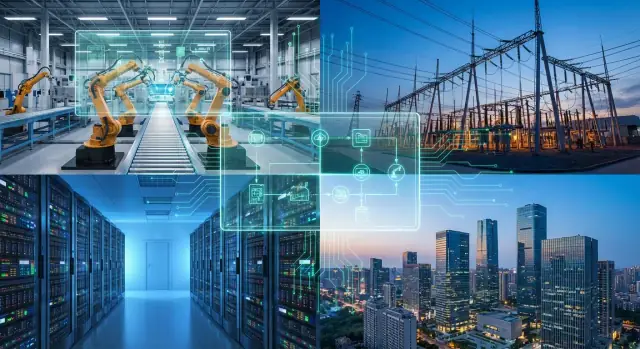
Modern infrastructure is the set of systems that keep everyday operations running: office buildings and hospitals, factories and warehouses, data centers, and the power networks (including on-site generation) that feed them. What these environments increasingly share is that energy is no longer just a utility bill—it’s a real-time operational variable that affects uptime, safety, output, and sustainability targets.
One operation, two viewpoints
Traditionally, energy teams focused on metering, tariffs, and compliance, while automation teams focused on machines, controls, and throughput. Those boundaries are fading because the same events show up in both worlds:
- A voltage sag can trip sensitive equipment and cause a production stop.
- A peak-demand spike can trigger costly charges and force load shedding.
- A cooling failure in a data center is both an automation issue (control loops) and an energy issue (capacity and efficiency).
When energy and automation data live in separate tools, teams often diagnose the same incident twice—on different timelines and with incomplete context. Convergence means they share a common view of what happened, what it cost, and what to do next.
Software is the meeting point
The practical driver is software that connects operational technology (OT)—controllers, relays, drives, and protection devices—with IT systems used for reporting, analytics, and planning. That shared software layer makes it possible to link process performance to power quality, maintenance schedules to electrical loading, and sustainability reporting to actual measured consumption.
This article is a practical overview of how that connection works at scale—what data gets collected, where platforms like SCADA and energy management overlap, and which use cases deliver measurable results.
Why Schneider Electric is a useful example
Schneider Electric is often referenced in this space because it spans both domains: industrial automation and energy management software for buildings, plants, and critical facilities. You don’t need to buy any specific vendor to benefit from convergence, but it helps to use a real-world example of a company building products on both sides of the “energy vs. automation” line.
Energy Management vs. Industrial Automation: The Basics
Energy management and industrial automation are often discussed as separate worlds. In practice, they’re two sides of the same operational goal: keep facilities running safely, efficiently, and predictably.
What “energy management” usually covers
Energy management focuses on how power is measured, purchased, distributed, and used across a site (or across many sites). Typical capabilities include:
- Metering and submetering to understand where energy is going (by building, line, tenant, or asset)
- Billing allocation and cost reporting so departments or tenants can be charged fairly
- Power quality monitoring to detect issues like harmonics, voltage sags, or flicker that can damage equipment
- Demand control to avoid peak charges by shifting or shedding non-critical loads at the right time
The key output is clarity: accurate consumption, costs, anomalies, and performance benchmarks that help you reduce waste and manage risk.
What “industrial automation” usually covers
Industrial automation is centered on controlling processes and machines. It typically spans:
- Control systems (PLC/DCS logic, alarms, interlocks, and operator interfaces)
- Safety systems that keep people and equipment protected
- Production scheduling and coordination so the right work happens at the right time
- Quality controls to ensure products meet specifications
The key output is execution: consistent, repeatable operation under real-world constraints.
Where they overlap—and why it matters
These domains overlap most clearly around uptime, cost control, compliance, and sustainability targets. For example, a power quality event is an “energy” issue, but it can instantly become an “automation” problem if it trips drives, resets controllers, or disrupts critical batches.
Software makes the overlap actionable by correlating electrical data with production context (what was running, what changed, what alarms fired) so teams can respond faster.
A misconception worth avoiding
Software doesn’t replace engineering expertise. It supports better decisions by making data easier to trust, compare, and share—so electrical teams, operations, and management can align on priorities without guessing.
The Software Layer That Connects OT and IT
Software is the “translator” between equipment that runs physical processes and the business systems that plan, pay, and report. In energy and automation, that middle layer is what lets one organization see the same reality—from a breaker trip to a monthly utility bill—without stitching together spreadsheets.
The stack: from field devices to analytics
Most converged systems follow a similar stack:
- Field devices: meters, protective relays, variable-speed drives, PLC I/O, temperature and vibration sensors.
- Control layer: PLCs, DCS, and protection/control schemes that keep processes stable and safe.
- Supervisory layer: SCADA/HMI and energy management platforms that collect, visualize, alarm, and coordinate actions across sites.
- Analytics and apps: dashboards, forecasting, optimization, reporting, and workflow tools that turn events into decisions.
Schneider Electric and similar vendors often provide components across this stack, but the key idea is interoperability: the software layer should normalize data from many brands and protocols.
OT vs. IT (and why the boundary is fading)
OT (Operational Technology) is about controlling machines in real time—seconds and milliseconds matter. IT (Information Technology) is about managing data, users, and business workflows—accuracy, security, and traceability matter.
The boundary is fading because energy and production decisions are now linked. If operations can shift loads, finance needs the cost impact; if IT schedules maintenance, OT needs the alarms and asset context.
What data actually flows—and why it matters
Typical data types include kWh and demand, voltage events (sags, swells, harmonics), temperatures, cycle counts, and alarms. When these land in one model, you get a single source of truth: maintenance sees asset health, operations sees uptime risk, and finance sees verified energy spend—all based on the same time-stamped records.
Turning insights into internal tools
In many organizations, the missing piece isn’t more dashboards—it’s the ability to quickly ship small, reliable internal apps that sit on top of the data layer (for example: a power-quality incident timeline, a demand-peak “early warning” page, or a maintenance triage queue). Platforms like Koder.ai can help here by letting teams prototype and build web apps via chat—then export source code if they need to integrate with existing OT/IT standards, deployment processes, or on-prem requirements.
From Sensors to Insights: Data Collection in the Real World
Good software can only be as smart as the signals it receives. In real facilities, data collection is messy: devices are installed years apart, networks have gaps, and different teams “own” different parts of the stack. The goal isn’t to collect everything—it’s to collect the right data, consistently, with enough context to trust it.
What data actually comes from the field
A converged energy + automation system typically pulls from a mix of electrical and process devices:
- Meters and breakers for energy, demand, and event logs (trip, overload, temperature).
- Relays for protection status and fault details.
- VFDs (variable frequency drives) for speed, load, run hours, and alarms.
- PLCs for process states, interlocks, and equipment sequences.
- Sensors (temperature, vibration, pressure, flow) for condition and performance.
When these sources are time-aligned and tagged correctly, software can connect cause and effect: a voltage sag, a drive fault, and a production slowdown may be part of the same story.
Why accurate data matters (more than more data)
Bad inputs create expensive noise. A mis-scaled meter can trigger false “high demand” alarms; a swapped CT polarity can invert power factor; inconsistent naming can hide a repeating fault across multiple panels. The result is wasted troubleshooting time, ignored alerts, and decisions that don’t match reality.
Edge computing: faster answers, lighter networks
Many sites use edge computing—small local systems that pre-process data near the equipment. This reduces latency for time-sensitive events, keeps critical monitoring running during WAN outages, and limits bandwidth by sending summaries (or exceptions) instead of raw high-frequency streams.
Calibration and quality checks are ongoing work
Data quality isn’t a one-time project. Routine calibration, time-sync checks, sensor health monitoring, and validation rules (like range limits and “stuck value” detection) should be scheduled like any other maintenance task—because trusted insights start with trusted measurements.
Where SCADA and Energy Platforms Meet
SCADA and energy management platforms often start in different teams: SCADA for operations (keep the process running), and Energy Management Systems (EMS) for facilities and sustainability (understand and reduce energy use). At scale, they’re most valuable when they share the same “source of truth” for what’s happening on the plant floor and in the electrical room.
SCADA, in plain terms
SCADA is built for real-time monitoring and control. It collects signals from PLCs, RTUs, meters, and sensors, then turns them into operator screens, alarms, and control actions. Think: start/stop equipment, track process variables, and respond quickly when something goes out of range.
EMS, in plain terms
An EMS focuses on visibility, optimization, and reporting for energy. It aggregates electric, gas, steam, and water data, converts it into KPIs (cost, intensity, peak demand), and supports actions like demand response, load shifting, and compliance reporting.
The overlap: one view, faster decisions
When SCADA context (what the process is doing) is shown alongside EMS context (what energy is costing and consuming), teams avoid handoff delays. Facilities doesn’t need to email screenshots of power peaks, and production doesn’t need to guess whether a setpoint change will break a demand limit. Shared dashboards can show:
- Process state (line running, batch phase) next to energy intensity
- Electrical events and alarms next to downtime reasons
- Peak demand forecasts alongside planned production schedules
Set the foundation early
Convergence succeeds or fails on consistency. Standardize naming conventions, tags, and alarm priorities early—before you have hundreds of meters and thousands of points. A clean tag model makes dashboards trustworthy, alarm routing predictable, and reporting far less manual.
Reliability and Power Quality: Protecting Uptime
Reliability isn’t only about whether power is available—it’s about whether power is clean enough for sensitive automation equipment to run without surprises. As energy management software connects with industrial automation, power quality monitoring becomes a practical uptime tool rather than a “nice-to-have” electrical feature.
What “power quality” problems look like
Most facilities don’t experience a single dramatic blackout. Instead, they see smaller disturbances that accumulate into lost production time:
- Sags: short drops in voltage that can reset drives, PLCs, or IT gear.
- Swells: brief voltage rises that stress power supplies and insulation.
- Harmonics: waveform distortion (often from variable-speed drives and UPS systems) that increases heat and misbehavior in equipment.
- Transients: fast spikes from switching events or lightning that can damage electronics over time.
How poor power quality hits automation
Automation systems react quickly—sometimes too quickly. A minor sag can trigger nuisance trips in motor protection, causing an unexpected line stop. Harmonics can raise temperatures in transformers and cables, accelerating equipment wear. Transients can degrade power supplies, creating intermittent faults that are hard to reproduce.
The result is costly: downtime, reduced throughput, and a maintenance team stuck chasing “ghost” issues.
Software-driven workflows that shorten recovery
When SCADA and an energy management platform work together (for example, in Schneider Electric-style architectures), the goal is to turn events into action:
event detection → root-cause hints → work orders
Instead of only logging an alarm, the system can correlate a trip with a voltage sag on a specific feeder, suggest likely upstream causes (utility disturbance, large motor start, capacitor switching), and generate a maintenance task with the right timestamp and waveform snapshot.
KPIs worth tracking
To measure impact, keep the metrics simple and operational:
- Mean time to recover (MTTR) after power-quality-related trips
- Event frequency (by type: sag, swell, harmonic threshold, transient)
- Critical load uptime (for lines, cleanrooms, or control rooms)
Predictive Maintenance Across Electrical and Mechanical Assets
Maintenance is often treated as two separate worlds: electricians watch switchgear and breakers, while maintenance teams track motors, pumps, and bearings. Converged software—tying energy management software to industrial automation data—lets you manage both with the same logic: detect early warning signs, understand risk, and schedule work before failures disrupt production.
Predictive vs. preventive maintenance (plain terms)
Preventive maintenance is calendar- or runtime-based: “inspect every quarter” or “replace after X hours.” It’s simple, but it can waste labor on healthy equipment and still miss sudden issues.
Predictive maintenance is condition-based: you monitor what assets are actually doing and act when the data suggests degradation. The goal isn’t to predict the future perfectly—it’s to make better decisions with evidence.
The signals that matter in real facilities
Across electrical and mechanical assets, a few signals consistently deliver value when captured reliably:
- Temperature rise: hotspots in panels, busbars, cables, transformers, or motor windings.
- Vibration: early indicator for bearings, misalignment, imbalance, and mechanical looseness.
- Breaker operations: count, trip history, close/open timing, and abnormal sequences.
- Insulation alerts: moisture/contamination trends and partial discharge indicators (where instrumented).
Platforms that integrate SCADA and EMS data can correlate these with operating context—load, starts/stops, ambient conditions, and process states—so you don’t chase false alarms.
How analytics prioritizes actions
Good analytics doesn’t just flag anomalies; it prioritizes them. Common approaches include risk scoring (likelihood × impact) and criticality ranking (safety, production, replacement lead time). The output should be a short, actionable queue: what to inspect first, what can wait, and what warrants an immediate shutdown.
Keep expectations realistic
Results depend on data coverage, sensor placement, and day-to-day discipline: consistent tagging, alarm tuning, and closed-loop work orders. With the right foundations, Schneider Electric–style OT and IT convergence can reduce unplanned downtime—but it won’t replace sound maintenance practices or fix gaps in instrumentation overnight.
Efficiency Gains: Demand Management and Process Optimization
Efficiency is where energy management and automation stop being “reporting tools” and start delivering measurable savings. The most practical wins often come from reducing peaks, smoothing operations, and tying energy use directly to production output.
Peak demand and time-of-use, in plain terms
Many facilities pay for how much electricity they use (kWh) and also for their highest short spike in power (peak kW) during a billing period. That spike—often caused by several large loads starting at once—can set demand charges for the whole month.
On top of that, time-of-use (TOU) pricing means the same kWh costs more during on-peak hours and less overnight or on weekends. Software helps by forecasting peaks, showing the cost of running now vs. later, and alerting teams before a costly threshold is crossed.
What automation does with those insights
Once price signals and limits are known, automation can act:
- Load shedding: temporarily turning off or reducing non-critical loads (e.g., some HVAC stages, compressed air trim, EV charging) when a peak is forming.
- Process scheduling: shifting energy-heavy steps (batch heating, cleaning cycles, pumping) to cheaper hours without hurting throughput.
- Setpoint adjustments: small, controlled tweaks (temperature, pressure, speed) to reduce power draw while staying within quality and safety constraints.
Energy KPIs that connect to production
To keep improvements credible, track energy in operational terms: kWh per unit, energy intensity (kWh per ton, per m², per run-hour), and baseline vs. actual. A good platform makes it clear whether savings came from real efficiency—or simply lower production.
Change management: make targets usable
Efficiency programs stick when operations, finance, and EHS agree on targets and exceptions. Define what can be shed, when comfort or safety overrides apply, and who approves schedule changes. Then use shared dashboards and exception alerts so teams act on the same version of cost, risk, and impact.
Data Centers: A High-Stakes Use Case for Converged Systems
Data centers make the value of converged energy management software and industrial automation easy to see because the “process” is the facility itself: a power chain delivering clean, continuous electricity; cooling systems removing heat; and monitoring that keeps everything within limits. When these domains are managed in separate tools, teams spend time reconciling conflicting readings, chasing alarms, and guessing at capacity.
One operational picture: power, cooling, and IT load
A converged software layer can connect OT signals (breakers, UPS, generators, chillers, CRAH units) with IT-facing metrics so operators can answer practical questions quickly:
- PUE (Power Usage Effectiveness): Is efficiency drifting because of cooling control, airflow changes, or rising IT load?
- Rack power: Which rows are approaching limits, and where is there safe headroom?
- Redundancy status: Are you still at N+1, or did a maintenance action quietly reduce resilience?
- Alarm response time: Are alerts being acknowledged and resolved fast enough to protect uptime?
This is where platforms that bridge SCADA and EMS concepts matter: you keep real-time visibility for operations while also supporting energy reporting and optimization.
Capacity planning and incident response, in the same workflow
Integrated monitoring supports capacity planning by combining rack-level trends with upstream constraints (PDU, UPS, switchgear) and cooling capacity. Instead of relying on spreadsheets, teams can forecast when and where constraints will appear and plan expansions with fewer surprises.
During incidents, the same system helps correlate events—power quality monitoring, transfer events, temperature excursions—so operators can move from symptom to cause faster and document actions consistently.
Practical tip: reduce noise without losing signal
Separate fast alerts (breaker trips, UPS on battery, high-temperature thresholds) from slow trends (PUE drift, gradual rack growth). Fast alerts should route to immediate responders; slow trends belong in daily/weekly reviews. This simple split improves focus and makes the software feel helpful rather than chatty.
Microgrids and DER: Managing Flexible Power with Software
Microgrids bring together distributed energy resources (DER) like solar PV, battery storage, standby generators, and controllable loads. On paper it’s “local power.” In practice it’s a constantly changing system where supply, demand, and constraints shift minute by minute.
Why coordination matters
A microgrid isn’t just a collection of assets—it’s a set of operating decisions. Software is what turns those decisions into repeatable, safe behavior.
When the grid is healthy, coordination focuses on cost and efficiency (for example, using solar first, charging batteries when prices are low, and keeping generators in reserve). When the grid is stressed—or unavailable—coordination becomes about stability and priorities:
- Islanding: separating from the utility grid without tripping sensitive equipment.
- Critical-load prioritization: keeping essential processes powered while shedding non-critical loads.
- Frequency/voltage stability: balancing fast-moving changes, especially with high solar penetration.
What the software layer actually does
Modern energy management software (including platforms from vendors like Schneider Electric) typically provides a few practical functions:
- Forecasting: estimating solar production and site demand using weather and historical data.
- Dispatch rules: deciding when to charge/discharge batteries, start generators, or curtail loads based on constraints (state of charge, fuel limits, demand caps, or emissions targets).
- Reporting and audit trails: proving performance—energy savings, runtime, outages avoided—and supporting internal or utility reporting.
A key point is integration: the same supervisory layer that monitors electrical conditions can coordinate with automation systems that control loads and processes, so “energy decisions” translate into real actions.
Avoid overpromising
Microgrids aren’t one-size-fits-all. Interconnection requirements, export limits, tariff structures, and permitting rules vary widely by region and utility. Good software helps you operate within those rules—but it can’t remove them. Planning should start with clear operating modes and constraints, not just asset shopping lists.
Cybersecurity and Safety for Connected Industrial Systems
Connecting energy management software with industrial automation improves visibility and control—but it also expands the attack surface. The goal is to enable secure remote operations and analytics without compromising uptime, safety, or compliance.
Core risks to plan for
Remote access is often the biggest multiplier of risk. A vendor VPN, a shared remote desktop, or an “emergency” modem can quietly bypass the controls you’ve built elsewhere.
Legacy devices are another reality: older PLCs, meters, protection relays, or gateways may lack modern authentication and encryption, yet still sit on networks that now reach the enterprise.
Finally, misconfigured networks and accounts cause many incidents: flat networks, reused passwords, unused open ports, and poorly managed firewall rules. In converged OT/IT environments, small configuration drift can have large operational consequences.
Practical best practices (kept simple)
Start with segmentation: separate OT networks from IT networks and from the internet, and only allow required traffic between zones. Then enforce least privilege: role-based access, unique accounts, and time-bound access for contractors.
Plan patching rather than improvising it. For OT systems, that often means testing updates, scheduling maintenance windows, and documenting exceptions when a device can’t be patched.
Assume you’ll need recovery: maintain offline backups of configurations (PLCs, SCADA projects, EMS settings), keep “golden” images for key servers, and routinely test restores.
Safety: secure changes, not just secure logins
Operational safety depends on disciplined change control. Any network change, firmware update, or control logic edit should have a review, a test plan, and a rollback path. When possible, validate changes in a staging environment before touching production.
Respect standards and internal policy boundaries
Use recognized standards and your organization’s security policies as the source of truth (for example, IEC 62443/NIST guidance). Vendor features—whether in SCADA, EMS, or platforms such as Schneider Electric’s—should be configured to match those requirements, not replace them.
How to Plan a Convergence Roadmap (Without Overcomplicating It)
Converging energy management and industrial automation isn’t a “rip and replace” project. The simplest way to keep it practical is to treat it like any operations improvement initiative: define the outcomes, then connect the minimum set of systems needed to achieve them.
1) Start with outcomes (not features)
Before you compare platforms or architectures, agree on what success looks like. Common targets include uptime, energy cost, compliance, carbon reporting, and resilience.
A helpful exercise is to write two or three “day-one decisions” you want the system to support, such as:
- “If power quality dips, we know which asset is impacted and who gets notified.”
- “We can explain monthly energy spikes by process, line, or shift.”
- “We can produce audit-ready reports without manual spreadsheets.”
2) Use a phased approach: assess → instrument → integrate → optimize
Assess. Inventory what you already have: SCADA, PLCs, meters, historians, CMMS, BMS, utility bills, and reporting requirements. Identify gaps in visibility and where manual work is creating risk.
Instrument. Add only the sensors and metering needed to measure the outcomes you defined. In many sites, the first wins come from targeted power quality monitoring and a few critical equipment signals rather than full-facility coverage.
Integrate. Connect OT and IT data so it’s usable across teams. Prioritize a small set of shared identifiers (asset tags, line names, meter IDs) to avoid “two versions of the truth.”
Optimize. Once data is trusted, apply workflows: alarms that map to roles, demand management rules, maintenance triggers, and standardized reports.
3) Questions to ask vendors and integrators
Interoperability is the make-or-break detail. Ask:
- Which protocols and systems do you support out of the box (including SCADA and EMS)?
- Who owns the data, and how can we export it if we change tools later?
- What does the support model look like (SLAs, patches, lifecycle, on-site vs. remote)?
- How do you handle user access, audit trails, and safety boundaries between OT and IT?
If you want examples of how teams sequence these steps, explore /blog. When you’re ready to compare options and scope rollout costs, see /pricing.
FAQ
What does “convergence” of energy management and industrial automation actually mean?
It means energy data (meters, demand, power quality) and automation data (process states, alarms, machine runtime) are viewed and used together.
Practically, teams can correlate what happened electrically with what the process was doing at the same timestamp, so incidents and cost drivers aren’t diagnosed twice in separate tools.
Why are energy and automation teams being forced to work from the same data?
Because energy is now a real-time operational constraint, not just a monthly bill.
A voltage sag, peak demand spike, or cooling instability can immediately affect uptime, safety, throughput, and compliance—so separating the toolsets creates delays, duplicate investigations, and missed context.
What’s the difference between energy management and industrial automation?
Energy management focuses on measuring and managing consumption, cost, demand, and power quality across a site or portfolio.
Industrial automation focuses on controlling processes and machines (PLCs/DCS, alarms, interlocks, scheduling) to deliver consistent output. The overlap is biggest around uptime, cost, sustainability, and compliance.
What is the “software layer” that connects OT and IT in practice?
A shared software layer connects OT devices (meters, relays, drives, PLCs, sensors) to supervisory and analytics tools (SCADA/HMI, EMS, dashboards, reporting).
The key requirement is interoperability—normalizing data from multiple brands/protocols so everyone uses the same time-aligned record.
What data should you collect first to make convergence useful (not overwhelming)?
Start with the minimum signals tied to specific outcomes:
- kWh, kW demand, and time-of-use cost inputs
- Power quality events (sags, swells, harmonics, transients)
- Asset states and alarms from PLCs/VFDs
- A few condition signals (temperature, vibration, breaker operations)
Then add context (consistent tags, time sync) so the data is trustworthy and comparable.
How do SCADA and an Energy Management System (EMS) overlap?
SCADA is optimized for real-time visibility and control (operator screens, alarms, start/stop, setpoints).
An EMS is optimized for energy KPIs and actions (cost allocation, peak management, reporting, sustainability metrics).
They “meet” when operators can see process state and energy cost/limits in the same workflow—e.g., forecasting a peak while scheduling production.
How does power quality monitoring improve automation uptime?
Power quality issues (sags, harmonics, transients) often trigger nuisance trips, resets, overheating, and intermittent faults.
Converged monitoring helps by correlating:
- Electrical events on a feeder
- Drive/PLC alarms and downtime reasons
- The operating condition at the time (load, starts/stops)
This shortens root-cause analysis and reduces repeat incidents.
What does “predictive maintenance” look like when electrical and mechanical data are combined?
Predictive maintenance is condition-based: act when data shows degradation rather than on a fixed calendar.
Common high-value signals include temperature rise, vibration, breaker trip/operation history, and insulation/partial discharge indicators (when available).
The practical benefit of convergence is prioritization—using operating context and criticality to decide what to fix first and what can wait.
How do demand management and process optimization create measurable savings?
Many sites pay both for energy (kWh) and for their highest peak (kW) during the billing period.
Software can forecast peaks and show cost-by-time, while automation can execute actions such as:
- Load shedding of non-critical loads
- Shifting energy-heavy steps to cheaper hours
- Small setpoint changes within quality/safety constraints
Track results with operational KPIs like kWh per unit (so savings aren’t confused with lower production).
How do you plan a convergence roadmap without turning it into a “rip and replace” project?
Use a phased roadmap and keep it outcome-driven:
- Assess: inventory existing SCADA/PLCs/meters/historians/CMMS and identify gaps.
- Instrument: add only the metering/sensors needed for the first use cases.
- Integrate: standardize naming/tags and connect OT/IT data into a shared model.
- Optimize: implement role-based alarms, demand rules, maintenance triggers, and audit-ready reports.
Also plan for cybersecurity (segmentation, least privilege, patch strategy, backups) as part of the design—not after deployment.