

Sea Limited: How Garena Funded Shopee and SeaMoney Growth
A clear look at how Sea Limited used Garena’s gaming cash flows to scale Shopee and SeaMoney, and what this strategy means in emerging markets.
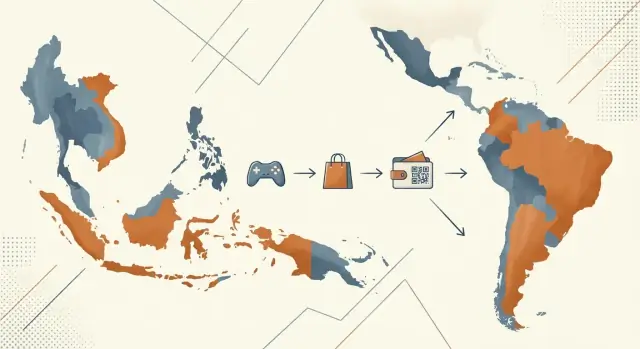
Sea Limited in one sentence: a three-engine growth story
Sea Limited is best understood as a company with three connected engines: Garena (digital entertainment and games like Free Fire), Shopee (e-commerce), and SeaMoney (payments and consumer/merchant financial services).
The big idea behind Sea’s story isn’t simply “fast growth.” It’s the way one engine—gaming—can generate real cash that helps power the others while they’re still in their expensive build-out phase.
The core question this article answers
Shopee and SeaMoney operate in markets where building scale takes time: you have to attract shoppers, convince sellers to list inventory, invest in logistics, and earn trust in payments. Early on, that often means spending more than you make.
So the central question is:
How did cash produced by Garena help Sea expand Shopee and SeaMoney across emerging markets without relying solely on outside funding?
What “cash flow funding” means (and why it matters)
“Cash flow funding” is the ability to pay for growth using cash generated from operations, rather than mainly depending on:
- raising new capital (selling shares), or
- borrowing (taking on debt)
This matters because revenue can grow while cash shrinks. Promotions, shipping subsidies, payment incentives, and new market launches can inflate sales numbers—but if they consume cash faster than the business generates it, the strategy becomes fragile.
What to expect from this piece
This is a strategic explainer about Sea’s multi-business model: how the three engines fit together, where the costs sit, and what signals show whether the funding loop is working.
It is not investment advice and doesn’t aim to predict the stock price. The goal is to give you a clear mental model for how a gaming cash machine can finance e-commerce and fintech expansion—especially in price-sensitive, high-growth markets.
Why emerging markets reward scale but punish early inefficiency
Emerging markets can look “underserved,” but they’re rarely cheap to enter. The first years of building an e-commerce or payments business often require spending heavily before customer habits, logistics capacity, and merchant tools catch up.
Why it’s expensive to win early
A typical order in Southeast Asia or Latin America has more moving parts than in the US or Western Europe. Last‑mile delivery is often fragmented, addresses can be inconsistent, and service quality varies widely—so platforms end up funding fulfillment improvements, returns, and customer support to hit acceptable reliability.
Payments are another cost center. Card penetration is often lower, so cash-on-delivery, bank transfers, and e-wallet top-ups remain common. That adds friction, increases failed deliveries, and raises fraud/chargeback risk. To earn trust, platforms may subsidize buyer protection, faster refunds, and seller verification—expenses that don’t always look like “growth,” but directly affect conversion.
Scale changes unit economics
At small volume, every inefficiency is loud: empty delivery routes, underused warehouses, high customer-service cost per order, and marketing spend that doesn’t compound. As volume grows, fixed costs spread out, delivery density improves, and data gets better—making recommendations, fraud controls, and credit scoring more accurate.
Scale also improves negotiating power with carriers and merchants, which can lift take rates (commissions, ads, logistics fees) without hurting competitiveness.
The timing trade-off: losses now, durability later
To reach scale, companies often accept upfront losses via shipping vouchers, seller incentives, and aggressive marketing. The bet is that once shoppers and sellers are “trained,” retention improves and the platform can taper subsidies while monetizing through higher-frequency purchases, ads, and payments.
But if incentives run ahead of operational readiness—slow delivery, inconsistent service, weak dispute handling—customers churn, and the same acquisition dollars must be spent again. In emerging markets, that gap between “cheap growth” and “repeatable growth” is where early inefficiency gets punished most.
Garena’s cash machine: how gaming can generate free cash flow
Garena is best understood as a game operator and publisher, not a game studio. It licenses or co-develops titles, launches them in specific markets, runs the servers and community, and then keeps players engaged through constant “live operations” (live-ops).
The model: operate, retain, monetize
Garena’s playbook typically looks like this:
- Publishing/operations: local marketing, payments, customer support, anti-cheat, and regional partnerships.
- Live-ops: frequent events, seasonal content, esports, and social features that keep the game feeling “new.”
- In-game purchases: players buy digital goods (cosmetics, battle passes, upgrades) with near-zero marginal cost per item.
When it works, the economics can be unusually attractive: there’s no inventory, no physical distribution, and revenue arrives in small, repeated purchases rather than one-time sales.
Why mature games can throw off cash
A game that has already reached scale often sees slower growth in costs than in revenue. Infrastructure and development remain, but they don’t rise one-for-one with bookings. That creates room for strong operating cash flow—cash that can be redeployed elsewhere.
A key driver is recurring spend: engaged players may buy a pass every season, pick up limited-time items, or respond to events. Those rhythms make a mature title feel more like a subscription business—even if nothing is formally “subscribed.”
The catch: lifecycle and hit dependence
Gaming cash flow is inherently volatile. A single franchise can dominate results, and player preferences shift quickly. When engagement falls, monetization can drop fast while fixed costs (teams, platform fees, commitments) don’t instantly disappear.
Cash vs accounting profit
Garena’s cash generation can also differ from reported profit because of timing effects—such as deferred revenue for unconsumed digital items, or non-cash expenses like amortization. Investors focusing on funding capacity often watch cash flow metrics, not just earnings.
The funding loop: cross-subsidizing growth across business lines
Sea is often described as a “three-engine” company, but the more important idea is how the engines finance each other. In a multi-business group, management can move capital internally—deciding how much cash each unit keeps, how much it invests, and whether profits from one business will fund another business that’s still loss-making.
How internal capital allocation actually works
Think of each business line as having its own income statement, but sharing one balance sheet. When one unit (historically, Garena) generates excess cash after paying for operations and ongoing product investment, the parent company can redeploy that cash to:
- cover operating losses elsewhere (often e-commerce during aggressive growth periods)
- fund marketing and subsidies to acquire users
- invest in logistics, product development, or credit risk systems
This is cross-subsidization: using surplus from one unit to temporarily absorb losses in another until that newer unit reaches scale and improves unit economics.
Why companies do this (and why it can be smart)
Cross-subsidization can be a strategic advantage in emerging markets where customer acquisition is expensive and competition is intense.
Speed and control: internal cash can be deployed faster than raising external funding, with fewer constraints on timing and narrative.
Less reliance on capital markets: when external funding is costly or volatile, internal funding can keep long-term plans on track.
Strategic patience: management can invest through short-term losses to build a moat—if there’s a credible path to profitability.
The risks: when the loop turns into a trap
The same structure can also hide problems.
Masking weak unit economics: subsidies can make growth look “healthy” even if repeat behavior and contribution margins don’t improve.
Overexpansion: easy internal funding can encourage pushing into too many markets or categories before the model works.
Governance and morale: profitable teams may resent “paying for” other units, and leadership must justify capital decisions with clear metrics and accountability.
A healthy funding loop is transparent: subsidies are treated as an investment with milestones—not a permanent crutch.
Shopee expansion basics: what it costs to win shoppers and sellers
Shopee’s expansion playbook is simple to describe and expensive to execute. To grow a marketplace, you have to attract shoppers (demand) and sellers (supply) at the same time—while making the experience feel safe, fast, and worth repeating.
The growth levers Shopee typically pulls
Shopee’s early levers are straightforward:
- Selection: more sellers, more SKUs, fewer “out of stock” moments.
- Price: vouchers and promotions that jump-start adoption.
- Trust: buyer protection, clear ratings, easy returns, and responsive dispute resolution.
- Delivery speed: predictable shipping dates and fewer failed deliveries.
Where the money goes
The major cost buckets usually cluster into four areas:
- Subsidies and incentives: free shipping, vouchers, seller rebates, referral bonuses
- Marketing: brand ads, influencer campaigns, performance ads, seasonal events (e.g., “double day” sales)
- Fulfillment and logistics: warehouses, sorting hubs, last-mile partnerships, pickup/drop-off points
- Customer service and operations: chat support, refunds/chargebacks, fraud prevention, content moderation
Marketplace vs. first-party (1P) in plain terms
In a marketplace model, Shopee mostly connects buyers and third-party sellers and takes a take rate (fees, ads, logistics services). In a 1P model, Shopee buys inventory and sells directly—often improving control over availability and shipping, but adding inventory risk and working-capital needs.
Unit economics: the scoreboard that matters
“Unit economics” means profit (or loss) per order after the direct costs tied to that order. Early on, unit economics are often negative because subsidies and marketing are heavy. Over time, improvement usually comes from lower subsidy per order, higher repeat purchase rates, better ad monetization, and more efficient shipping costs as volume scales.
Subsidies and incentives: when they help and when they hurt
Early e-commerce is a classic two-sided marketplace problem: shoppers won’t show up without selection and reliable delivery, and sellers won’t invest time listing products unless there are enough shoppers to make sales. Incentives are a way to “bridge” that gap long enough for habit and trust to form.
What incentives look like in plain language
Most promotions fall into a few simple buckets:
- Vouchers and coupons: money off at checkout (sometimes limited to certain categories or minimum order sizes)
- Free shipping or shipping credits: the platform pays part (or all) of delivery so the total price feels competitive
- Seller incentives: discounted commissions, ad credits, or bonuses for meeting service levels (fast shipping, low cancellation rates)
These tools don’t just make prices lower. They reduce the perceived risk of trying a new app: “If it’s cheap and shipping is free, I’ll give it a shot.”
Why gaming-funded spend can work
When Garena-generated cash helps fund Shopee incentives, it effectively buys time to build network effects. More orders mean:
- sellers see real demand and add more products,
- logistics partners get higher volume and can operate more efficiently,
- the app collects data to improve search, recommendations, and fraud prevention.
If the experience improves alongside the discounts, the marketplace can start to stand on its own—because people come back for selection and reliability, not just promotions.
The risk: incentives that become the business model
Subsidies help when they change behavior (first purchase, first repeat purchase) and then naturally fade. They hurt when they merely rent demand.
A useful rule of thumb: incentives should taper as retention, repeat purchase rate, and contribution margin per order improve. If repeat buyers still need heavy discounts to check out, growth may look good on charts but stay fragile—and expensive.
SeaMoney: turning transactions into a fintech growth platform
SeaMoney is Sea Limited’s fintech arm, and it’s broader than a “wallet.” Think of it as a set of financial rails that can power checkout and payouts across the ecosystem: digital payments, stored-value balances, merchant payment tools, and—where regulations allow—credit products like “buy now, pay later,” short-term working capital for sellers, or consumer loans.
Why payments matter so much for e-commerce
For a marketplace like Shopee, payments aren’t just an extra feature—they can directly change shopping behavior. A smoother checkout can lift conversion (fewer abandoned carts), while saved balances, one-tap repeat purchases, and integrated refunds can increase purchase frequency.
Payments also improve seller experience: faster payouts, simpler reconciliation, and clearer transaction histories can make small merchants more willing to stick with the platform.
Just as importantly, owning more of the payment flow creates data that helps manage risk and personalize offers—useful inputs if SeaMoney expands into lending or insurance-like products.
How wallets and QR payments spread
Adoption often grows through distribution, not marketing slogans. Marketplaces create repeated, high-intent moments to try a payment method: paying for orders, redeeming vouchers, receiving refunds, or topping up balances for future purchases.
Offline QR payments can extend that habit beyond the app. If Shopee users can pay at local merchants with the same wallet, and if those merchants can also accept payouts from Shopee sales, the wallet becomes a daily tool—not only a checkout button. That “closed loop” can reduce friction for both buyers and sellers.
The compliance reality check
Fintech growth is constrained by rules. SeaMoney’s pace and product mix depend on local licensing requirements, KYC/AML checks, consumer protection standards, and limits on stored value or lending. Country-by-country regulation means execution is uneven: what’s feasible in one market may be delayed or impossible in another, and compliance costs rise as products move from payments into credit.
The flywheel: how e-commerce and fintech reinforce each other
Sea’s e-commerce (Shopee) and fintech (SeaMoney) can reinforce each other because they sit on the same moment of truth: checkout. E-commerce provides steady transaction volume and a clear reason for users to adopt a wallet; fintech reduces pain points that can otherwise stop a purchase.
Why e-commerce is a distribution channel for fintech
When a wallet is offered right inside checkout, it’s embedded where shoppers already have intent. Instead of convincing someone to download a payments app “just in case,” Shopee can prompt wallet use for something immediate: paying for an order, using a voucher, splitting a payment, or saving a card once.
That embedded placement can also make SeaMoney a default choice for repeat purchases—especially if it’s integrated with order tracking, refunds, and customer support flows.
Why fintech can improve e-commerce
Payments friction kills conversion: failed card attempts, slow bank transfers, cash-on-delivery hassles, and uncertainty about refunds. A well-integrated wallet can reduce checkout steps, confirm payments faster, and increase trust because the user sees a familiar payment experience tied to the marketplace.
Practical flywheel examples include wallet-only promos at checkout, instant or faster refunds to the wallet after a return, and loyalty perks that are easier to redeem when the wallet is the “home” for rewards.
Data: powerful, but needs guardrails
The same integration that makes the flywheel work also creates responsibility. Using purchase and payment data should be grounded in clear user consent, privacy-by-design, and responsible targeting—especially when moving from “recommend a discount” to anything resembling credit decisions or risk scoring. Done well, the flywheel compounds trust; done poorly, it breaks it.
Customer acquisition synergy: can gamers become shoppers and wallet users?
Sea’s three businesses don’t just share capital—they can also share attention. In mobile-first markets, a large gaming audience is one of the few places you can reliably find millions of people who are already comfortable installing apps, topping up balances, and making frequent small transactions.
Where the overlap can happen
Gaming users and e-commerce/fintech users often share practical traits: they’re smartphone-native, value convenience, and respond to time-limited offers. Many are younger and live in dense urban areas where delivery networks and digital payments improve quickly. That doesn’t mean every gamer becomes a shopper—but it increases the odds that a meaningful slice will.
Cross-promotion (without assuming magic)
Cross-promotion can be simple rather than flashy:
- In-app banners or notifications that introduce a shopping event or a wallet feature
- Account linking that reduces signup friction (one identity across apps)
- Reward mechanics that feel familiar to gamers (vouchers, streaks, limited-time perks)
The key is distribution efficiency: if you already own a high-engagement channel, you can test messages cheaply, iterate fast, and learn what converts.
Trust transfer: entertainment → commerce → payments
Trust is expensive to build in e-commerce and especially in payments. A well-known entertainment brand can lower the perceived risk of trying a new service: “I’ve used this app for months; it works; it’s not a scam.” That initial comfort can reduce hesitation around first purchase or first wallet top-up.
The limits of synergy
Purchase intent is different. People open games for fun, not because they need detergent or a bill payment. Retention drivers also diverge: games rely on content and social competition, while shopping relies on selection, price, delivery reliability, and customer support. Cross-promotion can open the door—but unit economics still depend on delivering a great commerce and payments experience after the click.
Scaling across regions: what changes country to country
Sea’s playbook isn’t “copy-paste and spend.” Each country is a different operating system, and the same growth tactics can produce opposite results.
A simple market-comparison framework
Before scaling, it helps to score markets on four dimensions:
- Logistics maturity: address quality, delivery speed expectations, return rates, and whether third-party networks can handle peak demand
- Payment rails: card penetration, real-time transfers, cash usage, and how easy it is to onboard users into a wallet
- Competition: local champions, global rivals, and whether they’re willing to fund losses for share
- Regulation: licensing for digital payments and lending, foreign ownership rules, consumer protection, and data requirements
Markets that look similar on GDP can be wildly different on these four. That’s why expansion sequencing matters as much as total spend.
Southeast Asia vs. Latin America: why tactics diverge
In Southeast Asia, country-by-country fragmentation is a feature, not a bug: multiple languages, different payment habits, and uneven logistics. Shopee-style growth can work well when you tailor operations locally and build deep relationships with delivery partners.
In Latin America, scale often means bigger distances, higher logistics complexity, and intense competition from incumbents with entrenched fulfillment and payments ecosystems. Unit economics can swing more dramatically with fuel costs, fraud levels, and return behavior—so incentives that work in one city may break in another.
Localization basics that actually move the needle
Localization is more than translation:
- Language and customer support that matches local buying norms (and resolves disputes quickly)
- Seller education on pricing, promotions, packaging, and fulfillment standards
- Delivery partners chosen for reliability, not just cost—especially for returns and cash handling
Knowing when to pull back
Disciplined exits are a competitive advantage. If logistics can’t hit service levels, payments can’t scale safely, or competition forces perpetual subsidies, a controlled pullback preserves capital for markets where the flywheel can turn sustainably.
Key risks: dependence on gaming, competition, and macro shocks
Sea’s story works when one engine (Garena) reliably throws off cash while the other two (Shopee and SeaMoney) reinvest it efficiently. The risks are mostly about that loop breaking—or getting more expensive.
1) What can break the cross-subsidy model
If Garena’s profits shrink, the “fuel” for expansion tightens fast. A gaming downturn can come from fewer hit titles, changing player tastes, platform rules, or rising user-acquisition costs. At the same time, competition can force Shopee to keep spending to defend share.
The danger isn’t just “subsidies exist,” it’s subsidy inflation—when rivals bid up coupons, free shipping, and seller incentives so the cost to win each order rises faster than lifetime value.
2) Macro sensitivity: spending, currencies, and funding
Emerging markets can swing harder on:
- Consumer demand: weaker employment or higher inflation reduces discretionary spending, hurting order frequency and basket size
- Currency moves: FX depreciation can raise logistics and imported goods costs, while reported results become more volatile
- Funding conditions: higher interest rates and tighter capital markets punish loss-making growth and raise the bar for profitability timelines
3) Operational risks: trust and execution
As volumes grow, small failure rates become big numbers:
- Fraud and chargebacks in payments and BNPL-like products can quickly erase thin margins
- Delivery failures, returns, and seller quality issues can damage retention and increase customer service and logistics costs
4) Governance: targets per business line
The cleanest protection is managerial discipline: clear unit-level targets (take rate, contribution margin, loss rates, retention) and transparent reporting that shows which business is improving—and which is being “propped up.” When those metrics are consistent, observers can tell whether spending is strategic or simply reactive.
What to learn from Sea: a simple metric and strategy checklist
Sea’s story is less about “one magic product” and more about managing a portfolio: one engine throws off cash, while the others use that cash to buy scale—until they can stand on their own.
Practical metrics to watch (the few that actually move outcomes)
If you’re building (or investing in) a multi-product strategy, track these as a tight weekly/monthly scorecard:
- Free cash flow (FCF): Is the cash engine truly generating surplus cash after costs, taxes, and capex?
- Contribution margin (per order / per user): Revenue minus variable costs (fulfillment, payment fees, incentives, support). This tells you whether growth gets healthier or just bigger.
- Repeat rate / cohort retention: Are customers coming back without being “re-bought” through promos?
- Take rate: Marketplace revenue as a % of GMV. Rising take rate can help margins, but only if it doesn’t break seller economics.
- Payment penetration: % of orders paid via your wallet/fintech rails. This is the bridge between commerce and fintech.
Reading “improving unit economics” in plain terms
Unit economics are “improving” when you need less subsidy to create the same (or higher) level of activity, and more of the revenue sticks as profit.
A simple way to see it: if average contribution margin per order moves from negative to less negative to positive while repeat rate holds (or improves), your business is learning to grow without constantly paying customers to show up.
A simple operator checklist for multi-product strategies
- Name the cash engine and set a rule for how much cash can be reinvested vs. reserved.
- Separate growth from quality: measure orders/users, and contribution margin and repeat rate.
- Define cross-sell paths (e.g., marketplace → wallet) and instrument them like a funnel.
- Cap incentives with explicit payback targets (time to recover subsidies from margin and retention).
- Localize unit economics by country—assume logistics, competition, and payment habits differ.
A practical note for builders: instrument the loop early
If you’re building your own “multi-engine” product strategy, the hardest part is rarely the idea—it’s execution speed and measurement. You need a tight feedback cycle to test pricing, incentives, checkout friction, and retention cohorts without waiting months for a full engineering roadmap.
One way teams do this today is by using a vibe-coding platform like Koder.ai to prototype and ship internal tools (dashboards, admin panels, experiment flags), or even customer-facing MVPs via chat—then iterate quickly with features like planning mode, snapshots, and rollback. Because Koder.ai can generate a React web app, a Go backend, and a PostgreSQL database, it’s a practical fit for building the kind of commerce + payments workflows discussed here—while still allowing source code export if you later want to move to a more traditional pipeline.
Related reading: /blog/unit-economics-explained, /blog/marketplace-growth-playbook, and /pricing.
FAQ
What does “cash flow funding” mean in Sea Limited’s context?
It means using cash generated from operations (often from Garena) to pay for growth in Shopee and SeaMoney, instead of primarily relying on new equity raises or debt.
Practically, it lets Sea keep investing through volatile capital markets—as long as the cash engine keeps producing surplus cash.
Why do Shopee and SeaMoney need so much upfront investment in emerging markets?
E-commerce and fintech in emerging markets often require large upfront spending on things that don’t pay back immediately, such as:
- shipping subsidies and vouchers to trigger first purchases
- marketing to build buyer and seller density
- logistics and service quality (returns, support, fraud controls)
- compliance and risk systems for payments and credit
Scale eventually improves unit economics, but getting to that scale is costly.
Why can Garena produce a lot of cash—and why is that cash unstable?
Garena can generate strong cash because digital goods have near-zero marginal cost and mature games can monetize recurring engagement through live-ops.
But it’s volatile: game lifecycles fade, player tastes shift, and performance can depend heavily on a small number of hit titles.
What is cross-subsidization, and when does it become risky?
Cross-subsidization is when profits/cash from one business (Garena) are used to cover losses and investments in another (Shopee or SeaMoney).
It’s smart when subsidies are treated like an investment with clear milestones (retention, contribution margin improvement). It becomes dangerous when it hides bad unit economics or encourages overexpansion.
Where does Shopee typically spend money during expansion?
Common spend buckets include:
- subsidies/incentives: free shipping, vouchers, seller rebates
- marketing: brand and performance ads, shopping events
- logistics: warehouses, sorting, last-mile partnerships
- operations: support, refunds, fraud prevention, moderation
These costs often show up long before stable repeat behavior does.
How do you tell if subsidies are building a real marketplace or just buying growth?
They help when they create new habits (first purchase → repeat purchase) and can taper as retention and contribution margin improve.
They hurt when they only rent demand—meaning orders collapse without discounts. A practical check is whether repeat cohorts stay active as promos are reduced.
What metrics best show whether Shopee’s unit economics are improving?
Watch order-level profitability, not just GMV or revenue. A simple set of signals includes:
- contribution margin per order trending toward positive
- repeat rate/cohort retention holding up as incentives taper
- improving delivery reliability and fewer support tickets/returns
- rising sustainable take rate (fees/ads/logistics) without seller churn
If growth requires ever-higher subsidies, the loop is weakening.
Why is SeaMoney strategically important to Shopee?
Because it owns the checkout moment. A smoother, trusted payment flow can:
- raise conversion (fewer failed/abandoned checkouts)
- speed up refunds (which boosts trust)
- improve seller experience via faster payouts and reconciliation
It also generates transaction data that can support risk controls and, where allowed, credit products.
How do regulations constrain SeaMoney’s expansion?
Regulation shapes what products can launch and how fast they can scale. SeaMoney’s growth depends on country-by-country requirements like:
- licensing rules for wallets and lending
- KYC/AML checks and consumer protection standards
- limits on stored value, fees, or credit underwriting
Compliance adds cost and makes expansion uneven across markets.
What are the biggest warning signs that Sea’s three-engine model is breaking down?
Focus on whether the company can keep funding growth without the cash engine and whether spending is becoming structurally inflated.
Key red flags include:
- a sustained downturn in Garena cash generation
- “subsidy inflation” driven by intense competition
- worsening fraud/chargebacks or delivery failure rates at higher scale
- expanding into many markets without localized unit-economics proof
Healthy expansion looks like improving contribution margins alongside stable retention.