

Startup Fundraising Behind the Scenes: Intros, Meetings, No’s
A behind-the-scenes guide to how startup fundraising really happens: warm intros, screening calls, partner meetings, decision dynamics, and silent rejections.
What Fundraising Really Is (and Isn’t)
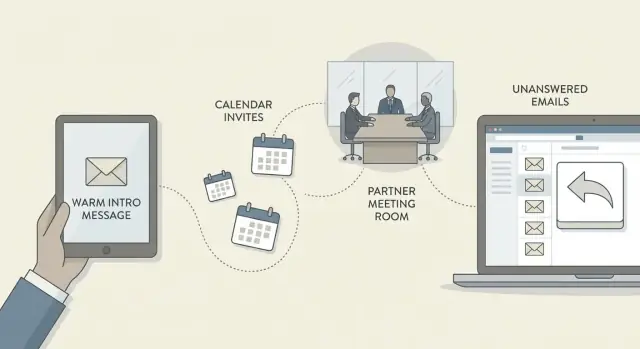
Fundraising “behind the scenes” is the work investors do when you’re not in the room: triaging inbound deals, comparing you to similar companies, checking incentives inside their fund, and coordinating calendars across a partnership. It’s less like a single pitch and more like moving a decision through a system with limited attention and very specific timing.
What it is
Fundraising is a structured process of risk reduction. A firm is trying to answer, in order: “Is this in our scope?”, “Is this defensible?”, and “Can we be confident enough to lead or join?” Along the way, your story gets translated into internal shorthand (market size, traction quality, team, pricing, competition) and tested against the fund’s mandate and current portfolio.
It also runs on incentives. Associates may optimize for sourcing volume and early signal detection; partners optimize for conviction and reputation. Timing matters because partner bandwidth, IC schedules, and competing deals can speed you up—or stall you.
Who’s involved (and what they do)
Typically, you’ll interact with founders/angels making the intro, an associate or principal running early screens, and partners who drive the decision. Many firms also have an Investment Committee (IC) or partner vote that formalizes the “yes.”
What you can and can’t control
You can control clarity (deck, metrics, narrative), responsiveness (follow-ups, data room readiness), and process discipline (who sees what, when). You can’t control internal politics, partner availability, or whether your category is “hot” this quarter.
How to use this guide
Treat the next sections as a map: what each meeting is really for, what signals investors look for, and how “no” often shows up as silence. The goal is fewer surprises, cleaner execution, and better odds of reaching a term sheet.
Warm Intros: How They’re Evaluated
Warm intros aren’t magic—they’re just a signal. Investors use them to quickly decide whether an opportunity is worth attention now, later, or never. The intro itself often determines which bucket you land in.
How investors sort inbound vs. warm vs. outbound
Most firms triage like this:
- Inbound (you emailed the fund): higher volume, lower context, easy to ignore unless it’s unusually crisp.
- Warm intro (someone they trust vouches): lower volume, higher signal, usually gets at least a glance.
- Outbound (they contacted you): rare and time-sensitive; you’re already on their radar.
A warm intro doesn’t guarantee a meeting. It mainly buys you consideration and a faster response expectation.
What makes an intro “warm”
Investors read an intro for three things:
- Context: Why this company, this round, this moment.
- Credibility: Who is introducing you, and do they have a track record with the investor?
- Relevance: Does it match the fund’s stage, sector, geography, and check size?
The warmest intros include a clear reason the introducer believes the startup is a fit—ideally with one concrete proof point (traction, customer names, growth, or a standout founder angle).
Why some intros get instant replies (and others stall)
Fast replies happen when the email is scannable: one sentence on what you do, one proof point, and a clear ask. Stalls happen when the intro is vague (“thought you two should meet”), mismatched to the fund, or when the introducer can’t truly vouch.
Simple templates
Asking for an intro
Subject: Intro to [Investor]?

Hi [Name]—would you be comfortable introducing me to [Investor] at [Firm]?

One-liner: We help [customer] do [outcome].
Proof: [traction metric / customer names / growth].
Round: Raising [$X] seed/Series A; looking for a lead/check of [$Y].
Why them: [1 line on fit with their thesis/portfolio].

If yes, I can send a 3–4 sentence blurb you can forward.
Thanks,
[Your name]
Forwardable intro blurb
Subject: Intro: [Startup] x [Investor]

[Investor]—introducing [Founder], CEO of [Startup]. They’re building [1-line description] for [target customer].

Why I’m reaching out: [Founder] has [proof point]. They’re raising [$X] and thought [Firm] could be a fit because [specific reason].

I’ll let you both take it from here.
The Initial Screen: Fit Before Excitement
Before any investor gets excited about your story, your deck usually goes through a quick “fit” screen. This is not a judgment on your team or product—it’s an internal sorting step to decide whether the opportunity belongs in their workflow at all.
The first filter: mandate basics
Most firms will sanity-check a few non-negotiables within minutes:
- Stage: pre-seed, seed, Series A, growth—many funds won’t bend here.
- Geography: some invest only in specific countries, regions, or time zones.
- Sector: “We do B2B SaaS” often means “we don’t do consumer, biotech, crypto, etc.”
- Check size: a $250k lead check and a $5M lead check are different worlds.
- Ownership targets: if they need 10–20% and your round structure can’t support it, it’s a mismatch.
This is why you can get a fast “pass” even when the intro is strong and the deck is polished.
The internal question: “Is this a fit for our fund?”
The most common behind-the-scenes question isn’t “Is this good?” It’s “Can we credibly invest in this given our mandate?” Partners and associates are protecting time and consistency: if they can’t imagine defending the deal in an internal meeting, they’ll stop early.
A frequent outcome is “not now.” Many times that translates to “not our mandate” (wrong stage, wrong check size, outside sector), not “you’re a bad company.”
How to pre-qualify investors and avoid dead ends
Do a quick pre-check before you ever ask for a meeting:
- Confirm their recent deals match your stage and geography.
- Look for lead vs. follow behavior at your round size.
- Ask directly (politely) about typical ownership and whether they can hit it.
- Tailor your outreach subject line to the mandate: “Seed B2B SaaS, $2M round, US/Canada.”
Treat this step like routing, not pitching: the goal is to get to investors who are allowed to say yes.
First Calls: The Real Goal of the “Quick Chat”
The first call is rarely about making a yes/no decision. It’s a sorting mechanism: can this company plausibly become a real fund return, and can the investor imagine working with this founder for years?
What investors actually listen for
They’re listening less for your full story and more for signal density:
- Clarity: Can you explain what you do, for whom, and why it’s different in two sentences?
- Wedge: What’s the narrow entry point that makes adoption likely (a specific user, use case, channel, or integration)?
- Traction signal: Not just numbers, but what those numbers mean (growth rate, retention, payback, pipeline quality).
- Pacing: Do you answer directly, or do you “presentation mode” your way around simple questions?
The hidden goals: coachability and judgment
A “quick chat” is also a test of how you think. Investors probe for coachability (do you engage with feedback) and judgment (do your priorities make sense). When asked about a risk—churn, sales cycle, competition—they’re not expecting perfection; they’re checking whether you see reality clearly and have a plan.
How notes get captured and shared
Most firms treat the first call like intake. The caller writes a short internal summary—problem, solution, market, traction, round size, use of funds, key risks—often in a template. That note gets dropped into the firm’s CRM and may be forwarded to partners with a quick “worth a deeper look?” message. The quality of this note often determines whether you get the next meeting.
Mistakes that create immediate doubt
Vague metrics (“growing fast”), unclear wedge (“for everyone”), and inconsistent basics (pricing, ICP, or go-to-market) raise alarms. Another fast negative: dodging direct questions about burn, runway, or why this round size makes sense.
Partner Meetings: What Changes and Why
A “partner meeting” is when your deal gets in front of the people who can actually say yes. Before this, you might be talking with an associate or a principal who’s gathering context, stress-testing basics, and deciding whether your story is worth scarce partner attention.
What a partner meeting really is
Think of it as a high-leverage checkpoint: partners are balancing your opportunity against every other potential investment and against their fund strategy. The meeting is less about “getting to know you” and more about whether the firm can credibly underwrite the bet.
How investors decide you’re ready for partner time
You usually get invited when the investor believes three things are true:
- The problem and buyer are clear (no mystery around who pays and why).
- There’s evidence of pull—traction, strong retention signals, or a sharp go-to-market wedge.
- They can imagine an investment memo forming without major holes.
If the story still relies on “we’ll figure it out,” it often stays at the pre-partner level.
What changes in the conversation
Partner conversations shift toward bigger, harder questions:
- Market sizing and ambition: not just TAM slides, but why this can become a category-scale outcome.
- Edge and defensibility: why you win against alternatives, and why that advantage compounds.
- Risks that kill companies: pricing power, long sales cycles, churn drivers, competitive responses, regulatory constraints.
- Team signal: how you make decisions, hire, and handle bad news.
How to prepare
Bring a tight narrative (problem → insight → solution → proof → why now), a metric set you can explain quickly, and a demo that highlights the “aha” moment—ideally tied to real customer behavior.
Also pre-load objections. Make a short list of the top 5 concerns you expect (competition, retention, CAC, timeline to scale, concentration) and have crisp, specific responses ready—numbers, examples, and what you’re doing next.
Internal Championing: Who Pushes Your Deal
After a good call, your startup doesn’t “move forward” on its own. A specific person inside the fund has to pick it up and carry it.
The champion’s job (and limits)
Your internal champion is usually the investor you met first—an associate, principal, or partner—who believes there’s something worth pursuing. Their job is to translate your story into the firm’s language: why now, why you, why this market, and why this is a venture-scale outcome.
But champions have constraints. They have a crowded pipeline, a weekly meeting cadence, and only so much political capital. If your deal isn’t crisp enough to retell in two minutes, it’s hard for them to spend that capital.
Consensus, skeptics, and time
Most firms don’t require unanimous excitement, but they do require “no strong objections.” Skeptics show up in predictable ways:
- “Competition is too intense.”
- “We’ve seen this story before.”
- “Traction isn’t strong enough for this round size.”
- “Great product, unclear distribution.”
Timing matters too. If partners are traveling, fundraising internally can stall. If the fund is already overloaded with diligence, your process can slow even if people like you.
What “let me discuss with the team” can mean
That phrase is ambiguous on purpose. It can mean:
- They’re genuinely excited and need alignment before scheduling next steps.
- They like you but expect pushback and want to pre-wire concerns.
- They’re buying time because the team isn’t leaning in.
The signal is what happens next: a calendar invite and concrete asks (data room, references, follow-up call) usually indicate real championing.
How to help your champion sell internally
Make it easy for someone else to advocate for you when you’re not in the room:
- A tight one-page memo: problem, wedge, traction, why now, round terms.
- Proof points that travel well: growth chart, retention/cohorts, sales cycle, unit economics.
- Clear “what we need to believe” bullets (and what evidence supports them).
- A short list of customer references or users who will respond quickly.
Your goal isn’t to oversell—it’s to give your champion a clean narrative and credible artifacts they can forward without rewriting.
Diligence Behind Closed Doors
Diligence is the work investors do when they’re interested—but not yet convinced. It rarely feels dramatic from your side: a few extra questions, another call, “can you share a bit more detail?” Behind the scenes, they’re trying to reduce uncertainty fast, without missing the one risk that would make them look careless.
Seed vs. Series A (and beyond)
At seed, diligence is often about people and direction. Investors look for founder-market fit, speed of learning, early customer pull, and whether the story holds together when you zoom in. Data matters, but “clean enough and honest” beats “perfect and over-produced.”
By Series A and later, diligence shifts toward repeatability. Investors want evidence that growth isn’t a one-off: a predictable acquisition motion, stable retention patterns, and a pipeline that supports the next 12–18 months. The bar rises because the check size and internal scrutiny rise too.
Common requests you should expect
Most diligence lists rhyme. Expect asks like:
- Customer calls (often 3–8): why they bought, what they’d miss, what they’d switch to
- Pipeline detail: stage definitions, conversion rates, sales cycle length, top deals, slip reasons
- Churn and retention: logo vs revenue churn, expansion, payback period
- Cohort data: retention by signup month/quarter, usage trends, time-to-value
They may also ask for pricing history, major roadmap decisions, and any “skeletons” (lost customers, security incidents, co-founder departures) explained plainly.
How investors validate what you say
Good firms triangulate. They’ll run reference checks on founders, do expert calls to pressure-test the market, and compare your metrics to similar companies. Some do channel checks (talking to partners, former employees, or adjacent buyers) to confirm urgency and budget.
Build a clean data room (and stay consistent)
A simple, well-labeled data room reduces back-and-forth: pitch deck, financial model, cap table, customer list (as appropriate), cohort/retention exports, and key contracts. Keep one “source of truth” for metric definitions, and don’t change numbers between emails and meetings without a clear note explaining why. Consistency builds trust faster than polish.
If you’re early and don’t have a full analytics stack, prioritize repeatable reporting over fancy dashboards. Many teams will spin up a lightweight internal portal for investor-friendly exports, reference links, and a single metrics glossary. Tools like Koder.ai can help here: because it’s a vibe-coding platform, you can prototype a simple web app from chat (often using React + a Go/PostgreSQL backend) to centralize your key charts and definitions, then iterate quickly as diligence questions come in.
How Investment Decisions Get Made
A “yes” from a VC is rarely one person’s decision. Even if a partner loves you, most firms need internal agreement before they can issue a term sheet.
The typical structure: partner vote + IC
Many funds run a two-step process:
- Partner meeting: the partner who met you presents the deal (often with help from an associate). The room pressure-tests the story.
- Investment Committee (IC): a smaller group (sometimes the same partners, sometimes founders of the fund, or senior advisors) that makes the final call and approves terms.
Some firms blur these together, but the dynamic is similar: your deal needs an internal champion and enough “no objections” to move forward.
What actually gets debated
The discussion isn’t “Is this team smart?” That’s table stakes. The debates are usually about:
- Risk: What breaks the company? Hiring? Distribution? Competition? Regulation? Customer concentration?
- Timing: Why is the market ready now—and why are you the one who can win now?
- Pricing: Is the valuation justified by traction and the next milestones, or are we paying for hope?
- Portfolio fit: Does this conflict with another investment? Does it overexpose the fund to one theme?
Why great meetings still end in a “no”
You can have strong calls and still get declined because the firm can’t align internally. One partner may worry the market is early, another thinks the round is overpriced, or the fund may have already “spent” its risk budget on a similar bet.
Timing: what delays usually mean
Decisions can take days to a few weeks. Delays usually signal internal uncertainty, partner travel, waiting for a reference call, or the firm trying to see if another lead investor sets terms first. A clear next step and date is often the difference between “still evaluating” and “quietly passing.”
Silent Rejections: Reading the Signals
Most “no’s” in startup fundraising aren’t delivered as a clean rejection. They arrive as delay, vague encouragement, or silence—because saying no has a social cost and investors want to preserve optionality.
Soft commitments vs real commitments
A soft commitment sounds like: “We like this,” “We’re interested,” or “Let’s stay close.” A real commitment looks like action with a deadline.
Real signals usually include at least one of these:
- A scheduled partner meeting with decision-makers (not “sometime next week”)
- A specific request tied to underwriting (cohort data, references, pricing history)
- Fast, concrete next steps (data room access, diligence calls, legal timing)
If the “yes” doesn’t change anyone’s calendar, it isn’t a yes yet.
Common stalling patterns
Two phrases are the classics: “keep us posted” and “circle back next quarter.” They can be genuine, but they often mean one of three things: they’re not convinced, they’re not aligned internally, or the fund’s priorities are elsewhere.
Other stall patterns include repeatedly asking for “one more metric update,” sending junior-only attendees, or stretching the time between replies.
Why investors go quiet
Silence is rarely personal. Common causes:
- Capacity: the partner is in IC prep, travel, or closing another deal
- Priorities: your deal slipped behind a hotter theme or existing portfolio issue
- Internal doubts: lukewarm feedback from a partner, missing conviction, or risk flags they don’t want to debate with you
A follow-up cadence that keeps momentum
Aim for polite, lightweight persistence:
- 48–72 hours after a meeting: send a concise recap + the agreed next step
- Once per week: a short update with one new proof point (revenue, pipeline, retention)
- After two unanswered touches: ask a binary question—“Should we close the loop for now?”
A clear “not now” is still progress. It frees you to focus on the investors who are actually moving.
From Interest to Term Sheet: The Narrow Bridge
A lot of fundraising “interest” is real—but it’s not a commitment. The narrow bridge is the gap between positive signals (great meeting, excited emails) and a written term sheet someone is willing to stand behind.
How term sheets usually emerge
Term sheets most often appear when an investor believes they can lead the round (set terms and rally others) or when they feel competition (another firm is circling as lead). A common dynamic: one partner says, “We’re leaning in,” then quietly tries to confirm (a) you’re fundable, and (b) they won’t be left holding the bag if others don’t follow.
If you already have a credible lead in motion, other investors may move faster—not because your company changed overnight, but because the “who’s leading?” risk is reduced.
The terms founders should actually understand
- Valuation: price of the company in this round. Pay attention to the pre-money vs. post-money framing and how much ownership you’re giving up.
- Liquidation preference: who gets paid first in an exit, and how much. This can matter more than valuation in mediocre outcomes.
- Pro rata rights: whether investors can maintain their ownership in future rounds (often valuable to them; sometimes useful to you if it keeps supportive insiders engaged).
What happens between verbal interest and signed docs
Expect internal partner alignment, reference calls, a quick legal sanity check, and drafting. Even with “we’re in,” investors may still be validating deal fit, risk, and the story they’ll tell the partnership.
Red flags in wording and timing
Watch for vague language (“we’re very interested,” “keep us posted”) without a concrete next step, slow responses after asking for sensitive materials, or repeated pushes for “one more meeting” without explaining what decision it unlocks. A serious path sounds like dates, owners, and deliverables—not enthusiasm alone.
Managing the Fundraising Process Like a Pipeline
Fundraising feels emotional because every “yes” or “no” is personal. Running it like a pipeline makes it operational: you stop relying on vibes and start managing throughput.
Momentum beats perfection
A round rarely closes because the deck is perfect. It closes because there’s consistent forward motion: intros turning into first calls, first calls turning into partner meetings, and clear next steps after each interaction.
Momentum does two useful things at once:
- It increases your odds through volume (more qualified shots on goal).
- It changes investor behavior—people move faster when they believe others are moving too.
That means your job is less “keep polishing” and more “keep advancing.” Improve materials in parallel, but don’t let refinement become a reason to slow outreach.
A simple pipeline you can actually run
Keep it lightweight. A spreadsheet is enough if it’s disciplined.
Use stages that map to actions, not feelings:
- Targeted → ready for outreach, thesis fit confirmed
- Intro requested → waiting on connector or cold email sent
- Scheduled → meeting on calendar
- Follow-up sent → materials + ask + deadline included
- Next step pending → they owe you something (partner meeting, references, data room request)
- In diligence → active workstreams, clear checklist
- Passed / stalled → archived with reason
For every line item, define: next step, owner, and date. If a deal has no next step, it’s not real—it’s a maybe you’re carrying.
If you want to operationalize this beyond a spreadsheet, consider building a simple internal “fundraising CRM” that mirrors these stages, stores email templates, and logs next-step dates. Teams often prototype something like this quickly on Koder.ai—especially when they want a lightweight web app they can tweak daily as their process evolves (and export the source code when it’s time to productionize).
Timelines: create urgency without bluffing
You can be direct without manufacturing drama. Share a real process timeline:
- “We’re doing first meetings this week and partner meetings next week.”
- “We’re aiming to wrap decisions by [date] so we can stay focused on growth.”
If there’s genuine interest elsewhere, say so plainly (“We’re in active discussions with a few firms”) and anchor it to your schedule, not a threat.
When to pause, reset, or change strategy
If you’re getting lots of meetings but no advancement, don’t just “follow up harder.” Consider a reset when you see patterns for 2–3 weeks:
- Pricing issue: repeated pushback on valuation/round size → adjust targets or structure.
- Targeting issue: the right people aren’t leaning in → tighten the investor list around your category and stage.
- Story issue: confusion about why now or why you win → rewrite the narrative, not the visuals.
A pipeline works when it forces honesty: what’s moving, what’s stuck, and what you’ll change next.
Closing the Round and What Happens After
Closing isn’t when someone says “we’re in.” Closing is when the paperwork is signed, the money is wired, and both sides have confirmed the final details (amount, entity, price, rights, timing). Until then, treat everything as “in progress,” even if the tone is enthusiastic.
What “closing” actually includes
Most rounds close in a small sprint of logistics:
- Final documents: typically a set of definitive agreements (or SAFE/notes plus side letters) reflecting the agreed terms.
- Signatures and countersignatures: investors sign, the company signs, and sometimes key holders sign (depending on structure).
- Wire instructions + confirmations: banking details, wiring deadlines, and proof of funds received.
It’s normal for closings to happen in tranches: a first close with the lead and a few investors, then later closes as additional investors finish their process.
Communicating outcomes to investors who passed
Don’t disappear. A short, polite note keeps your reputation intact and avoids awkwardness later.
- Thank them for their time.
- Confirm you’re closing the round (or have closed).
- If appropriate, offer to keep them in the loop with periodic updates.
Avoid framing it as “you missed out.” The goal is to keep the door open.
Keeping relationships warm for later rounds
Many “no’s” are really “not yet.” The best founders maintain light, consistent contact—without selling every month.
Send occasional updates tied to milestones: revenue, key hires, product releases, retention improvements, major partnerships. A simple cadence (e.g., quarterly) is enough to stay on their radar so your next raise doesn’t start from zero.
Turning rejections into useful feedback (without overreacting)
Feedback is valuable, but it’s also noisy. Some investors give a generic reason; others name the real issue. Instead of debating, look for patterns.
Ask one calm follow-up question: “If we hit X in the next 3–6 months, would you want to re-engage?” If they give a clear metric or concern, log it and move on.
Your job after the round is to shift back to execution—then use updates to make the next fundraising cycle easier, not more emotional.
FAQ
What is fundraising really, beyond the pitch meeting?
Fundraising is mostly an internal workflow where investors reduce risk step by step: mandate fit → defensibility → confidence to lead/join. Your pitch gets translated into internal shorthand (market, traction quality, team, pricing, competition) and debated based on the fund’s incentives, bandwidth, and timing—not just your presentation.
Do warm intros actually matter, and what makes one effective?
A warm intro doesn’t guarantee a meeting—it mainly buys faster consideration. It works when it provides:
- Context: why this company/round/now
- Credibility: the introducer is trusted by the investor
- Relevance: clear match on stage, sector, geography, and check size
A vague “you two should meet” intro is often treated like inbound.
Why do investors pass quickly even when the deck looks strong?
Most firms do a fast “mandate basics” screen:
- stage (pre-seed/seed/A)
- geography/time zone
- sector scope
- check size and lead/follow behavior
- ownership targets
A quick pass often means “not allowed by our fund constraints,” not “bad company.”
How can I pre-qualify investors so I’m not wasting cycles?
Pre-qualify before you ask for time:
- scan recent deals for stage + geography match
- confirm whether they lead rounds your size
- ask (politely) about typical ownership and whether they can reach it
- tailor outreach with a mandate-forward subject line (e.g., “Seed B2B SaaS, $2M round, US/Canada”)
The goal is to talk to investors who are structurally able to say yes.
What are investors really trying to learn on the first call?
The first call is an intake and sorting step. Investors listen for signal density:
- clear 1–2 sentence description (what, for whom, why different)
- a believable wedge (specific entry point)
- traction meaning (growth/retention/pipeline quality, not vanity)
- direct answers (not “presentation mode”)
They’re also quietly testing judgment and coachability.
What happens to my story after the call—how do notes get shared internally?
Your interviewer typically writes an internal note (often templated) covering: problem, solution, market, traction, round size, use of funds, key risks, and next steps. That summary often determines whether partners pay attention—so your job is to be easy to summarize with crisp metrics and a clean narrative.
What changes in a partner meeting compared to earlier meetings?
Partner meetings are when you’re in front of people who can actually commit. The conversation shifts to:
- why this becomes category-scale (not just TAM slides)
- defensibility and why your edge compounds
- company-killers (pricing power, churn drivers, sales cycle, competition)
- team decision-making under stress
Prepare a tight narrative and pre-loaded answers to your top 5 likely objections.
How do I help an internal champion push my deal forward?
A deal doesn’t advance on its own—someone must champion it internally. Help them by providing:
- a forwardable one-page memo (problem, wedge, traction, why now, round terms)
- proof points that “travel” (growth, cohorts/retention, sales cycle, unit economics)
- clear “what we need to believe” bullets + evidence
- quick-to-reach customer references
If your story can’t be retold in two minutes, it’s hard to sell inside a partnership.
What should I expect during diligence, and how do I stay prepared?
Expect diligence to “rhyme,” including:
- 3–8 customer calls (why they bought, what they’d miss, alternatives)
- pipeline detail (stage definitions, conversions, slip reasons)
- churn/retention splits (logo vs revenue, expansion, payback)
- cohort and usage trends (time-to-value)
Keep a simple data room and one consistent source of truth for metric definitions—consistency builds trust faster than polish.
How do I tell the difference between real interest and a silent rejection?
Silence is often the default “no” because it preserves optionality. Treat actions as the real signal. Strong signs include:
- a meeting scheduled with decision-makers
- specific underwriting requests (cohorts, references, pricing history)
- clear owners and deadlines for next steps
A practical follow-up cadence: 48–72 hours post-meeting recap, then weekly one-proof-point updates; after two unanswered touches, ask a binary close-the-loop question.