

Startup vs Company: Why Founders Confuse Building Each
Learn how building a startup differs from building a company, the stages where founders get stuck, and practical shifts in goals, team, and execution.
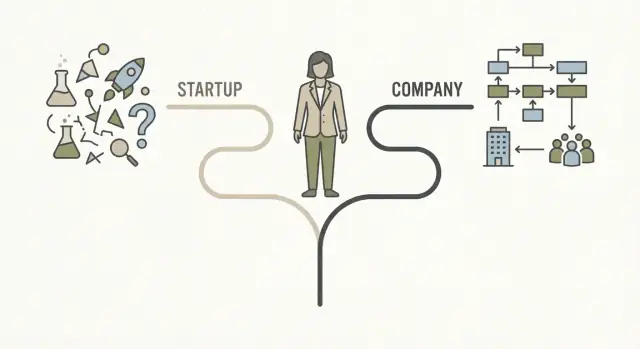
What Founders Mean by “Startup” vs “Company”
Founders often use “startup” and “company” as if they mean the same thing: a small team building something new. The confusion starts when the work changes, but the words don’t.
A startup is primarily an exploration. You’re searching for something that’s true but not yet proven: who the customer really is, what problem they’ll pay to solve, what the product must do (and not do), and what story reliably creates demand. You can be shipping every week and still be “in startup mode” if the main question is still whether this should exist and for whom.
A company is primarily an execution engine. You’re delivering a solution that’s already validated, then making it predictable: consistent quality, repeatable sales, stable operations, clear roles, and measurable performance. You can still innovate, but most work is about doing the proven things better, faster, and at larger scale.
Why this distinction matters
When leaders treat exploration like execution, they add process too early, hire the wrong profiles, and punish “uncertainty” as if it were poor performance. When they treat execution like exploration, they keep changing direction, avoid accountability, and exhaust the team with constant reinvention.
The result isn’t just bad decisions—it’s morale damage. Teams can handle hard work; what drains them is unclear expectations: “Move fast” paired with “Stop making mistakes,” or “Be experimental” paired with “Why isn’t this predictable yet?”
The key shifts you’ll see throughout this guide
This article maps the transition across four areas:
- Goals: from searching for product-market fit to delivering and scaling what works
- Team shape: from adaptable generalists to clear functions and ownership
- Systems: from minimal process to repeatable operating rhythms
- Leadership: from doer-in-chief to designing and managing a system
No single right path—just clearer phases
There’s no universal timeline, and many businesses blend both modes for a while. The point isn’t to “graduate” on a schedule—it’s to name the phase you’re actually in, so your decisions match reality and your team knows what success looks like.
Different Goals: Searching vs Delivering
Founders argue about whether they’re “still a startup” or “already a company,” but the more useful distinction is the goal you’re optimizing for.
A startup is searching
A startup’s job is to find a repeatable way to create value—which means you’re still testing what to build, who it’s for, why they’ll choose you, and how you can reach them profitably.
Because you’re searching, the best metrics aren’t “how much did we ship?” but “how quickly did we learn?” Look for validation signals such as:
- Are target customers consistently experiencing the problem?
- Do they pull the product into their workflow without heavy pushing?
- Are you seeing repeat usage, referrals, or willingness to pay in interviews and pilots?
- Is your cost to reach customers trending down as the message gets sharper?
In this phase, a sprint that proves an assumption wrong can be a win—if it saves you months of building the wrong thing.
A company is delivering
A company’s job is to deliver value reliably at scale. You’re not only making customers happy; you’re making outcomes predictable across teams, quarters, and markets.
That changes what “good” looks like. Company metrics tilt toward efficiency and reliability, for example:
- Retention and expansion (do customers stay and grow?)
- Unit economics and margins (do you earn more as you scale?)
- Forecast accuracy and throughput (can you plan and hit targets?)
- Support load, quality, and time-to-resolution (can you serve more customers without chaos?)
Revenue doesn’t decide the phase
Revenue can exist in both phases. Early revenue might be part of learning (paid pilots, services, custom deals). Later revenue reflects a repeatable system (standard pricing, predictable renewal patterns). The question isn’t “are we making money?”—it’s whether you’re still proving the model or executing a model you can trust.
Different Constraints: Uncertainty vs Complexity
A startup’s main constraint is uncertainty: you don’t yet know what customers truly want, which message will resonate, or whether you can acquire users at a sustainable cost. The goal is to learn the truth quickly—often by running small experiments that are “good enough” to test a hypothesis.
A company’s main constraint is complexity: once the business works, you have more customers, more edge cases, more integrations, more people, and more dependencies. The goal shifts to keeping the system stable while you grow.
Uncertainty rewards speed and learning
In a startup, optimizing for speed is rational because the biggest risk is building the wrong thing. Lightweight prototypes, narrow pilots, and quick iterations reduce the time between “we think” and “we know.”
That also changes risk tolerance. Early on, the acceptable failure mode is a flawed experiment that teaches you something. The unacceptable failure mode is spending months polishing a product no one needs.
Practical note: tools that reduce build-and-iterate time can be a genuine advantage in this phase—especially when you’re testing multiple directions. For example, a vibe-coding platform like Koder.ai lets teams create web, backend, or mobile apps through a chat interface (React on the web, Go + PostgreSQL on the backend, Flutter for mobile), which can compress “idea → usable prototype” cycles without committing to a heavy engineering pipeline. You still need good judgment about what to test—but faster loops make that judgment pay off sooner.
Complexity rewards standards and uptime
Once demand is proven and you’re delivering repeatedly, the cost of “just ship it” climbs. Every shortcut becomes future work, and every inconsistency multiplies across teams.
This is where companies optimize for quality, consistency, and uptime:
- Experiments still exist, but they’re bounded (feature flags, staged rollouts, clear ownership)
- Standards aren’t bureaucracy; they prevent rework and production incidents
The core tradeoff: experiments vs standards
Startups trade precision for learning. Companies trade optionality for reliability. Neither is morally better; they serve different constraints.
A common failure is keeping the “move fast” posture after the system becomes interconnected. What used to be a harmless shortcut can now break billing, support, or trust—because complexity turns small errors into company-wide problems.
The founder skill is knowing which constraint you’re under, and choosing the operating style that matches it.
Team Shape: Roles in a Startup vs Functions in a Company
Early on, a startup “org chart” is mostly a map of who talks to whom. It’s communication, not structure. If two people can sit down, decide, ship, and learn within a day or two, you’re doing it right.
The startup team: fluid roles, shifting ownership
In a startup, roles are intentionally blurry. One week you’re “product,” the next you’re writing support replies, negotiating a partnership, and debugging onboarding. Ownership shifts daily because the work shifts daily.
That flexibility is a feature: it keeps the team fast while you’re still figuring out what matters. The tradeoff is that you can’t rely on consistent handoffs or predictable throughput—and that’s acceptable when the goal is learning.
The company team: functions, accountability, and handoffs
Once you’re building a company, you’re optimizing for repeatability. That requires clearer accountability: who decides, who executes, who reviews, and how work moves between functions (product → design → engineering → QA → support → sales).
Handoffs aren’t “bureaucracy” by default. They’re a way to prevent expensive mistakes and make output dependable. Clear roles also make hiring and onboarding easier because expectations are legible.
When ambiguity stops being helpful
A practical test is approvals. Ask: do you need approvals to avoid costly errors? If a single wrong pricing change, security miss, or contract term can create outsized damage, you’re no longer in the “everyone just ships” phase.
You don’t need a heavy org chart overnight. Start by defining:
- One owner per outcome (not per task)
- Decision rights for recurring choices
- A lightweight handoff for work that crosses functions
That’s the shift from “we all do everything” to “we all move faster because responsibilities are clear.”
Hiring Differences: Generalists First, Specialists Later
Hiring is one of the easiest ways to accidentally turn a startup problem into a company problem (or vice versa). The “right” hire depends less on your ambition and more on what phase you’re in.
Startup hiring: generalists who can discover and adapt
Early on, you’re still proving what works. You need people who can move across messy boundaries: talk to customers in the morning, ship something by afternoon, and rewrite the plan the next day.
Good early-stage generalists typically:
- Learn fast with little context and vague goals
- Prefer experiments over perfect plans
- Can own outcomes, not just tasks
- Communicate clearly when things are uncertain
A common mistake is hiring a “big-company” specialist too early—someone optimized for running a well-defined function (like demand gen, data science, or HR) before you’ve nailed the basics. They often need stable inputs (clear ICP, consistent channels, predictable roadmap). Without those, performance looks “bad,” but the real issue is phase mismatch.
Company hiring: specialists who can run a function well
Once you have a repeatable motion, specialists add leverage. They create depth, improve quality, and build systems others can follow.
Specialists are most valuable when:
- The work repeats and can be measured consistently
- You can define a role’s inputs/outputs
- The rest of the org can support them (tools, data, handoffs)
The opposite mistake is keeping only generalists too long. You get heroic execution, but quality slips, knowledge stays in people’s heads, and the business can’t scale without constant firefighting.
Interview signals: questions that reveal phase fit
To test for startup generalists, ask:
- “Tell me about a time you shipped something with incomplete information. What did you decide not to learn yet?”
- “What’s the smallest test you’d run to validate this idea in two weeks?”
To test for company specialists, ask:
- “Walk me through the system you built to make results predictable. What metrics did you standardize?”
- “How do you document and hand off your process so someone else can run it?”
Hiring gets easier when you name your phase honestly: are you still searching, or are you delivering at scale?
Product Work: Discovery Mode vs Delivery Mode
Founders often say “we’re building the product,” but that hides two very different jobs. In a startup, product work is mainly about learning what should exist. In a company, product work is mainly about delivering what you’ve already promised—consistently.
Startup product work: learn fast, change fast
In discovery mode, your primary output isn’t features—it’s validated insight. You’re trying to answer questions like: Which problem is painful enough? Who feels it most? What do they do today? What would they pay for?
That’s why early product cycles should be short and cheap: prototypes, scrappy onboarding, manual workarounds, narrow experiments. “Done” means you reached a learning milestone (e.g., 10 users successfully complete a key task without help), not that the UI is polished.
A useful test: if you can’t name the assumption a feature is meant to validate, you’re drifting into delivery mode too early.
Company product work: roadmap discipline and reliability
Once you have real customers and real expectations, product work shifts. The product team’s job becomes meeting customer commitments: predictable releases, fewer regressions, clear prioritization, and stability.
Roadmaps become a contract with the business. “Done” means reliable behavior at scale: edge cases handled, analytics in place, support trained, performance and security addressed. Iteration still happens—but within guardrails, because breaking things now breaks trust.
How feedback loops change as customers grow
In discovery, feedback loops are direct and qualitative: calls, screenshares, live observation, fast reversals.
As you add customers, feedback becomes noisier and slower: more segments, more competing requests, and more second-order effects. You’ll rely more on support tickets, usage data, churn signals, and sales notes—then translate those into coherent product decisions.
Don’t let process block discovery
The trap is importing “company” process too early: heavy approval chains, rigid quarterly roadmaps, or shipping standards that make experiments impossible. Keep just enough structure to avoid chaos—lightweight definitions of success, tight experiment scopes, and simple release checks—while protecting speed of learning.
Go-to-Market: Proving Demand vs Scaling a Motion
Go-to-market (GTM) is where the “startup vs company” difference becomes painfully visible. In a startup, selling is an experiment: you’re trying to prove who buys, what they buy, and why they buy now. In a company, selling is an operating system: you’re trying to run a repeatable motion that new people can execute without guessing.
Sales in a startup: prove demand (messy is normal)
Early on, messy sales is not a failure—it’s data. You might change the target customer mid-week, rewrite the pitch daily, and discover that the product is “really” solving a different problem than you thought.
At this stage, success looks like:
- A clear pattern in which types of buyers lean in (and which don’t)
- A story that consistently gets meetings and honest objections
- A few channels that might work, even if they don’t scale yet
Sales in a company: scale a motion with repeatability
Once you’ve found a working path, the job changes: make it predictable.
Repeatability (in plain language) means: if you give the same inputs, you usually get similar outputs. For GTM, that’s things like “X qualified calls per week tends to produce Y new customers per month,” within a reasonable range.
This is where you build:
- A defined pipeline stage-by-stage
- Basic forecasting you can plan around
- Consistent qualification and handoffs (marketing → sales → onboarding)
When to write the playbook—and enforce it
Document the playbook when you can explain your best deals without saying, “It was luck” or “They just loved us.” Enforce it when you’re hiring people who didn’t live through the early chaos.
Red flag: founders still closing everything
If the founder still has to close every deal out of habit, the motion isn’t truly repeatable. The goal isn’t to be heroic—it’s to make closing boring, so growth doesn’t depend on one person.
Operations: Minimal Process vs Repeatable Systems
Startup operations are about momentum. You put in the minimum structure required to keep shipping, learning, and not running out of cash. If a workaround keeps you moving for two more weeks, it’s often the right answer.
Company operations are about trust. Once customers rely on you, “good enough” can quietly turn into missed invoices, messy data, inconsistent releases, or support failures that are hard to undo. Operations shift from “how do we move faster?” to “how do we keep promises repeatedly?”
What “minimum process” looks like in a startup
In early-stage mode, the goal is to reduce drag:
- One simple way to track cash (even a spreadsheet)
- A lightweight support inbox and clear owner
- A basic release checklist you can run in 5 minutes
You’re not avoiding discipline—you’re avoiding overhead that doesn’t increase learning.
What “repeatable systems” mean in a company
As you transition, operations start protecting customers, data, and finances:
- Fewer “hero saves” and more predictable execution
- Clear handoffs between product, engineering, support, and billing
- Auditability: you can explain what happened, when, and why
This is where lightweight systems help: short docs, consistent onboarding, simple QA steps, and a basic budget with monthly review.
If you’re using platforms that accelerate shipping, this is also where you add guardrails: versioned environments, clear deployment ownership, and safe rollback. (For instance, Koder.ai includes snapshots and rollback and supports exporting source code—useful when you’re moving from fast iteration to higher reliability without losing control over your stack.)
What to standardize first (and why)
Standardize the workflows that touch customers and cash before internal preferences:
- Support: response times, escalation rules, where issues are logged
- Billing: who approves discounts, invoice timing, refund policy
- Releases: a small checklist (tests, rollback plan, comms)
These areas reduce churn, prevent revenue leakage, and lower stress for the team.
How to avoid process for process’s sake
A good rule: every new process should answer one question—what failure are we preventing or what speed are we increasing?
Keep processes small, measurable, and reversible. If a doc isn’t used, delete it. If a meeting doesn’t change decisions, cancel it. Operations should make it easier to do the right thing by default—not harder to get work done.
Leadership Shift: Doer-in-Chief vs Manager of a System
Early on, startup leadership is mostly about direct control. You decide, you ship, you sell, you fix the customer issue, and you rewrite the onboarding email at midnight. Fast decisions beat perfect decisions, and your personal output is a meaningful share of the company’s progress.
As the business turns into a company, that same style stops working. The work multiplies, coordination costs rise, and your calendar becomes the constraint. Leadership becomes less about “doing the work” and more about designing how the work gets done—through other people, shared standards, and clear priorities.
Startup leadership: speed through direct action
In a startup, the fastest path is usually the founder’s hands on the wheel:
- Make decisions in minutes, not meetings.
- Unblock others by jumping in and finishing the task.
- Hold context in your head because the team is small.
This can feel efficient—and it is, for a while.
Company leadership: scale through delegation and alignment
When you have multiple teams or functions, speed comes from alignment, not heroics. Company leadership shifts toward:
- Delegation with clear outcomes (what “good” looks like)
- Coaching so leaders beneath you can make strong decisions without you
- Alignment across product, sales, support, and operations so teams don’t work at cross-purposes
The goal is to create a system that produces good decisions repeatedly, even when you’re not in the room.
Why “being the bottleneck” starts to hurt
Founders often stay involved because they’re the best person for many jobs. The problem is throughput: if every important decision requires you, everything waits. People slow down, take fewer risks, and start “saving problems” for you instead of solving them. You’ll also be forced into constant context switching—often the worst use of founder time once execution is spread across a team.
Meetings: from ad-hoc to intentional cadences
Startups run on impromptu conversations. Companies need predictable rhythms: weekly leadership check-ins, clear project updates, and defined decision forums. The point isn’t more meetings; it’s fewer surprises.
Practical shift: write decisions down, clarify owners
Two simple habits accelerate the transition:
- Write down decisions (what, why, and what changes). This prevents re-litigating the same topics.
- Clarify owners (one person accountable) and timelines. Ambiguity is where execution goes to die.
This is the founder’s real job as you scale: replace “ask me” with “here’s how we decide and who owns it.”
Common Confusions and the Costs of Mixing the Phases
Founders often feel what’s wrong—stress, slow progress, or churn—without realizing they’re using company-building tools in startup mode (or the reverse). The penalty isn’t just frustration. It’s wasted time, lost customers, and team burnout.
When you’re acting like a company too early
Common symptoms include too much process, slow shipping, and weak learning. You have templates, approval chains, and perfectly formatted plans—but you can’t answer basic questions like “Who exactly is this for?” or “Why did the last five trials fail?”
The cost: you optimize for predictability before you have truth. That usually means long cycles and confident decisions built on thin evidence.
When you’re acting like a startup too late
The opposite mismatch shows up as constant fire drills, unclear priorities, and churn. Everyone is heroic and busy, but customers still experience inconsistencies: bugs, missed follow-ups, unclear packaging, and surprise changes.
The cost: you keep “discovering” when you should be delivering. Customers stop trusting you, and your team can’t build momentum.
A simple weekly framework: match decisions to the phase
Ask these diagnostic questions in a 15-minute weekly check-in:
- Are we still proving demand, or are we scaling a repeatable motion?
- Is this decision reversible (experiment) or hard to undo (system change)?
- Are we learning fastest by shipping, or by standardizing?
- What would hurt more this week: slower learning or lower reliability?
If most answers point to learning, bias toward startup-style execution (tight loops, fewer rules). If they point to reliability, bias toward company-style execution (clear ownership, repeatable systems).
Common mismatches to watch for
- OKRs too early: measurable targets without a stable model can create theater and cherry-picked metrics.
- No QA too late: “move fast” turns into avoidable churn once customers depend on you.
- Hiring specialists too soon: you get silos before you have a validated path.
- Keeping everything ad hoc too long: institutional knowledge stays in heads, and onboarding never gets easier.
The goal isn’t to pick one mode forever—it’s to recognize which phase you’re in, then operate accordingly.
A Practical Transition Plan: From Startup to Company Building
Making the transition isn’t a single “we’ve made it” moment. It’s a set of deliberate choices that reduce uncertainty and replace improvisation with repeatability—without turning your team into a bureaucracy.
1) Identify your current phase using evidence, not hope
Write down the facts you can verify. For example:
- Are customers renewing or re-buying without heavy founder involvement?
- Is demand predictable enough that you can forecast next month within a range?
- Do you have a repeatable way to acquire customers (even if it’s not efficient yet)?
If the answer is mostly “no,” you’re likely still in startup mode (search). If the answer is mostly “yes,” you’re entering company-building mode (delivery + scaling).
2) Pick 1–2 phase-appropriate goals for the next quarter
Avoid “grow fast” as a goal. Choose goals that match your phase:
- Startup mode: prove a specific use case, improve retention, validate willingness to pay.
- Company-building mode: increase throughput, reduce cycle time, scale one acquisition channel.
Limit yourself to one primary goal and one supporting goal. Everything else becomes “nice to have.”
3) Adjust hiring to match the goal
Hiring is strategy made permanent. If you’re still searching, prioritize adaptable generalists who can run experiments end-to-end. If you’re scaling a proven motion, add specialists where bottlenecks are obvious (e.g., sales ops, QA, customer success).
4) Introduce only the next layer of systems you truly need
Add process like you add infrastructure: only when load requires it. Examples of “next layer” systems:
- A single source of truth for priorities
- A lightweight weekly operating cadence
- Clear ownership for key metrics
5) Create a “stop doing” list to reduce mixed signals
Transitions fail when teams hear “move faster” and “be careful” at the same time. List 5–10 practices you will stop this quarter—like custom one-off features, untracked deals, or shipping without acceptance criteria—and communicate why. This is how you make the new phase real.
FAQ
What’s the simplest way to define “startup” vs “company”?
A startup is in search mode: you’re validating who the customer is, what problem matters, and what product/message reliably creates demand.
A company is in delivery mode: you’re executing a proven model with predictable quality, sales, and operations. The key difference is whether you’re still proving the model or scaling one you can trust.
Why does the startup vs company distinction matter for founders?
Because the operating style that works in one phase often fails in the other.
- Treating exploration like execution adds process too early, slows learning, and hires the wrong profiles.
- Treating execution like exploration creates constant churn, unclear accountability, and burned-out teams.
Does revenue mean you’ve become a company?
Revenue exists in both phases.
Early revenue can be learning revenue (paid pilots, custom deals, services) that proves willingness to pay. Later revenue tends to come from a repeatable system (standard packaging, predictable renewals, consistent acquisition). The real question is whether revenue is evidence or output of a proven machine.
What metrics should we track in startup mode vs company mode?
Use phase-appropriate metrics:
- Startup/search: speed of learning, activation milestones, repeat usage in a narrow segment, willingness to pay, message clarity, early retention signals.
- Company/delivery: retention/expansion, unit economics, forecast accuracy, support load and time-to-resolution, release quality and uptime.
Pick the metrics that match your main constraint (uncertainty vs complexity).
What’s the real constraint in a startup compared to a company?
A startup’s main constraint is uncertainty—you don’t yet know what’s true about customers, product, or channels.
A company’s main constraint is complexity—more customers, edge cases, integrations, people, and dependencies.
That’s why startups bias toward fast experiments, while companies bias toward standards and stability.
How do team roles change as you move from startup to company?
In a startup, roles are intentionally fluid: people jump between product, support, sales, and engineering to keep learning fast.
In a company, you need functions and clear ownership so work can be repeatable:
- defined decision rights
- one owner per outcome
- lightweight handoffs across teams
This clarity increases throughput and reduces expensive mistakes.
What’s different about hiring in a startup vs a company?
Hire for phase fit:
- Early/startup: adaptable generalists who can run messy experiments end-to-end and make progress with incomplete information.
- Later/company: specialists who can run a function reliably and build systems others can follow.
A common mistake is hiring big-company specialists before you have stable inputs (ICP, channels, roadmap).
How does product work differ between discovery and delivery?
In discovery mode (startup), “done” means you validated an assumption (e.g., users complete a key task without help). Output is learning, not features.
In delivery mode (company), “done” means reliable behavior at scale: fewer regressions, edge cases handled, support prepared, performance/security covered.
If you can’t name the assumption a feature tests, you may be doing delivery work too early.
What changes in go-to-market when you become a company?
Startup GTM is an experiment to prove who buys, what they buy, and why now—messy iteration is normal.
Company GTM is an operating system focused on repeatability:
- defined pipeline stages
- qualification rules and handoffs
- forecasting you can plan around
If the founder must close every deal out of habit, the motion likely isn’t repeatable yet.
How can we tell if we’re mixing startup and company modes incorrectly?
A fast weekly check-in can prevent phase-mismatch:
- Are we proving demand, or scaling a repeatable motion?
- Is this decision reversible (experiment) or hard to undo (system change)?
- What hurts more right now: slower learning or lower reliability?
Then align actions: fewer rules + tight loops in search mode; clear owners + repeatable systems in delivery mode.