

Stripe as Infrastructure: The Hidden Operating Layer Online
See how Stripe can act as the hidden operating layer for online businesses—covering payments, billing, identity, fraud, taxes, and compliance end to end.
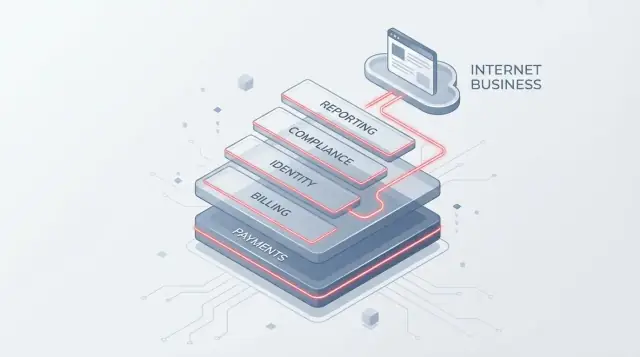
What “Stripe as infrastructure” really means
“Infrastructure” is the set of hidden layers a business relies on to function—things customers rarely notice unless something breaks. Think of it like plumbing and electricity in a building: it’s not the product, but it makes the product usable, reliable, and scalable.
For an internet business, Stripe can serve as that operating layer for revenue. It’s not only a checkout button. It’s a set of building blocks that help you accept money, move money, verify who users are, manage risk, and produce records your finance team can trust.
Payments are more than checkout
When people say “payments,” they often mean the moment a customer enters a card. In practice, payment operations include many steps and outcomes that affect cash flow and customer experience:
- Authorization and capture (including delayed capture for shipping, pre-orders, or services)
- Refunds and partial refunds
- Disputes, chargebacks, and evidence workflows
- Payment method routing, retries, and failures
- Reporting and reconciliation signals your finance team needs
If these pieces live in separate tools, gaps appear quickly: inconsistent statuses, manual work, and delayed visibility into what was actually earned.
A unified operating layer: money + trust + compliance
The “Stripe as infrastructure” idea is that money movement doesn’t sit alone. It’s closely tied to identity and risk (who’s paying, who’s selling, who should be allowed to transact) and to compliance (what you must collect, store, and report).
In many businesses—especially subscriptions, marketplaces, or platforms—these systems become your de facto “runtime” for revenue operations.
That’s why Stripe is often evaluated not as a single product, but as an integrated stack: payments, billing, identity/onboarding, fraud tooling, taxes, payouts, and reporting working from shared data and consistent events.
What this article will (and won’t) do
In the rest of this article, we’ll focus on practical concepts and examples of how these layers fit together—how teams use them to reduce manual work, handle edge cases, and scale with fewer surprises.
This is not legal, tax, or compliance advice. It’s a guide to common operating patterns internet businesses typically need, and how an infrastructure approach can help.
Why internet businesses need a hidden operating layer
Most internet businesses look different on the surface—SaaS, marketplaces, e-commerce, on-demand services, paid newsletters, platforms with usage-based pricing. Underneath, they often run on the same set of operational flows that decide whether revenue is smooth or chaotic.
The repeatable core loop behind revenue
No matter the model, the lifecycle tends to follow a familiar sequence:
Sign up → pay → deliver → reconcile → renew
- A customer or seller creates an account and needs to be verified enough for your risk level.
- Money moves (one-time, subscription, invoice, or split across parties).
- You fulfill the product or service.
- Finance needs clean records: what was earned, what was refunded, what fees were charged, what taxes were collected.
- The relationship continues: renewals, upgrades, disputes, chargebacks, and retried payments.
Early on, teams often stitch this together with manual reviews, spreadsheet workflows, and a handful of point tools. It works—until volume exposes the cracks.
Why it turns into a bottleneck as you grow
As transactions scale, small inconsistencies become expensive:
- Payment failures and retries create unpredictable cash flow.
- Refunds, disputes, and fraud checks add support workload and margin leakage.
- Subscription changes (proration, credits, cancellations) turn into accounting edge cases.
- Marketplace payouts require accurate routing, timing, and reconciliation across multiple parties.
- Taxes and compliance requirements expand across geographies, products, and entity structures.
At that point, payments aren’t “just a checkout.” They’re a production system that touches identity, billing logic, risk decisions, reporting, and compliance.
Who feels the pain first
Founders feel it in slowed launches and operational fire drills. Finance feels it at month-end close and during audits. Support feels it in “Where’s my refund?” tickets. Risk teams feel it in chargebacks and blocked accounts. Product teams feel it when every new pricing idea requires weeks of integration work.
A hidden operating layer exists to make these recurring flows consistent, automated, and scalable—so revenue operations don’t become the company’s constraint.
Payments as the core runtime for revenue
Payments aren’t just a checkout button—they’re the system that turns intent into revenue, and then turns revenue into cash you can use. When payments work smoothly, the rest of the business (support, finance, growth) stays calm. When they don’t, everything else inherits the chaos.
A basic card payment flow
A typical card payment has a few distinct steps:
- Authorization: the customer’s bank checks funds and reserves the amount.
- Capture: you “take” the payment (immediately or later—useful for shipping physical goods).
- Settlement: the card networks move funds between banks; this can take days.
- Payout: the payments provider deposits money into your bank account on a schedule.
Each step has operational consequences: when you capture, when you ship, how you recognize revenue, and when cash actually hits your account.
Payment methods change the work behind the scenes
Cards tend to be fast and global, but come with chargebacks. Wallets (like Apple Pay) can increase conversion and reduce friction, but may have different dispute behavior and device-based authentication. Bank transfers can lower fees and disputes, but reconciliation and confirmation timing can be slower or more manual.
Choosing payment methods is an ops decision as much as a product decision.
The moments customers actually feel
Most payment “incidents” happen after the click:
- Failed payments: expired cards, insufficient funds, or authentication issues. Smart retries and clear messaging matter.
- Refunds: partial vs. full, timing, and how they appear on statements.
- Chargebacks: evidence collection, deadlines, and knowing which disputes are worth fighting.
What good infrastructure provides
Good payments infrastructure gives you reliability (stable uptime, graceful fallbacks), visibility (clear event trails from authorization to payout), and controls (fraud checks, refund permissions, capture rules, dispute workflows). That’s what turns “taking payments” into a dependable revenue runtime.
Billing and subscriptions: the system of record for revenue
Subscriptions aren’t just “monthly payments.” For most internet businesses, billing becomes the source of truth for what a customer is entitled to, what they were charged, and why. When billing is consistent, finance, support, and product teams stop arguing about numbers and start trusting the same record.
Recurring billing fundamentals (and where things break)
A subscription typically starts with a plan (price, interval, currency) and a billing cycle. Real life quickly adds edge cases:
- Trials: letting customers activate access before charging, with clear start/end dates and what happens when the trial converts.
- Proration: adjusting charges when someone changes tiers mid-cycle—either charging immediately for an upgrade or crediting the unused period on a downgrade.
- Invoicing: generating a document that explains the charge (useful for B2B procurement and audit trails), not just collecting a card payment.
- Credits: issuing credits for goodwill, outages, or negotiated terms—without creating a reporting mess.
Subscription lifecycle events you should track
Subscriptions constantly change, so treat events as first-class data. Upgrades, downgrades, cancellations, scheduled cancellations, pauses, and reactivations all affect access and revenue. If you can’t answer “what changed, when, and who initiated it,” you’ll feel it later in support escalations and month-end close.
Dunning: preventing churn you didn’t earn
A large slice of “churn” is actually payment failure. Dunning workflows reduce that:
- Automatic retries on a smart schedule
- Reminder emails that prompt customers to update details
- Payment method updates (e.g., card refreshers) that recover failed renewals without customer effort
Billing’s direct link to finance
Clean billing data becomes inputs for revenue recognition (start/end of service periods, discounts, credits, refunds) and creates a defensible audit trail. When invoicing, adjustments, and subscription changes are captured consistently, reconciliation is faster—and finance can explain the numbers with confidence instead of detective work.
Identity and onboarding: building trust without friction
Identity verification is the part of your “operating layer” that answers a simple question: who is on the other side of the transaction? For internet businesses, that question affects everything—fraud rates, chargebacks, payout eligibility, and whether you can legally operate in certain regions.
What identity verification actually does
At a practical level, identity checks help you confirm that a user (or business) is real, consistent, and not using stolen or synthetic information. That reduces:
- Fraud and chargebacks (fewer bad actors slipping through)
- Account takeovers and abuse (harder to create throwaway accounts)
- Regulatory exposure (meeting financial crime prevention requirements)
KYC/AML: where it shows up in the product
You’ll often hear “KYC” (Know Your Customer) and “AML” (Anti–Money Laundering) as legal and banking requirements. You don’t need to be a compliance expert to design for them—you need to know when they surface:
- Onboarding: collecting basic details, validating documents, and verifying ownership for businesses
- Payouts: confirming identities before money moves out, especially across borders
- Limits and step-up checks: allowing low-risk activity quickly, then asking for more info as volume grows
Marketplaces: verifying sellers without slowing growth
Marketplaces, creator platforms, and on-demand apps have an extra challenge: you’re onboarding two sides. Verifying sellers, hosts, or creators helps prevent stolen identities, prohibited goods, and coordinated fraud rings—before they damage customer trust.
The UX goal: fast start, smart friction
Good onboarding feels quick for legitimate users and “sticky” for risky ones. Aim for progressive disclosure (ask only what you need), clear explanations (“why we need this”), and rescue paths (easy re-upload, status updates). The result is a flow that protects the business while keeping conversion high.
Fraud and disputes: protecting margin and customer trust
Fraud prevention is a balancing act: every extra hurdle can reduce chargebacks, but it can also reduce conversion. Treat it like revenue operations, not just “security”—because the cost shows up everywhere: margin (fees and lost goods), support workload, and customer trust when legitimate buyers get blocked.
The signals and controls that matter
Most internet businesses start with a few high-leverage controls and refine them over time:
- Velocity checks: spotting abnormal patterns like too many attempts from one card, device, or IP in a short window.
- Risk scoring: combining signals (purchase history, card metadata, email/phone patterns, device fingerprinting) into a decision.
- Step-up authentication (3D Secure): prompting only when risk is higher, so low-risk customers get a fast checkout while higher-risk payments get additional verification.
The goal isn’t “zero fraud.” It’s an acceptable fraud rate with minimal false declines—because false declines are invisible churn.
Disputes: process beats panic
Disputes are predictable if you run them like an operational workflow:
- Evidence collection: order confirmation, delivery logs, usage history, refund policy, and customer communications.
- Timelines: card networks have strict deadlines; missing them turns a winnable case into an automatic loss.
- Feedback loops: track win/loss reasons and feed them back into checkout, policies, and risk rules.
Disputes also reveal product and support gaps. If “fraud” disputes cluster around unclear billing descriptors, cancellation friction, or slow support, improving those can reduce dispute volume as effectively as tighter fraud filters.
Compliance and taxes: reducing operational risk
Compliance and taxes are rarely what make a product exciting—but they often determine whether you can launch, scale to new regions, or survive an audit. Treating them as part of the operating layer (not a last-minute checklist) reduces surprises and keeps revenue flowing.
What “compliance” often includes in online payments
For most internet businesses, “payments compliance” is a bundle of requirements and controls that touch product, engineering, and finance:
- PCI scope: whether and how your systems store, process, or transmit card data. The more sensitive data you touch, the more controls, evidence, and recurring validation you’ll need.
- Data handling and privacy: access controls, encryption, retention policies, incident response, and permissions around payment and identity data.
- Operational controls: chargeback workflows, customer communications, refunds, and logging—because disputes and audits are as much about process as they are about tech.
Regional complexity: rules change when you cross borders
Expanding internationally isn’t just adding currencies. You’ll run into local payment rules, banking requirements, and verification expectations that vary by country. Even basic decisions—like how you describe charges on statements or what customer details you collect—can have regional constraints.
You’ll also need sanctions screening basics: ensuring you’re not doing business with individuals, entities, or jurisdictions on restricted lists. This typically involves screening customer information and monitoring updates over time.
Taxes: calculate, collect, report
Taxes are a separate layer of complexity from payments. Common needs include:
- Determining whether you must collect sales tax, VAT, or GST
- Calculating the right rate based on customer location and product type
- Collecting the tax at checkout and maintaining records for reporting and filings
Important disclaimer
This section is general information, not legal or tax advice. Requirements vary by country, industry, and business model—consult qualified legal and tax professionals for guidance specific to your situation.
Marketplaces and payouts: moving money across parties
Marketplaces aren’t just “taking a payment.” They coordinate money between a buyer, a platform, and one or more sellers—often with different timelines, fees, and responsibilities. The infrastructure has to reflect that reality.
How multi-party payment flows work
A typical flow is: the customer pays once, the platform automatically takes its fee or commission, and the remainder is allocated to the seller (or split across multiple sellers). That split can be fixed (e.g., a 10% platform fee) or dynamic (category-based fees, promotions, or negotiated rates).
For customers, the expectation is simple: one checkout, one charge, and a receipt that clearly shows who they bought from. For sellers, it’s “I can see what I earned, what was deducted, and when I’ll get paid.”
Payout operations that affect real trust
Payouts are an operational system, not a one-time action. You’ll typically manage:
- Payout schedules (daily, weekly, instant where available)
- Failed payouts (closed bank accounts, incorrect routing, compliance flags)
- Beneficiary changes (updated bank details, entity name changes)
- Holds and delays (high-risk categories, new sellers, unusual volume)
When sellers rely on payouts to cover payroll or inventory, predictability matters as much as speed.
Refunds, negative balances, and reserves
Multi-party businesses must handle edge cases cleanly: refunds after a seller has already been paid out, chargebacks that arrive weeks later, or partial refunds on split orders. These scenarios can create negative balances, requiring recovery mechanisms, platform-level reserves, or rolling holds to protect the business.
What users expect to see
Clear statements, transparent fees, and fast—yet explainable—payout timing reduce support tickets and increase retention. The goal is that every party can answer, at a glance: “What happened to this money, and why?”
Reconciliation and reporting: making finance fast and accurate
Payments don’t become “revenue” just because money moved. Finance teams need a clean, provable trail from customer activity to bank deposits to accounting entries. That’s what reconciliation and reporting should deliver: speed, accuracy, and confidence—without heroics at month-end.
The back-office requirements you can’t skip
A finance-friendly payments setup needs more than dashboards. Look for:
- Reconciliation tools that tie processor activity to bank payouts and your ledger
- Reporting and exports (CSV or direct sync) with consistent IDs and timestamps
- Audit trails for every change (refund issued, dispute won/lost, fee adjusted)
- Clear mappings between events (charge, payout, refund) and accounting categories
- Exception visibility so mismatches aren’t buried in a spreadsheet
How payouts, fees, refunds, and disputes hit the books
Most confusion comes from the fact that deposits are net, while accounting wants gross.
- Payouts: what lands in your bank account—typically gross charges minus fees, refunds, and dispute-related holds.
- Fees: processor fees are an expense, often deducted before payout, so you need reports that show them explicitly.
- Refunds: reduce revenue (or increase contra-revenue) and can also reverse fees depending on the policy.
- Disputes/chargebacks: temporarily pull funds out (or create a negative balance), may add dispute fees, and later resolve as wins/losses.
If those elements aren’t captured with stable transaction IDs, your team ends up guessing which deposit includes which activities.
A clean monthly close workflow
A practical close process keeps effort focused on exceptions:
- Match transactions → tie payment activity to payouts and bank deposits.
- Resolve exceptions → investigate missing orders, duplicated refunds, pending disputes, timing differences, and manual adjustments.
- Post entries → book revenue, fees, refunds, and dispute outcomes with consistent rules.
When this workflow is repeatable, closing becomes routine, not a scramble.
The hidden cost of messy data
Messy payment data doesn’t just waste time—it delays decisions. Teams spend hours reconciling by hand, errors slip into revenue and expense lines, and leadership sees numbers later (or trusts them less). Clean reconciliation and reporting turn payments data into operations data: fast enough to run the business, accurate enough to bet on.
One stack vs. point tools: integration choices that scale
Most internet businesses start with whatever works: a payment link here, a subscription plugin there, a separate tool for identity checks, and maybe a tax calculator bolted on later. It’s fast—until the business grows and every system keeps its own “version of the truth.”
What “composability” actually means
Composability is the ability to pick modules (payments, billing, identity, fraud tools, tax) that work together and share data, without forcing you into a single rigid workflow.
With a unified stack, the same customer, payment method, invoice, dispute, and payout can reference each other automatically. That reduces duplicate data entry and makes reporting less of a detective story.
Point solutions vs. a unified stack
Point tools can be excellent at one job, but they usually create extra integration work:
- More connectors to maintain: each tool needs setup, monitoring, and upgrades.
- Mismatched records: “customer” in billing may not match “customer” in payments, leading to churn and support issues.
- Harder troubleshooting: when a charge fails, it’s unclear whether the problem is payments, subscription logic, or identity verification.
A unified stack trades some vendor variety for fewer moving parts and more consistent data.
Integration, explained for non-technical readers
When people say “integrate,” they typically mean three things:
- APIs: the building blocks your product uses to create charges, subscriptions, refunds, and more.
- Webhooks: automated notifications (like “payment succeeded” or “charge disputed”) that keep your app and tools in sync.
- No-code and admin tools: dashboards, hosted checkout, and prebuilt components that reduce engineering time.
If you’re prototyping new revenue workflows (for example, a React checkout plus a Go/PostgreSQL backend, or a Flutter mobile purchase flow), a vibe-coding approach can speed up the “integration-to-demo” step. Platforms like Koder.ai let teams build and iterate on these flows via chat, then export source code, deploy/host, and use snapshots with rollback—useful when you’re experimenting with billing models or webhook-driven state machines before committing to a full build.
How to evaluate options
Before you choose “one stack” or “best-of-breed,” assess:
- Coverage: does it handle your current and near-future needs (subscriptions, invoicing, identity, taxes, payouts)?
- Reliability: uptime, retries, and failure handling when systems are under load.
- Support and clarity: documentation quality and how quickly issues get resolved.
- Long-term flexibility: can you add modules later without replatforming, and can you export data cleanly if plans change?
The goal isn’t to avoid point tools—it’s to avoid a business held together by brittle integrations.
Scaling and resilience: running payments like a core system
When a business is small, payments can feel like a “set it and forget it” integration. At scale, payments behave more like a production system: they break in edge cases, attract abuse, and create operational work when you expand.
Where scaling pain shows up first
Growth usually introduces predictable stress points:
- New countries and currencies: local card behaviors, bank declines, and settlement timing differences.
- New payment methods: wallets, bank debits, and local rails each add rules around authentication, refunds, and disputes.
- Higher fraud pressure: attacks get more automated, and fraudsters probe for the weakest flow (checkout, account creation, refunds).
Treat these as engineering and ops problems, not just “payments settings.” Stripe can help consolidate complexity, but you still need clear owners, change control, and measurable targets.
Operational guardrails that prevent expensive mistakes
As volume grows, internal errors can cost as much as external fraud. Put guardrails around who can move money and change configuration:
- Role-based access for finance, support, and engineering
- Approvals and dual control for refunds above a threshold or payout updates
- Limits (refund caps, payout controls) that match your risk tolerance
- Monitoring and alerting on failures, spikes in refunds, and dispute activity
Document your “break glass” process: who can act, what evidence is required, and how changes are rolled back.
Reliability: plan for incidents, not perfection
Assume there will be outages—yours or a partner’s—and design a response:
- Maintain status visibility and a clear incident channel.
- Use idempotency and retry-safe patterns so customers aren’t double-charged.
- Create fallback plans: queue payments for later capture, offer an alternative payment method, or temporarily limit risky flows.
KPIs that keep revenue operations healthy
Track a small set of metrics weekly:
- Payment success rate (overall and by country/method)
- Dispute rate and win rate
- Churn (especially involuntary churn from failed renewals)
- Time-to-close (days to close the books)
If these numbers improve while volume grows, you’re running payments like a core system—not a plugin.
A practical adoption checklist and rollout plan
Treating Stripe as infrastructure is less about “adding a payments provider” and more about selecting the operating layer that will shape your revenue workflows for years. This section offers a pragmatic way to evaluate fit and roll out capabilities without breaking what already works.
Adoption checklist: features, fit, and cost drivers
Start by validating the basics, then pressure-test the edges:
- Payment methods & geographies: Do you need cards only, or also wallets, bank transfers, local methods, multi-currency pricing, and settlement?
- Checkout experience: Hosted vs. embedded, saved payment methods, retries, and support for mobile and one-click purchase.
- Billing maturity: Subscriptions, usage-based billing, proration, trials, coupons, invoicing, and dunning.
- Identity & onboarding: Required KYC/KYB, verification pass rates, supported document types, and how exceptions are handled.
- Fraud & disputes: Controls for risky cohorts, chargeback workflows, evidence templates, and rule tuning.
- Compliance & taxes: Sales tax/VAT handling, nexus logic, invoices/receipts, and audit-friendly records.
Cost drivers to model early: interchange/processing fees, dispute fees, billing fees, identity checks, tax calculation, payout fees, FX, plus engineering time to build and maintain integrations.
Questions by team (ask before you build)
Product: What metrics define success (conversion, approval rate, churn)? Which user flows must stay unchanged?
Engineering: Do we need multi-account/marketplace support? How will we handle webhooks, idempotency, retries, and incident response?
Finance: What’s the source of truth for revenue recognition? How will payouts map to orders, invoices, and refunds? What reports are required monthly?
Support: What user issues are most common (failed payments, refunds, chargebacks)? What tools and permissions do agents need?
Risk/Legal: What thresholds trigger enhanced verification? What data retention and consent requirements apply?
A phased rollout plan (reduce risk)
- Start with payments: Ship core checkout, refunds, and reconciliation basics.
- Add billing: Migrate subscriptions/invoicing once payment flows are stable and reporting is validated.
- Add identity/compliance: Introduce verification and tax tooling where risk and regulation demand it (often by region or customer segment first).
If you want a quick sanity check on your rollout plan, see /contact (or compare options on /pricing).
FAQ
What does “Stripe as infrastructure” mean in plain English?
It means Stripe can function as the operating layer behind revenue—not just a checkout form. In practice, it’s the shared system that helps you accept and move money, manage subscriptions/invoices, verify users/sellers, reduce fraud, calculate taxes, and produce finance-ready records from consistent events.
Why are payments “more than checkout”?
Checkout is only the visible moment of a longer workflow. Real payment operations include authorization vs capture, settlement and payout timing, refunds, disputes/chargebacks, retries, routing, and reconciliation signals—each of which affects cash flow, support load, and reporting accuracy.
What’s the main benefit of using one unified revenue stack instead of point tools?
You get fewer gaps and fewer mismatched “sources of truth.” A shared data model and consistent events across payments, billing, identity/risk, taxes, and payouts typically reduces:
- Manual spreadsheet work
- Status mismatches across tools
- Time spent debugging failed charges or missing payouts
- Month-end close effort focused on detective work
What is the “core revenue loop” most internet businesses share?
A common loop is sign up → pay → deliver → reconcile → renew. As volume grows, the expensive problems show up between steps (failed payments, proration edge cases, disputes, payout timing, tax changes, and reporting mismatches). Infrastructure matters because it makes that loop repeatable and auditable.
How do authorization, capture, settlement, and payout differ—and why does it matter?
Because cash and revenue timing differ. A card payment typically goes through authorization, capture (now or later), settlement (often days), then payout to your bank on a schedule. Understanding those steps helps you set shipping rules, refund expectations, and accurate finance reconciliation.
How should we choose payment methods (cards vs wallets vs bank transfers)?
Pick methods based on conversion and operations. Cards are global but come with chargebacks; wallets can improve conversion and authentication UX; bank transfers can reduce disputes but may add reconciliation and confirmation complexity. Evaluate by country, customer type (B2C vs B2B), and your support/reconciliation capacity.
Why is billing the “system of record” for subscriptions?
Billing is usually the system of record for what a customer is entitled to and why they were charged. It needs to handle trials, proration, invoicing, credits, cancellations, and upgrades/downgrades with a clear audit trail—so support and finance can answer “what changed, when, and who did it.”
What is dunning, and how does it reduce churn?
Dunning is the set of workflows that recover revenue from failed renewals—often reducing involuntary churn. Common pieces include smart retry schedules, reminder emails, and payment method updates (like card refreshers). The goal is to fix payment failures without turning them into cancellations.
Where do KYC/AML and identity verification show up in the product?
Identity checks help answer “who is on the other side of the transaction?” and support KYC/KYB/AML requirements. You’ll typically see them during onboarding and before payouts, with step-up verification as volume or risk increases—so legitimate users move quickly while risky activity gets more scrutiny.
What’s a practical rollout plan for adopting Stripe as infrastructure?
Start with stable basics, then layer complexity:
- Ship core payments (checkout, refunds, webhooks, reconciliation basics).
- Add billing once payment flows and reporting are validated.
- Introduce identity/tax/compliance where risk or geography demands it.
If you want help pressure-testing a rollout, use /contact. If you’re comparing options or packages, see /pricing.