

How Technical Founders Shift From Code to Better Decisions
How technical founders shift from writing code to making better calls: prioritizing bets, building product sense, and aligning teams as the company grows.
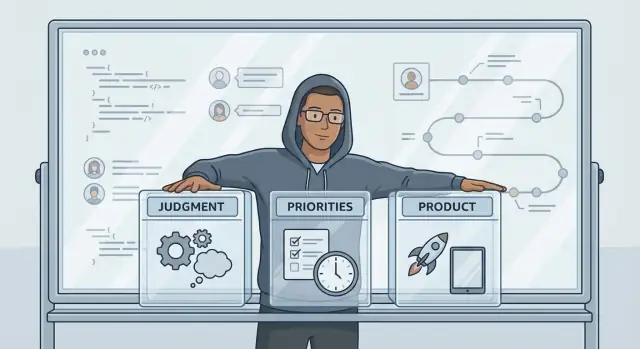
Why the Technical Founder Job Changes Over Time
Early on, the technical founder’s job often feels like: “build everything.” You write most of the code, ship fixes in minutes, and make decisions by opening the editor. That phase is real—and valuable—because speed and technical coherence matter more than polish. If you can build, you can learn.
But once the company starts working (more users, more revenue, more expectations), the job quietly shifts—even if your title never does. You’re no longer optimizing for “can we build this?” You’re optimizing for “should we build this, and what do we trade off to do it?” The work becomes less about personally producing features and more about shaping the system—product, team, and process—so the right features get produced.
The “build everything” phase vs. the scaling phase
In the build phase, progress is mostly linear: more hours coding often means more shipped product. Communication is lightweight, and decisions are reversible because the surface area is small.
In the scaling phase, progress becomes non-linear. Each new feature interacts with existing customers, support load, sales promises, infrastructure limits, and other engineers’ work. “Just ship it” starts creating hidden costs: more bugs, slower onboarding, harder deployments, and a backlog that grows faster than your ability to pay it down.
Why the job changes (even if the title doesn’t)
Your leverage changes. The highest-impact thing you can do is rarely “write the next module.” It’s deciding what the team should build next, setting standards (where quality is non-negotiable vs. where speed is fine), and creating clarity so others can execute without constant correction.
It also means making more decisions with incomplete data. You won’t have time to fully research every option. Waiting for certainty becomes its own decision—and often the wrong one.
The three pillars you’ll rely on
As you scale, three skills replace “more code” as your main tool:
- Judgment: choosing direction under uncertainty, and revising quickly when reality disagrees.
- Prioritization: turning an endless backlog into a strategy, not a to-do list.
- Product sense: understanding what users actually value, so engineering effort lands where it matters.
As these strengthen, your output shifts from lines of code to better decisions—decisions that compound across the whole company.
From Expert Builder to Decision Maker
Early on, your edge as a technical founder is obvious: you can build. The company moves forward because you personally turn ideas into working software.
Once you have real users and a growing team, the bottleneck is no longer “can we implement this?” but “should we implement this, now, in this way?” That shift is basically a shift from output to judgment.
What “judgment” actually means
Judgment is the ability to make high-quality decisions under uncertainty.
Not perfect decisions. Not decisions backed by a spreadsheet that eliminates risk. High-quality decisions are reasonable given the information you have—and they keep the company flexible when the information changes.
Technical correctness vs. business correctness
Technical correctness answers: “Is this the cleanest design? Is it scalable? Is it elegant?”
Business correctness answers: “Does this move the company forward this quarter? Does it help the right users? Does it increase learning speed, revenue, retention, or trust?”
A technically correct decision can still be business-incorrect. For example: investing two weeks to perfect an architecture might be “right” in engineering terms but “wrong” if it delays a feature that closes deals, reduces churn, or validates a risky assumption.
Second-order effects: the hidden part of every decision
As you become a decision maker, you start looking past the immediate result. A choice affects:
- The team: morale, ownership, clarity, hiring difficulty, and how much work becomes blocked on you.
- Users: expectations, trust, support load, and whether you’re building habits or one-off usage.
- Future speed: how easy it will be to change direction, maintain quality, and ship the next ten iterations.
Two simple lenses that keep decisions sane
Reversibility: Ask “If we’re wrong, how hard is it to undo?” Reversible decisions can be made faster with smaller bets. Irreversible decisions deserve more debate, prototypes, or staged rollouts.
Cost of delay: Ask “What do we lose by waiting?” Sometimes the biggest cost isn’t money—it’s missed learning, competitor advantage, or weeks of the team building the wrong thing.
Founder evolution is learning to apply these lenses consistently, so the company makes fewer heroic sprints—and more deliberate, compounding moves.
When Great Engineering Choices Become Bad Company Choices
Early on, “good engineering” often equals “good company.” Clean code, a solid architecture, and polished infrastructure help you move fast tomorrow.
Once you have users, deadlines, and a narrow runway, that alignment can break. A choice can be technically correct and still be the wrong move for the business.
The common failure mode: building what’s most interesting
Technical founders often default to the work that feels safest and most satisfying: the elegant solution, the perfect abstraction, the tool you’ve wanted to try.
That’s not laziness—it’s a bias. Interesting tech delivers immediate feedback and a sense of progress, while messy customer problems are ambiguous and emotionally harder.
Local optimization vs. global outcomes
A local optimization improves one part of the system (code quality, test coverage, latency, internal tooling). A global outcome improves what the company is trying to accomplish (retention, revenue, activation, fewer support tickets, faster sales cycles).
The trap is mistaking “we improved the system” for “we improved the company.” If the improvement doesn’t change what customers experience—or what your team can ship next month—it may not matter right now.
Opportunity cost, in plain terms
Opportunity cost is what you give up by choosing something else. It’s concrete:
- If you spend two weeks refactoring, you’re not shipping the onboarding fix that could reduce churn.
- If you upgrade infrastructure early, you may delay the feature that helps close three deals.
You don’t pay opportunity cost later—you pay it immediately, in missed learning and missed momentum.
Examples you’ll recognize
Refactor vs. ship: A refactor might remove future pain, but shipping a small, “good enough” improvement might validate pricing, unblock sales, or reveal the real constraints.
Infra upgrades vs. customer wins: Shaving 50ms off response time feels measurable, but a clearer workflow or fewer bugs in a key path might do far more for retention.
The goal isn’t to ignore engineering excellence. It’s to time it. Great founders learn to ask: “What does the company need next—and what’s the cheapest way to learn if we’re right?”
Prioritization: Turning a Backlog Into a Strategy
A backlog feels comforting because it’s a list of “good ideas.” Strategy is harder: it forces you to choose what not to do.
Prioritization isn’t about finding the perfect ranking; it’s about making a small number of deliberate bets that match the company’s current goal.
Why prioritization gets harder as you grow
When it’s just you, the “options” are mostly whatever you can build next. As the team grows, options multiply:
- More people means more parallel work—and more possible combinations of work.
- Customer feedback increases, so requests arrive faster than you can ship.
- Dependencies appear (sales needs enablement, support needs tooling, infra needs upgrades).
The result: the backlog stops being a queue and becomes a junk drawer. Without a strategy, you’ll default to the loudest request, the most interesting technical project, or whatever is easiest to estimate.
Lightweight methods that actually work
You don’t need a complicated scoring spreadsheet. Two simple frames are usually enough:
Impact vs. effort. Put items into four buckets: high-impact/low-effort (do), high-impact/high-effort (plan), low-impact/low-effort (only if it unblocks something), low-impact/high-effort (don’t).
Risk vs. reward. Some work is less about immediate impact and more about reducing downside (security, reliability, compliance). Be explicit: “This is insurance,” and decide how much insurance you can afford this quarter.
The key is to make tradeoffs visible. If you can’t explain what you’re giving up, you haven’t really prioritized.
Clarity: one goal, a few bets
A useful rule for technical founders: pick one top goal for the next cycle (e.g., activation, retention, sales cycle time), then choose two to four top bets that directly move it.
Everything else is either supporting work (must-do) or parked. A backlog becomes a strategy the moment you can say: “These are the bets we’re making—and these are the things we’re intentionally not doing.”
Product Sense for Technical Founders (Without the Jargon)
“Product sense” doesn’t have to mean sticky notes, frameworks, or speaking like a PM. For a technical founder, it’s simply the ability to understand who the user is, what they’re trying to achieve, and whether your product actually helps—in measurable ways.
Product sense = users, value, outcomes
A useful definition: product sense is the habit of connecting work to an outcome that matters.
- Users: the specific person with a specific job to do.
- Value: the benefit they get (time saved, risk reduced, money earned, less stress).
- Outcomes: evidence the value happened (they return, they pay, they recommend, support load drops).
If you can’t explain the value in one sentence without mentioning the implementation, you’re still thinking like a builder.
The shift: from features to problems (and results)
Early on, building features feels like progress because code ships and demos are exciting. But once real usage arrives, the job becomes choosing which problems are worth solving—and judging success by results, not release notes.
A feature request like “add export to CSV” is often a symptom. The underlying problem might be “my team can’t share results with finance,” or “I don’t trust the data unless I can audit it.” Solving the real problem might mean a CSV export—or it might mean a scheduled report, an API endpoint, or fixing data quality.
Signals to pay attention to
You don’t need complicated analytics to build product sense. Watch for:
- Activation: do new users reach “aha” quickly, or get stuck?
- Retention: do they come back next week without reminders?
- Support tickets: are questions repetitive (confusion) or edge cases (power users)?
- Sales calls / demos: where do prospects lean in, and where do they hesitate?
These signals tell you what’s valuable, what’s unclear, and what’s missing.
Where technical intuition helps—and where it misleads
Your technical intuition is an advantage: you can spot feasibility traps, simplify architectures, and prototype fast. But it can mislead you into optimizing for elegance over impact—perfect abstractions, generalized systems, or “we’ll need this later” infrastructure.
Product sense is the counterweight: build what changes the user’s outcome now, and let reality—not assumptions—decide what deserves engineering excellence first.
Leading Through Constraints: Goals, Metrics, and Tradeoffs
Early on, a technical founder can feel productive by saying “yes” to good ideas and pushing code. As the company grows, the job flips: your main value is choosing the constraints that keep everyone focused. Constraints aren’t limitations to work around; they’re guardrails that prevent you from building three half-finished products.
Pick a small set of constraints and goals
Start by setting 2–4 constraints that shape every decision for the next period. Examples:
- A hard ship date (e.g., “launch onboarding v2 by May 15”)
- A budget limit (“no net-new vendors this quarter”)
- A reliability floor (“no more than 0.5% failed checkouts”)
- A focus boundary (“only work that improves activation”)
Then define 1–2 goals that are easy to repeat in one sentence. If your team can’t recite them, you have too many.
Translate vision into milestones and metrics
Vision is the “why.” Execution needs “what by when” and “how we’ll know.” A simple pattern:
- Milestone: the concrete deliverable (what changes for the user)
- Success metric: the number that should move (and by how much)
- Counter-metric: what must not get worse (quality, support load, churn)
For example: “Reduce time-to-first-value from 20 minutes to 5 minutes” paired with “support tickets per new user doesn’t increase.” This makes tradeoffs discussable, not personal.
Clarify ownership: decide vs. delegate
As founder, you should directly decide:
- Company-level goals, constraints, and what not to do
- The handful of irreversible bets (pricing, positioning shifts, major platform choices)
Delegate:
- Task-level prioritization within an agreed goal
- Implementation details and day-to-day tradeoffs
- Most hiring decisions after you set the bar and role outcomes
If you’re still debating every endpoint name, you’re taking leverage away from your team.
A simple operating cadence
- Weekly: pick 3–5 priorities, name an owner, and define “done.”
- Monthly: review metrics, re-rank risks, stop one project on purpose.
- Quarterly: choose 1–3 big bets, set constraints, and write down what you’ll sacrifice to make them real.
This cadence turns pressure into clarity—and makes tradeoffs explicit before they become emergencies.
Quality vs. Speed: Choosing the Right Standard for Each Area
Early-stage teams win by learning faster than they build. That’s why “good enough” often beats “perfect”: a solid, usable version in customers’ hands creates feedback, revenue, and clarity. Perfection, meanwhile, can be an expensive guess—especially when you’re still validating who the user is and what they’ll actually pay for.
That doesn’t mean quality doesn’t matter. It means quality needs to be applied selectively.
Decide where quality is non‑negotiable
Some areas create irreversible damage when they fail. Treat these as “must be boring”:
- Security & access control (auth, permissions, secrets handling)
- Data integrity (migrations, backups, audit logs where needed)
- Payments and billing (idempotency, clear receipts, fraud checks)
- Reliability of the core workflow (the one thing users come for)
- Privacy & compliance constraints relevant to your market
If any of those break, you don’t just ship a bug—you ship a trust problem.
Use decision guardrails to move fast safely
Guardrails let you ship quickly without relying on memory or heroics.
- SLAs (or internal SLOs): Define what “reliable enough” means for key paths (e.g., “login works 99.9% of the time”).
- Error budgets: Agree how much failure you can tolerate. If you’re “spending” too much budget, pause new features to stabilize.
- Definition of Done: Keep it lightweight, but explicit (tests for critical paths, basic monitoring, rollback plan, updated docs).
These aren’t bureaucracy; they’re shortcuts that prevent repeated debates.
Intentional shortcuts that don’t create permanent pain
Speed doesn’t require sloppy work—it requires reversible decisions.
Examples:
- Manual ops with a time limit: “We’ll onboard customers via a spreadsheet for 30 days, then automate if usage justifies it.”
- Feature flags and staged rollouts: Ship behind a toggle, learn, then widen access.
- Use managed services: Offload queues, email, auth, and databases instead of building bespoke infrastructure.
- “Good enough” UI around a strong core: Clean, simple screens while you validate workflows; invest in polish after retention is proven.
A useful rule: cut corners on anything you can replace in a week, not anything that could sink the company in a day.
If you want to compress the “small bet → learn → iterate” loop even further, tools that support rapid prototyping plus easy rollback can help. For example, Koder.ai’s planning mode and snapshots/rollback workflow are designed for shipping experiments safely—especially when you’re juggling speed in non-critical areas while keeping quality non-negotiable in core paths.
Scaling Yourself: Delegation, Hiring, and Decision Leverage
The fastest way a technical founder runs out of runway isn’t money—it’s attention. Your new leverage comes from hiring well, coaching consistently, and setting principles that let the team make good decisions without you in every thread.
The new leverage: principles over proximity
As headcount grows, “being the best builder” stops being the multiplier. Your multiplier becomes clarity: a few reusable rules that guide dozens of small choices.
Examples of principles that scale:
- “We optimize for reliability in payment flows, and for speed in internal admin tools.”
- “If a change affects onboarding conversion, we measure before and after.”
- “We write things down when the decision will repeat.”
These principles reduce rework and keep quality consistent without you reviewing every PR.
Designing teams to avoid decision bottlenecks
Bottlenecks form when one person (often you) is the only one allowed to say “yes.” Instead, design for ownership with constraints:
- Assign a directly responsible individual (DRI) per area (e.g., onboarding, billing, infrastructure).
- Give them a budget: time, performance targets, and “must not break” rules.
- Create predictable decision forums (weekly product/engineering review) so decisions don’t require emergency pings.
The goal isn’t consensus; it’s fast, explainable decisions made close to the work.
What to delegate first—and what to keep longer
Delegate in layers:
- First: implementation (tickets, refactors, UI polish). You define the “why” and the acceptance criteria.
- Next: estimation and sequencing within an area (they own tradeoffs inside the box you set).
- Later: decisions that change the box (scope cuts that affect positioning, pricing, or core user promises).
A useful test: if the cost of a wrong call is mostly rework, delegate it. If it risks trust, revenue, or strategy, stay closer.
1:1 prompts that improve judgment
Use 1:1s to sharpen decision quality, not to status-check:
- “What decision are you postponing, and what makes it uncomfortable?”
- “What’s the smallest experiment that would reduce uncertainty this week?”
- “If we had to cut this scope by 30%, what would you remove first—and why?”
- “What principle should we write down based on what we learned?”
- “Where did you feel blocked by me or the process? How do we remove that bottleneck?”
When your team gets better at judgment, you get back the only scarce resource you can’t hire: your focus.
Common Traps and How to Avoid Them
Technical founders often keep “winning” the way they did at the start: by building faster, thinking harder, and pushing through. The traps below happen when that same instinct stops matching the company’s needs.
Trap 1: Overbuilding (shipping features, not learning)
A classic sign of weak product sense is consistent output with inconsistent outcomes: releases don’t change activation, retention, revenue, or support load in a meaningful way.
How to spot it: you can’t name what you expected to learn from the last shipment, or you measure success as “it shipped” instead of “it moved X.”
Corrective move: tighten the feedback loop. Make each release answer a question (“Will teams invite coworkers if we add X?”). Prefer small bets you can evaluate within days, not months.
Trap 2: Premature scaling
This shows up as building systems for a future org: microservices, complex abstractions, heavy process, or “enterprise-grade” everything—before you have stable usage patterns.
How to spot it: your architecture decisions are driven by hypothetical scale, while today’s bottleneck is actually unclear product direction or low demand.
Corrective move: set “good enough” standards by area. Keep core paths reliable, but allow simpler solutions elsewhere. Revisit scaling work only when a real constraint repeats.
Trap 3: Roadmap thrash
Frequent priority changes can feel like agility, but it often signals a lack of strategy. Teams stop trusting plans and start waiting for the next pivot.
How to spot it: many half-finished projects, frequent context switching, and “urgent” work that isn’t tied to a goal.
Corrective move: narrow the bet. Commit to a small set of outcomes for a fixed window (e.g., 4–6 weeks), and treat new ideas as inputs, not interrupts.
Trap 4: The founder as blocker
When every meaningful decision routes through the founder, speed drops as the company grows.
How to spot it: people ask for approvals instead of making calls, meetings multiply, and work pauses when you’re unavailable.
Corrective move: delegate decisions, not just tasks. Write simple decision rules (what good looks like, tradeoffs, boundaries), then let others execute and review outcomes—not every step.
Practical Habits to Build Better Judgment and Product Sense
Better judgment isn’t a personality trait—it’s a set of repeatable habits that help you notice signal, reduce unforced errors, and make decisions that stay good as the company changes.
A simple weekly founder review (30–45 minutes)
Run this at the same time each week. Keep it short, written, and shared with your cofounder or leads.
- What moved? Key metrics, user feedback themes, sales pipeline, uptime/incidents.
- What surprised us? Anything that didn’t match your expectations.
- Where did time go? Biggest time sinks and whether they were worth it.
- What decisions are now “due”? Items waiting on you (pricing, hiring, roadmap calls).
- What are we avoiding? The uncomfortable conversation or choice.
End the review by naming one bet you’re making next week and how you’ll know if it’s working.
Keep a decision log (so you can get smarter)
Most founders remember outcomes but forget the assumptions. A decision log turns “good/bad luck” into learning.
Decision:
Date:
Owner:
Context (what’s happening):
Options considered (and why not):
Rationale (why this is the best bet now):
Data used (links/notes):
Risks + mitigations:
Success metric (what changes if it works?):
Follow-up date (when we’ll review):
Result + what we learned:
Review 2–3 past decisions each month. You’re looking for patterns: which inputs you over-trust, which risks you underweight, and where you decide too late.
A prioritization ritual that fights drift
When everything is possible, your job is to make “not now” feel safe.
- Top 3 outcomes (next 4–6 weeks): measurable and user-visible where possible.
- Top 5 tasks (next 7 days): the smallest set that advances those outcomes.
- Stop-doing list: 3 things you will pause, delegate, or explicitly deprioritize.
If a task can’t be tied to one of the outcomes, it needs a strong reason to exist.
Reflection questions that build product sense
Use these after launches, customer calls, and tough weeks:
- What did we learn that we didn’t know last month?
- What changed (market, users, constraints, team capacity)?
- What’s next: one decision to make, one experiment to run, one thing to remove?
Over time, these habits make your instincts less about taste—and more about tested understanding.
FAQ
Why does a technical founder’s job change as the company grows?
In the early stage, progress is mostly linear: more time coding tends to equal more product shipped. As users, revenue, and a team appear, progress becomes non-linear—each change interacts with customers, support, sales promises, infrastructure, and other engineers.
Your highest leverage shifts from building the next thing to deciding what the team should build and why, setting standards, and creating clarity so others can execute without constant correction.
What’s the difference between technical correctness and business correctness?
A useful split is:
- Technical correctness: clean design, scalability, elegance.
- Business correctness: moves the company forward now (learning speed, revenue, retention, trust).
A technically “best” choice can be business-wrong if it delays the thing that validates a risky assumption or closes deals. Aim for decisions that are reasonable with current info and keep you flexible to change.
How do I factor “second-order effects” into engineering decisions?
Look past the immediate output and ask what the choice does to:
- The team: ownership, morale, hiring difficulty, how often people get blocked on you.
- Users: trust, expectations, support load, habit formation.
- Future speed: deploy friction, maintainability, ability to pivot.
A quick way to apply this: before committing, name one likely downstream cost and one downstream benefit.
How can I decide faster when I don’t have enough data?
Use two quick lenses:
- Reversibility: If you’re wrong, how hard is it to undo? Reversible decisions deserve smaller, faster bets.
- Cost of delay: What do you lose by waiting (learning, momentum, competitive advantage, deals)?
If a decision is hard to reverse and delay is expensive, do a staged approach: prototype, limited rollout, or a smaller initial commitment that preserves options.
How do I turn a backlog into an actual strategy?
Start by making tradeoffs visible rather than “perfect.” Two lightweight methods:
- Impact vs. effort: do (high/high or high/low), plan, only-if-unblocking, don’t.
- Risk vs. reward: explicitly label “insurance work” (security, reliability) and decide how much you can afford this cycle.
Then pick one top goal for the period and 2–4 bets that directly move it. Everything else is supporting work or parked.
What does “product sense” mean for a technical founder in plain terms?
Product sense is the habit of connecting engineering work to outcomes:
- User: who exactly is this for?
- Value: what benefit do they get (time saved, risk reduced, money earned, less stress)?
- Evidence: what changes if it worked (retention, conversion, fewer tickets, more invites, payment success)?
A practical test: if you can’t explain the value in one sentence without mentioning implementation, you’re still thinking like a builder.
What signals should I track to know if we’re building the right things?
You can learn a lot without heavy analytics. Watch for:
- Activation: do new users reach “aha” quickly or get stuck?
- Retention: do they come back next week without prompting?
- Support tickets: repetitive confusion vs. edge-case power use.
- Sales/demos: where prospects lean in vs. hesitate.
Tie each planned change to one of these signals so you can say what you expect to move—and review it after shipping.
How do I set goals and metrics that make tradeoffs clearer?
Use a simple trio:
- Milestone: what changes for the user (deliverable).
- Success metric: the number you expect to move (and by how much).
- Counter-metric: what must not get worse (quality, churn, support load, latency, incident rate).
This keeps tradeoffs discussable (numbers and constraints) instead of personal (“engineering vs product”).
How do I balance speed vs. quality without creating long-term pain?
Be selective: quality is non-negotiable where failure creates trust damage, like:
- security & access control
- data integrity (migrations/backups)
- payments/billing
- reliability of the core workflow
Move fast elsewhere with guardrails:
- lightweight Definition of Done (tests for critical paths, monitoring, rollback plan)
- feature flags and staged rollouts
- intentional manual steps with a time limit (e.g., “manual onboarding for 30 days”)
What should I delegate, and how do I avoid becoming the bottleneck?
Delegate decisions in layers:
- First: implementation details (you set the “why” and acceptance criteria).
- Next: sequencing and tradeoffs within an area (they own the box).
- Later: decisions that change the box (core promises, pricing/positioning shifts).
To prevent founder bottlenecks, write a few principles that scale (e.g., “reliability for billing, speed for internal tools”), assign clear ownership (DRI per area), and review outcomes rather than approving every step.