

Tesla’s Playbook: Turning Cars into Software with Data Loops
Learn how Tesla treats vehicles like computers: software-defined design, fleet data feedback loops, and manufacturing scale that speed iteration and reduce cost.
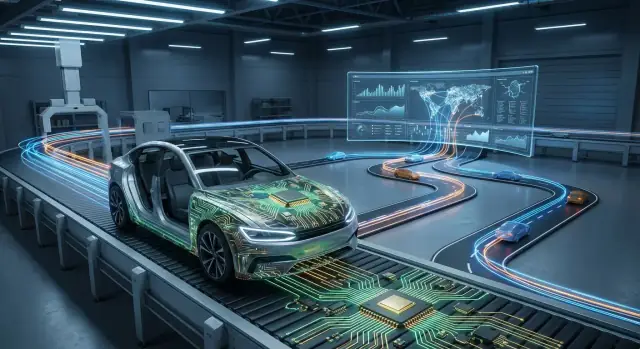
What It Means to Treat a Car Like a Computer
Treating a car like a computer doesn’t mean adding a bigger touchscreen. It means reframing transportation as a computing problem: a vehicle becomes a programmable platform with sensors (inputs), actuators (outputs), and software that can be improved over time.
In that model, the “product” isn’t frozen at delivery. The car is closer to a device you can update, measure, and iterate—while it’s already in customers’ hands.
The core idea: software + data + factories
This article focuses on three practical levers that follow from that framing:
- Software-defined behavior: Features and driving logic are increasingly determined by code rather than fixed mechanical design.
- Fleet data loops: Real-world usage generates feedback that can guide what to build next—and what to fix.
- Manufacturing scale as an enabler: Fast iteration only matters if you can build and deliver efficiently.
What this piece is (and isn’t)
This is written for product, operations, and business readers who want to understand how a software-first approach changes decision-making: roadmaps, release processes, quality systems, supply chain tradeoffs, and unit economics.
It is not a brand-boosting story, and it won’t rely on hero narratives. Instead, we’ll focus on observable mechanisms: how software-defined vehicles are architected, why over-the-air updates change distribution, how data loops create compounding learning, and why manufacturing choices affect speed.
We also won’t make predictions about timelines for autonomy or claim inside knowledge of proprietary systems. Where specifics aren’t public, we’ll discuss the general mechanism and the implications—what you can verify, what you can measure, and what you can reuse as a framework in your own products.
If you’ve ever asked “How can a physical product ship improvements like an app?”, this sets the mental model for the rest of the playbook.
Software-Defined Vehicles: The Shift in the Value Chain
A software-defined vehicle (SDV) is a car where the most important features are shaped by software, not by fixed mechanical parts. The physical vehicle still matters, but the “personality” of the product—how it drives, what it can do, how it improves—can change through code.
From “build it once” to “ship, learn, improve”
Traditional car programs are organized around long, lock-in development cycles. Hardware and electronics are specified years in advance, suppliers deliver separate systems (infotainment, driver assistance, battery management), and features are largely frozen at the factory. Updates, if they happen, often require dealer visits and are limited by fragmented electronics.
With SDVs, the product cycle starts to resemble consumer tech: deliver a baseline, then keep improving. The value chain shifts away from one-time engineering and toward continuous software work—release management, telemetry, validation, and fast iteration based on real usage.
Why a unified software stack changes speed
A unified software stack means fewer “black box” modules that only a supplier can change. When key systems share common tooling, data formats, and update mechanisms, improvements can move faster because:
- engineers can change behavior without swapping hardware
- fixes can be deployed consistently across the fleet
- teams can reuse components instead of reinventing them per model
This also concentrates differentiation: the brand competes on software quality, not just on mechanical specs.
The tradeoffs: complexity, safety, and trust
An SDV approach increases the surface area for errors. Frequent releases require disciplined testing, careful rollout strategies, and clear accountability when something goes wrong.
Safety and reliability expectations are also higher: customers tolerate app bugs; they don’t tolerate braking or steering surprises. Finally, trust becomes part of the value chain. If data collection and updates aren’t transparent, owners may feel the car is being changed to them rather than for them—raising privacy concerns and hesitation to accept updates.
Over-the-Air Updates as a Product Delivery System
Over-the-air (OTA) updates treat a car less like a finished appliance and more like a product that can keep improving after delivery. Instead of waiting for a service visit or a new model year, the manufacturer can ship changes through software—much like updates on a phone, but with higher stakes.
What OTA updates can change
A modern software-defined vehicle can receive different kinds of updates, including:
- Feature updates: adding or refining infotainment options, driver-assistance behaviors, energy or charging-related settings, UI improvements, or new integrations.
- Fixes and reliability patches: addressing bugs, stability issues, and edge cases that show up only after thousands of cars are on the road.
- Tuning and calibration: adjusting how systems behave within safe limits—for example, smoothing acceleration mapping, improving thermal management strategies, or refining alerts.
The key idea isn’t that everything can be changed, but that many improvements no longer require physical parts.
Why cadence matters to customers
Update cadence shapes the ownership experience. Faster, smaller releases can make the car feel like it’s getting better month to month, reduce the time a known issue affects drivers, and let teams respond quickly to real-world feedback.
At the same time, too-frequent changes can frustrate people if controls move around or behavior shifts unexpectedly. The best cadence balances momentum with predictability: clear release notes, optional settings where appropriate, and updates that feel intentional—not experimental.
Practical constraints: validation, regulation, and rollback
Cars aren’t phones. Safety-critical changes often require deeper validation, and some updates may be limited by regional regulations or certification rules. A disciplined OTA program also needs:
- Staged rollouts (small groups first, then wider release)
- Telemetry and monitoring to catch problems early
- Rollback plans to revert if an update causes regressions
This “ship safely, observe, and revert if needed” mindset mirrors mature cloud software practices. In modern app teams, platforms like Koder.ai bake in operational guardrails—such as snapshots and rollback—so teams can iterate quickly without turning every release into a high-stakes event. SDV programs need the same principle, adapted for safety-critical systems.
Done well, OTA becomes a repeatable delivery system: build, validate, ship, learn, and improve—without making customers schedule their lives around a service appointment.
Fleet Data Loops: Learning From Real-World Driving
Tesla’s biggest software advantage isn’t just writing code—it’s having a living stream of real-world inputs to improve that code. When you treat a fleet of vehicles as a connected system, every mile becomes a chance to learn.
A fleet as a sensor network (high level)
Each car carries sensors and computers that observe what happened on the road: lane markings, traffic behavior, braking events, environmental conditions, and how drivers interact with the vehicle. You can think of the fleet as a distributed sensor network—thousands (or millions) of “nodes” experiencing edge cases that no test track can recreate at scale.
Instead of relying only on lab simulations or small pilot programs, the product is constantly exposed to messy reality: glare, worn paint, odd signage, construction zones, and unpredictable human drivers.
The feedback loop: usage → data → analysis → software changes
A practical fleet data loop looks like this:
- Usage: Vehicles operate in the wild and encounter both normal and rare scenarios.
- Data capture: The system logs selected events—often triggered by specific conditions (hard braking, driver intervention, uncertain perception, etc.).
- Analysis: Engineers review patterns, regressions, and where the software struggled.
- Software changes: Teams ship improvements (bug fixes, perception updates, UI changes, efficiency tweaks).
- Validation: New releases are monitored to confirm they improved outcomes without introducing new issues.
The key is that learning is continuous and measurable: release, observe, adjust, repeat.
Data quality and labeling: the hidden bottleneck
More data isn’t automatically better. What matters is signal, not just volume. If you collect the wrong events, miss important context, or capture inconsistent sensor readings, you can train models or make decisions that don’t generalize.
Labeling quality matters too. Whether labels are human-generated, model-assisted, or a mix, they need consistency and clear definitions. Ambiguous labels (“is that object a cone or a bag?”) can lead to software that behaves unpredictably. Great outcomes usually come from tight feedback between the people defining labels, the people producing them, and the teams deploying the model.
Privacy and transparency: what customers expect
A fleet data loop also raises legitimate questions: What is collected, when, and why? Customers increasingly expect:
- Clear explanations of data collection and retention
- Controls and consent where applicable
- Strong security for stored and transmitted data
- Transparency when data is used to improve safety features
Trust is part of the product. Without it, the data loop that fuels improvement can become a source of customer resistance instead of momentum.
Hardware Choices That Enable Fast Software Iteration
Treating a car “like a computer” only works if the hardware is built with software in mind. When the underlying architecture is simpler—fewer electronic control units, clearer interfaces, and more centralized computing—engineers can change code without negotiating with a maze of bespoke modules.
Why simpler hardware speeds software
A streamlined hardware stack reduces the number of places software can break. Instead of updating many small controllers with different suppliers, toolchains, and release cycles, teams can ship improvements through a smaller set of computers and a more consistent sensor/actuator layer.
That accelerates iteration in practical ways:
- Fewer variants to support means fewer “it only fails on this trim” surprises.
- More repeatable testing because the same software runs across a larger portion of the fleet.
- Faster root-cause analysis thanks to more consistent logs, diagnostics, and wiring paths.
Standardization: the hidden multiplier
Standard parts and configurations make every fix cheaper. A bug found in one vehicle is more likely to exist (and be fixable) across many vehicles, so the benefit of a single patch scales. Standardization also simplifies compliance work, service training, and parts inventory—reducing the time between discovering an issue and deploying a reliable update.
The trade-offs and risks
Simplifying hardware can concentrate risk:
- Single points of failure: a centralized computer is more critical than a niche controller.
- Supply constraints: fewer unique parts can increase dependence on specific chips or suppliers.
- Repair complexity: highly integrated components may be harder or more expensive to replace.
Hardware designed to serve software goals
The core idea is intentionality: choose sensors, compute, networking, and module boundaries based on how quickly you want to learn and ship improvements. In a rapid-update model, hardware isn’t just “the thing software runs on”—it’s part of the product delivery system.
Vertical Integration: Coordinating Software, Hardware, and Ops
Vertical integration in EVs means one company coordinates more of the stack end-to-end: the vehicle software (infotainment, controls, driver assistance), the electronic hardware and powertrain (battery, motors, inverters), and the operations that build and service the car (factory processes, diagnostics, parts logistics).
What integration can improve
When the same organization owns the interfaces between software, hardware, and the factory, it can ship coordinated changes faster. A new battery chemistry, for example, isn’t “just” a supplier swap—it affects thermal management, charging behavior, range estimates, service procedures, and how the factory tests packs. Tight integration can reduce handoff delays and “who owns this bug?” moments.
It can also lower cost. Fewer intermediaries can mean less margin stacking, fewer redundant components, and designs that are easier to manufacture at scale. Integration helps teams optimize the whole system rather than each part in isolation: a software change might allow simpler sensors; a factory process change might justify a revised wiring harness.
What integration can hurt
The trade-off is flexibility. If most critical systems are internal, bottlenecks shift inside: teams compete for the same firmware resources, validation benches, and factory change windows. A single architectural mistake can ripple broadly, and recruiting/retaining specialized talent becomes a core risk.
When partnerships may still win
Partnerships can outperform integration when speed-to-market matters more than differentiation, or when mature suppliers already provide proven modules (for example, certain safety components) with strong certification support. For many automakers, a hybrid approach—integrate what defines the product, partner for standardized pieces—can be the most pragmatic path.
Manufacturing as a Competitive Advantage, Not Just a Cost Center
Many companies treat the factory as a necessary expense: build the plant, run it efficiently, and keep capital spending low. Tesla’s more interesting idea is the opposite: the factory is a product—something you design, iterate, and improve with the same intent you’d apply to the vehicle.
The “factory is a product” mindset
If you see manufacturing as a product, your goal isn’t only to reduce unit cost. It’s to create a system that can reliably produce the next version of the car—on time, at consistent quality, and at a pace that supports demand.
That shifts attention to the factory’s core “features”: process design, automation where it helps, line balance, defect detection, supply flow, and how quickly you can change a step without breaking everything upstream or downstream.
Throughput and repeatability are strategic
Manufacturing throughput matters because it sets the ceiling for how many cars you can deliver. But throughput without repeatability is fragile: output becomes unpredictable, quality swings, and teams spend their time firefighting instead of improving.
Repeatability is strategic because it turns the factory into a stable platform for iteration. When a process is consistent, you can measure it, understand variation, and make targeted changes—then verify the result. That same discipline supports faster engineering cycles, because manufacturing can absorb design tweaks with fewer surprises.
How factory changes show up for customers
Factory improvements eventually translate into outcomes people actually notice:
- Availability: stable production reduces long wait times and makes deliveries more predictable.
- Price: fewer wasted steps, less rework, and simpler flows tend to reduce the embedded cost in each vehicle.
- Quality: consistent processes catch defects earlier and prevent them from being created in the first place.
The key mechanism is simple: when manufacturing becomes a continuously improving system—not a fixed cost center—every upstream decision (design, sourcing, software rollout timing) can be coordinated around a dependable way to build and deliver the product.
Gigacasting and Parts Simplification: Why Fewer Pieces Matter
Gigacasting is the idea of replacing many stamped and welded parts with a few large cast aluminum structures. Instead of assembling a rear underbody from dozens (or hundreds) of components, you pour it as one major piece, then attach fewer subassemblies around it.
What the big castings are trying to achieve
The goal is straightforward: reduce part count and simplify assembly. Fewer parts means fewer bins to manage, fewer robots and welding stations, fewer quality checkpoints, and fewer opportunities for small misalignments to compound into bigger problems.
At the line level, that can translate into fewer joints, fewer fastening operations, and less time spent “making parts fit.” When the body-in-white stage becomes simpler, it’s easier to increase line speed and stabilize quality because there are fewer variables to control.
The trade-offs: repairability, yield, and learning curves
Gigacasting isn’t a free win. Large castings raise questions about repairability: if a big structural piece is damaged, the repair may be more complex than swapping a smaller stamped section. Insurers, body shops, and parts supply chains all have to adapt.
There’s also manufacturing risk. Early on, yields can be volatile—porosity, warping, or surface defects can scrap an entire large part. Getting yields up requires tight process control, materials know-how, and repeated iteration. That learning curve can be steep, even if the long-run economics are attractive.
Back to the computing analogy: modularity vs consolidation
In computers, modularity makes upgrades and repairs easier, while consolidation can improve performance and reduce costs. Gigacasting mirrors consolidation: fewer interfaces and “connectors” (joints, welds, brackets) can improve consistency and simplify production.
But it also pushes decisions upstream. Just like an integrated system-on-chip demands careful design, a consolidated vehicle structure demands correct choices early—because changing one big piece is harder than tweaking a small bracket. The bet is that faster learning at scale outweighs the reduced modularity.
Scale Effects: Cost Curves, Learning Curves, and Speed
Scale isn’t just “making more cars.” It changes the physics of the business: what a vehicle costs to build, how fast you can improve it, and how much negotiating power you have across the supply chain.
Cost curves: why unit economics shift
When volume rises, fixed costs get spread thin. Tooling, factory automation, validation, and software development don’t scale linearly with each additional vehicle, so cost per unit can drop fast—especially once a plant is running near its designed throughput.
Scale also improves supplier leverage. Bigger, steadier purchase orders typically mean better pricing, priority allocation during shortages, and more influence over component roadmaps. That matters for batteries, chips, power electronics, and even mundane parts where pennies add up.
Learning curves: more reps, more real-world feedback
High volume creates repetition. More builds mean more chances to spot variation, tighten processes, and standardize what works. At the same time, a larger fleet produces more real-world driving data: edge cases, regional differences, and long-tail failures that lab testing rarely catches.
This combination supports faster iteration. The organization can validate changes sooner, detect regressions earlier, and decide with evidence rather than opinion.
The risk: scaling makes problems louder
Speed cuts both ways. If a design choice is wrong, scale multiplies its impact—more customers affected, more warranty exposure, and a heavier service load. Quality escapes become expensive not only in money, but in trust.
A simple mental model: scale is an amplifier. It amplifies good decisions into compounding advantages—and bad decisions into headline problems. The goal is to pair volume growth with disciplined quality gates, service capacity planning, and data-driven checks that slow down only when they must.
From Feedback Loop to Flywheel: How Momentum Builds
A “data flywheel” is a loop where using the product creates information, that information makes the product better, and the improved product attracts more users—who then create even more useful information.
The basic loop: adoption → data → improvement
In a software-defined car, each vehicle can act like a sensor platform. As more people drive the car in the real world, the company can collect signals about how the system behaves: driver inputs, edge cases, component performance, and software quality metrics.
That growing pool of data can be used to:
- spot recurring issues faster (bugs, confusing UI flows, reliability patterns)
- prioritize what to fix or improve next
- validate whether a change actually helped after a release
If the updates measurably improve safety, comfort, or convenience, the product becomes easier to sell and easier to keep customers happy—expanding the fleet and continuing the cycle.
Better data is not automatic
More cars on the road doesn’t guarantee better learning. The loop has to be engineered.
Teams need clear instrumentation (what to log and when), consistent data formats across hardware versions, strong labeling/ground truth for key events, and guardrails for privacy and security. They also need a disciplined release process so changes can be measured, rolled back, and compared over time.
Where competitors can build different loops
Not everyone needs the exact same flywheel. Alternatives include simulation-heavy development to generate rare scenarios, partnerships that share pooled data (suppliers, fleet operators, insurers), and niche focus where a smaller fleet still produces high-value data (e.g., delivery vans, cold-weather regions, or specific driver-assist features).
The point isn’t “who has the most data,” but who turns learning into better product outcomes—repeatedly.
Safety, Reliability, and Privacy in a Rapid-Update Model
Shipping frequent software updates changes what “safe” and “reliable” mean in a car. In a traditional model, most behavior is fixed at delivery, so risk is concentrated in the design and manufacturing phases. In a rapid-update model, risk also lives in the ongoing change itself: a feature can improve one edge case while accidentally degrading another. Safety becomes a continuous commitment, not a one-time certification event.
Why reliability is different when software changes often
Reliability isn’t just “does the car work?”—it’s “does it work the same way after the next update?” Drivers build muscle memory around braking feel, driver-assist behavior, charging limits, and UI flows. Even small changes can surprise people at the worst time. That’s why update cadence must be paired with discipline: controlled rollout, clear validation gates, and the ability to reverse course fast.
Governance: how you keep change from becoming chaos
A software-defined vehicle program needs governance that looks closer to aviation + cloud operations than classic auto releases:
- Testing: automated regression tests, hardware-in-the-loop simulations, and scenario libraries that target safety-critical behaviors.
- Monitoring: fleet telemetry focused on anomalies (fault rates, disengagements, sensor errors), not just performance metrics.
- Incident response: on-call ownership, clear severity levels, rapid rollback/disable mechanisms, and documented postmortems.
- Audits: version traceability (what code is on what vehicles), access controls, and periodic reviews of safety and security controls.
Customer communication: set expectations and earn trust
Frequent updates only feel “premium” when customers understand what changed. Good habits include readable release notes, explanations of any behavior changes, and guardrails around features that may require consent (for data collection or optional capabilities). It also helps to be explicit about what updates can’t do—software can improve many things, but it can’t rewrite physics or compensate for neglected maintenance.
Privacy basics: minimize, secure, and explain the purpose
Fleet learning can be powerful, but privacy has to be intentional:
- Minimize what you collect and keep it only as long as needed.
- Secure data end-to-end (encryption, strict access, and separation of identifiers).
- Be clear about purpose: tell customers what data is used for (e.g., safety analysis, diagnostics) and what it is not used for.
Key Takeaways: A Practical Framework You Can Reuse
Tesla’s advantage is often described as “tech,” but it’s more specific than that. The playbook is built on three reinforcing pillars.
The 3 pillars in plain terms
1) Software-defined vehicle (SDV): Treat the car as an updatable computing platform, where features, efficiency tweaks, and bug fixes ship through software—not model-year redesigns.
2) Fleet data loops: Use real-world usage data to decide what to improve next, validate changes quickly, and target edge cases you’d never find in lab testing.
3) Manufacturing scale: Drive costs down and speed up iteration through simplified designs, high-throughput factories, and learning curves that compound over time.
How to translate this outside automotive
You don’t need to build cars to use the framework. Any product that mixes hardware, software, and operations (appliances, medical devices, industrial equipment, retail systems) can benefit from:
- Shipping improvements continuously (not only at “big releases”)
- Instrumenting real usage (with clear customer consent)
- Designing operations so updates and fixes are cheap to deliver
If you’re applying these ideas in software products, the same logic shows up in how teams prototype and ship: tight feedback loops, fast iteration, and reliable rollback. For example, Koder.ai is built around rapid build–test–deploy cycles via a chat-driven interface (with planning mode, deployments, and snapshots/rollback), which is conceptually similar to the operational maturity SDV teams need—just applied to web, backend, and mobile apps.
SDV strategy checklist
Use this to evaluate whether your “software-defined” story is real:
- Can you deliver meaningful feature updates without replacing hardware?
- Do you have a measurable feedback loop (telemetry → insight → change → validation)?
- Are teams organized to ship end-to-end (software, hardware, support, compliance)?
- Is your manufacturing/supply chain designed for change, not just cost?
- Do you track reliability and safety as first-class metrics, not afterthoughts?
The realistic limit
Not every company can copy the full stack. Vertical integration, massive data volume, and factory investment require capital, talent, and risk tolerance. The reusable part is the mindset: shorten the cycle between learning and shipping—and build the organization to sustain that cadence.
FAQ
What is a software-defined vehicle?
A software-defined vehicle uses code to control and improve many features after delivery. The car still depends on physical parts, but software can change settings, interfaces, diagnostics, and some driving behavior over time.
Why do carmakers use over-the-air updates?
They let manufacturers deliver many fixes and feature improvements without a dealer visit. Teams still need careful testing because changes that affect driving, charging, or safety carry more risk than a typical phone update.
What can an OTA update actually change in a car?
Updates can refine infotainment, charging settings, thermal management, alerts, diagnostics, and some driver-assistance functions. They cannot replace damaged hardware or remove the need for normal vehicle maintenance.
How do fleet data loops improve a vehicle?
Fleet data shows how vehicles behave in real traffic, weather, and road conditions. Engineers use selected events and performance signals to find recurring faults, test fixes, and focus on cases that test tracks may miss.
Does having more driving data always lead to better software?
No. Useful data needs context, consistent sensors, clear labels, and a defined purpose. Collecting too much irrelevant data can make analysis slower and create larger privacy and security obligations.
What privacy protections should connected-car owners expect?
Manufacturers should explain what they collect, why they collect it, and how long they keep it. They also need consent where required, strong access controls, and security protections for data in transit and storage.
Why does vehicle hardware architecture affect software speed?
Centralized computers, common interfaces, and fewer controller variants make testing and deployment more consistent. That simplification can also concentrate risk, so designers need redundancy and practical repair plans.
What does vertical integration mean for an EV company?
It means one company coordinates more of the vehicle software, electronics, powertrain, factory processes, and service operations. This can reduce handoffs, but it also requires broad internal expertise and careful coordination.
What is gigacasting and why does it matter?
Gigacasting replaces many smaller stamped and welded pieces with a large cast structure. It can simplify assembly and reduce part count, while making repairs and early production quality control more difficult.
How does manufacturing scale change EV costs and speed?
Scale spreads fixed engineering and factory costs across more vehicles, gives teams more production repetitions, and creates more real-world feedback. It also spreads defects faster, so companies need strong quality checks and service capacity.