

Tim Sweeney’s Epic: How Fortnite Became a Tech Power Hub
A plain-English look at Tim Sweeney’s strategy: Unreal Engine, the Epic Games Store, and platform leverage that made Fortnite a tech power center.
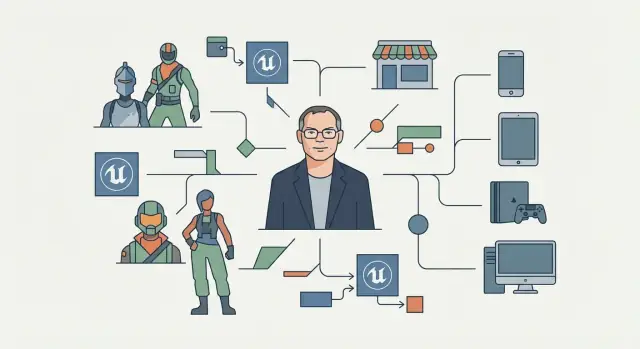
The big idea: Fortnite as a strategy, not just a game
Tim Sweeney founded Epic Games and spent decades building not only hit games, but the tools and business systems around them. That context matters, because Fortnite is best understood as the most visible piece of a much bigger plan—one that links software, creators, distribution, and bargaining power.
Three simple definitions
An engine is the underlying software that powers a game—graphics, physics, networking, and the building blocks developers use to create worlds and gameplay (Epic’s is Unreal Engine).
An ecosystem is the network that forms around a product: players, creators, developers, tools, marketplaces, partners, and the rules that connect them.
Platform leverage is the advantage you gain when you control a place others rely on—so you can negotiate better terms, set standards, or expand into new services.
Why Fortnite is more than a game
Fortnite isn’t a title you buy, finish, and move on from. It’s a continuously updated service with seasons, events, collaborations, and a social layer that keeps attention concentrated. That attention becomes an asset: it attracts creators, brands, and developers, and it strengthens Epic’s ability to push its tools and storefront.
This is a strategy-focused, non-technical walkthrough of how Epic turned a blockbuster into a hub. We’ll look at how engines create compounding advantages, how cross-platform access amplifies reach, and how owning distribution changes the economics—and power dynamics—of modern games.
Tim Sweeney’s long arc: tools first, hits second
Epic’s story is often told as “Fortnite happened, then everything else followed.” Sweeney’s track record points the other way: build tools that outlast any one hit, and let the hits fund the next layer of tools.
A high-level timeline (no trivia, just the pattern)
In the early years, Epic shipped games like most studios: small teams, direct sales, constant reinvention. The pivot was treating technology not only as a cost center, but as a product.
- Late 1990s: Unreal proves Epic can ship a major game—and that its underlying tech can be packaged for others.
- 2000s: Unreal Engine licensing becomes a second business alongside making games, creating a steadier B2B-style revenue stream.
- 2010s: Epic pushes toward broader access and modern tooling (including more creator-friendly pipelines), expanding the pool of developers who can ship with Unreal.
- 2017: Fortnite breaks out in a new form (Battle Royale), turning Epic from “a successful engine company” into a consumer phenomenon.
Tools as leverage, not just revenue
Sweeney’s long-term bet was that tools compound. A game earns once; an engine earns repeatedly through many games, many studios, and many years. That changes the options available later:
- Engine adoption creates relationships with developers before any store exists.
- Shared tooling lowers the cost of building and updating a live game at scale.
- Technical control (engine + pipeline) gives flexibility when platforms, policies, or payment rules shift.
Fortnite’s breakout didn’t create this strategy—it amplified it. With a massive hit funding aggressive investment, Epic could accelerate the same thesis: expand the toolchain, widen distribution, and build positions that don’t depend on any single title staying on top forever.
Why engines matter: compounding returns from Unreal
A game engine is the “kitchen” behind the meal. Players see the dish (the game), but the engine is the set of tools and routines that make it possible: the stove (rendering graphics), the fridge (asset management), the recipes (physics and animation systems), and the staff handbook (workflows for teams).
Another analogy: think of an engine as the chassis and drivetrain of a car. You can swap the body style every year—sedan, SUV, sports car—without reinventing steering, braking, or the transmission from scratch.
Reuse turns effort into leverage
Engines matter because they turn one-time work into repeatable advantage. When Epic improves Unreal—better lighting, smoother networking, faster tools—those gains don’t belong to a single title. They roll forward into every project built on top of it.
That’s what “compounding returns” looks like in software:
- Fix a bug once, remove it from many future games.
- Add a feature once, ship it across multiple teams and release cycles.
- Train staff once, keep productivity high even as projects change.
For Epic, Unreal isn’t just something sold to others. It’s also the internal foundation that makes building and operating games faster and cheaper. Fortnite benefits from engine upgrades, and Fortnite’s real-world demands (scale, performance, security) push Unreal to improve—creating a feedback loop.
Licensing revenue vs. game revenue
Game revenue is hit-driven: it spikes when a title succeeds and can fall when tastes change. Engine licensing revenue is different. It can be steadier, tied to long production timelines, and spread across many studios and industries.
Unreal therefore functions like a second business line: one side is entertainment sales, the other is tooling. Together, they let Epic invest more confidently—because success isn’t riding on any single game alone.
Fortnite’s live model: shipping once, updating forever
Fortnite didn’t win by being “finished.” It won by treating launch as the start of an ongoing service: frequent patches, seasonal resets, and time-limited events that give players a reason to return even if they skipped last week.
Seasons, updates, and events as a habit loop
Each season works like a soft relaunch: new mechanics, map changes, and a refreshed Battle Pass make the game feel current without asking players to learn an entirely new title. Regular updates and surprise drops keep the conversation alive, while big events (concerts, crossovers, narrative moments) turn playing into “being there.” The result is a rhythm—anticipation, payoff, repeat.
Live operations = retention you can plan around
A live model turns attention into something you can schedule. If you know a new season hits every few months, you can plan marketing, partnerships, and creator campaigns around predictable spikes. On the player side, the model rewards long-term engagement: progress systems, limited-time cosmetics, and rotating modes encourage routine play and reduce churn.
Shared tooling makes iteration fast
Constant updates only work when shipping is efficient. Epic’s advantage was shipping Fortnite on top of the same Unreal Engine pipelines it sells to developers. The feedback loop is tight: tools built to update Fortnite faster improve the engine, and engine improvements make the next Fortnite update easier to deliver.
A live game can double as a distribution channel
When you own the update stream, you own a communication channel. Fortnite’s front page can spotlight new modes, creator-made experiences, and promotions—effectively acting as a storefront built into the game. Over time, that turns a hit title into a place where audiences discover what Epic wants them to try next, not just what they came to play.
Ecosystem thinking: turning a hit into a hub
A game “ecosystem” isn’t just the people who play. In Epic’s case, it’s a connected group: players who show up for fun and status, creators who make maps and modes, developers who build with Unreal, and partners (brands, artists, media) who create moments that pull in new audiences.
Network effects, explained simply
Network effects mean: the more people participate, the more valuable the whole thing becomes.
When Fortnite has more players, matchmaking is faster, friends are more likely to be online, and events feel bigger. That increased attention makes it attractive for creators to publish new experiences. More great experiences give players more reasons to return—bringing in even more players. Partners then want in because they can reach a concentrated, engaged crowd.
Social play turns usage into a habit
Fortnite’s stickiness isn’t only about winning matches. It’s about shared experiences: dropping in with friends, showing off cosmetics, reacting live to surprises, and treating the game like a hangout space. Social loops are powerful because they create a subtle cost to leaving: if your friends are there, you’re likely to be there too.
How ecosystem thinking changes priorities
If you treat Fortnite as a single product, you optimize for one thing: the next hit update. If you treat it as a hub, priorities shift to:
- tools and rules that help creators publish safely and quickly
- cross-compatible identities, inventories, and friend networks
- events and partnerships that create “everyone’s talking about it” moments
That mindset turns a popular title into a place where other products—and other businesses—can plug in.
Cross-platform reach: access as leverage
Fortnite didn’t just chase “more players.” It chased more places to play, and that turns availability into negotiating power.
When a game is playable on console, PC, and mobile, each platform is no longer the single gate to the audience. Players can move, spend, and stay connected even if one platform’s store policies change. That portability quietly shifts leverage: partners want Fortnite because it keeps users engaged on their hardware, but Fortnite also has other routes to reach those same users.
Cross-play and shared accounts: convenience that compounds
Cross-play and shared accounts sound like quality-of-life features—and they are—but they also create a unified player base. Friends can squad up without caring what device everyone owns, and progress (skins, stats, purchases) follows the person, not the box.
This reduces friction that normally keeps people “stuck” on one platform. A player who can switch from console to PC without losing their identity is less dependent on any single ecosystem. The bigger the connected network, the harder it is for any one platform to treat the game like a captive audience.
The tradeoffs: rules, revenue splits, approvals
Cross-platform reach isn’t free. Every platform has certification processes, technical requirements, and policy constraints that affect how quickly updates ship and what features are allowed.
And then there’s the business side: revenue splits on in-app purchases, restrictions around alternative payment options, and rules about account systems can all limit how much control Epic has over its own relationship with players. Expanding access can increase bargaining power, but it also means living with multiple sets of gatekeepers—each with the ability to slow launches, reject updates, or take a meaningful cut.
Still, for Fortnite, being everywhere made the game harder to contain—and that was the point.
Distribution power: why build the Epic Games Store
Epic didn’t build the Epic Games Store just to sell more games. It’s an attempt to change who holds the keys to distribution—how games reach players, how revenue is split, and how much control developers have over their business.
What the store is trying to change
On major PC storefronts, getting discovered can feel like competing in a crowded supermarket aisle: thousands of titles, limited shelf space, and algorithms that can be hard to predict. Epic’s pitch has been that a store can be more developer-friendly—clearer economics, more direct promotion opportunities, and fewer “take it or leave it” rules.
Store economics, simply: fees, marketing, discovery
A game store typically earns money by taking a percentage of each sale (a “fee”). That cut funds the payment system, customer support, fraud prevention, hosting downloads, and the storefront itself.
But fees are only part of the story. Marketing and discovery often matter more than raw percentages. If a store can help your game get seen—through placement, featuring, or paid campaigns—that visibility can be worth more than a slightly better split on paper. The tension is that developers want both: fair fees and real attention.
Fortnite’s traffic as a growth engine
Fortnite gives Epic a rare asset: enormous, recurring player traffic. A store attached to a widely used launcher can turn that attention into distribution power—more users, more purchases, and better data on what players want.
The relationship runs in both directions. A stronger store can make it easier to bring players into Epic’s broader ecosystem (accounts, social features, payments), while a popular live game keeps the launcher installed and active.
Third-party relationships (without the hype)
For third-party publishers and indie studios, the store offers another route to market and another negotiating counterweight. That doesn’t guarantee success for any one game, but it can change the balance of options—and options are leverage.
Developer gravity: Unreal as a community flywheel
Unreal isn’t just a piece of software Epic ships—it’s a meeting point. A powerful engine attracts ambitious developers because it can handle demanding projects, from high-end visuals to complex online worlds. Once enough serious teams rely on the same toolset, a “gravity” effect kicks in: knowledge, talent, and third‑party support start clustering around Unreal, making it even more attractive for the next wave.
Why a big engine grows a big community
Studios bet on engines that lower risk. Unreal’s breadth (rendering, animation, networking, tooling) reduces the number of custom systems a team needs to invent. That matters to both AAA studios and small teams trying to punch above their weight.
As more projects ship on Unreal, hiring gets easier (“we already know Unreal”), training paths become clearer, and shared expectations emerge. The engine becomes a common language for production.
Learning, plugins, and tutorials as compounding value
Community output turns into real product value. Tutorials, templates, and open examples shorten the time from idea to prototype. Plugins and assets—sold and shared through channels like the Unreal Marketplace (and now broader asset ecosystems)—let teams buy leverage instead of rebuilding basics.
This is compounding: each new guide, tool, or workflow improvement helps thousands of future projects. Unreal’s learning ecosystem becomes part of the engine’s “feature set,” even when Epic didn’t write it.
Mindshare turns into adoption (and more content)
When Unreal dominates developer mindshare, innovation happens faster: new genres, new techniques, and new production tricks spread quickly. That translates into more polished games and experiences, which then reinforces Unreal’s reputation and adoption.
Creator tools widen the funnel beyond studios
Epic also pushes Unreal downward into simpler creation. Blueprints, MetaHuman, and UEFN (Unreal Editor for Fortnite) let non-traditional creators build without a full studio pipeline. More creators means more experimentation, more content, and a bigger top-of-funnel that can grow into tomorrow’s professional developers.
Platform rules and pushback: the fight over fees and control
Who are the “platform gatekeepers?”
Platform gatekeepers are the companies that control the primary routes to customers—and set the terms for anyone who wants access. In games, that usually means mobile app stores (Apple’s App Store and Google Play) and console storefronts (PlayStation Store, Xbox Store, Nintendo eShop). They don’t just “host” apps. They approve what ships, decide which payment methods are allowed, and can remove products that break policy.
What’s really at stake: fees, payments, and policy power
The obvious flashpoint is the standard cut (often framed as a 30% fee). But the deeper issue is control:
- Payment rules: whether a game can use its own checkout system or must use the store’s billing.
- Customer relationship: who owns the billing data, refunds, subscriptions, and account history.
- Policy control: what content is permitted, how updates are reviewed, and how quickly a business can respond.
For a live service like Fortnite, those rules affect pricing, promotions, and how directly Epic can build a long-term relationship with players.
Apple/Google disputes (high level) and why they matter
Epic’s public fight with Apple (and conflict with Google) centered on bypassing required in-app payment systems to avoid fees and regain pricing flexibility—followed by removal from stores and years of legal and policy battles. The legal details are complex, but the strategic signal was simple: Epic was willing to trade short-term distribution for a shot at changing the rules.
Strategy implications beyond the courtroom
Even without rewriting mobile economics overnight, the pushback reinforced Epic’s broader strategy: reduce dependency on gatekeepers by strengthening its own channels (like the Epic Games Store), expanding cross-platform identity, and positioning Fortnite and Unreal as services that can survive beyond any single storefront. The fight wasn’t only about margin—it was about who gets to define the business model.
Content, culture, and partnerships: attention as an asset
Fortnite isn’t just competing with other games—it’s competing with everything people do for fun. Streaming, social apps, TV, sports: all of it fights for the same limited hours. That makes attention the scarcest resource in entertainment, and Fortnite is unusually good at capturing it because it feels like a place where “something is happening” on a regular schedule.
Why brands and events show up inside Fortnite
When a game has a massive, returning audience, it starts to look less like a product and more like a venue. That’s why you see concerts, movie tie-ins, fashion drops, and sports crossovers inside Fortnite: partners aren’t only buying visibility, they’re borrowing Fortnite’s momentum—the built-in habit of millions of players logging in to see what’s new.
Culturally, Fortnite also works as a common reference point. A collab skin or limited-time mode can travel beyond the game into TikTok clips, streams, and memes—turning an in-game beat into broader pop-culture oxygen.
Partnerships 101: reach, timing, measurement
At the basics, successful partnerships line up three things:
- Reach: who you can credibly reach (age mix, regions, platforms) and how naturally the brand fits the Fortnite tone.
- Timing: launches and cultural moments matter—events work best when they feel like an appointment, not an ad.
- Measurement: the practical question is “did people show up and stick around?” That can mean in-game participation, time spent, repeat visits during a campaign window, and the secondary wave of social/streaming chatter.
The key point: Fortnite converts attention into a predictable, repeatable asset—one Epic can use to deepen loyalty, attract partners, and keep the ecosystem feeling alive between traditional game releases.
Creators and UGC: scaling content with community
Fortnite’s shift from “a game with seasons” to “a place people build in” hinges on user-generated content (UGC). A simple way to think about the creator economy is: people make things, share them with an audience, and earn money when that audience shows up.
Why UGC solves the content bottleneck
Traditional games rely on a studio to ship every new map, mode, or experience. That’s expensive, slow, and limited by headcount. UGC flips the equation: Epic provides the foundation, while creators supply an ongoing stream of fresh ideas—parkour maps, competitive arenas, social hangouts, mini-games.
The payoff compounds:
- Players get more variety without waiting months for a “big update.”
- Epic gets more hours played per update cycle.
- Creators get a reason to keep improving their work.
Tools + audience = creator magnet
Creators rarely choose platforms based on vibes; they choose them based on distribution and workflow.
Fortnite offers both:
- Tools (to build, test, and publish) that reduce the friction from idea to playable experience.
- A built-in audience that can discover creations immediately, which is the hardest part of making anything online.
When creators believe their work can be seen—and rewarded—they invest more time, bring friends, and build communities around their islands. That, in turn, makes Fortnite feel “alive” even when Epic isn’t the one shipping the content.
Moderation and safety are the price of scale
Opening the doors to UGC also opens the door to spam, copycats, scams, and inappropriate content. That means moderation is not optional—it’s a recurring operational cost. Platforms need clear rules, reporting systems, automated checks, and human review to protect players and advertisers.
Done well, creators deepen engagement, extend Fortnite’s lifespan, and turn the community into an engine for growth—without Epic having to produce every minute of fun itself.
Takeaways: how Epic turned Fortnite into platform leverage
Epic’s advantage wasn’t simply “Fortnite is popular.” It was what Fortnite powered—and what powered Fortnite.
One simple model: the Engine–Game–Store triangle
Think of Epic as a three-part loop:
- Unreal Engine lowers the cost and time to build high-quality experiences (for Epic and for outside studios).
- Fortnite is the always-on showcase: it proves the tech, attracts players and creators, and generates cash.
- Epic Games Store is the distribution bet: it reduces reliance on other storefronts and strengthens bargaining power.
Each corner feeds the other: the engine improves the game, the game builds attention, and attention helps distribution—while distribution and cash fund more engine and content investment.
What others can copy (and what’s hard to replicate)
Copyable moves:
- Treat a hit product as a service, not a launch: regular updates, seasonal rhythms, and clear reasons to return.
- Build creator-friendly tooling and incentives so the community helps scale content.
- Use partnerships to turn attention into new use cases (events, brands, media crossovers) without changing the core product.
- Design for cross-platform access early so growth isn’t trapped inside one gatekeeper.
Hard to replicate:
- A top-tier engine with years of accumulated tech and a huge developer base.
- The capital and patience to build a store while competing with entrenched platforms.
- The credibility to convince creators and studios that your ecosystem will be stable and fair.
Risks to watch
Epic’s model still depends on (1) keeping a hit culturally relevant, (2) shifting platform rules and fees, and (3) community trust—one misstep in moderation, monetization, or creator payouts can slow the flywheel.
Takeaways for product teams building ecosystems
Start with a product people love, then invest in tools, distribution, and incentives that let others build value on top. Measure success not only in users, but in reuse (plugins, mods, maps, integrations) and in how quickly your ecosystem can ship new experiences without rebuilding from scratch.
A practical parallel outside gaming: modern “vibe-coding” platforms apply the same flywheel logic to software products. For example, Koder.ai focuses on reducing time-to-shipping by letting teams build web, backend, and mobile apps through chat (with planning mode, deploy/hosting, source export, and snapshots/rollback). It’s the same strategic pattern Epic leveraged with Unreal + Fortnite: invest in reusable tooling, then let that tooling amplify distribution and iteration speed—so you’re less dependent on any single launch going perfectly.
FAQ
What do “engine,” “ecosystem,” and “platform leverage” mean in this article?
An engine is the reusable software foundation (graphics, physics, networking, workflows) that multiple games can be built on.
An ecosystem is everyone and everything connected to a product—players, creators, tools, marketplaces, partners, and the rules that coordinate them.
Platform leverage is the bargaining power you gain when others depend on your “place” (a store, an account system, a creator hub) to reach users or earn revenue.
Why is Fortnite described as a strategy, not just a game?
Because Fortnite concentrates recurring attention via seasons, events, and a social layer. That attention becomes an asset Epic can route toward:
- creator-made experiences (UGC)
- brand partnerships and timed events
- Epic’s account, payments, and distribution ambitions
A one-time hit earns once; a live hub can keep compounding value over years.
How does Unreal Engine create “compounding returns” for Epic?
Unreal turns improvements into reusable advantage:
- Fix a bug once → many future projects benefit
- Add a feature once → multiple teams ship faster
- Train talent on one toolset → hiring and switching projects gets easier
Epic also benefits from a feedback loop: Fortnite’s scale pressures Unreal to improve, and Unreal upgrades make Fortnite easier to run and update.
What’s the practical difference between game revenue and engine licensing revenue?
A hit game’s revenue can spike and fade; engine revenue is typically spread across many projects and timelines.
Practically, Unreal gives Epic:
- a steadier B2B-style business line
- early relationships with developers (before any store discussion)
- more confidence to invest long-term because success isn’t tied to one title alone
How do seasons and live updates actually build retention?
A live service treats launch as the beginning. The operational playbook usually includes:
- seasonal “soft relaunches” to reset interest
- frequent updates to keep the conversation alive
- limited-time content (events, cosmetics, modes) to create urgency
The goal is predictable retention—so marketing, partnerships, and creator pushes can be planned around known spikes.
Why is cross-platform access considered a form of leverage?
Cross-play and shared accounts reduce friction:
- friends can play together regardless of device
- inventory/progress follows the user, not the hardware
- players aren’t locked into one storefront by sunk progress
That convenience also shifts power: if users can move platforms without losing identity, no single gatekeeper fully “owns” the audience.
Why did Epic build the Epic Games Store—what does it change?
It’s a bet to reduce dependency on other storefronts and change distribution economics.
Key levers a store can affect:
- revenue split (store fee)
- discoverability and featuring (often more important than the fee)
- control over customer relationship (accounts, payments, support policies)
Fortnite’s traffic helps because it keeps Epic’s launcher installed and active, making it easier to route users to other products.
Who are the “platform gatekeepers,” and why do their rules matter?
Gatekeepers are the companies controlling primary routes to customers (mobile app stores and console storefronts). They typically control:
- app approval and removals
- allowed payment methods
- rules for updates, content, and account systems
For a live service, these rules directly affect pricing, promotions, iteration speed, and how directly the publisher can build a long-term customer relationship.
What are the biggest risks of scaling Fortnite with user-generated content (UGC)?
UGC scales content output, but it creates ongoing safety and trust costs.
A practical moderation stack usually needs:
- clear publishing rules and enforcement
- reporting flows for players
- automated detection (spam, scams, prohibited content)
- human review for edge cases and appeals
Without credible moderation, you risk player churn, partner reluctance, and ecosystem degradation.
What can other product teams realistically learn (and copy) from Epic’s Fortnite strategy?
Start with what’s copyable:
- run your hit as a service (rhythm, reasons to return)
- invest in creator tools + incentives
- design for cross-platform identity early
- use partnerships as timed “moments,” not random ads
Be realistic about what’s hard to replicate: years of engine investment, capital to build distribution, and trust from creators and developers.