

Travis Kalanick and Uber: Network Effects, Expansion, Tradeoffs
A clear look at how Uber scaled under Travis Kalanick, the network effects behind it, and the costs in regulation, culture, and trust.
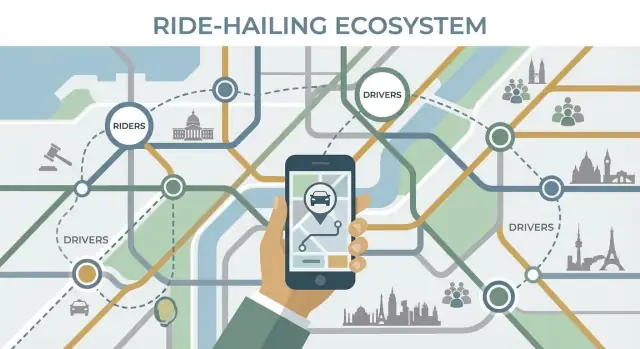
The big idea: building a global mobility layer
When people say Uber was trying to build a “global mobility layer,” they mean something simple: make it as easy to get a ride as it is to send a text. Open an app, see a car, tap a button, pay automatically. If that works in every neighborhood and in every city you visit, transportation starts to feel like a utility—available on demand, with consistent expectations.
A plain-language definition
A mobility layer is the invisible system that sits between you and getting from A to B: matching, pricing, payments, driver supply, routing, and support. The “global” part is the ambition that the same experience works across borders—rather than being a one-off local taxi alternative.
Why Uber is a useful marketplace case study
Uber is one of the clearest examples of a two-sided marketplace scaling at high speed. It had to attract riders and drivers at the same time, in the same places, while coordinating real-world operations (cars, traffic, safety, city rules). That mix makes it a practical reference for anyone building a marketplace where supply and demand must meet quickly.
This post looks at the growth engines—network effects, expansion tactics, and pricing levers—and also the consequences: regulatory conflict, subsidy dependence, and the tradeoffs felt by drivers, riders, and cities.
A quick timeline to anchor the story
Uber’s arc moves fast:
- 2009–2011: Early product-market fit in a few cities; proving the “tap for a car” experience.
- 2012–2014: Rapid city launches; major driver acquisition; UberX expands the addressable market.
- 2015–2017: Global scale, heavier regulatory fights, and intensifying competitive burn.
- After: Consolidation, governance scrutiny, and a shift from pure growth to sustainability.
Seen through the “mobility layer” lens, each phase pursued the same goal: improve reliability everywhere—while managing the costs and conflicts that reliability creates.
From pain point to product: why ride-hailing clicked
Uber didn’t invent the idea of getting a car to pick you up. It removed the friction that made taxis feel unpredictable—and turned a once-in-a-while service into something people could reliably use.
The taxi problems it attacked head-on
In many cities, the taxi experience suffered from three recurring issues:
- Availability was uncertain: you couldn’t easily know when a car would arrive—or whether one would arrive at all.
- Payment was awkward: cash-only rides, broken card readers, and no receipt if you needed to expense the trip.
- Reliability was inconsistent: drivers might refuse short rides, avoid certain neighborhoods, or simply not show up.
Uber’s early promise was simple: a car, where you are, with an expected arrival time and a tracked route.
A product designed for speed and confidence
The early product focus wasn’t “transportation” in the abstract. It was a tight loop of trust-building moments:
- One tap to request a ride (no phone calls, no street-hailing)
- Fast pickup with an ETA you can see
- Cashless payment that “just works,” plus an automatic receipt
That combination mattered because it reduced anxiety. Even when the ride itself was ordinary, the process felt controlled.
Why the first cities mattered
Launching in high-visibility cities did more than generate demand. It created a strong brand association—modern, premium, and efficient. Those early markets also acted like testing grounds. Uber could learn what broke first—pickup confusion at airports, rider cancellation habits, local regulations—before repeating the playbook elsewhere.
How a narrow use case became a habit
The initial use case was straightforward: “I need a ride now.” But once it worked repeatedly, people stopped treating rides as a special occasion and started defaulting to the app—after dinner, for airport runs, when it rained, or whenever parking felt like a hassle. That repeat behavior is what made ride-hailing “click”: it turned uncertainty into routine.
Network effects 101: riders, drivers, and liquidity
Uber is a classic two-sided marketplace: it has to attract riders who want fast, predictable pickups and drivers who want steady earnings with minimal downtime. The twist is that neither side fully shows up until the other is already there.
Liquidity: the metric that matters
In ride-hailing, “network effects” don’t just mean “more users.” They show up as liquidity—the ability to reliably match a rider with a driver in the right place, at the right time, at an acceptable price.
Liquidity is felt in a few concrete moments:
- A rider opens the app and sees a short ETA (confidence)
- A driver goes online and gets a trip quickly (utilization)
- Peak periods don’t break the experience (reliability)
Why shorter ETAs boost conversion and retention
A shorter ETA doesn’t merely make a trip faster; it changes user behavior. When pickups are consistently quick, people stop “planning for Uber” and start using it reflexively—after dinner, in the rain, after a meeting.
That drives:
- Conversion: fewer riders abandon the request when pickup time looks reasonable
- Retention: if the last three rides were fast and smooth, the app becomes the default
On the driver side, more completed trips per hour increases earnings, which can keep drivers active and encourage others to join.
Density beats spreading thin
Uber’s flywheel works best with city-level density, not scattered presence across many markets. A thin network creates long ETAs, idle drivers, and unreliable service—exactly the conditions that prevent the marketplace from healing itself.
The goal isn’t “available in more places.” It’s liquid in the places that matter, block by block and hour by hour. Once a city hits that threshold, growth gets easier because the product experience improves automatically as the network deepens.
Aggressive supply growth: getting enough drivers fast
Uber’s early growth constraint wasn’t demand—it was having enough drivers in the right places at the right times. In a two-sided marketplace, supply is the “inventory,” and without it the app feels broken: long ETAs, missed pickups, and frustrated riders who don’t come back.
Driver onboarding: remove friction, add confidence
Onboarding had to feel simple and predictable. The basics were straightforward—vehicle requirements, background checks, insurance documentation, and a smartphone—but the real work was operational: local onboarding centers, step-by-step checklists, and fast answers when paperwork stalled.
To accelerate sign-ups, Uber leaned on referrals and clear earnings narratives (“how much you can make this weekend”), plus support that reduced early drop-off: quick-start guides, in-app navigation prompts, and help channels when things went wrong on a first shift.
Guarantees and bonuses: buying liquidity (with risks)
Guaranteed earnings and sign-up bonuses were powerful because they lowered perceived risk for new drivers. If you’re unsure whether you’ll get enough trips, a guarantee turns “maybe” into “worth trying.”
The downside is cost and expectation-setting. Subsidies can attract opportunistic drivers who churn once bonuses end, and they can distort the marketplace if incentives are richer in one area than another.
Scheduling the hard hours
Supply isn’t evenly distributed. Peaks, late nights, bad weather, and big events create short windows where reliability matters most. Uber tackled this with targeted “quest” bonuses, heatmaps, and nudges that pushed drivers toward underserved zones—effective, but sometimes experienced as pressure rather than choice.
Quality controls and their tradeoffs
Ratings and deactivations helped maintain trust, but they also introduced tension: drivers worried about unfair reviews, riders used ratings inconsistently, and automated thresholds could punish edge cases. The marketplace grew faster when standards were enforced, yet every enforcement decision carried human consequences.
Demand growth: making Uber a default habit
Uber didn’t just need riders to try the app—it needed them to stop thinking about alternatives. Demand growth was about turning a discounted first ride into a repeated behavior: “when I need a car, I open Uber.” That habit only forms when the service is reliably available, easy to understand, and feels safe.
The rider acquisition playbook
Early growth leaned on simple, measurable levers:
- Promos to remove the “why bother?” barrier on the first trip
- Referrals that rewarded both sides, turning existing users into a distribution channel
- Word of mouth powered by a clear story: tap a button, a car arrives
Discounts helped people experiment, but they weren’t the product. The product was the experience.
Reliability is what makes discounts stick
A promo can buy a first ride; reliability earns the second. If ETAs are unpredictable, pickups fail, or prices jump without warning, riders revert to taxis, driving, or not going out at all. But when a rider can trust that “it’ll work” after a late dinner or in bad weather, the app becomes a default.
Hotspots: airports and events as demand multipliers
Airports, concerts, and sporting events concentrate both intent and urgency. Winning these moments created recurring demand because riders learned a repeatable pattern: “land, open Uber, go.” These hotspots also amplify visibility—busy curbside areas serve as live advertising.
Trust primitives that reduce friction
Marketplace demand grows when uncertainty shrinks. Uber built trust through basics that feel small but compound:
- Identity and stored payment
- Two-way ratings that encourage good behavior
- Receipts that make expenses easy
- GPS tracking to show the ride is real and on-route
Together, these features made taking a ride feel normal—even in a stranger’s car.
Pricing, surge, and subsidies: growth fuel with a cost
Uber’s growth depended as much on pricing mechanics as on product design. In a two-sided marketplace, the hardest problem isn’t getting people to download an app—it’s getting a car to arrive quickly when they need one.
What dynamic pricing is meant to solve
Dynamic (or “surge”) pricing is mainly a matching tool. When demand spikes—after a concert, during rain, at bar close—fixed prices create a predictable failure mode: too many riders request, too few drivers accept, and wait times explode.
By raising prices in those moments, the platform tries to do two things at once: encourage more drivers to get on the road (or move toward busy areas) and reduce marginal demand from riders who can wait or choose another option. The goal is liquidity: reliable pickup times that keep the marketplace feeling “alive.”
Why surge helps availability but hurts sentiment
Even when surge improves outcomes, it can feel like price gouging—especially when the rider is surprised at checkout or when the surge map appears to “follow” them. That perception cost matters because ride-hailing is a high-frequency product: one bad surprise can create lasting distrust.
Uber tried to balance this with clearer upfront pricing, caps in some cases, and messaging that higher prices bring more drivers. But the core tension remains: the marketplace may work better, while the brand feels worse.
Price wars and subsidies: scale now, pay later
Subsidies (discounts for riders and bonuses for drivers) can accelerate scale when they’re targeted: a new city launch, a specific neighborhood, or a time window where reliability is weak. They can also paper over structural problems—like low driver supply at peak times—by bribing the system into functioning.
Used too broadly, subsidies become a cash furnace. Competitors match discounts, riders become deal-sensitive, and drivers treat bonuses as the “real” pay. Growth continues, but profitability moves further away.
Why unit economics vary by city—and by hour
A ride that looks healthy at 2 p.m. in a dense downtown may look awful at 1 a.m. in the suburbs. Local factors—traffic, parking rules, airport queues, enforcement risk, fuel prices, and driver alternatives—change costs and acceptance rates. Time-of-day and day-of-week patterns also matter: peaks can be profitable with surge, while off-peak requires incentives to maintain coverage.
Uber’s challenge wasn’t just setting a price. It was continuously tuning an entire city’s marketplace—while absorbing the reputational and financial costs of that tuning.
Regulation and confrontation: scaling into legal gray areas
Uber didn’t just enter new cities; it often entered rulebooks written for dispatch taxis, not app-based marketplaces. That mismatch created a predictable pattern: launch first, argue later, and let customer demand become part of the negotiating leverage.
Different local rules meant different legal risks
Every market had its own tripwires—commercial licensing, insurance requirements, background checks, vehicle inspections, and, eventually, questions about labor classification. A model that looked fine in one city could be noncompliant a few miles away.
Uber’s core bet was that the product improved transportation enough that regulators would update frameworks after the fact. That’s a risky bet because “eventually legal” is not the same as “currently permitted,” and penalties can include fines, vehicle impounds, or outright bans.
Where conflicts usually erupted
The most common flashpoints were:
- Incumbent taxi and limousine industries claiming unfair competition (medallions, fixed fares, mandated equipment)
- City agencies focused on passenger safety, insurance coverage, and accountability
- Labor advocates arguing drivers were effectively employees, not independent contractors
Those groups weren’t just opposing a company; they were protecting existing investments, tax revenue, and enforcement models.
Why speed mattered
Marketplace businesses benefit from liquidity: once riders can reliably get a car in minutes, switching back feels painful. Rapid scaling made the service “real” to consumers and politically harder to remove. In practice, growth became a defensive moat—if enough voters use the app, regulators face pressure to find a compromise instead of shutting it down.
The reputational cost of confrontation
Fast expansion can look like arrogance when messaging is opaque, rules are treated as optional, or local officials feel bypassed. Even when Uber’s arguments were compelling, combative tactics risked eroding trust—turning what could have been a policy debate into a character judgment about the company’s integrity.
Operational excellence: the machinery behind the app
Uber’s growth wasn’t only a marketing story—it depended on day-to-day operations getting measurably better, week after week. The app was the front door; the advantage came from turning messy real-world movement into repeatable processes.
Dispatch and mapping: cutting ETAs and improving matching
Early ride-hailing lived or died on “How long until my car arrives?” Dispatch is essentially a continuous matching problem: which driver should pick up which rider, right now, given traffic, driver location, and driver intent.
Better mapping and routing reduced pickup times, improved ETA accuracy, and made cancellations less likely. Even small gains mattered: if riders trust the ETA, they request more often; if drivers trust the trip flow, they stay online longer.
Fraud, safety tooling, and incident response
At scale, marketplaces attract abuse: fake accounts, payment fraud, GPS spoofing, and scams aimed at drivers or riders. Operational excellence meant building internal tooling that could flag suspicious activity quickly and give teams a clear workflow: review, intervene, and prevent repeat attempts.
Safety required similar rigor. Reporting flows, escalation paths, and incident response processes needed to work across cities and time zones—not just during business hours. The goal wasn’t “zero incidents” (unrealistic), but faster detection, clearer decisions, and consistent follow-through.
Customer support at scale
Support is where product promises meet reality: missed pickups, fare disputes, lost items, and driver deactivations. It breaks when volume spikes—during bad weather, events, or rapid city growth. Fixes usually look unglamorous: better self-serve flows, clearer policies, and specialized queues for high-risk issues.
Operational playbooks: launching and iterating
Uber treated each city launch like a repeatable campaign: seed supply, validate demand pockets, monitor key metrics daily, and run weekly experiments. The playbook standardized the basics, while local teams adapted to quirks like airports, nightlife patterns, and regulations.
Global expansion: copy, adapt, and sometimes exit
Uber’s expansion playbook looked repeatable—launch the app, recruit drivers, discount rides, and build liquidity—but it was never truly “plug and play.” The product could be copied; the operating system around it had to be rebuilt city by city.
City-by-city expansion: why operations must be local
Even inside the same country, each city behaved like its own market. Airports had different pickup rules, local taxi politics varied, and enforcement could be strict in one place and absent in another. That meant local teams had to manage driver onboarding, incentives, support, and relationships with regulators and venues. The app was global; the day-to-day execution was intensely local.
Entering new countries: payments, language, and cultural norms
International launches forced a re-think of basics that were “solved” at home. In cash-heavy markets, card-only payments limited growth, so Uber added cash options and new risk controls. Language wasn’t just translation; it affected customer support, driver training, and even map data. Cultural norms mattered too: what counts as safe, polite, or acceptable service differs widely, and those expectations shape ratings, cancellations, and retention.
Competing with local champions and global rivals
In many regions, Uber wasn’t introducing ride-hailing—it was entering a fight. Local champions often understood regulators better and had stronger brand trust. Global rivals brought similar tactics and deep pockets. Winning usually required heavier subsidies, faster hiring, and tighter operational discipline.
Retreats and consolidations: when expansion doesn’t stick
Not every market justified the burn. Uber sometimes exited or merged operations when regulation hardened, unit economics stayed weak, or competitors outlasted subsidy wars. Those retreats were painful, but they also showed a hard truth of marketplaces: global ambition doesn’t override local realities.
Culture and governance: what growth pressures expose
Hypergrowth doesn’t just scale a product—it scales whatever behaviors are tolerated inside the company. At Uber, a “win at all costs” posture helped teams move fast, take big bets, and push into new cities with unusual intensity. That speed created real advantages in a two-sided marketplace, but it also rewarded rule-bending, internal competition, and short-term results over long-term trust.
“Win at all costs”: speed with sharp edges
When the goal is to out-expand rivals city by city, incentives tilt toward aggressive execution: ship quickly, argue later, and treat setbacks as obstacles to route around. That can be effective when you’re building liquidity, but it can also normalize risk-taking that’s hard to unwind—especially when growth metrics become the primary language of success.
Accountability gaps: common failure modes
A few patterns show up repeatedly in fast-scaling companies:
- Metrics overpower judgment. If promotions track launches and growth, teams learn to optimize for numbers even when the cost is internal health or external trust.
- Rule ambiguity becomes a feature. “Move fast” can quietly turn into “no one owns the downside.”
- HR and reporting channels lag reality. If people don’t believe complaints will be handled fairly, problems compound until they become public.
Governance: boards, incentives, and leadership behavior
Boards are often least effective exactly when companies are growing the fastest. Oversight can fall behind because the story is still working—revenue is up, expansion is up, competitors are on the back foot. But governance is about non-metric risks too: leadership conduct, internal controls, and whether incentives encourage ethical decision-making. When leaders model confrontational behavior, it travels.
Culture becomes product and brand
Culture issues rarely stay internal. They affect how drivers and riders are treated, how safety is prioritized, and how the company responds to regulators and cities. Over time, that becomes part of the product experience—and the brand. In marketplaces, trust is a feature; once damaged, it’s expensive to rebuild.
Tradeoffs for people: drivers, riders, and cities
Uber’s growth didn’t just reshape a category—it redistributed risk, convenience, and control across drivers, riders, and urban systems. The app made transportation feel simpler, but the human tradeoffs were real and often uneven.
Drivers: flexibility with volatility
For many drivers, the headline benefit was flexibility: choose hours, turn the app on and off, and generate income without a long hiring process. The tradeoff was income volatility. Earnings could swing by time of day, neighborhood, bonuses, and changing incentive rules. After accounting for fuel, maintenance, insurance, and downtime, the “hourly rate” often looked different than what the app’s gross numbers implied.
Ratings, deactivation, and perceived fairness
The rating system helped maintain service quality at scale, but it also created anxiety. A few low scores—sometimes tied to factors outside a driver’s control—could threaten access to the platform. Deactivation policies were frequently criticized as opaque, especially when appeals felt slow or one-sided. For drivers, this turned a marketplace into something that could feel like an employer without traditional protections.
Safety: trust mediated by software
For riders, features like GPS tracking, cashless payments, and ride receipts improved perceived safety. For drivers, the risk calculus could be harsher: picking up strangers, late-night trips, and uncertain rider behavior. Safety tools (in-app emergency help, identity checks, support lines) mattered, but the fundamental tension remained: rapid matching increases convenience, yet it can compress the time available for careful screening.
Cities and taxis: disruption with side effects
Uber expanded mobility options and reduced wait times in many areas, but it also pressured taxi operators and changed the economics of urban transport. In some cities, increased ride-hailing contributed to congestion, competed with public transit on high-demand corridors, and raised questions about curb access, airport rules, and accessibility. Cities were left balancing innovation with public goals—safety, fairness, and efficient streets—often while regulations lagged behind reality.
Lessons and takeaways for marketplace builders
Uber’s story is a reminder that marketplaces don’t “grow” in a straight line—they compound when the core loop works. But that loop is fragile: a few bad experiences, mismatched incentives, or a city-level backlash can slow everything.
1) Network effects need density, not just users
The practical lesson isn’t “get big.” It’s “get liquid in a specific place.” Focus on a tight geography and clear use case until pickup times and reliability feel automatic. Once the experience is predictably good, word-of-mouth and habit do more than marketing.
2) Aggressive expansion can be rational—and still dangerous
Blitzscaling can make sense when speed creates defensibility (locking in supply, brand, and local mindshare). It backfires when the playbook ignores local constraints: enforcement risk, local competitors, labor norms, and unit economics that never stabilize.
A useful internal test: if subsidies stop tomorrow, does the product still solve a frequent, painful problem?
3) Treat regulators and communities as part of the product
Legal strategy isn’t separate from growth strategy. Build channels early: city officials, airports, disability advocates, neighborhood groups, and the local press. Share data responsibly, show safety investments, and create ways to address complaints before they become headlines.
4) Governance and culture are scaling systems
Hiring, incentives, incident response, and leadership behavior are operational controls. If you don’t design them, growth will design them for you—often in the worst way. Define what “winning” includes (safety, fairness, compliance), measure it, and hold leaders accountable as the organization multiplies.
A practical note for builders: prototype the marketplace loop early
One meta-lesson from Uber is that the “real product” isn’t a single feature—it’s the end-to-end loop (onboarding, matching, payments, pricing, support, and ops tooling). If you’re building a marketplace today, it’s worth pressure-testing that loop in a small geography before you scale incentives and expansion.
Platforms like Koder.ai can help teams do this faster: you can describe the marketplace you’re building in a chat interface and generate a working web app (often React on the frontend, Go + PostgreSQL on the backend), iterate in planning mode, and use snapshots/rollback as you tune the workflow. That doesn’t remove the hard parts—supply, regulation, unit economics—but it can shorten the time from idea to a testable, city-level MVP.
FAQ
What does it mean that Uber aimed to build a “global mobility layer”?
A “global mobility layer” is the behind-the-scenes system that makes getting from A to B feel like a utility: open an app, get matched to supply, see an ETA, pay automatically, and receive support if something goes wrong.
In practice it includes matching, pricing, payments, routing, safety tooling, and customer support—ideally working consistently across cities and countries.
What is “liquidity,” and why is it the key marketplace metric for ride-hailing?
In a two-sided marketplace, raw user counts matter less than whether the market reliably clears in real time. Liquidity is that reliability: riders get quick pickups at acceptable prices, and drivers get trips with minimal idle time.
A practical way to track it is by looking at ETAs, cancellation rates, time-to-next-trip for drivers, and peak-hour reliability by neighborhood.
Why do shorter ETAs have outsized impact on conversion and retention?
Short ETAs reduce the “will this work?” anxiety that causes riders to abandon requests. When pickup times are consistently quick, usage becomes reflexive (after dinner, in the rain, for airport runs), which boosts both conversion and retention.
On the supply side, faster matching increases trips per hour, which can improve driver earnings and keep more drivers online—reinforcing the loop.
Why does city-level density beat expanding into many markets at once?
Density means concentrating supply and demand in a tight geography until matches are fast and consistent block-by-block and hour-by-hour.
Spreading thin across many areas often produces long ETAs, idle drivers, and unreliable service—conditions that prevent the marketplace flywheel from taking off. Many marketplaces win by dominating a few “core zones” before expanding outward.
How did Uber grow driver supply quickly in the early days?
Early-stage supply growth often requires removing onboarding friction (clear requirements, fast verification, local support) and reducing perceived risk.
Common tactics include:
- Driver referrals
- Clear earnings expectations (without overpromising)
- Guarantees or sign-up bonuses to get drivers to try the platform
- In-app guidance (navigation, pickup workflows) to reduce early churn
What problem is surge pricing meant to solve, and why do riders dislike it?
Surge is primarily a matching mechanism for spikes in demand (concerts, rain, bar close). Higher prices aim to:
- Pull more drivers toward high-demand areas
- Reduce marginal rider demand from people who can wait
The tension is perception: even if surge improves availability, riders may experience it as price gouging—so transparency (upfront pricing, clear messaging) becomes critical.
When do subsidies help a marketplace, and when do they become a trap?
Subsidies (rider discounts, driver bonuses) can “buy liquidity” during launches or known weak spots, helping a marketplace cross the reliability threshold.
They become dangerous when they mask structural issues:
- Riders become deal-sensitive and churn when promos end
- Drivers anchor on bonuses as “real pay”
- Unit economics drift further from sustainability
A useful test: if incentives stopped tomorrow, would the service still be reliable enough to keep habitual users?
Why did Uber face so many regulatory fights during expansion?
Ride-hailing often entered cities with regulations written for dispatch taxis, creating gray areas around licensing, insurance, background checks, and labor classification.
Conflicts typically flare with:
- Taxi incumbents claiming unfair competition
- Regulators focused on safety and accountability
- Labor advocates disputing contractor vs. employee status
The business risk is real: fines, impounds, or bans can quickly break liquidity in a market.
What does “operational excellence” mean in a marketplace like Uber?
The app is the “front door,” but reliability comes from operations: accurate mapping, smart dispatch, fraud detection, safety incident response, and scalable customer support.
Even small operational improvements compound:
- Better ETAs reduce cancellations
- Faster support resolves trust-breaking moments (fare disputes, lost items)
- Stronger safety workflows reduce severe downside events
At scale, these systems can be as defensible as the product UI.
What are the culture and governance lessons from Uber’s blitzscaling era?
Hypergrowth amplifies whatever behaviors leadership rewards. If metrics dominate judgment, teams may optimize for launches and growth even when it harms trust with drivers, riders, or regulators.
Practical safeguards include:
- Defining “winning” to include safety, fairness, and compliance
- Building credible reporting and escalation channels
- Holding leaders accountable for non-metric risks (conduct, controls, incident handling)
In marketplaces, trust is part of the product—and culture helps determine whether that trust compounds or erodes.