

Vibe Coding at Scale: Risks, Debt, Complexity, Overconfidence
Vibe coding can feel fast, but at scale it can create technical debt, hidden complexity, quality and security gaps, and risky overconfidence. Learn safeguards.
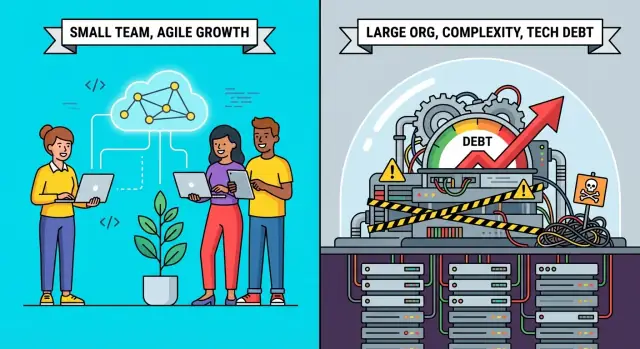
What “Vibe Coding” Means When You Scale
“Vibe coding” is intuition-first, speed-first coding: you follow momentum, make quick decisions, and keep shipping without stopping to formalize every requirement, edge case, or design choice. It often relies on a mix of personal experience, copy‑paste patterns, lightweight testing, and a “we’ll clean it up later” optimism.
That approach can be genuinely useful when you’re exploring ideas, validating a prototype, or trying to find product–market fit. The key is that the code is treated as a means to learn fast—not as a long-term contract.
Why it changes when the team and codebase grow
At small scale, the same person (or a tiny team) holds most context in their head. When something breaks, it’s usually obvious where to look. When you scale, context becomes distributed: new developers join, systems multiply, and the code’s “unwritten rules” stop being shared knowledge.
So vibe coding stops being just a personal style and becomes an organizational behavior. The cost of undocumented decisions rises, quick fixes become dependencies, and shortcuts get copied because they appear to work.
The three risks we’ll keep returning to
As the codebase grows, three failure modes show up repeatedly:
- Technical debt that compounds quietly: small hacks harden into permanent structure.
- Hidden complexity and surprise dependencies: changes in one area break another in ways nobody predicted.
- Overconfidence as a team habit: shipping fast starts to feel like proof that the system is healthy.
This isn’t anti-speed. The goal is to keep the benefits of momentum while adding guardrails so the product can scale without turning every release into a gamble.
Why It Feels Fast (and Why That Can Mislead You)
Vibe coding feels fast because it optimizes for flow: you’re making decisions quickly, cutting ceremony, and following intuition instead of checklists. That can create real momentum—especially when you’re starting from nothing and every commit visibly changes the product.
The short-term wins are real
When the goal is learning, not perfection, vibe coding can be a superpower. You ship rough prototypes, explore ideas, and keep creativity high. Teams often get:
- Rapid prototypes that validate (or kill) an idea cheaply
- Quick feedback from users because there’s something to try
- A sense of progress that keeps everyone engaged
That speed is genuinely useful when uncertainty is high and the cost of being wrong needs to stay low.
Early success can hide weak foundations
The misleading part is that early-stage software is forgiving. With a small codebase, one developer, and low traffic, many problems simply don’t show up. Missing tests don’t bite yet. Ambiguous naming is still “in your head.” A shortcut configuration works because nothing else depends on it.
But those foundations are being poured while you’re moving fast. Later, when you add features, onboard new teammates, or integrate third-party services, the same shortcuts turn into friction—and the “fast” approach starts producing slower outcomes.
The “it worked once” trap
A common pattern is: something works once, so the team assumes it will keep working. That’s how one-off fixes become copy‑pasted patterns, and clever hacks quietly become “the way we do things.” Speed turns into a habit, and the habit turns into a culture.
Where it’s genuinely useful
Vibe coding shines for spikes, prototypes, and short-lived experiments—places where learning matters more than maintainability. The mistake is letting an experiment become the product without a deliberate transition to engineering practices that support scale.
Risk #1: Technical Debt That Compounds Quietly
Technical debt is the “we’ll fix it later” cost you take on when you choose the fastest path over the clearest, safest one. In vibe coding, that often looks like shipping a feature with minimal tests, unclear naming, or a quick patch that works for the current demo but isn’t designed for the next three requests.
What debt looks like in real code
A few concrete examples:
- Shortcuts in logic: duplicating the same validation in three places instead of centralizing it
- Missing tests: no automated checks for edge cases, error handling, or permissions
- Unclear code: “magic” variables, vague function names, and comments like “TODO: cleanup” that never get addressed
- Hard-coded rules: pricing thresholds, feature flags, or region rules embedded directly in code
- Messy data models: fields added ad hoc (“temp2”, “status_v3”), inconsistent enums, or mixed meanings in one column
Why small shortcuts multiply
A single shortcut might be fine for one person working in one file. At scale, it spreads: multiple teams copy patterns that seem to work, services integrate with assumptions that were never documented, and the same “quick fix” gets reimplemented in slightly different ways. The result isn’t one big failure—it’s a thousand tiny mismatches.
The cost curve: it gets expensive fast
Debt changes the shape of work. Simple changes start taking longer because engineers must untangle side effects, add tests after the fact, and relearn undocumented decisions. Bugs become more frequent and harder to reproduce. Onboarding slows down because new teammates can’t tell what is intentional versus accidental.
Debt stays invisible—until it doesn’t
Technical debt often hides in “working” systems. It surfaces when you attempt a big change: a redesign, a compliance requirement, a performance push, or a new integration. That’s when the quiet shortcuts demand payment, usually with interest.
Risk #2: Hidden Complexity and Surprise Dependencies
Vibe coding tends to optimize for “it works on my machine” speed. At small scale, you can often get away with that. At scale, complexity hides in the spaces between modules: integrations, edge cases, and the real path data takes through the system.
Where complexity actually lives
Most surprises don’t come from the function you changed—they come from what that function touches.
Integrations add invisible rules: API quirks, retries, rate limits, partial failures, and “successful” responses that still mean “something went wrong.” Edge cases pile up in production data: missing fields, unexpected formats, out-of-order events, or old records created before a validation rule existed.
Data flows are the ultimate complexity multiplier. A small change to how you write a field can break a downstream job, an analytics dashboard, or a billing export that assumes the old meaning.
Unknown dependencies (the stuff no one remembers)
Hidden coupling shows up as:
- Modules that share a database table (or even just a column) without a clear contract
- Shared configs and feature flags reused for unrelated behavior
- “Utility” libraries that quietly become a grab bag used everywhere
When these dependencies aren’t explicit, you can’t reason about impact—only discover it after the fact.
The production gap (what it seems to do vs. what it does)
A change can look correct in a local test but behave differently under real concurrency, retries, caching, or multi‑tenant data.
AI-assisted code can add to this: generated abstractions that hide side effects, inconsistent patterns that complicate future edits, or slightly different error-handling styles that create odd failure modes.
A simple story
A developer “just” renames a status value to be clearer. The UI still works. But a webhook consumer filters on the old status, a nightly sync skips records, and finance reports drop revenue for a day. Nothing “crashed”—it just quietly did the wrong thing, everywhere.
Risk #3: Overconfidence Becomes a Team Habit
Overconfidence in vibe coding isn’t just “being confident.” It’s trusting intuition over evidence as the stakes rise—shipping because it feels right, not because it’s been verified.
Early wins make this tempting. A quick prototype works, customers react, metrics tick up, and the team learns a dangerous lesson: reviews, tests, and design thinking are “optional.” When you’re moving fast, anything that slows you down can start to look like bureaucracy—even when it’s the only thing preventing a future fire.
How early wins turn into skipped discipline
Vibe coding often starts with real momentum: fewer meetings, fewer docs, faster commits. The problem is the habit it forms:
- Pull requests become rubber stamps (“looks good, ship it”).
- Tests are postponed (“we’ll add coverage later”).
- Architecture decisions happen in someone’s head, not in shared context.
That’s manageable with one person and a small codebase. It breaks when multiple people need to change the same systems safely.
“Hero coding” doesn’t scale
Overconfidence often produces hero patterns: one person shipping huge changes late at night, rescuing releases, and becoming the unofficial owner of everything. It feels productive—until that person is on vacation, leaves the company, or simply burns out.
Decision risk: timelines get optimistic, migrations get ignored
As confidence rises, estimates get shorter and risks get discounted. Migrations, refactors, and data changes are treated like simple rewrites rather than coordinated projects. That’s when teams commit to launch dates that assume everything will go smoothly.
How it spreads culturally
If speed gets rewarded more than learning, the team copies the behavior. People stop asking for evidence, stop sharing uncertainty, and stop raising concerns. A healthy engineering process isn’t about moving slowly—it’s about creating proof before production does it for you.
Quality and Reliability Drift as the Codebase Grows
Vibe coding can feel like constant forward motion—until the codebase reaches a size where small changes ripple into surprising places. At that point, quality doesn’t fail all at once. It drifts. Reliability becomes “mostly fine,” then “occasionally weird,” then “we’re scared to deploy on Fridays.”
Typical failure modes you start seeing
As the surface area grows, the most common breakages aren’t dramatic—they’re noisy:
- Regressions: a fix in one area quietly breaks a different flow.
- Flaky behavior: the same action sometimes works, sometimes doesn’t (often due to timing, caching, race conditions, or inconsistent data assumptions).
- Inconsistent UX: similar screens behave differently because patterns weren’t standardized (validation rules, error states, loading spinners, empty states).
Why manual testing stops working
Manual testing scales poorly with release frequency. When you ship more often, each release has less time for careful checking, and the “test everything quickly” approach turns into sampling. That creates blind spots, especially in edge cases and cross-feature interactions. Over time, teams start relying on user reports as a detection mechanism—which is expensive, slow, and damaging to trust.
Quality signals that degrade (and how it shows up)
Quality drift is measurable even if it feels subjective:
- Bug backlog grows faster than it shrinks
- Repeated incidents with similar root causes
- Hotfix culture: frequent “tiny emergency deploys” after releases
- Higher support volume for “it used to work” issues
What “done” should mean at scale
At scale, “done” can’t mean “it works on my machine.” A reasonable definition includes:
- Automated tests for critical paths (and fixes include regression tests)
- Basic documentation for non-obvious behavior and decisions
- Monitoring hooks: logs/metrics around key actions and failure points
Speed without quality turns into slower speed later—because every new change costs more to verify, more to debug, and more to explain.
Security, Privacy, and Compliance Risks
Speed is a feature—until it skips the “boring” steps that prevent breaches. Vibe coding often optimizes for visible progress (new screens, new endpoints, quick integrations), which can bypass threat modeling, basic security review, and even simple questions like: what could go wrong if this input is malicious or this account is compromised?
Common gaps that show up later
A few patterns appear repeatedly when teams move fast without guardrails:
- Secrets in code: API keys, database passwords, and tokens committed to repos, pasted into tickets, or embedded in frontend code.
- Missing input validation: endpoints accepting unchecked IDs, file uploads, or “free-form” JSON that later becomes an injection or data exposure path.
- Unsafe permissions: services running with broad cloud roles, shared admin accounts, or “temporary” access that becomes permanent.
These gaps can sit quietly until the codebase is large enough that nobody remembers why a shortcut exists.
Privacy and compliance: risk multiplies with user data
Once you store user data—emails, payment metadata, location, health details, even behavioral analytics—you’re accountable for how it’s collected, stored, and shared. Rapid iteration can lead to:
- collecting more data than you need (harder to justify and protect),
- unclear retention policies (“we’ll clean it up later”),
- accidental exposure through logs, exports, or poorly scoped internal dashboards.
If you’re subject to GDPR/CCPA, SOC 2, HIPAA, or industry requirements, “we didn’t realize” isn’t a defense.
Supply-chain risk from quick dependency adds
Adding libraries fast—especially auth, crypto, analytics, or build tooling—can introduce vulnerabilities, telemetry you didn’t intend, or incompatible licenses. Without review, a single dependency can widen your attack surface dramatically.
Safe defaults that keep momentum
Use automation and lightweight gates rather than hoping people remember:
- Automated scanning: secret scanning, dependency/vuln scanning, and SAST in CI.
- Least-privilege access by default for cloud roles, service accounts, and production data.
- Review gates for sensitive areas (auth, payments, PII, permissions, encryption) with a short checklist and required reviewers.
Done well, these guardrails preserve speed while preventing irreversible security debt.
Operations: When Production Becomes the Reality Check
Vibe coding often “works” in the place it was created: a developer laptop with cached credentials, seeded data, and a forgiving runtime. Production removes those cushions. “It works on my machine” becomes expensive when every mismatch turns into failed deploys, partial outages, or customer-visible bugs that can’t be reproduced quickly.
The missing layer: observability
When speed is prioritized over structure, teams frequently skip the plumbing that explains what the system is doing.
Poor logs mean you can’t answer “what happened?” after a failure.
No metrics means you can’t see performance degrading gradually until it crosses a threshold.
No traces means you can’t see where time is spent across services, queues, or third-party APIs.
Weak error reporting means exceptions pile up in the dark, turning real incidents into guesswork.
Operational debt shows up as fragile delivery
Operational debt is the gap between “the app runs” and “the app can be safely operated.” It often looks like brittle deployments, environment-specific fixes, unclear rollback steps, and hidden manual actions (“run this script after deploy,” “restart that worker if it stalls”). Runbooks don’t exist, or they’re outdated and owned by “whoever last touched it.”
Symptoms you’ll feel first
Common signs production is becoming your bottleneck:
- Incident response takes longer because nobody can see the root cause
- Ownership is unclear: alerts fire, but no team feels responsible
- Alerts are noisy or meaningless, so people start ignoring them
- Deploys require tribal knowledge and “don’t touch it on Fridays” rules
Small habits that prevent chaos
Start early with lightweight operational routines: a one-page runbook per service, a few dashboards tied to user impact, automatic error reporting, and short postmortems that produce one or two concrete fixes. These aren’t “extra process”—they’re how you keep speed without making production your unpaid QA team.
Team and Process Breakdown at Scale
Vibe coding can feel collaborative early on because everyone is “just shipping.” But as the team grows, the codebase becomes the shared interface between people—and inconsistency turns into friction.
Style drift slows collaboration
When each feature follows a different pattern (folder structure, naming, error handling, state management, API calls), engineers spend more time translating than building. Reviews become debates about taste rather than correctness, and small changes take longer because nobody is sure which pattern is “the right one” for this area.
The result isn’t only slower delivery—it’s uneven quality. Some parts are well-tested and readable, others are fragile. Teams start routing work to “who knows that part,” creating bottlenecks.
Onboarding becomes guesswork
New engineers need predictability: where business logic lives, how data flows, how to add a new endpoint, where to put validation, which tests to write. In a vibe-coded codebase, those answers vary by feature.
That pushes onboarding costs up in two ways:
- New hires need more support time from senior engineers.
- They make “reasonable” changes in the wrong place, creating regressions or duplicate logic.
Coordination costs show up as duplicates and conflicts
As multiple people work in parallel, inconsistent assumptions create rework:
- Two engineers build similar utilities because neither can find the existing one.
- Features conflict because one module silently depends on another’s side effects.
- Merge conflicts increase because shared files become dumping grounds.
Eventually, the team slows down not because coding is hard, but because coordinating is hard.
Decision debt replaces architecture
When you skip explicit choices—boundaries, ownership, API contracts, “this is the one way we do X”—you accumulate decision debt. Every future change reopens old questions. Without clear seams, nobody feels confident refactoring, and everything becomes interconnected.
Simple alignment tools that keep speed
You don’t need heavyweight bureaucracy. A few lightweight “alignment primitives” go a long way:
- Conventions: naming, folder structure, error handling, logging.
- Shared templates: service/module scaffolds, testing setup, PR checklists.
- Golden paths: one recommended approach for common work (e.g., adding an API route, creating a background job, introducing a new UI page).
These tools reduce coordination overhead and make the codebase easier to predict—so the team can keep moving fast without tripping over itself.
Warning Signs: Metrics and Smells to Watch
Vibe coding can look fine—until the day it doesn’t. The trick is catching the shift from “temporary mess we’ll clean up” to “systemic debt that keeps spreading.” Watch both the numbers and the team’s behavior.
Measurable indicators (the numbers don’t lie)
A few metrics tend to move first:
- Cycle time is rising: small changes take longer week over week, even when scope is similar.
- Defect rate is rising: more bugs per release, more customer-reported issues, or more hotfixes.
- Rollbacks increase: releases get reverted more often, or deploys are paused because “it feels risky.”
- Incident frequency/severity grows: more pages, longer time to restore service, repeat incidents.
Qualitative smells (what people start saying)
These are often earlier signals than dashboards:
- “Don’t touch that file—it breaks everything.”
- “Only Alex understands this part.”
- Features ship, then get rewritten every few weeks because the last version is hard to extend.
- PRs become huge because teams avoid integrating frequently.
Temporary mess vs. systemic debt
Temporary mess is intentional and time‑boxed (e.g., a quick experiment with a clear cleanup ticket and owner). Systemic debt is default behavior: shortcuts have no plan, spread across modules, and make future changes slower.
Lightweight ways to audit reality
- Create a simple dependency map (even a diagram) to spot surprise couplings.
- Track test coverage trends over time (direction matters more than the number).
- Run quick incident reviews to identify repeat causes, not just one-off fixes.
Make risk visible
Use a “debt register” and monthly tech health checks: a short list of the top debts, their impact, an owner, and a target date. Visibility turns vague worry into manageable work.
Practical Guardrails That Keep Speed Without Chaos
Fast coding can stay fast if you define what “safe speed” looks like. The goal isn’t to slow people down—it’s to make the quick path the predictable path.
Define a “safe speed” workflow
Keep changes small and owned. Prefer pull requests that do one thing, have a clear reviewer, and can be rolled back easily.
A simple rule: if a change can’t be explained in a few sentences, it probably needs to be split.
Put lightweight gates in front of merges
Guardrails work best when they’re automatic and consistent:
- Code review norms: require at least one reviewer outside the author, and make “what could break?” a standard question.
- CI gates: builds must pass, tests must run, and failures block merges.
- Linting/formatting: enforce style with tools so humans don’t waste time debating tabs vs. spaces.
- Dependency policy: document how new libraries get approved, how versions are upgraded, and who owns critical dependencies.
Testing layers (in plain English)
Think in layers so you don’t try to test everything the same way:
- Unit tests: check small pieces of logic quickly.
- Integration tests: ensure components work together (database, queues, external services).
- End-to-end tests: simulate a real user path; keep these few and high-value.
- Contract tests: validate the “handshake” between services or API consumers so changes don’t surprise others.
Documentation that scales
Write less, but write the right things:
- ADRs (Architecture Decision Records): short notes on what you decided and why.
- Mini design notes: a page before major work to align on scope and risks.
- Runbooks: step-by-step guides for common production issues and deploy/rollback procedures.
Where AI tools fit (and where they don’t)
Use AI assistants for drafts: first-pass code, test scaffolding, refactoring suggestions, and documentation outlines. But keep accountability human: reviewers own the merge, teams own the dependency choices, and nobody should accept generated code they can’t explain.
One practical way to keep “prototype speed” while reducing operational risk is to standardize the handoff from chat-built prototypes to maintained systems. For example, if you’re using a vibe-coding platform like Koder.ai to spin up web apps (React), backends (Go + PostgreSQL), or mobile apps (Flutter) from a chat interface, treat the output like any other engineering artifact: export the source, put it through your normal CI gates, and require tests + review before it reaches broad usage. Features like snapshots/rollback and planning mode can help you move fast while still making changes auditable and reversible.
When Vibe Coding Is Okay (and When It’s Not)
Vibe coding can be a smart choice when you’re trying to learn fast, validate an idea, or unblock a team. It becomes a bad bet when speed quietly replaces clarity, and the code is treated as “good enough” for long-term use.
Decision criteria (quick reality check)
Use vibe coding when most of these are true:
- Risk level: low (a mistake is annoying, not catastrophic)
- User impact: limited blast radius (a small cohort, internal users, or feature‑flagged)
- Data sensitivity: no regulated or highly sensitive data involved
- Time horizon: you can replace it soon, or you’ve explicitly planned time to harden it
Avoid it when you’re touching payments, auth, permissions, core workflows, or anything you’d be embarrassed to explain during an incident review.
Think in “zones”
- Experiment zone: prototypes, throwaway scripts, demos. Vibe coding fits.
- Core systems zone: revenue paths, customer data, shared libraries. Vibe coding only for spikes—then refactor.
- Regulated zone: healthcare, finance, privacy-heavy products, audit requirements. Don’t vibe code production.
A simple playbook: fast first, then harden
- Prototype quickly behind a flag or in a sandbox.
- Name it as a prototype (ticket label, README note, expiry date).
- Harden before broad adoption: add tests, simplify dependencies, document behavior, and get a review.
- Graduate or delete: either make it maintainable—or remove it.
Checklist you can use next week
- Is there a clear owner and an expiry date for this code?
- Is it feature‑flagged or safely scoped?
- Are basic tests in place for the critical path?
- Are dependencies minimal and intentional?
- Does it handle errors and edge cases predictably?
Pick one guardrail to implement first: “No prototype reaches 20% of users without tests + review.” Align on that as a team, and you keep the speed without inheriting chaos.
FAQ
What is “vibe coding” in practical terms?
“Vibe coding” is intuition-first, speed-first development: you prioritize momentum and shipping over fully specifying requirements, edge cases, and long-term design.
It’s often effective for prototypes and learning, but it becomes risky when the code is expected to serve as a durable system others must safely extend.
When is vibe coding actually a good idea—and when is it dangerous?
Use it for spikes, prototypes, and time-boxed experiments—especially when uncertainty is high and the cost of being wrong should stay low.
Avoid it for payments, auth, permissions, core workflows, shared libraries, and anything involving sensitive/regulated data. If it must start “vibey,” ship behind a feature flag and schedule hardening work before wider rollout.
Why does vibe coding break down as the team and codebase grow?
Scaling distributes context. What used to be “in your head” becomes tribal knowledge, and tribal knowledge doesn’t survive team growth.
At scale, undocumented decisions, one-off fixes, and inconsistent patterns get copied. The cost isn’t one big failure—it’s many small surprises: slower changes, more regressions, harder onboarding, and riskier releases.
How do you transition from prototype speed to production safety?
Create an explicit transition point: “prototype” vs “production.” Then run a short hardening pass:
- Add tests for critical paths and failure modes
- Replace hard-coded rules with configuration or clear constants
- Document non-obvious behavior (short ADRs or notes)
- Clarify ownership and boundaries (which service/module owns what)
Time-box it and treat it like graduation: either make it maintainable or delete it.
How can we stop technical debt from compounding quietly?
Start by making debt visible and owned:
- Keep a small “debt register” (item, impact, owner, target date)
- Require a follow-up ticket for intentional shortcuts
- Add a rule: fixes must include a regression test when feasible
- Reserve a small, regular capacity slice for tech health (e.g., 10–20%)
The goal isn’t zero debt—it’s preventing silent compounding.
What can we do about hidden complexity and surprise dependencies?
Make dependencies explicit and test the “handshakes”:
- Map key data flows: who writes a field, who reads it, and why
- Add contract tests for APIs/events between services
- Centralize shared rules (validation, status enums) instead of copying
- Prefer clear boundaries over shared DB tables/columns without a contract
If you can’t explain what might break, the coupling is too hidden.
What’s a practical testing strategy that preserves speed?
Use layered testing so you don’t rely on manual checks:
- Unit tests for core logic (fast feedback)
- Integration tests for DB/queues/external APIs (real wiring)
- A small number of high-value end-to-end tests for critical user journeys
- Contract tests for service-to-service/API consumer compatibility
Keep PRs small; smaller changes are easier to test and safer to rollback.
What operational guardrails help when production becomes the reality check?
Add the minimum viable observability per service:
- Structured logs for key actions and failure paths
- Metrics tied to user impact (latency, error rate, queue depth)
- Traces for cross-service requests (where time/errors occur)
- Actionable alerts (few, meaningful, owned)
Pair it with basic runbooks: how to deploy, rollback, and diagnose common incidents.
How do we keep speed without creating security and compliance risk?
Implement “safe defaults” that don’t rely on memory:
- Secret scanning and dependency/vulnerability scanning in CI
- Least-privilege access for service accounts and cloud roles
- Review gates for sensitive areas (auth, payments, PII, permissions)
- Clear data handling rules (what you collect, retention, and logging hygiene)
These are lightweight compared to the cost of a breach or compliance scramble.
What are the clearest warning signs we’ve outgrown vibe coding?
Watch both metrics and team language:
- Rising cycle time for small changes
- Increasing rollbacks, hotfixes, and incident frequency
- Bug backlog growing faster than it shrinks
- People saying “don’t touch that file” or “only X understands this”
When you see these, treat it as a scaling signal: tighten guardrails, standardize patterns, and reduce hidden coupling before it becomes a release lottery.