

Ward Cunningham, Wikis, and Technical Debt Over Time
Explore how Ward Cunningham’s wiki and “technical debt” metaphor reshaped collaboration, refactoring habits, and long-term code management decisions.
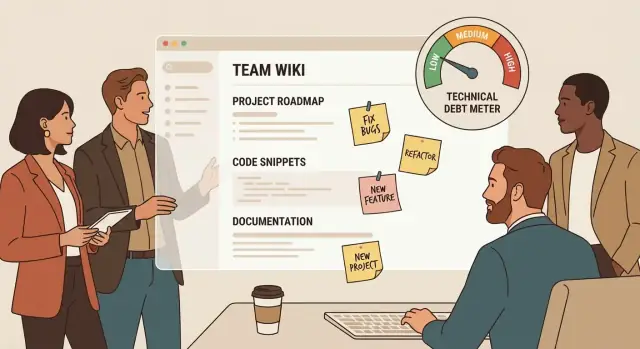
Ward Cunningham: The Problem-Solver Behind Two Big Ideas
Ward Cunningham is best known for two phrases that escaped their original contexts and became everyday tools: “wiki” and “technical debt.” What’s easy to miss is that neither idea started as a branding exercise. Both were practical answers to recurring team problems.
A builder in early software communities
Cunningham was active in early patterns and agile circles, contributing to the conversations where modern software teamwork was being shaped. He co-created the first wiki, built tools, and influenced practices that emphasized feedback, learning, and simplicity.
His reputation grew less from grand theories and more from shipping small, working solutions people could copy.
The team problems he kept running into
Across projects, Cunningham saw the same friction points: knowledge trapped in email threads, decisions lost after meetings, and codebases that got harder to change every month.
Teams didn’t just need “better documentation” or “better architecture.” They needed ways to keep shared understanding current—and to make trade-offs visible when speed today created cost tomorrow.
How the ideas spread: practice over hype
The wiki worked because it lowered the barrier to contributing and correcting information. The debt metaphor worked because it gave teams a respectful way to talk about future cost without blaming individuals.
Both spread organically: someone tried it, it helped, and others adapted it.
Key takeaway
Cunningham’s throughline is simple: optimize for shared understanding and sustainable change. Tools and metaphors matter most when they help teams learn faster, align sooner, and keep the codebase pliable under real deadlines.
How the Wiki Started and What Made It New
A wiki is a set of web pages that anyone in a group can create and edit using a browser. Instead of sending a document around for approval, you change the page itself—and the page is immediately updated for everyone.
The breakthrough: “editable by many”
That simple idea was the real innovation. Before wikis, “shared knowledge” usually meant one of three things:
- A document owned by a single author (or a small gatekeeping group)
- Email threads where the latest answer was buried in someone’s inbox
- Meetings where decisions were made, then slowly (and often inconsistently) written down later
A wiki flipped that model. It treated knowledge as something the team maintains together, in the open. If you saw a mistake, you didn’t file a ticket to fix the document—you fixed it.
The first wiki: what Cunningham intended
Ward Cunningham built the first wiki, the WikiWikiWeb, in the mid-1990s to help software practitioners share patterns, ideas, and working approaches. His intent wasn’t to create a polished publishing platform. It was to make a “conversation” that could be refined over time, where small improvements accumulated into something surprisingly useful.
Early use cases were pragmatic: capturing common solutions, clarifying terminology, recording examples, and linking related topics so readers could explore instead of searching through folders.
How it differed from docs, emails, and meetings
Traditional documentation often aims to be finished and authoritative. A wiki is comfortable being unfinished—as long as it’s helpful right now.
Emails are chronological; wikis are organized. Meetings are ephemeral; wikis leave a trail that newcomers can learn from without scheduling time on someone’s calendar.
That combination—low-friction editing, quick linking, and shared ownership—made wikis feel less like “documentation” and more like teamwork written down.
Wikis and Collaboration: Faster Learning, Fewer Silos
The early wiki idea wasn’t just “a website anyone can edit.” It was a simple mechanism for turning what people know into something the whole team can use.
That shift matters because most slowdowns don’t come from typing speed—they come from waiting: waiting for the one person who remembers the deployment steps, the one person who understands an edge case, the one person who knows why a decision was made.
Turning tacit knowledge into shared notes
A good team wiki captures small, practical facts while they’re still fresh: the error message you saw, the workaround that worked, the customer constraint that keeps coming back.
When these notes live in one place, learning speeds up for everyone—especially new joiners who can self-serve instead of scheduling a series of “can you explain…” meetings.
Reducing bottlenecks without heavy process
Wikis work best when they stay lightweight: brief pages, quick edits, clear ownership, and “good enough” writing. The goal isn’t perfect documentation; it’s alignment.
A two-paragraph page that prevents one recurring misunderstanding is more valuable than a polished document nobody updates.
Examples that pay off quickly
Common wiki pages that reduce silos in everyday work:
- Runbooks: how to deploy, roll back, rotate keys, and handle common incidents
- Architecture notes: what talks to what, plus the “gotchas” you only learn after breaking something
- Decision logs (ADRs): the problem, options considered, the choice, and the trade-offs
Over time, these pages become a team memory. They don’t replace conversation—they make conversations shorter, more specific, and easier to act on.
Technical Debt: What Cunningham Meant (Not Just “Bad Code”)
Ward Cunningham didn’t coin “technical debt” as an insult for ugly code. He used it to describe a deliberate trade-off: you take a shortcut to learn faster or ship sooner, knowing you’ll owe extra work later.
The original meaning: a deliberate shortcut with a cost
In Cunningham’s framing, debt is often taken on purpose. You might choose a simpler design to get real user feedback, or skip an elegant abstraction until you understand the problem better.
The key is that the shortcut creates a future obligation—not because the team was careless, but because speed and learning were valuable right now.
Why “debt” was the word—and what it implies
Debt is powerful because it implies two things at once:
- You get value upfront (time, learning, momentum)
- You pay interest if you carry it too long (changes get slower, risk rises)
That “interest” isn’t moral failure; it’s the natural cost of working on a codebase that no longer fits what you now know.
Paying it back: refactoring and redesign
Repayment maps neatly to refactoring, improving tests, and redesigning parts that became central over time. You don’t “pay” by rewriting everything—you pay by steadily removing friction so future work stays predictable.
Planned debt vs. accidental mess
Cunningham’s idea is closest to planned debt: conscious, documented, and revisited.
Accidental mess is different: unclear ownership, no tests, rushed merges, and neglected design. Calling all of that “debt” hides the real issue—lack of decision-making and follow-through.
What the Debt Metaphor Gets Right—and Where It Misleads
Ward Cunningham’s “technical debt” metaphor stuck because it explains a real feeling teams have: you can ship something faster today, but you may pay for it later.
What it explains well
Like financial debt, technical debt has interest. Quick fixes, missing tests, or unclear design often don’t hurt immediately—but they make every later change slower, riskier, and more stressful.
It also highlights trade-offs and timing. Sometimes taking on debt is rational: a temporary workaround to meet a deadline, validate an idea, or unblock a customer. The key is acknowledging it as a choice, not pretending it’s “done.”
And it helps teams talk about repayment. Refactoring, adding tests, simplifying dependencies, and improving documentation are all ways to reduce interest so future work gets cheaper.
Where it breaks down
The metaphor can quietly turn moral: “debt” sounds like wrongdoing, which invites blame (“Who caused this?”) instead of learning (“What pressure led us here?”).
It can also oversimplify. Not all mess behaves like debt with predictable interest. Some problems are closer to “unknown risk,” “complexity,” or “missing product decisions.” Treating everything as debt can create false certainty.
How language shapes planning meetings
When you label something “debt,” the room may hear “engineering wants a cleanup sprint.” When you describe impact—slower releases, more outages, harder onboarding—people can weigh it alongside other business goals.
Guideline
Use the metaphor to clarify choices: what did we gain, what will it cost, and when do we plan to pay it down? Don’t use it to shame people for past decisions made under real constraints.
From Metaphor to Practice: Refactoring, Tests, Iteration
Technical debt is only useful if it changes what you do on Monday morning. Cunningham’s point wasn’t “your code is bad,” but “you can borrow speed now—if you repay deliberately.” Repayment has a name: refactoring.
Small, frequent changes beat big cleanups
Debt grows when changes are rare and risky. A team that waits for a “cleanup sprint” often discovers the codebase has shifted under them, making the cleanup expensive and politically hard to justify.
Small, frequent refactors—done alongside feature work—keep the cost of change low. You’re paying a little interest continuously rather than letting it compound.
Refactoring is principal; tests control risk
Refactoring is the “principal payment”: improving structure without changing behavior. The catch is confidence.
Automated tests act like risk controls: they reduce the chance that your repayment plan breaks production.
A practical rule: if you can’t safely refactor an area, invest first in a thin layer of tests around the behavior you rely on most.
Iteration supports learning without locking in mistakes
Iteration isn’t just about shipping faster; it’s about learning earlier. When you deliver in small slices, you get feedback while changes are still cheap. That prevents premature “hardening” of a design that turns out to be wrong.
Signals it’s time to invest
Watch for these debt signals in everyday work:
- Delivery slowing even when scope stays similar
- “Fragile” changes: small edits causing surprising breakage
- Recurring bugs in the same modules
- Engineers avoiding certain files or components
When those appear, treat refactoring and test coverage as planned work—not heroic side quests.
Where Technical Debt Really Comes From in Everyday Work
Technical debt doesn’t usually arrive with a dramatic “we chose the wrong architecture” moment. It shows up as small trade-offs made under real pressure—then quietly accumulates until the team feels slower, less confident, and more reactive.
The usual suspects: speed, ambiguity, and aging parts
One common source is the rushed release: a deadline forces a “good enough for now” solution, but the “now” stretches into months.
Another is unclear requirements. When the goal keeps shifting, teams often build flexible workarounds instead of clean solutions—because rebuilding repeatedly feels wasteful.
Outdated dependencies are also a practical driver. Libraries, frameworks, and services evolve, and staying current takes time. Falling behind can be rational in the short term, but it raises future costs: security updates become harder, integrations break, and hiring becomes trickier when the stack feels stuck.
Design drift: when quick fixes become the design
Even well-designed systems can drift. A small patch to handle an edge case becomes a precedent. Then another patch layers on top. Over time, the “real” design becomes whatever survived production, not what anyone intended.
This is why teams sometimes say, “No one understands this module.” It’s not a moral failure—it’s drift.
Knowledge debt and tooling debt (the overlooked kinds)
Not all debt is in code.
Knowledge debt builds when decisions aren’t captured: why a shortcut was taken, what risks were accepted, what alternatives were rejected. The next person can’t repay what they can’t see.
Tooling debt is equally real: slow builds, flaky tests, fragile CI pipelines, and inconsistent dev environments. These create daily friction that encourages more shortcuts—feeding the cycle.
If you’re trying to spot debt early, pay attention to repeated work, rising “fear refactors,” and time spent fighting tools rather than building features.
Prioritizing Debt: Practical Decision Rules for Teams
Technical debt isn’t a single “cleanup sprint.” It’s a stream of trade-offs. The hard part is choosing which trade-offs to reverse first—without stalling delivery or letting the mess compound.
1) Pay down what’s blocking change (not what’s ugly)
Start with debt that makes everyday work slower or riskier:
- Areas that break often, require heroics to deploy, or trigger long bug chains
- Modules nobody wants to touch because changes are unpredictable
- Parts of the product where small feature requests routinely turn into big rewrites
A simple test: if a piece of debt increases the time to deliver user-facing value every week, it’s a high-interest loan.
2) Balance user value vs. internal improvement with “bundling”
Instead of arguing “feature vs. refactor,” pair them:
- When you ship a feature in a fragile area, budget time to reduce the local debt you touched
- Tie cleanup to a concrete outcome (fewer incidents, faster release, simpler onboarding)
This keeps internal work grounded in user impact, while preventing “new feature” work from digging the hole deeper.
3) Make debt visible in lightweight ways
Teams prioritize what they can see. Keep it simple:
- A debt register in your tracker: short title, location, impact, and suggested fix
- Tags like
debt,risk,slow-build,hard-to-teston issues and PRs - Small notes in docs explaining “why this is weird” and what a safer direction looks like
Visibility turns vague complaints into actionable options.
4) Set limits: no new debt without an owner and a plan
Sometimes you’ll take on debt deliberately (deadlines happen). Make it a controlled decision:
- Name an owner
- Define the payback trigger (next release, after a metric threshold, after a customer rollout)
- Capture the minimum plan: what will be changed, and what “done” means
This prevents “temporary” shortcuts from becoming permanent architecture.
Using Wikis to Manage Debt: Documentation That Actually Helps
A big reason technical debt keeps returning is that teams forget why a decision was made.
A wiki can act as the “memory” of the codebase: not just what the system does, but what trade-offs were accepted, what was postponed, and what assumptions might break later.
How a wiki supports consistent decisions over time
When new people join—or a team revisits a module months later—a wiki gives them the context that isn’t visible in the code. That context helps teams make consistent choices, so you don’t “pay interest” by relearning the same lessons through bugs, rewrites, or slow delivery.
The key is linking knowledge to the moments when decisions were made: releases, incidents, migrations, and major refactors.
Useful templates (simple and repeatable)
A wiki works best when pages follow a few lightweight templates:
- ADRs (Architecture Decision Records): the decision, alternatives considered, and consequences
- Incident reviews: what happened, contributing factors, and follow-ups (including debt items)
- Coding standards: the small set of rules that prevent recurring cleanup work
- Debt log: intentionally postponed improvements, with “why now/why not” captured
Keep each page short. If it needs a meeting to understand, it’s too long.
Keeping docs trustworthy
Documentation becomes harmful when it’s stale. Small habits prevent that:
- Ownership: every page has a named owner (team or person)
- Dates: include “Last reviewed” and “Next review” fields
- Lightweight review: a quick check during a sprint review or monthly tech sync—five minutes is enough
Link work items to context
Whenever you open a ticket to “refactor X” or “clean up Y,” link it to the related ADR, incident review, or debt-log entry.
Then, when someone asks “why are we spending time on this?”, the answer is one click away—and future changes become easier because the intent is clear.
Communicating Debt Without Overpromising on Metrics
Technical debt is easiest to fund when people understand the impact, not when you hand them a spreadsheet of “debt points.” Cunningham’s metaphor works because it translates engineering trade-offs into a business conversation—so keep the message simple, specific, and grounded in outcomes.
Lead with impact statements (not fake precision)
Avoid claims like “we have 37% debt” or “this module is 12 days behind.” Instead, describe what the team can’t do—or can’t do safely—because of the debt.
Examples:
- “Adding one small pricing rule now takes a full day because changes ripple across three services.”
- “Releases require a manual checklist and two people on standby, so we ship less often.”
- “We avoid touching the billing workflow, which increases the chance of a high-severity incident when we finally must.”
Use a small set of honest signals
Metrics can help, but only if you treat them as indicators, not proof.
Good options that many teams can measure without heavy tooling:
- Lead time (idea to production): debt often stretches it
- Change failure rate: debt shows up as more rollbacks and hotfixes
- Build/test duration: debt turns feedback loops slow
- Defect trends: especially repeat defects in the same areas
Explain “interest” in plain terms
Interest is the extra cost you pay every time you work in that area. Say it like: “Each change costs an additional 2–3 hours in rework, coordination, or manual testing. Paying down this debt reduces that ongoing surcharge.”
Report with stories, then numbers
Pair one short example (what slowed down, what risk increased) with one supporting metric. Stories create clarity; metrics add credibility—without pretending you can measure everything exactly.
Mini Playbook: Apply Wiki + Debt Thinking to One Project
You don’t need a company-wide initiative to benefit from Ward Cunningham’s two big ideas. Run a small, repeatable loop on one project: use a wiki page as shared memory, and treat technical debt as a conscious trade-off you can repay.
Step 1: Inventory (30–60 minutes)
Create a single wiki page: “Project X: Debt & Learning Log.” In a short meeting, list the hotspots your team keeps bumping into.
Focus on recurring pain, not abstract code quality:
- Areas that are slow to change
- Bugs that keep coming back
- Tests people avoid updating
- Onboarding questions asked every week
For each item, add two notes: “What happens when it breaks?” and “What work gets delayed?” This keeps the conversation grounded in outcomes.
Step 2: Plan (15 minutes)
Pick 1–3 items only. For each, write:
- Done means: a concrete end state (e.g., “API has tests for edge cases A/B/C”)
- Timebox: 2–10 hours or 1–3 days—small enough to finish
- Owner + reviewer: to avoid half-finished cleanups
If you need a rule: choose the debt that most improves next week’s work, not a theoretical future.
Step 3: Do the work (during normal development)
Treat it like feature work: small commits, tests where possible, and a short note on the wiki about what changed and why.
Step 4: Review and update the wiki (10 minutes)
Add a brief “What we learned” section: what surprised you, what took longer, and what you’ll do differently next time. Then adjust your list and repeat the loop weekly or biweekly.
Tooling note: speeding up the loop without losing the trail
If your team is building new internal tools or prototypes, platforms like Koder.ai can fit this workflow well: you can use its chat-based planning mode to capture assumptions and decisions up front, ship a working React/Go/PostgreSQL (or Flutter) slice quickly, and use snapshots and rollback to keep experimentation from turning into accidental, long-lived debt. When needed, you can export source code and bring the project into your usual repo and review process.
Common Misuses of “Technical Debt” (and Better Alternatives)
“Technical debt” is a useful metaphor—until it becomes a catch-all label for anything frustrating. When that happens, teams lose the ability to make clear trade-offs.
Misuse 1: “Technical debt” = any disliked code
Not all messy code is debt. Debt is a deliberate shortcut taken to move faster now, with an understood cost later.
Better alternatives:
- If it’s unclear: call it readability or maintainability work
- If it’s risky: call it a reliability issue or a defect pattern
- If it’s slow: call it performance work
Misuse 2: Treating debt as a one-time cleanup
A “pay it all down” sprint often fails because new debt is created the next week. Cunningham’s idea fits better as a habit: borrow carefully, pay regularly.
Better alternative: build a continuous refactoring budget (small, frequent fixes tied to real work) rather than a big-bang cleanup.
Misuse 3: Blaming individuals
Debt is rarely one person’s fault. Deadlines, unclear requirements, missing tests, and handoffs create conditions where shortcuts are rational.
Better alternative: describe the system constraint (“no test environment,” “unclear ownership,” “rush releases”) and fix that first.
Misuse 4: Letting docs rot (especially in wikis)
A stale wiki is worse than no wiki: it increases confidence while spreading wrong assumptions.
Better alternative: keep wiki pages small, owned, and reviewable—add “last verified” notes, link to source-of-truth tickets, and delete pages that can’t be maintained.
Action Checklist: What to Do This Week
You don’t need a reorg or a new tool to get value from Cunningham’s “wiki + debt” thinking. You need a few lightweight habits that make trade-offs visible and repeatable.
1) Start a debt log that stays alive
Create a single page in your team wiki called Debt Log. Keep it short and current.
For each entry, capture:
- What hurts (symptom users/devs feel)
- Where (repo/module/service)
- Why now (what triggered it)
- Next smallest payment (a concrete step under a day)
- Owner + review date (not a “forever backlog”)
2) Put refactoring into normal planning
Add a recurring budget inside sprint/weekly planning (even small): e.g., 10–20% capacity or one refactor story per feature.
Make it explicit: “We’re paying interest every week; this is a scheduled payment.” Tie refactoring tasks to a user-visible goal when possible (faster changes, fewer incidents, easier testing).
3) Standardize 2–3 wiki templates
Consistency beats detail. Start with:
- Decision Record (ADR-lite): context → decision → consequences
- Module Page: purpose → key flows → common pitfalls → how to test
- Debt Log Entry: the fields above
4) Agree on team language (so “debt” doesn’t mean “anything I dislike”)
Write a short “Definition of Debt” on the wiki: what counts, who can label it, and how payoff gets approved.
A useful rule: Debt is a conscious trade-off with a payback plan. If it’s just unclear, call it “unknown,” “bug,” or “design risk” instead.
FAQ
Who is Ward Cunningham and why is he important to modern software teams?
Ward Cunningham is best known for two practical ideas that spread widely: the first wiki (WikiWikiWeb) and the “technical debt” metaphor.
In both cases, the point wasn’t branding—it was solving recurring team problems like lost context, slow knowledge sharing, and invisible trade-offs that make code harder to change over time.
Why did Ward Cunningham create the first wiki?
Cunningham built the first wiki in the mid-1990s so software practitioners could share patterns and improve ideas collaboratively over time.
The goal was a living conversation: small edits, fast linking, and shared ownership—so the knowledge base could evolve as the community learned.
What makes a wiki different from traditional documentation, email, or meetings?
A wiki is maintained “in place”: you edit the page itself and everyone immediately sees the updated version.
Compared to typical alternatives:
- Documents often have gatekeepers and go stale.
- Email threads bury the latest answer in chronology.
- Meetings create decisions that can be hard to rediscover later.
A wiki optimizes for quick corrections and shared, current understanding.
What are the best first pages to create in a team wiki?
Start with pages that remove repeated bottlenecks, not a big documentation initiative.
A practical starter set:
- A runbook for deploy/rollback and common incidents
- One architecture “map” page (what talks to what + key gotchas)
- A lightweight decision log (ADR-style)
Keep each page short and usable today; you can refine later.
Which wiki templates are most useful for engineering teams?
Use a few consistent templates so people can write quickly and readers can scan reliably.
Good lightweight templates:
- ADR-lite: context → decision → consequences
- Incident review: what happened → contributing factors → follow-ups
- Module page: purpose → key flows → pitfalls → how to test
- Debt log entry: impact → location → why now → next smallest payment → owner/review date
Templates should reduce friction, not enforce perfection.
How do you keep a wiki trustworthy instead of letting it rot?
Treat staleness as the main failure mode and add small habits that make it visible.
Practical safeguards:
- Assign an owner (person or team) per page
- Add “Last reviewed” (and optionally “Next review”) dates
- Review a few high-impact pages during an existing cadence (e.g., sprint review or monthly tech sync)
- Delete or merge pages that can’t be maintained
A smaller, trusted wiki beats a larger, outdated one.
What did Ward Cunningham originally mean by “technical debt”?
In Cunningham’s original framing, technical debt is a deliberate trade-off: you choose a simpler or faster approach now to learn or ship sooner, knowing it creates a future obligation.
It’s not inherently “bad code.” It’s borrowing time with the expectation you’ll repay it through refactoring, tests, redesign, or improved tooling when the area proves important.
What’s the difference between planned technical debt and accidental mess?
Planned debt is a conscious shortcut with context and a payback plan; accidental mess is unmanaged complexity without clear ownership or follow-through.
Ways to tell the difference:
- Planned debt is documented (what you gained, what you deferred).
- Planned debt has a trigger or date to revisit.
- Accidental mess tends to come with missing tests, unclear boundaries, and “nobody wants to touch it” areas.
Calling everything “debt” can hide the real issue, which might be reliability risk, unclear requirements, or missing ownership.
How should teams prioritize which technical debt to pay down first?
Prioritize “high-interest” debt: the stuff that repeatedly slows delivery or increases risk, not the stuff that’s merely ugly.
Decision rules that work in practice:
- Fix what blocks change in areas you touch often
- Bundle cleanup with feature work in fragile modules
- Make debt visible (a short debt register with impact and suggested next step)
- Require an owner and a payback trigger for any new deliberate shortcut
The goal is predictable change, not perfect code.
How do you communicate technical debt to non-engineers without overpromising on metrics?
Lead with concrete impact statements and use a small set of honest indicators—avoid fake precision.
What to say instead of “we have 37% debt”:
- “This change takes an extra day because it ripples across three services.”
- “Releases require manual steps and two people on standby, so we ship less often.”
Helpful supporting signals:
- Lead time (idea to production)
- Change failure rate (rollbacks/hotfixes)
- Build/test duration
- Repeat defects in the same modules
Pair one story with one metric so the trade-off is understandable and credible.