

What Is AGI and Why LLMs May Never Truly Achieve It
Learn what artificial general intelligence really means, how LLMs work, and key arguments for why current text models may never amount to true AGI.
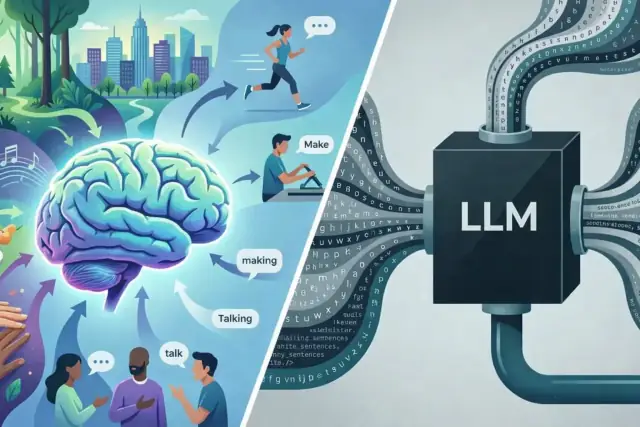
Why AGI and LLMs Are Being Confused Everywhere
If you read tech news, investor decks, or product pages, you’ll notice the word intelligence getting stretched to breaking point. Chatbots are “almost human,” coding assistants are “practically junior engineers,” and some people casually call powerful large language models (LLMs) the first steps toward artificial general intelligence (AGI).
This article is for curious practitioners, founders, product leaders, and technical readers who use tools like GPT-4 or Claude and wonder: Is this what AGI looks like—or is something important missing?
The Source of the Confusion
LLMs are genuinely impressive. They:
- converse fluently in natural language
- write code, summarize research, and pass exams
- reflect on their own outputs in ways that look like reasoning
To most non-specialists, that feels indistinguishable from “general intelligence.” When a model can write an essay on Kant, fix your TypeScript error, and help draft a legal memo in the same session, it’s natural to assume we’re brushing up against AGI.
But that assumption quietly equates being good with language to being generally intelligent. That’s the core confusion this article will unpack.
The Central Claim of This Article
The argument you’ll see developed section by section is:
Current LLMs are extremely capable pattern learners over text and code, but that architecture and training regime make them unlikely to ever become true AGI by simple scale or fine-tuning alone.
They will keep getting better, broader, and more useful. They may be part of AGI-like systems. Yet there are deep reasons—about grounding in the world, agency, memory, embodiment, and self-models—why “bigger LLM” is probably not the same path as “general intelligence.”
Expect an opinionated tour, but one anchored in current research, concrete capabilities and failures of LLMs, and the open questions serious scientists are wrestling with, rather than hype or fear-mongering.
What Do We Actually Mean by Artificial General Intelligence?
When people say AGI, they rarely mean the same thing. To clarify the debate, it helps to separate a few core concepts.
From Narrow AI to General Intelligence
AI (artificial intelligence) is the broad field of building systems that perform tasks requiring something like “intelligent” behavior: recognizing speech, recommending movies, playing Go, writing code, and more.
Most of what exists today is narrow AI (or weak AI): systems designed and trained for a specific set of tasks under specific conditions. An image classifier that labels cats and dogs, or a customer-service chatbot tuned for banking questions, can be extremely capable within that niche but fails badly outside it.
Artificial General Intelligence (AGI) is very different. It refers to a system that can:
- Generalize across a wide range of domains, not just one task or data type
- Adapt to new problems and environments it was not explicitly trained for
- Act autonomously, setting and pursuing goals with minimal hand-holding
- Transfer learning, using what it learned in one context to perform well in others
A practical rule of thumb: an AGI could, in principle, learn almost any intellectually demanding job a human can, given time and resources, without needing bespoke redesign for each new task.
Strong AI, Human-Level AI, and Beyond
Closely related terms often appear:
- Strong AI: usually used interchangeably with AGI, emphasizing genuine understanding rather than clever mimicry.
- Human-level AI: an AGI whose overall cognitive abilities are roughly comparable to an average human adult.
- Superintelligence: a hypothetical system that vastly exceeds the best human minds across most or all domains.
By contrast, modern chatbots and image models remain narrow: impressive, but optimized for patterns in specific data, not for open-ended, cross-domain intelligence.
A Brief History of the AGI Dream
Early Visions: Turing and Symbolic AI
The modern AGI dream starts with Alan Turing’s 1950 proposal: if a machine can carry on a conversation indistinguishable from a human (the Turing test), might it be intelligent? That framed general intelligence largely in terms of behavior, especially language and reasoning.
From the 1950s to the 1980s, researchers pursued AGI through symbolic AI or “GOFAI” (Good Old-Fashioned AI). Intelligence was seen as manipulating explicit symbols according to logical rules. Programs for theorem proving, game playing, and expert systems led some to believe human-level reasoning was close.
But GOFAI struggled with perception, common sense, and dealing with messy real-world data. Systems could solve logic puzzles yet fail on tasks a child finds trivial. This gap led to the first major AI winters and a more cautious view of AGI.
The Machine Learning Turn
As data and compute grew, AI shifted from hand-crafted rules to learning from examples. Statistical machine learning, then deep learning, redefined progress: instead of encoding knowledge, systems learn patterns from large datasets.
Milestones like IBM’s DeepBlue (chess) and later AlphaGo (Go) were celebrated as steps toward general intelligence. In reality, they were extraordinarily specialized: each mastered a single game under fixed rules, with no transfer to everyday reasoning.
From Narrow Wins to Generative Models
The GPT series marked another dramatic leap, this time in language. GPT-3 and GPT-4 can draft essays, write code, and mimic styles, fueling speculation that AGI might be near.
Yet these models are still pattern learners over text. They do not form goals, build grounded world models, or autonomously broaden their competencies.
Across each wave—symbolic AI, classic machine learning, deep learning, and now large language models—the dream of AGI has repeatedly been projected onto narrow achievements, then revised once their limits became clear.
How Large Language Models Actually Work
Large language models (LLMs) are pattern learners trained on enormous collections of text: books, websites, code, forums, and more. Their goal is deceptively simple: given some text, predict what token (a small chunk of text) is likely to come next.
Tokens and Next-Word Prediction
Before training, text is broken into tokens: these may be whole words ("cat"), word pieces ("inter", "esting"), or even punctuation. During training, the model repeatedly sees sequences like:
"The cat sat on the ___"
and learns to assign high probability to plausible next tokens ("mat", "sofa") and low probability to implausible ones ("presidency"). This process, scaled over trillions of tokens, shapes billions (or more) of internal parameters.
Under the hood, the model is just a very large function that turns a sequence of tokens into a probability distribution over the next token. Training uses gradient descent to gradually adjust parameters so predictions better match patterns in the data.
Scaling Laws in Plain Terms
"Scaling laws" describe a regularity researchers observed: as you increase model size, data size, and compute, performance tends to improve in a predictable way. Bigger models trained on more text usually get better at prediction—up to practical limits of data, compute, and training stability.
What LLMs Actually "Know"
LLMs do not store facts like a database or reason like a human. They encode statistical regularities: which words, phrases, and structures tend to go together, in which contexts.
They do not have grounded concepts tied to perception or physical experience. An LLM can talk about "red" or "heaviness" only through how those words were used in text, not through seeing colors or lifting objects.
This is why models can sound knowledgeable yet still make confident mistakes: they are extending patterns, not consulting an explicit model of reality.
Pre-Training, Fine-Tuning, and RLHF
Pre-training is the long initial phase where the model learns general language patterns by predicting next tokens on huge text corpora. This is where almost all capabilities emerge.
After that, fine-tuning adapts the pretrained model to narrower goals: following instructions, writing code, translating, or assisting in specific domains. The model is shown curated examples of the desired behavior and adjusted slightly.
Reinforcement learning from human feedback (RLHF) adds another layer: humans rate or compare model outputs, and the model is optimized to produce responses people prefer (e.g., more helpful, less harmful, more honest). RLHF does not give the model new senses or deeper understanding; it mainly shapes how it presents and filters what it has already learned.
Together, these steps create systems that are extremely good at generating fluent text by leveraging statistical patterns—without possessing grounded knowledge, goals, or awareness.
What Current LLMs Can Do Surprisingly Well
Large language models look impressive because they can perform a wide range of tasks that once seemed far out of reach for machines.
Code, text, and translation on demand
LLMs can generate working code snippets, refactor existing code, and even explain unfamiliar libraries in plain language. For many developers, they already function as a highly capable pair‑programmer: suggesting edge cases, catching obvious bugs, and scaffolding entire modules.
They also excel at summarization. Given a long report, paper, or email thread, an LLM can condense it into key points, highlight action items, or adapt the tone for different audiences.
Translation is another strength. Modern models handle dozens of languages, often capturing nuances of style and register well enough for everyday professional communication.
Reasoning benchmarks and emergent behaviors
As models scale, new abilities seem to appear “out of nowhere”: solving logic puzzles, passing professional exams, or following multi‑step instructions that earlier versions failed. On standardized benchmarks—math word problems, bar exam questions, medical quizzes—top LLMs now reach or exceed average human scores.
These emergent behaviors tempt people to say the models are “reasoning” or “understanding” like humans. Performance graphs and leaderboard rankings reinforce the idea that we are closing in on artificial general intelligence.
Why it feels like understanding—but isn’t
LLMs are trained to continue text in ways that match patterns seen in data. That training objective, combined with scale, is enough to mimic expertise and agency: they sound confident, remember context within a session, and can justify their answers in fluent prose.
Yet this is an illusion of understanding. The model does not know what code will do when executed, what a medical diagnosis means for a patient, or what physical actions follow from a plan. It has no grounding in the world beyond text.
Strong performance on tests—even tests designed for humans—does not automatically equal AGI. It shows that pattern learning over massive text data can approximate many specialized skills, but it does not demonstrate the flexible, grounded, cross‑domain intelligence that “artificial general intelligence” usually implies.
Fundamental Limits of Text-Only Pattern Learners
Large language models are extraordinary text predictors, but that very design creates hard limits on what they can be.
No perception, no embodied world
LLMs do not see, hear, move, or manipulate objects. Their only contact with the world is through text (and, in some newer models, static images or short clips). They have no continuous sensory stream, no body, and no way to act and observe consequences.
Without sensors and embodiment, they cannot form a grounded, continuously updated model of reality. Words like “heavy,” “sticky,” or “fragile” are just statistical neighbors in text, not lived constraints. That allows impressive imitation of understanding, but it restricts them to recombining past descriptions rather than learning from direct interaction.
Hallucinations and the absence of stable beliefs
Because an LLM is trained to extend a sequence of tokens, it produces whatever continuation best fits its learned patterns, not whatever is true. When the data are thin or conflicting, it simply fills gaps with plausible-sounding fabrications.
The model also lacks a persistent belief state. Each response is generated fresh from the prompt and weights; there is no enduring internal ledger of “facts I hold.” Long-term memory features bolt on external storage, but the core system does not maintain or revise beliefs the way humans do.
Frozen knowledge and limited real-time learning
Training an LLM is an offline, resource-intensive batch process. Updating its knowledge typically means retraining or fine-tuning on a new dataset, not smoothly learning from each interaction.
This creates a crucial limitation: the model cannot reliably track rapid changes in the world, adapt its concepts based on ongoing experience, or correct deep misunderstandings through step-by-step learning. At best, it can simulate such adaptation by rephrasing its outputs in light of recent prompts or attached tools.
Pattern matching without causal understanding
LLMs excel at capturing statistical regularities: which words co-occur, which sentences usually follow others, what explanations look like. But this is not the same as grasping how and why the world works.
Causal understanding involves forming hypotheses, intervening, observing what changes, and updating internal models when predictions fail. A text-only predictor has no direct way to intervene or to experience surprise. It can describe an experiment but cannot perform one. It can echo causal language yet lacks an internal machinery tied to actions and outcomes.
As long as a system is confined to predicting text from past text, it remains fundamentally a pattern learner. It can mimic reasoning, narrate causes, and pretend to revise its views, but it does not inhabit a shared world where its "beliefs" are tested by consequences. That gap is central to why language mastery alone is unlikely to reach artificial general intelligence.
Why General Intelligence Demands More Than Language Mastery
Language is a powerful interface to intelligence, but it is not the substance of intelligence itself. A system that predicts plausible sentences is very different from an agent that understands, plans, and acts in the world.
Grounded concepts, not just word patterns
Humans learn concepts by seeing, touching, moving, and manipulating. "Cup" is not just how the word is used in sentences; it is something you can grasp, fill, drop, or break. Psychologists call this grounding: concepts are tied to perception and action.
An artificial general intelligence would almost certainly need similar grounding. To generalize reliably, it must connect symbols (like words or internal representations) to stable regularities in the physical and social world.
Standard large language models, however, learn from text alone. Their "understanding" of a cup is purely statistical: correlations between words across billions of sentences. That is powerful for conversation and coding, but fragile when pushed outside familiar patterns, especially in domains that depend on direct interaction with reality.
Memory, goals, and consistent preferences
General intelligence also involves continuity over time: long-term memory, enduring goals, and relatively stable preferences. Humans accumulate experiences, revise beliefs, and pursue projects over months or years.
LLMs have no built-in persistent memory of their own interactions and no intrinsic goals. Any continuity or "personality" must be bolted on via external tools (databases, profiles, system prompts). By default, each query is a fresh pattern-matching exercise, not a step in a coherent life history.
Planning, causality, and acting in the world
AGI is often defined as the ability to solve a wide range of tasks, including novel ones, by reasoning about cause and effect and by intervening in the environment. That implies:
- Building causal models: what will happen if I do X?
- Planning multi-step actions under uncertainty
- Updating plans from sensory feedback
LLMs are not agents; they generate the next token in a sequence. They can describe plans or talk about causality because such patterns exist in text, but they do not natively execute actions, observe consequences, and adjust their internal models.
To turn an LLM into an acting system, engineers must wrap it in external components for perception, memory, tool use, and control. The language model remains a powerful module for suggestion and evaluation, not a self-contained generally intelligent agent.
General intelligence, in short, demands grounded concepts, enduring motivations, causal models, and adaptive interaction with the world. Mastery of language—while extremely useful—is just one piece of that larger picture.
Consciousness, Self, and Why LLMs Only Seem Person-Like
When people chat with a fluent model, it feels natural to assume there is a mind on the other side. The illusion is strong, but it is an illusion.
Does AGI Need Consciousness?
Researchers disagree on whether artificial general intelligence must be conscious.
- Functional views say that if a system behaves like a generally intelligent agent—learning across domains, planning, reasoning, adapting—then consciousness is optional or even irrelevant.
- Phenomenal views hold that genuine understanding and general intelligence require subjective experience—a “what it is like” to be the system.
We do not yet have a testable theory that settles this. So it’s premature to declare that AGI must, or must not, be conscious. What matters for now is being clear about what current LLMs lack.
No Unified Self
A large language model is a statistical next‑token predictor operating on a snapshot of text. It does not carry a stable identity across sessions or even across turns, except as encoded in the prompt and short‑term context.
- There is no persistent autobiographical memory that belongs to a single continuing subject.
- Any “persona” is a pattern we impose or specify, not a genuine self that endures over time.
When an LLM says “I,” it is merely following linguistic conventions learned from data, not referring to an inner subject.
No Experiences or Intrinsic Motivations
Conscious beings have experiences: they feel pain, boredom, curiosity, satisfaction. They also have intrinsic goals and cares—things matter to them independently of external rewards.
LLMs, by contrast:
- Do not feel anything when generating text.
- Have no desires, fears, or preferences of their own.
- Do not pursue long‑term projects unless we script or scaffold them to do so.
Their “behavior” is the output of pattern matching over text, constrained by training and prompting, not the expression of an inner life.
Why Anthropomorphism Is Dangerous
Because language is our main window into other minds, fluent dialogue strongly suggests personhood. But with LLMs, this is precisely where we are most easily misled.
Anthropomorphizing these systems can:
- Distort risk assessments (e.g., worrying about hurt “feelings” instead of actual failure modes).
- Encourage over‑trust and over‑reliance because the system sounds confident and empathic.
- Lead to ethical confusion, such as debating rights for systems that have no capacity for experience.
Treating LLMs as people blurs the line between simulation and reality. To think clearly about AGI—and about current AI risks—we have to remember that a convincing performance of personhood is not the same as being a person.
How Would We Even Recognize True AGI?
If we ever build artificial general intelligence, how would we know it’s the real thing and not just an extremely convincing chatbot?
Existing Proposals: Useful but Not Enough
Turing-style tests. Classic and modern Turing tests ask: can the system sustain human-like conversation well enough to fool people? LLMs already do this surprisingly well, which shows how weak this bar is. Chat skill measures style, not depth of understanding, planning, or real-world competence.
ARC-style evaluations. Tasks inspired by the Alignment Research Center (ARC) focus on novel reasoning puzzles, multi-step instructions, and tool use. They probe whether a system can solve problems it has never seen by composing skills in new ways. LLMs can do some of these tasks—but often need carefully engineered prompts, external tools, and human supervision.
Agency tests. Proposed "agent" tests ask whether a system can pursue open-ended goals over time: breaking them into subgoals, revising plans, handling interruptions, and learning from outcomes. Current LLM-based agents can appear agentic, but behind the scenes they depend on brittle scripts and human-designed scaffolding.
Practical Criteria for Recognizing AGI
To treat something as genuine AGI, we would want to see at least:
-
Autonomy. It should set and manage its own subgoals, monitor progress, and recover from failures without humans constantly steering it.
-
Transfer across domains. Skills learned in one area should carry over smoothly to very different areas, without retraining on millions of new examples.
-
Real-world competence. It should plan and act in messy, uncertain environments—physical, social, and digital—where rules are incomplete and consequences are real.
Where LLMs Fall Short
LLMs, even when wrapped in agent frameworks, generally:
- Depend on hand-crafted workflows to appear autonomous.
- Struggle to transfer skills when tasks deviate significantly from their training distribution.
- Need external tools, explicit safety filters, and humans in the loop to cope with real-world stakes.
Passing chat-based tests, or even narrow benchmark suites, is therefore nowhere near sufficient. Recognizing true AGI means looking beyond conversation quality to sustained autonomy, cross-domain generalization, and reliable action in the world—areas where current LLMs still need extensive scaffolding just to get partial, fragile results.
Beyond LLMs: Pathways Researchers Explore Toward AGI
If we take AGI seriously, then “a big text model” is only one ingredient, not the finished system. Most current research that sounds like "toward AGI" is really about wrapping LLMs inside richer architectures.
LLMs as Components in Agent Systems
One major direction is LLM-based agents: systems that use an LLM as a reasoning and planning core, but surround it with:
- Stateful memory that persists across sessions, so the system can accumulate knowledge and experience.
- Schedulers and planners that break goals into sub-tasks and decide which tools to invoke.
- Feedback loops that allow self-critique, revision, and trial-and-error.
Here the LLM stops being the whole “intelligence” and becomes a flexible language interface inside a broader decision-making machine.
Tool Use, APIs, and External Knowledge
Tool-using systems let an LLM call search engines, databases, code interpreters, or domain-specific APIs. This helps it:
- Access up-to-date or specialized information
- Offload math, simulation, and logic to reliable engines
This patchwork can fix some weaknesses of text-only pattern learning, but shifts the problem: the overall intelligence depends on orchestration and tool design, not just the model.
Multimodal Models and Embodied Systems
Another route is multimodal models that process text, images, audio, video, and sometimes sensor data. They move closer to how humans integrate perception and language.
Go a step further and you get LLMs controlling robots or simulated bodies. These systems can explore, act, and learn from physical feedback, addressing some missing pieces around causality and grounded understanding.
Changing the Question, Not Solving It
All of these pathways may bring us closer to AGI-like abilities, but they also change the research target. We are no longer asking, “Can an LLM alone be AGI?” but instead, “Can a complex system that includes an LLM, tools, memory, perception, and embodiment approximate general intelligence?”
That distinction matters. An LLM is a powerful text predictor. An AGI—if it is possible at all—would be a whole integrated system, of which language is only one part.
Why Mislabeling LLMs as AGI Is Risky
Calling current large language models “AGI” is not just a vocabulary mistake. It distorts incentives, creates safety blind spots, and confuses the people who have to make real decisions about AI.
Hype, Disappointment, and Misallocated Resources
When demos are framed as “early AGI,” expectations shoot far beyond what the systems can actually do. That hype has several costs:
- Funding skew: Money and talent chase flashy claims instead of long‑term foundations like reasoning, interpretability, and safety.
- Hype → crash cycle: Overpromising leads to inevitable disappointment when systems fail at basic generalization. That can trigger a downturn that also harms serious, careful research.
- Distorted product design: Teams may optimize for impressive AGI‑like demos rather than reliability, evaluation, and user safeguards.
Safety Risks From Overtrust
If users think they are talking to something “general” or “almost human,” they tend to:
- Rely on generated answers for medical, legal, or financial decisions beyond what the model was validated for.
- Grant the system authority instead of treating it as a fallible tool.
- Miss subtle failure modes like confident hallucinations, hidden biases, and easy prompt manipulation.
Overtrust makes ordinary bugs and errors much more dangerous.
Policy and Public Understanding
Regulators and the broader public already struggle to track AI capabilities. When every strong autocomplete is marketed as AGI, several problems follow:
- Misfocused regulation: Lawmakers might target hypothetical AGI scenarios while underregulating concrete harms of current systems.
- Poor risk calibration: People either panic about “superintelligence” or dismiss all AI concerns as hype.
Why Precise Language Matters
Clear terms—LLM, narrow model, AGI research direction—help align expectations with reality. Precision about capabilities and limits:
- Supports honest safety evaluation.
- Enables better governance and standards.
- Lets the public appreciate real advances without being misled about what has actually been achieved.
Using LLMs Wisely While Keeping AGI in Perspective
LLMs are exceptionally capable pattern machines: they compress huge amounts of text into a statistical model and predict likely continuations. That makes them powerful for writing help, coding assistance, data exploration, and prototyping ideas. But this architecture is still narrow. It does not provide a persistent self, grounded understanding of the world, long-horizon goals, or the flexible learning across domains that define artificial general intelligence.
Treat LLMs as Tools, Not Minds
LLMs:
- Do not understand in the human sense; they manipulate symbols without grounded concepts.
- Have no goals or intentions; any appearance of motive is an illusion created by language.
- Lack stable memory and world models; they recompute patterns each time from a frozen training snapshot plus a short context.
These structural limits are why simply scaling text models is unlikely to yield true AGI. You can get better fluency, more knowledge recall, and impressive simulations of reasoning—but not a system that genuinely knows, wants, or cares.
Practical Guidelines for Using LLMs
Use LLMs where pattern prediction shines:
- Drafting text, summarizing, editing, and translation
- Exploring options, outlining strategies, or brainstorming
- Assisting with coding, queries, and documentation
Keep a human firmly in the loop for:
- Factual accuracy and critical decisions
- Ethical or safety-sensitive contexts
- Long-term planning, responsibility, and accountability
Treat outputs as hypotheses to be checked, not truths to be trusted.
Keep AGI in Perspective
Calling LLMs "AGI" hides their real limits and invites overreliance, regulatory confusion, and misplaced fear. It is more honest—and safer—to see them as advanced assistants embedded in human workflows.
If you want to dive deeper into practical uses and trade-offs, explore related articles on our /blog. For details on how we package and price LLM-powered tools, see /pricing.
FAQ
What exactly is Artificial General Intelligence (AGI)?
AGI (Artificial General Intelligence) refers to a system that can:
- Learn and reason across many domains (not just one task)
- Adapt to new, unfamiliar problems without being redesigned
- Set and pursue its own goals with minimal human steering
- Transfer what it learns in one area to succeed in very different areas
A rough rule: an AGI could, in principle, learn almost any intellectually demanding job a human can, given time and resources, without needing a custom architecture for each new task.
Why aren’t today’s large language models considered true AGI?
Modern LLMs are:
- Trained mainly on text (and sometimes code, images, or audio)
- Optimized to predict the next token in a sequence
- Lacking perception, a body, intrinsic goals, and persistent memory
They can simulate broad knowledge and reasoning because language encodes so much human expertise. But they:
- Do not have grounded concepts tied to real-world experience
- Do not maintain evolving beliefs about the world
- Do not autonomously plan and act across time
So LLMs are powerful narrow pattern learners over language, not self-contained generally intelligent agents.
Why do so many people confuse LLMs with AGI?
People often conflate fluent language with general intelligence because:
- Conversation is our main way of judging other minds
- LLMs can handle many domains (code, essays, emails, summaries) in one interface
- They pass human-designed exams and benchmarks
This creates an illusion of understanding and agency. The underlying system is still “just” predicting text based on patterns in data, not building and using a grounded world model to pursue its own goals.
How do LLMs actually work under the hood?
You can think of an LLM as:
- A huge function that maps a sequence of tokens to probabilities for the next token
- Trained by seeing trillions of examples and adjusting its internal weights to better predict continuations
Key points:
- It does not store facts in a database-like way
- It encodes statistical regularities of language
- It has no built-in notion of truth, only of plausibility given past text
Everything that looks like reasoning or memory is emerging from that next-token objective plus scale and fine-tuning, not from explicit symbolic logic or a persistent belief store.
What are LLMs genuinely good at, and where do they struggle?
LLMs are excellent when tasks are mostly about pattern prediction over text or code, such as:
- Drafting, rewriting, and summarizing documents
- Translation and style adaptation
- Code generation, refactoring, and explanation
- Brainstorming options or outlining possible strategies
They struggle or become risky when tasks require:
- Up-to-the-minute, verifiable facts
- Real-world causal reasoning and experimentation
- Long-horizon planning with real consequences
- Ethical judgment or accountability
In those areas, they should be used only with strong human oversight and external tools (search, calculators, simulators, checklists).
If scaling helps so much, why won’t a much bigger LLM eventually become AGI?
“Scaling laws” show that as you increase model size, data, and compute, performance on many benchmarks reliably improves. But scaling alone does not fix structural gaps:
- No grounded perception or embodiment
- No persistent self, goals, or life history
- No direct interaction loop of acting, observing, and updating world models
More scale gives:
- Better fluency and coverage of patterns seen in text
- More convincing simulations of reasoning and expertise
It does not automatically produce general, autonomous intelligence. New architectural ingredients and system-level designs are needed for that.
How should I practically use LLMs today without over-trusting them?
Use LLMs as powerful assistants, not authorities:
- Treat outputs as drafts or hypotheses, not ground truth
- Keep humans in the loop for high-stakes decisions (medical, legal, financial, safety-critical)
- Pair LLMs with tools (search, calculators, IDEs) for verification
- Log and review usage in sensitive workflows
Design your products and processes so that:
- The model augments human judgment instead of replacing it
- There are clear escalation paths when the model is uncertain or fails
- Users understand limitations and are discouraged from blind trust
Why is it risky to market or think about LLMs as AGI?
Labeling current LLMs as “AGI” causes several problems:
- Overtrust: Users assume human-like understanding and reliability where none exists
- Bad investment signals: Funding and talent chase hype instead of foundational work on reasoning, safety, and interpretability
- Regulatory confusion: Policymakers fixate on hypothetical AGI scenarios while neglecting real current harms (bias, misinformation, overreliance)
More precise language—“LLM,” “narrow model,” “agentic system using LLMs”—helps align expectations with actual capabilities and risks.
How could we tell if we had actually built an AGI?
A plausible set of criteria would go well beyond good chat. We’d want evidence of:
- Autonomy: The system sets and manages its own subgoals and recovers from failures
- Transfer: Skills learned in one domain carry over to very different ones with minimal extra training
- Real-world competence: It can plan and act in messy physical and social environments, not just text
- Continual learning: It updates its internal models based on ongoing experience, not only offline retraining
Current LLMs, even with agent scaffolding, need heavy human scripting and tool orchestration to approximate these behaviors—and still fall short in robustness and generality.
If LLMs alone aren’t enough, what are the realistic paths researchers are exploring toward AGI?
Researchers are exploring broader systems where LLMs are components, not the whole intelligence, for example:
- Agent architectures that add memory, planning, and tool orchestration around an LLM
- Tool-using setups where LLMs call external APIs, databases, and simulators
- Multimodal and embodied systems that combine language with perception and physical action
These directions move closer to general intelligence by adding grounding, causality, and persistent state. They also change the question from “Can an LLM become AGI?” to “Can complex systems that include LLMs approximate AGI-like behavior?”