

Vibe Coding: When Momentum and Flow Beat Rigid Architecture
Learn why vibe coding favors momentum and intuition over strict architecture, what you gain and risk, and how to know when it’s the right tradeoff.
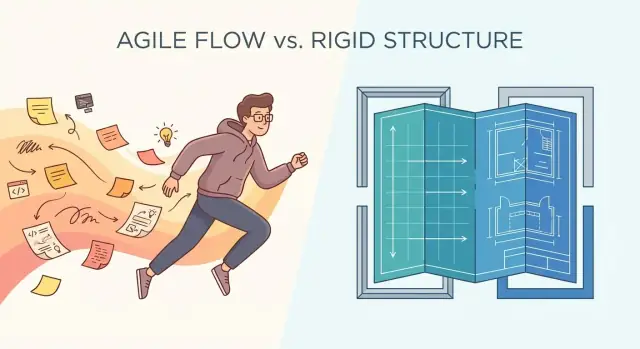
What “Vibe Coding” Means (and What It Doesn’t)
“Vibe coding” is building software by following momentum: you start with a rough idea, write code quickly, and keep adjusting based on what feels right and what works in the moment. The goal isn’t perfection—it’s getting something real running so you can learn faster.
At its best, vibe coding is a deliberate choice: speed over ceremony, intuition over upfront planning, and progress over polish.
What it is
Vibe coding usually looks like:
- starting with a thin slice that works end-to-end
- making decisions late, when you have more information
- changing direction often because feedback arrives often
- writing “good enough” code to validate an idea
It’s common during product discovery, prototypes, internal tools, hack-week experiments, and early MVPs.
What it isn’t
Vibe coding is not:
- “no thinking” or “no design”
- an excuse to ignore bugs, security, or user pain
- a long-term strategy for a growing codebase
- the same as being sloppy
There’s still judgment involved—you’re just spending it on choosing the next experiment, not perfecting abstractions.
Vibe coding vs. architecture-first development
Architecture-first development optimizes for reliability and scale: you plan core concepts early, define boundaries, and invest in maintainability before shipping.
Vibe coding optimizes for learning: you ship sooner, accept messier internals, and refactor once you’ve discovered what actually matters.
Why teams care
Teams shipping products live or die by iteration speed. If you build the wrong thing with beautiful architecture, you still lose. Vibe coding can be a competitive advantage when uncertainty is high.
But it has a cost: the faster you skip structure, the sooner you accumulate friction—confusing code, brittle behavior, and growing technical debt. The rest of this article is about making that tradeoff consciously: knowing when it works, and when it hurts.
Why Momentum, Intuition, and Flow Feel So Powerful
Vibe coding feels effective because it optimizes for a specific kind of progress: learning-by-shipping. When requirements are fuzzy and the real risk is “building the wrong thing,” moving quickly can outperform careful planning—not because planning is bad, but because the inputs are still unreliable.
Momentum: small wins that compound
Shipping small increments quickly creates visible progress and frequent “done” moments. That does two things at once: it keeps motivation high and it turns abstract ideas into real software you can poke at.
Momentum also reduces the cost of being wrong. If you ship a thin slice today and learn it’s the wrong direction tomorrow, you’ve spent a day—not a month—on the mistake.
Intuition: judgment under uncertainty
Early on, you’re often deciding without crisp requirements: What does the user actually need? Which edge cases matter? Which workflows will exist at all?
In that phase, intuition is a practical tool. You make the best call you can, implement the simplest version, and validate it. The goal isn’t to “be right” upfront—it’s to generate evidence.
Flow: less friction, fewer context switches
Flow is the hidden multiplier. When you reduce ceremony, you keep a continuous thread of thought: edit → run → see result → adjust. That tight loop improves speed and creativity.
Fewer meetings, fewer documents, fewer debates about an architecture that might be discarded—those all protect attention. And attention is what makes rapid prototyping actually rapid.
Why this can beat planning early on
Planning is most valuable when you can trust the requirements and predict the shape of the system. In product discovery, the shape is the thing you’re trying to find. Vibe coding prioritizes momentum, intuition, and flow because they maximize learning per unit time—until the cost of shortcuts starts to exceed the value of speed.
The Discovery Phase: Speed as a Learning Strategy
Discovery is not “building the thing.” It’s figuring out what the thing actually is.
That’s why vibe coding tends to shine early: when the goal is learning, not efficiency. In this phase, the fastest team isn’t the one with the cleanest architecture—it’s the one that can turn a hunch into something users can react to before the hunch goes stale.
Exploration vs. execution
Exploration and execution look similar (you’re still writing code), but they reward different habits.
Exploration is about widening options: testing multiple product shapes, UI flows, or value props. Execution is about narrowing down: hardening what’s proven, making it scalable, predictable, and maintainable.
If you use execution tools too early—strict abstractions, heavy patterns, formal boundaries—you can accidentally lock in assumptions that haven’t earned the right to exist yet.
The real unknowns aren’t technical
Most early-stage uncertainty has nothing to do with whether you can implement a feature. It’s about:
- Who actually needs this (and how badly)
- What they’ll pay for (pricing and packaging)
- How they’ll find it (distribution)
- Which use case is the “core” (and which are distractions)
Speed helps because each small release collapses uncertainty. A quick prototype isn’t just a demo—it’s a question you can ask the market.
Why premature structure slows learning
Structure has a cost: every layer you introduce demands decisions—naming, boundaries, interfaces, test strategy, configuration, conventions. Those are great investments once the problem is stable.
But during discovery, many decisions are temporary. You may delete the feature, change the user, or swap the workflow entirely. Over-structuring can make change feel expensive, which quietly pushes teams to defend what they built instead of following what they learned.
Quick iterations create better questions
The first version usually answers the wrong question. The second version asks a better one.
When you ship something small fast—an onboarding flow, a pricing page, a tiny automation—you don’t just get feedback. You learn what to measure, what users misunderstand, where they hesitate, and which “must-have” features nobody touches.
Vibe coding is useful here because it optimizes for learning velocity: build, watch, revise—until the product’s shape becomes obvious enough that architecture starts paying for itself.
Feedback Loops: The Real Payoff of Moving Fast
Vibe coding isn’t valuable because it produces clean code quickly. It’s valuable because it produces information quickly—about what users want, what stakeholders expect, and what actually moves the product forward.
When you move fast, you shorten the time between an idea and real-world proof. That proof is the fuel for better decisions.
Tight loops with users and stakeholders
Fast shipping makes feedback concrete. Instead of debating requirements, you can show a working flow in a demo, put it in front of a few users, and watch where they hesitate.
That loop can include:
- a 10-minute stakeholder review on a clickable or barely-finished version
- a small beta release to a handful of target users
- a support channel where people report confusion in their own words
The key is frequency: small releases that invite quick reactions.
Validate value before elegance
Early on, “good architecture” is often a guess about what matters. Feedback loops let you validate product value first—activation, retention, willingness to pay—before you spend time perfecting internals.
If the feature doesn’t change user behavior, it doesn’t matter how elegant the implementation is.
Clarity on what to build next
Real signals beat intuition when you’re deciding priorities. Moving fast helps patterns emerge sooner.
Watch for signals like:
- Support tickets: repeated questions point to missing UX or unclear behavior
- Demos: the part you keep explaining is usually the part that needs redesign
- Churn: users leaving after a specific moment shows where value breaks down
- Activation: if people don’t reach the “aha” moment, your next work is obvious
Speed turns “we think” into “we know,” and that’s the real payoff.
The Costs: What You Trade Away When You Skip Structure
Vibe coding feels like flying: fewer rules, fewer pauses, more output. But speed isn’t free—you’re often paying with future certainty.
The direct costs (you feel these quickly)
When you skip structure, you usually trade away predictability.
Bugs rise because assumptions live in your head instead of in tests, types, or clear boundaries. Rework increases because early decisions weren’t isolated—changing one thing breaks three others.
Performance issues also sneak in. Quick choices (extra database calls, duplicated computations, “temporary” polling loops) work fine at small scale, then suddenly become the reason your app feels slow.
The hidden costs (you feel these later)
The biggest losses often show up when someone else touches the code—or when you revisit it after a month.
Onboarding slows down because the system has no obvious shape. New teammates can’t tell what’s safe, so they either move timidly or accidentally create bigger messes.
Fear of change becomes real: each edit risks a weird side effect. Releases turn fragile, with more last-minute rollbacks and “it works on my machine” surprises.
The compounding effect
A shortcut rarely stays “one time.” Each unstructured patch makes the next patch harder, because there’s less clarity to build on. That pushes you toward even more shortcuts to keep momentum—until speed flips into drag.
How “just one more shortcut” accumulates
A common pattern looks like this:
- Skip naming and boundaries to ship today
- Duplicate logic because it’s faster than refactoring
- Add conditionals to handle edge cases instead of simplifying the design
- Stop writing tests because the code is already hard to test
None of these choices is catastrophic alone. Together, they create a codebase that resists progress—exactly the opposite of what vibe coding was meant to achieve.
When the Tradeoff Makes Sense
Vibe coding is a bet: you’re trading predictability and long-term neatness for speed of learning right now. That bet is worth making when the goal is to find the right thing to build, not to perfect how it’s built.
Short-lived prototypes and internal tools
If the code is expected to live for days or weeks—not years—optimization shifts. A scrappy prototype that answers “Does this workflow even help?” is more valuable than a polished system no one uses.
Internal tools are similar: the users sit close to the builder, requirements change daily, and small bugs are usually recoverable with quick fixes and clear communication.
MVPs where the problem is still unclear
When you’re still testing basic assumptions (who the user is, what they’ll pay for, what “good” looks like), architecture can become a form of procrastination.
In this phase, the fastest path to clarity is often a thin, end-to-end slice: one happy path, minimal abstractions, and shipping something people can react to.
Solo builders or very small teams
Vibe coding works best when coordination cost is low. A solo builder can hold the whole system in their head and move quickly without heavy documentation.
In a tiny team with tight communication, shared context replaces formal process—at least temporarily.
Low-risk domains where errors are recoverable
If mistakes are cheap (a failed experiment, a reversible setting, a non-critical feature flag), moving fast is rational.
A good rule: if you can roll back, patch forward, or manually correct the outcome without serious harm, you can afford to prioritize momentum.
The common thread in all these cases is that the value of learning outweighs the cost of future cleanup—and you’re consciously accepting that cleanup as part of the plan.
When You Should Not Vibe Code
Vibe coding is great for learning fast, but some contexts punish improvisation. If the downside of a mistake is expensive, irreversible, or legally risky, momentum isn’t the main goal—predictability is.
High-stakes domains (where “oops” is unacceptable)
If you’re touching security, payments, healthcare, or any compliance-heavy system, avoid vibe coding as the default mode.
Small shortcuts—skipping threat modeling, access controls, audit trails, data retention rules, or validation—tend to surface later as incidents, chargebacks, regulatory exposure, or user harm. In these domains, “we’ll clean it up later” often becomes “we can’t ship until it’s cleaned up.”
Multi-team environments with shared components
Once multiple teams depend on the same code, vibe coding creates invisible costs: breaking changes, inconsistent patterns, and unclear ownership.
Teams need shared contracts, versioning discipline, documentation, and review standards. Without them, coordination overhead grows faster than the codebase, and every “quick win” becomes someone else’s production fire.
Systems that must scale reliably
If your product must handle significant traffic, large datasets, or strict uptime expectations, don’t rely on vibes for core architecture.
You can still prototype at the edges, but the foundations—data modeling, performance budgets, observability, backups, and failure modes—require intentional design. Scaling problems are easiest to prevent early and hardest to fix under load.
Long-lived products with many future contributors
If you expect a long runway and frequent handoffs, you’re building an asset, not a sketch.
Future contributors need clear boundaries, tests, naming conventions, and an understandable structure. Otherwise the code works but can’t be safely changed—leading to slow delivery, brittle features, and escalating technical debt.
A Middle Path: Fast Shipping with Minimal Guardrails
Vibe coding works because it keeps you moving. The risk is that “moving” turns into “thrashing” when shortcuts pile up. A middle path keeps the speed and intuition—while adding a few guardrails that prevent avoidable mess.
Guardrails, not heavyweight design
Guardrails are rules that protect future you without requiring a big upfront architecture. They’re easy to follow in the moment, and they keep your codebase from becoming a single tangled ball of “just one more quick change.”
Think of them as boundaries: you can improvise freely inside them, but you don’t cross them just to ship today.
Pick a few non-negotiables
Choose a small set you will not skip, even during rapid prototyping:
- Testing level: at least smoke tests for the critical path (signup, checkout, core workflow). If you can’t test everything, test what would embarrass you if it broke.
- Logging: consistent, searchable logs for key events. You want answers to “what happened?” without guessing.
- Error handling: no silent failures. If something goes wrong, the system should fail clearly and recover safely.
These aren’t about perfection—they’re about keeping feedback trustworthy.
Keep modules small and separable
Even if the internals are imperfect, aim for small components with clear boundaries: one module owns one job, inputs and outputs are explicit, and dependencies are limited. That makes later refactoring more like rearranging blocks than untangling knots.
A simple rule: if a file or module makes you scroll for more than a few seconds, split it.
Document lightly, but consistently
Write a short README that answers: what this is, how to run it, how to deploy it, and the known sharp edges. Add a simple diagram (even ASCII) showing the main pieces and how data flows.
Light documentation turns speed into shared momentum—so your future self (or a teammate) can keep shipping without re-learning everything from scratch.
Where “vibe coding” tools can help
If part of the goal is to keep the loop tight—idea → working app → feedback—tools that reduce setup friction can be a force multiplier.
For example, Koder.ai is a vibe-coding platform that lets you create web, server, and mobile apps through a chat interface, then iterate quickly with features like snapshots/rollback and planning mode. It’s especially useful in discovery because you can validate a workflow end-to-end (React on the web, Go + PostgreSQL on the backend, Flutter for mobile) before you commit to heavier architecture or process.
The same guardrails still apply: even if you generate and iterate fast, treat auth, billing, and data deletion as “structure now” work.
Practical Rules That Keep Vibe Coding From Turning Into Chaos
Vibe coding works best when everyone agrees it’s a phase, not a permanent operating system. The goal isn’t “no architecture”—it’s just enough structure to keep shipping without painting yourself into a corner.
1) Define “good enough” architecture for right now
Write down a minimal bar you won’t cross. Keep it short and concrete, for example:
- One clear entry point (no mystery scripts)
- A single place for configuration
- Basic logging and error handling
- A tiny folder convention (e.g.,
/api,/ui,/lib)
This isn’t a design document. It’s a “we won’t make future us hate present us” agreement.
2) Timebox experiments—and label them in the code
Fast exploration is valuable, but only if it ends. Put experiments on a timer (half a day, two days, one week) and mark them clearly:
- Prefix branches and PRs with
exp/ - Add comments like
// EXPERIMENT: remove by 2026-01-15 - Use feature flags so you can disable risky work quickly
The label is important: it prevents temporary code from silently becoming the system.
3) Track shortcuts explicitly with a simple debt list
If you took a shortcut, don’t rely on memory. Maintain a lightweight “debt list” (a markdown file in the repo or a single ticket board) with:
- What was skipped (tests, validation, migrations)
- The risk (data loss, outages, confusing UX)
- A trigger to fix it (before launch, after 50 users, before payments)
The point isn’t guilt—it’s visibility.
4) Decide who can approve risky changes
Moving fast needs clear ownership. Define a small set of “risky change” categories (auth, billing, data deletion, production config) and name who can approve them. That one rule prevents most chaos while keeping everyday iteration lightweight.
Red Flags: How to Know You’ve Outgrown the Approach
Vibe coding is great when you’re still learning what you’re building. But once the product starts to stabilize—or starts to matter financially—the “move fast, decide later” style can quietly turn into a tax you pay every day.
Here are signals that you’re no longer getting the upside, and you’re mostly paying the downside.
The change cost keeps rising
A healthy codebase lets you make small, local changes. When you’ve outgrown vibe coding, even tiny tweaks start breaking unrelated parts of the product.
You’ll notice patterns like: fix a button style and a checkout edge case fails; rename a field and three different screens behave oddly. The code may still work, but it’s tightly coupled in ways you can’t see until it snaps.
Deployments start to feel scary
Early on, shipping is fun because it’s low-stakes. Later, if releases become slow or anxiety-inducing, that’s a major red flag.
If you’re double- and triple-checking everything, delaying pushes to “a safer time,” or avoiding refactors because “what if it breaks production,” the team is telling you something: the system no longer tolerates improvisation.
Onboarding takes too long
Vibe coding often lives in one person’s head: why a shortcut exists, which parts are safe to touch, what to never change. When you add teammates, that implicit knowledge becomes a bottleneck.
If new hires need constant guidance, can’t complete a simple task without stepping on landmines, or take weeks to feel productive, the approach has outgrown its original context.
Reliability issues start affecting revenue
The most important line: when customers feel the chaos.
If bugs cause cancellations, support tickets spike after each release, or reliability issues disrupt core workflows, you’re no longer learning quickly. You’re risking trust. At that stage, iteration speed isn’t just about shipping faster—it’s about shipping safely.
If two or more of these red flags show up consistently, it’s a good moment to introduce minimal guardrails before the cost of change becomes the cost of growth.
How to Transition From Vibes to Architecture Without a Rewrite
You don’t need to “stop everything and rebuild” to get the benefits of good architecture. The goal is to keep what you learned while gradually turning a fast prototype into something dependable.
Start by protecting behavior, not code
Before you rearrange internals, make sure the app keeps doing what users already rely on. Add tests around behavior before changing internals—think: “When I click X, I get Y,” “This API returns Z,” “This checkout completes.” Even a small set of high-value tests gives you confidence to clean up without breaking the product.
Refactor in slices (one workflow at a time)
Avoid broad rewrites. Refactor in slices: pick one workflow or module at a time, such as onboarding, billing, or search. Choose a slice that’s painful (slow to change, bug-prone) and also important (used often, tied to revenue, or blocking new features). Finish the slice end-to-end so you actually feel the improvement.
Introduce boundaries that match reality
As patterns repeat, introduce boundaries: APIs, modules, and clear ownership. A boundary can be as simple as “Everything related to subscriptions lives here, exposes these functions, and nothing else reaches into its database tables.” Clear edges reduce accidental coupling and make future work more predictable.
Plan a short hardening sprint
Once you’ve proven value, schedule a “hardening sprint.” Use it to pay down the highest-interest debt: stabilize key flows, improve observability, tighten permissions, and document the few rules that keep the system coherent.
This is how you keep momentum while earning structure—step by step, without losing weeks to a restart.
Decision Checklist and Examples You Can Copy
Vibe coding works best when speed is a learning strategy—not a permanent operating mode. Use this quick checklist to decide which mode you’re in.
Decision checklist
Ask four questions:
- Stage: Are you exploring what to build (discovery) or scaling something people already rely on (delivery)?
- Risk: If this breaks, do you lose money, data, trust, or compliance status—or just a bit of time?
- Team size: Is this one person (or a tight pair) or a multi-team effort with handoffs?
- Time horizon: Is this meant to live for days/weeks (experiment) or months/years (product surface area)?
If you answer discovery / low risk / small team / short horizon, vibe coding is usually fine. If you answer the opposite on 2+ items, default to structure.
Metrics that tell you when to switch
Track a few simple signals:
- Lead time: How long from “idea” to “in use”? (Speed is the point—until it isn’t.)
- Defect rate: Bugs per week or per release.
- Rollback frequency: How often you need to revert a deploy to recover.
When defects and rollbacks rise while lead time stalls, you’re paying interest on technical debt.
Copyable examples
Vibe now, structure later
- A throwaway onboarding flow to test activation.
- A one-off internal tool for a single team.
- A prototype integration to validate demand.
Structure now
- Payments, auth, permissions, and data migrations.
- Anything with compliance, auditing, or irreversible side effects.
- Shared libraries used by multiple services or teams.
Next reads
Browse more articles at /blog. If you’re comparing options or need a clearer rollout plan, see /pricing.
FAQ
What does vibe coding mean?
Vibe coding is a fast way to turn a rough idea into working software, then improve it from real feedback. It favors a small usable version over detailed planning at the start.
Is vibe coding just sloppy development?
No. You still make design choices and solve real problems. The difference is that you delay expensive decisions until users and product needs give you better evidence.
When does vibe coding make sense?
Use it when you need to test an unclear idea quickly, such as an early MVP, prototype, hack-week project, or internal tool. It works best when mistakes are easy to fix or roll back.
When should I avoid vibe coding?
Avoid it for payments, authentication, permissions, healthcare data, compliance work, or irreversible actions. These areas need deliberate design, tests, access controls, and review before release.
What is a thin slice in product development?
A thin slice includes one complete user path from start to finish, with only the features needed to test it. For example, let a user sign up, complete one task, and see the result before adding every setting and edge case.
How do I get useful feedback from a fast prototype?
Ship small changes to a few users, watch where they hesitate, read support questions, and check whether they return or pay. Real behavior tells you more than a long debate about assumptions.
What guardrails should a vibe-coded project have?
Start with a few rules: protect the critical path with smoke tests, log important events, show errors clearly, and keep risky changes reversible. Keep authentication, billing, and data deletion out of the quick-and-dirty category.
How does vibe coding create technical debt?
Technical debt grows when temporary shortcuts become permanent. Duplicated logic, unclear ownership, missing tests, and tightly connected modules make every future change slower and riskier.
How do I know we have outgrown vibe coding?
The approach has run its course when small changes break unrelated features, deployments feel risky, new teammates need constant help, or bugs start causing cancellations and support spikes. At that point, add structure before delivery slows further.
How can I move from a prototype to a maintainable product?
Do not rewrite everything. First add tests around behavior users rely on, then refactor one painful workflow at a time. Create clear module boundaries, improve logging and permissions, and schedule focused cleanup work.