

Why Functional Programming Ideas Keep Returning to Modern Code
Functional ideas like immutability, pure functions, and map/filter keep showing up in popular languages. Learn why they help and when to use them.
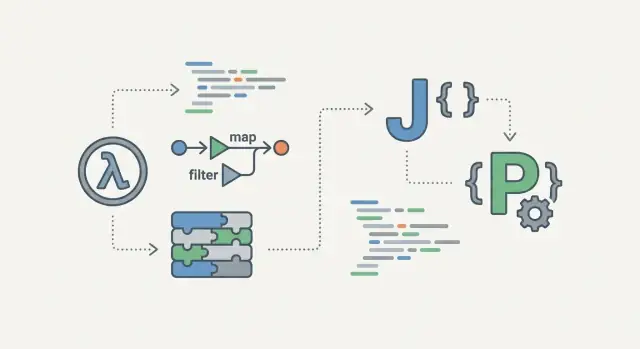
What We Mean by “Functional Concepts”
“Functional programming concepts” are simply habits and language features that treat computation like working with values, not constantly changing things.
Instead of writing code that says “do this, then change that,” functional-style code leans toward “take an input, return an output.” The more your functions behave like reliable transformations, the easier it is to predict what the program will do.
Not “Pure FP” (and That’s Fine)
When people say Java, Python, JavaScript, C#, or Kotlin are “getting more functional,” they don’t mean these languages are turning into purely functional programming languages.
They mean mainstream language design keeps borrowing useful ideas—like lambdas and higher-order functions—so you can write some parts of your code in a functional style when it helps, and stick with familiar imperative or object-oriented approaches when that’s clearer.
What to Expect: Benefits and Trade-offs
Functional ideas often improve software maintainability by reducing hidden state and making behavior easier to reason about. They can also help with concurrency, because shared mutable state is a major source of race conditions.
The trade-offs are real: extra abstraction can feel unfamiliar, immutability can add overhead in some cases, and “clever” compositions can hurt readability if overdone.
Concepts We’ll Refer To
Here’s what “functional concepts” means throughout this article:
- Pure functions: same input → same output, with minimal side effects
- Immutability: prefer values that don’t change after creation
- Functions as values: pass functions around like data (lambdas)
- Higher-order functions: functions that take/return other functions
- Map / filter / reduce: common patterns for transforming collections
- Composition: building bigger behavior by combining small functions
These are practical tools, not a doctrine—the goal is to use them where they make code simpler and safer.
A Short History of Ideas That Never Really Left
Functional programming isn’t a new trend; it’s a set of ideas that resurfaces whenever mainstream development hits a scaling pain point—bigger systems, bigger teams, and new hardware realities.
A quick timeline (with the hits)
In the late 1950s and 1960s, languages like Lisp treated functions as real values you could pass around and return—what we now call higher-order functions. That same era also gave us the roots of “lambda” notation: a concise way to describe anonymous functions without naming them.
In the 1970s and 1980s, functional languages such as ML and later Haskell pushed ideas like immutability and strong type-driven design, mostly in academic and niche industrial settings. Meanwhile, many “mainstream” languages quietly borrowed pieces: scripting languages popularized treating functions like data long before enterprise platforms caught up.
In the 2000s and 2010s, functional ideas became hard to ignore:
- C# introduced LINQ (query-like operations over collections), making map/filter-style data processing feel natural.
- Java 8 added lambdas and Streams, bringing a similar style into everyday server code.
- JavaScript’s ecosystem normalized callbacks, then Promises, then async/await—features not purely functional, but ones that nudged developers toward clearer data flow and more disciplined handling of side effects.
More recently, languages like Kotlin, Swift, and Rust doubled down on function-based collection tools and safer defaults, while frameworks in many ecosystems encourage pipelines and declarative transformations.
Why older ideas keep cycling back
These concepts return because the context keeps changing. When programs were smaller and mostly single-threaded, “just mutate a variable” was often fine. As systems became distributed, concurrent, and maintained by large teams, the cost of hidden coupling increased.
Functional programming patterns—like lambdas, collection pipelines, and explicit async flows—tend to make dependencies visible and behavior more predictable. Language designers keep reintroducing them because they’re practical tools for modern complexity, not museum pieces from computer science history.
Predictability: Fewer Surprises, Easier Debugging
Predictable code behaves the same way every time you use it in the same situation. That’s exactly what gets lost when functions quietly depend on hidden state, the current time, global settings, or whatever happened earlier in the program.
When behavior is predictable, debugging becomes less like detective work and more like inspection: you can narrow a problem down to a small piece, reproduce it, and fix it without worrying that the “real” cause is somewhere else.
Why predictability saves time
Most debugging time isn’t spent typing a fix—it’s spent figuring out what the code actually did. Functional programming ideas push you toward behavior you can reason about locally:
- The inputs are obvious.
- The outputs are consistent.
- The function doesn’t secretly change other things.
That means fewer “it only breaks on Tuesdays” bugs, fewer print statements scattered everywhere, and fewer fixes that accidentally create a new bug two screens away.
Pure functions are easier to test and reuse
A pure function (same input → same output, no side effects) is friendly to unit tests. You don’t need to set up complex environments, mock half your application, or reset global state between test runs. You can also reuse it during refactors because it doesn’t assume where it’s being called from.
This matters in real work:
- Refactors are safer when functions don’t rely on hidden context.
- Bug fixes are faster when you can isolate the failing input and reproduce the output.
- Onboarding is smoother when new teammates can understand a function without learning the entire app’s history.
A tiny before/after (conceptual)
Before: A function called calculateTotal() reads a global discountRate, checks a global “holiday mode” flag, and updates a global lastTotal. A bug report says totals are “sometimes wrong.” Now you’re chasing state.
After: calculateTotal(items, discountRate, isHoliday) returns a number and changes nothing else. If totals are wrong, you log the inputs once and reproduce the issue immediately.
Predictability is one of the main reasons functional programming features keep getting added to mainstream languages: they make everyday maintenance work less surprising, and surprises are what make software expensive.
Side Effects: The Real Source of Many Bugs
A “side effect” is anything a piece of code does besides calculating and returning a value. If a function reads or changes something outside its inputs—files, a database, the current time, global variables, a network call—it’s doing more than just computing.
Everyday examples are everywhere: writing a log line, saving an order to the database, sending an email, updating a cache, reading environment variables, or generating a random number. None of these are “bad,” but they change the world around your program—and that’s where surprises begin.
Why effects create confusion
When effects are mixed into ordinary logic, behavior stops being “data in, data out.” The same inputs can produce different outcomes depending on hidden state (what’s already in the database, which user is logged in, whether a feature flag is on, whether a network request fails). That makes bugs harder to reproduce and fixes harder to trust.
It also complicates debugging. If a function both calculates a discount and writes to the database, you can’t safely call it twice while investigating—because calling it twice might create two records.
Isolating effects to simplify reasoning
Functional programming pushes a simple separation:
- Pure logic: deterministic functions that transform data (data in, data out)
- Effects at the edges: small, clearly marked parts that read/write files, call APIs, log, or persist data
With this split, you can test most of your code without a database, without mocking half the world, and without worrying that a “simple” calculation triggers a write.
Common pitfalls when effects spread everywhere
The most common failure mode is “effect creep”: one function logs “just a little,” then it also reads config, then it also writes a metric, then it also calls a service. Soon, many parts of the codebase depend on hidden behavior.
A good rule of thumb: keep core functions boring—take inputs, return outputs—and make side effects explicit and easy to find.
Immutability and Safer Shared State
Immutability is a simple rule with big consequences: don’t change a value—make a new version.
Instead of editing an object “in place,” an immutable approach creates a fresh copy that reflects the update. The old version stays exactly as it was, which makes the program easier to reason about: once a value is created, it won’t unexpectedly change later.
Why this reduces bugs
Many everyday bugs come from shared state—the same data being referenced in multiple places. If one part of the code mutates it, other parts may observe a half-updated value or a change they didn’t expect.
With immutability:
- Functions can safely accept data without worrying that a caller (or another thread) will modify it mid-way.
- “Accidental changes” stand out, because the only way to alter data is to explicitly produce a new value.
- Features like undo/redo, caching, and time-travel debugging become more natural, since older versions still exist.
This is especially helpful when data is passed widely (configuration, user state, app-wide settings) or used concurrently.
The trade-offs (and how to avoid them)
Immutability isn’t free. If implemented poorly, you can pay in memory, performance, or extra copying—for example, repeatedly cloning large arrays inside tight loops.
Most modern languages and libraries reduce these costs with techniques like structural sharing (new versions reuse most of the old structure), but it’s still worth being deliberate.
Practical guidance: when to prefer immutable structures
Prefer immutability when:
- Data is shared across modules, callbacks, or threads.
- You want predictable updates (state management, event handling).
- You’re building APIs where callers shouldn’t be able to tamper with internal state.
Consider controlled mutation when:
- You’re in a performance-critical inner loop.
- Data is local, short-lived, and not shared (e.g., building up a result before returning it).
A useful compromise is: treat data as immutable at the boundaries (between components) and be selective about mutation inside small, well-contained implementation details.
Functions as Building Blocks: Map, Filter, and Friends
A big shift in “functional-style” code is treating functions as values. That means you can store a function in a variable, pass it into another function, or return it from a function—just like data.
That flexibility is what makes higher-order functions practical: instead of rewriting the same loop logic over and over, you write the loop once (inside a reusable helper), and plug in the behavior you want via a callback.
Functions as values (the core idea)
If you can pass behavior around, code becomes more modular. You define a small function that describes what should happen to one item, then hand it to a tool that knows how to apply it to every item.
const addTax = (price) => price * 1.2;
const pricesWithTax = prices.map(addTax);
Here, addTax isn’t “called” directly in a loop. It’s passed into map, which handles the iteration.
Map, filter, reduce: readable building blocks
- map transforms each item:
[a, b, c] → [f(a), f(b), f(c)] - filter keeps items that match a rule: keep only items where
predicate(item)is true - reduce folds a list into one value: sum, max, grouped object, etc.
const total = orders
  .filter(o => o.status === "paid")
  .map(o => o.amount)
  .reduce((sum, amount) => sum + amount, 0);
This reads like a pipeline: select paid orders, extract amounts, then add them up.
Less boilerplate, less duplication
Traditional loops often mix concerns: iteration, branching, and the business rule all sit in one place. Higher-order functions separate those concerns. The looping and accumulation are standardized, while your code focuses on the “rule” (the small functions you pass in). That tends to reduce copy-pasted loops and one-off variants that drift over time.
A quick warning: chains can get unreadable
Pipelines are great until they become deeply nested or too clever. If you find yourself stacking many transformations or writing long inline callbacks, consider:
- naming intermediate steps (small helper functions)
- breaking the pipeline into a few clear lines
- adding a comment for the “why,” not the “what”
Functional building blocks help most when they make intent obvious—not when they turn simple logic into a puzzle.
Concurrency: A Big Reason These Ideas Matter Now
Modern software rarely runs in a single, quiet thread. Phones juggle UI rendering, network calls, and background work. Servers handle thousands of requests at once. Even laptops and cloud machines ship with multiple CPU cores by default.
Shared mutable state is where concurrency hurts
When several threads/tasks can change the same data, tiny timing differences create big problems:
- Two operations interleave and overwrite each other (“lost updates”).
- One task reads data halfway through another task’s update (“inconsistent reads”).
- Bugs appear only under load and vanish when you add logging (“heisenbugs”).
These issues aren’t about “bad developers”—they’re a natural outcome of shared mutable state. Locks help, but they add complexity, can deadlock, and often become performance bottlenecks.
Immutability and pure functions reduce coordination
Functional programming ideas keep resurfacing because they make parallel work easier to reason about.
If your data is immutable, tasks can share it safely: nobody can change it out from under anyone else. If your functions are pure (same input → same output, no hidden side effects), you can run them in parallel more confidently, cache results, and test them without setting up elaborate environments.
This fits common patterns in modern apps:
- UI apps: compute derived view state from immutable models.
- Servers: process requests as transformations of data.
- Data pipelines: split work across cores using predictable operations.
It’s not always faster—but it’s often safer
Concurrency tools based on FP don’t guarantee a speedup for every workload. Some tasks are inherently sequential, and extra copying or coordination can add overhead.
The main win is correctness: fewer race conditions, clearer boundaries around effects, and programs that behave consistently when run on multi-core CPUs or under real-world server load.
Composition and Pipelines for Readable Programs
A lot of code is easier to understand when it reads like a series of small, named steps. That’s the core idea behind composition and pipelines: you take simple functions that each do one thing, then connect them so data “flows” through the steps.
What a pipeline is (in plain terms)
Think of a pipeline like an assembly line:
- Step 1 cleans the input.
- Step 2 transforms it.
- Step 3 filters out what you don’t want.
- Step 4 summarizes the result.
Each step can be tested and changed on its own, and the overall program becomes a readable story: “take this, then do that, then do that.”
Why it helps: readability, reuse, and safer changes
Pipelines push you toward functions with clear inputs and outputs. That tends to:
- Improve readability: less jumping around in a long method.
- Increase reuse: the “filter valid orders” step can be reused in multiple places.
- Make changes smaller: if tax rules change, you often update one step rather than rewriting a whole routine.
Composition is simply the idea that “a function can be built from other functions.” Some languages offer explicit helpers (like compose), while others rely on chaining (.) or operators.
Example: processing a list of orders
Here’s a small, pipeline-style example that takes orders, keeps only paid ones, computes totals, and summarizes revenue:
const paid = o => o.status === 'paid';
const withTotal = o => ({ ...o, total: o.items.reduce((s, i) => s + i.price * i.qty, 0) });
const isLarge = o => o.total >= 100;

const revenue = orders
  .filter(paid)
  .map(withTotal)
  .filter(isLarge)
  .reduce((sum, o) => sum + o.total, 0);
Even if you don’t know JavaScript well, you can usually read this as: “paid orders → add totals → keep large ones → sum totals.” That’s the big win: the code explains itself by how the steps are arranged.
Safer Data Modeling and Fewer Edge Cases
A lot of “mystery bugs” aren’t about clever algorithms—they’re about data that can silently be wrong. Functional ideas push you to model data so that wrong values are harder (or impossible) to construct, which makes APIs safer and behavior more predictable.
Make data explicit, then validate it
Instead of passing around loosely structured blobs (strings, dictionaries, nullable fields), functional-style modeling encourages explicit types with clear meaning. For example, “EmailAddress” and “UserId” as distinct concepts prevent mixing them up, and validation can happen at the boundary (when data enters your system) rather than scattered across the codebase.
The effect on APIs is immediate: functions can accept already-validated values, so callers can’t “forget” a check. That reduces defensive programming and makes failure modes clearer.
Algebraic data types and pattern matching (conceptually)
In functional languages, algebraic data types (ADTs) let you define a value as one of a small set of well-defined cases. Think: “a payment is either Card, BankTransfer, or Cash,” each with exactly the fields it needs. Pattern matching is then a structured way to handle each case explicitly.
This leads to the guiding principle: make invalid states unrepresentable. If “Guest users” never have a password, don’t model it as password: string | null; model “Guest” as a separate case that simply has no password field. Many edge cases disappear because the impossible can’t be expressed.
Mainstream approximations you can use today
Even without full ADTs, modern languages offer similar tools:
- Enums for a closed set of cases
- Sealed classes (or sealed interfaces) to restrict subclasses
- Tagged unions / discriminated unions to bundle a “type tag” with case-specific fields
Combined with pattern matching (where available), these features help ensure you handled every case—so new variants don’t become hidden bugs.
Why Language Designers Keep Adding FP Features
Mainstream languages rarely adopt functional programming features because of ideology. They add them because developers keep reaching for the same techniques—and because the rest of the ecosystem rewards those techniques.
Demand (and competition) from working developers
Teams want code that’s easier to read, test, and change without unintended ripple effects. As more developers experience benefits like cleaner data transformations and fewer hidden dependencies, they expect those tools everywhere.
Language communities also compete. If one ecosystem makes common tasks feel elegant—say, transforming collections or composing operations—others feel pressure to reduce friction for everyday work.
Libraries pull languages in a functional direction
A lot of “functional style” is driven by libraries rather than textbooks:
- Stream/sequence APIs encourage chaining operations instead of writing loops.
- Reactive and async libraries often model work as pipelines of transformations.
- Data libraries (JSON, parsing, validation) frequently prefer “take input → return output” functions.
Once these libraries become popular, developers want the language to support them more directly: concise lambdas, better type inference, pattern matching, or standard helpers like map, filter, and reduce.
Syntax follows patterns people actually use
Language features often show up after years of community experimentation. When a certain pattern becomes common—like passing small functions around—languages respond by making that pattern less noisy.
That’s why you often see incremental upgrades rather than sudden “all-in FP”: first lambdas, then nicer generics, then better immutability tools, then improved composition utilities.
Pragmatic adoption: mixing styles for real teams
Most language designers assume real-world codebases are hybrids. The goal isn’t to force everything into pure functional programming—it’s to let teams use functional ideas where they help:
- Use pure functions for business rules and transformations.
- Allow controlled side effects at the edges (I/O, logging, UI).
- Keep the learning curve manageable for mixed-experience teams.
That middle path is why FP features keep returning: they solve common problems without demanding a full rewrite of how people build software.
How to Use Functional Ideas Without Going Overboard
Functional programming ideas are most useful when they reduce confusion, not when they become a new style contest. You don’t need to rewrite an entire codebase or adopt a “pure everything” rule to get the benefits.
Start small: make the next change safer
Begin with low-risk places where functional habits pay off immediately:
- Write pure helper functions for formatting, parsing, validation, and calculations. If a function only depends on its inputs, it’s easier to test and reuse.
- Treat inputs as effectively immutable inside a function. Instead of changing an object in place, create a new value (or a copy with one field changed) when it keeps the logic clearer.
- Draw clear boundaries for side effects: one part of the code talks to the database, filesystem, or network; another part prepares the data. This separation makes bugs easier to locate.
If you’re building quickly with an AI-assisted workflow, these boundaries matter even more. For example, on Koder.ai (a vibe-coding platform for generating React apps, Go/PostgreSQL backends, and Flutter mobile apps via chat), you can ask the system to keep business logic in pure functions/modules and isolate I/O in thin “edge” layers. Pair that with snapshots and rollback, and you can iterate on refactors (like introducing immutability or stream pipelines) without betting the whole codebase on one big change.
When to avoid going “full FP”
Functional techniques can be the wrong tool in a few situations:
- Performance hotspots: creating many short-lived copies or chaining lots of tiny operations may add overhead. Measure first; optimize the specific bottleneck.
- Overly clever abstractions: if the code needs a “decoder ring” of custom operators, heavy nesting, or magical one-liners, it will slow the team down.
- Unfamiliar patterns: a neat trick isn’t worth it if nobody can maintain it in six months.
Team considerations: make it readable together
Agree on shared conventions: where side effects are allowed, how to name pure helpers, and what “immutable enough” means in your language. Use code reviews to reward clarity: prefer straightforward pipelines and descriptive names over dense compositions.
A practical checklist for your next feature
Before you ship, ask:
- Can the core logic be expressed as a pure function?
- Are side effects isolated to a small, obvious area?
- Did we avoid mutating shared data across modules?
- Would a new teammate understand the flow in one reading?
- If performance matters here, did we measure, not guess?
Used this way, functional ideas become guardrails—helping you write calmer, more maintainable code without turning every file into a philosophy lesson.
FAQ
What does “functional concepts” mean in this article?
Functional concepts are practical habits and features that make code behave more like “input → output” transformations.
In everyday terms, they emphasize:
- predictable functions
- minimizing hidden state
- isolating side effects
- using tools like
map,filter, andreduceto transform data clearly
Are mainstream languages becoming “purely functional”?
No. The point is pragmatic adoption, not ideology.
Mainstream languages borrow features (lambdas, streams/sequences, pattern matching, immutability helpers) so you can use functional style where it helps, while still writing imperative or OO code when that’s clearer.
How do functional ideas improve predictability and debugging?
Because they reduce surprises.
When functions don’t rely on hidden state (globals, time, mutable shared objects), behavior becomes easier to reproduce and reason about. That typically means:
- faster debugging
- safer refactoring
- simpler unit tests
What is a pure function, and why does it matter for testing?
A pure function returns the same output for the same input and avoids side effects.
That makes it easy to test: you call it with known inputs and assert the result, without setting up databases, clocks, global flags, or complex mocks. Pure functions also tend to be easier to reuse during refactors because they carry less hidden context.
What counts as a side effect, and why are side effects risky?
A side effect is anything a function does beyond returning a value—reading/writing files, calling APIs, writing logs, updating caches, touching globals, using the current time, generating random values, etc.
Effects make behavior harder to reproduce. A practical approach is:
- keep core logic pure
- put side effects in small, obvious “edge” functions (I/O boundaries)
How does immutability reduce bugs in real code?
Immutability means you don’t change a value in place; you create a new version instead.
This reduces bugs caused by shared mutable state, especially when data is passed around or used concurrently. It also makes features like caching or undo/redo more natural because older versions remain valid.
Does immutability hurt performance?
Yes—sometimes.
The costs usually show up when you repeatedly copy large structures in tight loops. Practical compromises include:
- treat data as immutable at module/component boundaries
- allow controlled mutation inside small, local implementations
- measure performance before “optimizing away” immutability
Why are map/filter/reduce such a big deal?
They replace repetitive loop boilerplate with reusable, readable transformations.
map: transform each elementfilter: keep elements that match a rulereduce: combine many values into one
Used well, these pipelines make intent obvious (e.g., “paid orders → amounts → sum”) and reduce copy-pasted loop variants.
How do functional ideas help with concurrency?
Because concurrency breaks most often due to shared mutable state.
If data is immutable and your transformations are pure, tasks can safely run in parallel with fewer locks and fewer race conditions. It doesn’t guarantee speedups, but it often improves correctness under load.
What’s the best way to adopt functional ideas without going overboard?
Start with small, low-risk wins:
- write pure helpers for parsing/formatting/validation/calculations
- separate “prepare data” from “do I/O” (DB/network/logging)
- avoid mutating shared objects across modules
Stop and simplify if the code becomes too clever—name intermediate steps, extract functions, and favor readability over dense compositions.