

Why Many Startups Should Skip VC and Win Bootstrapped
Venture capital isn’t right for many startups. Learn when to avoid VC, what bootstrapped companies do differently, and how to win with customer-funded growth.
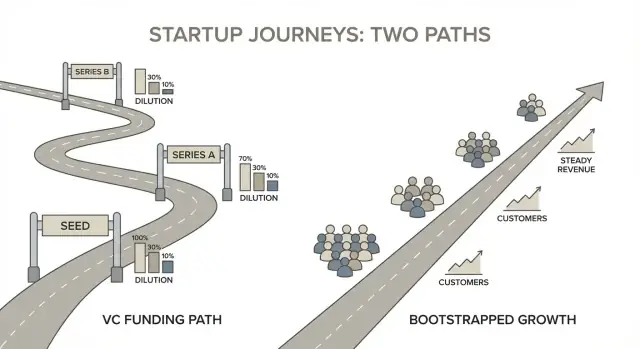
VC vs. Bootstrapping: What This Decision Really Means
Most funding advice treats venture capital (VC) like a milestone: raise a round, hire fast, “scale.” But VC isn’t a trophy—it’s a specific trade.
Venture capital, in plain terms
VC is professional investment money you take in exchange for equity (ownership). In return, investors expect you to pursue a growth path big enough to produce an outlier outcome—typically a large acquisition or IPO.
That expectation shapes almost every decision afterward: how quickly you hire, how aggressively you spend, what market you target, and how soon you need evidence that the business can become very large.
Bootstrapping, in plain terms
Bootstrapping means building the business using revenue from customers, founder savings, or smaller, more flexible capital (like a modest loan). Instead of optimizing for the fastest possible growth, you’re optimizing for survival, learning, and steady improvement—often aiming for profitability earlier.
Bootstrapping doesn’t mean “small” or “slow.” It means you keep more control over pace, priorities, and outcomes because you’re not committed to a venture-style return timeline.
What this post is trying to help you do
The goal is not to persuade you that one path is morally superior. It’s to help you choose the funding approach that matches your business model, your market, and what you actually want as a founder.
Some startups are genuinely venture-backable and benefit from VC. Many others can build a valuable company—with less stress and more optionality—by staying customer-funded.
There’s no universal “best” option—only best fit, given your product, growth ceiling, and tolerance for dilution, pressure, and loss of control.
Why VC Is a Poor Fit for Many Startups
Venture capital isn’t “bad.” It’s built for a very specific kind of business. VC funds need a small number of investments to return the entire fund, which means they’re hunting for outlier outcomes—companies that can plausibly become huge.
If your startup can become a great, profitable business without becoming a category-dominating giant, VC may push you toward a game you don’t actually want to play.
VC requires extreme growth paths
To meet investor expectations, founders often accept growth targets that are not just ambitious, but structurally aggressive. That can lead to premature scaling: hiring ahead of demand, expanding into new markets too early, or building features for an imagined enterprise buyer instead of serving the customers who are already paying.
The business can end up optimized for the next funding round rather than for durable customer value.
Dilution changes incentives and control
Raising VC almost always means selling meaningful ownership. Over time, dilution can shift how decisions get made and what “success” looks like.
Common side effects include:
- Pressure to chase revenue at any cost (even if margins suffer)
- Less freedom to choose a slower, more profitable path
- Decision-making that prioritizes exit timelines over product quality
Even when investors are supportive, the incentives are different: funds are rewarded for big exits, not steady, profitable growth.
Fundraising is a major distraction
Fundraising is more than pitch meetings. It’s prep work, financial modeling, follow-ups, partner meetings, legal negotiations, and then ongoing investor updates. That time comes from somewhere—usually customer research, sales, support, and product iteration.
If your advantage is speed, focus, and closeness to customers, a long fundraising cycle can be an expensive trade.
VC can be right when the market demands huge upfront spend and the upside is massive. But for many startups, it’s simply a mismatch between the business you can realistically build and the outcome the capital requires.
Four Filters to Decide If Your Startup Is Venture-Backable
Venture capital isn’t “good money” or “bad money”—it’s a tool designed for a specific outcome: a small number of outsized winners returning the whole fund. To decide if VC fits, run your startup through four practical filters.
1) Market size: venture-scale upside or strong niche?
Ask whether your market can realistically support a company worth hundreds of millions (or more), not just a healthy, profitable business. A niche can be excellent for bootstrapping—high customer value, low competition, and steady demand—but it may not produce the kind of exit VC requires.
A quick check: if you captured a meaningful share of your best customers, would the result be “life-changing for a fund,” or “a great founder business”?
2) Growth speed: can you scale without breaking the business?
VC-backed companies are expected to grow aggressively. The question isn’t whether you want to grow fast, but whether fast growth is operationally safe.
If onboarding, support, implementation, compliance, or hiring can’t keep up, rushing can create churn, reputation damage, and a fragile culture. If your product needs deep iteration with early customers, slower growth might be a feature—not a bug.
3) Business model: margins, payback, and reinvestment
Venture-scale growth usually depends on strong gross margins and fast payback on customer acquisition. If you spend $1 to acquire a customer, how quickly do you earn it back—and how confidently can you reinvest?
If margins are thin, sales cycles are long, or churn is hard to predict, raising VC can amplify pressure without solving the underlying economics.
4) Distribution: repeatable acquisition or relationship-driven sales?
VC works best when there’s a repeatable way to acquire customers: a clear channel, a predictable funnel, and scalable messaging.
If your go-to-market depends on founder networks, bespoke enterprise deals, or slow trust-building, that can still be a great business—but it often scales in years, not quarters.
If you’re unsure, treat these filters as hypotheses to test over the next 60–90 days before taking capital that will set your pace for you.
How VC Pressure Can Warp Product and Go-To-Market
VC money rarely just “accelerates” what you were already going to do. It usually changes the game you’re playing. Once your timeline is tied to the next round, growth stops being one priority among many and becomes the priority that everything else serves.
Growth pressure can push you into the wrong customer
The fastest path to bigger numbers often isn’t the best path to a durable business.
Under VC pressure, it’s common to chase larger logos, broader markets, or trendier use cases because they sound like a bigger outcome. But that shift can pull you away from the customer segment that actually loves your product and pays reliably.
Instead of deepening product-market fit in one clear niche, you end up with a blur of “we can serve everyone,” which usually means you serve no one especially well.
Hiring too early creates burn that demands more funding
Headcount is the easiest lever to pull when growth is the headline goal. A bigger team feels like progress—until your monthly burn forces decisions you wouldn’t otherwise make.
When you hire ahead of proven demand, the business model starts to revolve around maintaining the team:
- Sales targets become less about learning and more about feeding payroll
- Marketing becomes louder (and less precise) to justify spend
- Every month without growth feels like a crisis
That burn then “requires” another round, which increases the pressure cycle.
Pricing gets distorted away from value
To hit adoption targets, startups often slide into free plans, steep discounts, or custom pricing that’s hard to raise later. It can look great in a dashboard—more users, more logos—but it teaches the market the wrong lesson: that your product is cheap, optional, or easy to replace.
Value-based pricing takes patience and clarity. VC timelines can punish both.
Product becomes an investor story, not a user tool
A subtle shift happens when the main audience becomes investors rather than customers. Roadmaps start optimizing for narrative:
- Shiny features that demo well
- Broad “platform” claims before the core workflow is nailed
- Expansion into adjacent products to signal bigger TAM
The result is a product that is easier to pitch than to use.
If you want to see the alternative path, the next section on /blog/the-hidden-costs-dilution-control-and-incentives digs into why these incentives are so sticky once they start.
The Hidden Costs: Dilution, Control, and Incentives
Raising venture capital doesn’t just add cash—it rewrites ownership, decision rights, and what “success” looks like.
Dilution, in plain numbers
A simple cap table example makes this real. Suppose two founders start with 50/50.
- Day 1: Founder A 50%, Founder B 50%
- You create a 15% option pool (common before a priced round): A 42.5%, B 42.5%, Option pool 15%
- You raise a Seed round selling 20% to investors: A 34%, B 34%, Option pool 12%, Investors 20%
Nothing “bad” happened—and yet each founder went from 50% to 34% before Series A. If you raise multiple rounds, dilution can compound quickly.
Control: boards and approval rights
VC money often comes with governance. Once you have an investor on the board (or strong protective provisions), certain decisions may require approval, such as:
- Hiring/firing the CEO or changing executive compensation
- Issuing new shares, expanding the option pool, or raising additional financing
- Selling the company or making major acquisitions
- Approving annual budgets or taking on significant debt
Even if you’re still “in charge,” you may need consensus to move.
Preference stacks change exits
Many VC deals include liquidation preferences (often 1x, sometimes with participation) and other terms that create a “preference stack.” In some exits, investors get their money back first—sometimes plus extra—before common shareholders (founders/employees) see proceeds. Two companies can sell for the same price and produce very different founder outcomes depending on the stack.
Personal risk and incentive drift
VC can increase pressure on founders: higher burn, higher expectations, and less freedom to keep salary stable. That can create runway anxiety and reduce career optionality—because the plan may require a big outcome on a fixed timeline.
Bootstrapping usually trades speed for resilience: more control over pace, product direction, and what “enough” looks like.
How Bootstrapped Companies Win Differently
Bootstrapped startups don’t win by telling the best funding story—they win by building a revenue engine early. That changes what “progress” looks like. Instead of chasing the biggest possible market narrative, bootstrapped founders tend to prioritize a business model that starts paying for itself quickly and gets stronger month after month.
Revenue first, story second
When you’re not optimizing for fundraising, you stop designing the company around what investors want to hear. You design it around what customers will pay for—now.
That usually means:
- A narrower initial use case (but one with clear urgency)
- Packaging and pricing decisions made early, not “later”
- A product roadmap driven by retention and willingness to pay
The goal isn’t to look impressive on a pitch deck. The goal is to make the next sale easier than the last.
Customers who pay early (and stay)
Bootstrapped companies often choose customers differently. They look for buyers who have budget, feel the pain today, and can decide quickly. Early revenue does more than fund growth—it validates that you’re solving a problem worth paying for.
Retention matters even more under bootstrapping. If customers don’t stick around, you don’t just lose growth—you lose oxygen. So bootstrapped teams tend to build:
- Onboarding that gets to value fast
- Support and documentation that reduce churn
- Features that deepen daily/weekly usage, not just expand the roadmap
Tighter feedback loops: ship, charge, learn
Bootstrapping forces a simple loop: ship something useful, charge for it, learn from real behavior, and iterate. There’s less room for “free traction” that doesn’t translate to revenue.
Because the feedback is tied to payment and retention, it’s clearer. You find out quickly whether:
- The problem is truly painful
- The pricing makes sense
- The product is delivering ongoing value
Capital efficiency as an advantage
Capital efficiency isn’t only about spending less—it’s about getting more output per dollar and per hour. Bootstrapped teams often build habits that compound: smaller experiments, disciplined hiring, and marketing channels that pay back quickly.
Over time, this becomes a competitive edge: you can grow steadily without needing perfect timing, constant fundraising, or permission to keep going.
Customer-Funded Growth: The Bootstrapping Playbook
Customer-funded growth is simple: you let real buyers pay for the work that moves the business forward. It’s not “growth at any cost.” It’s growth that stays honest—because revenue, churn, and renewals quickly reveal what’s working.
1) Pick a narrow ICP and a painful, immediate problem
Bootstrapped companies win by being specific. Choose an ideal customer profile (ICP) you can reach quickly and understand deeply, then focus on a problem that already has budget attached.
A useful test: can your target buyer describe the pain in one sentence and explain what it costs them each month in lost time, missed revenue, compliance risk, or headcount? If not, it’s probably too vague to fund your early build.
2) Start with a simple paid offer
Instead of spending months building a “complete product,” sell a small, clear engagement:
- Pilot: a time-boxed implementation with defined outcomes
- Retainer: ongoing delivery tied to a business result
- Paid beta: early access with hands-on support and tight feedback loops
This creates urgency, keeps scope controlled, and gives you real usage data—not opinions.
3) Price for sustainability (not hope)
Bootstrapping breaks when pricing is built on “we’ll monetize later.” Price so the business can support delivery, support, and continued development now.
A practical starting point: price around the customer’s cost of the problem (or the savings you create), and make sure the first deal can contribute meaningfully to payroll and tooling after direct costs.
4) Build only what drives retention, referrals, or expansion
When cash is your fuel, your roadmap should be tied to outcomes:
- Retention: fewer drop-offs after onboarding, higher weekly use
- Referrals: shareable outputs, multi-user workflows, clear wins customers talk about
- Expansion: add seats, usage, or modules once the core value is proven
If a feature doesn’t help customers stay, share, or buy more, it’s a “later” item—no matter how exciting it sounds.
A note on tooling: ship faster without hiring ahead of demand
One underrated bootstrapping advantage is shortening the build–sell–learn loop without inflating headcount. For example, teams use Koder.ai (a vibe-coding platform) to go from a product idea to working web, backend, or mobile prototypes through a chat interface—then iterate quickly with customers.
If you’re trying to stay lean, features like planning mode, source code export, built-in hosting/deployment, custom domains, and snapshots/rollback can reduce both engineering overhead and “tool sprawl,” while keeping you in control of the codebase as the product matures.
Operating Model: Runway, Cash Flow, and Capital Efficiency
Bootstrapped companies don’t “run on runway” the same way VC-backed startups do. Your operating model has one job: keep the business alive long enough to learn, ship, and sell—without forcing a fundraising timeline.
Set a burn limit—and tie it to profitability milestones
Start by defining an explicit monthly burn limit (or a break-even deadline) that you refuse to cross. Treat it as a design constraint, not a spreadsheet output.
Instead of planning around a future round, plan around profitability milestones: “We reach cash-flow break-even at X MRR,” or “We can fund one more hire once we sustain Y gross margin for Z months.” This keeps decisions grounded in what the business can actually afford.
Manage cash flow like a product feature
Cash flow is something you can engineer. A few tactics reliably extend runway without starving growth:
- Use pre-selling or paid pilots to fund development before you fully build.
- Push annual plans (even with a discount) to convert revenue into upfront cash.
- Use services-to-product: deliver a manual version first, charge for outcomes, then automate what customers repeatedly buy.
These moves reduce dependency on external capital while validating demand early.
Make payback period a first-class metric
If you spend money to acquire customers, keep the payback period short whenever possible. A shorter payback means your growth “recycles” cash faster, which is the bootstrapped advantage.
Even simple discipline helps: cap acquisition spend until you can confidently measure payback, and prefer channels where you can pause spend without breaking growth.
Keep fixed costs low, revisit spend regularly
Fixed costs create fragile companies. Keep the team lean, outsource selectively (especially for design, specialized engineering, or one-time projects), and audit tool spend every quarter. Small recurring costs compound into real burn—often without improving customer value.
Capital efficiency isn’t about being cheap. It’s about buying time and focus, so customers—not investors—fund the next step.
Metrics and Goals That Match a Bootstrapped Strategy
Bootstrapping changes what “winning” looks like. When you’re not optimizing for the next round, your goals can be built around durability: staying in control, serving customers well, and growing at a pace that doesn’t break the team or the product.
Define success before you define targets
Start by writing down what you actually want to optimize for—because bootstrapping gives you more choices than “grow at all costs.” For many founders, success is a mix of:
- Freedom: control over direction, pricing, hiring, and pace
- Impact: solving a real problem for a specific customer set
- Wealth: long-term dividends and meaningful ownership
- Time: a company that doesn’t demand constant emergencies
- Mission: building something you’d still choose in five years
Once those priorities are explicit, it becomes easier to pick metrics that reinforce them.
Use metrics that reward quality and cash generation
Bootstrapped companies benefit from measurement that reflects customer love and financial stability, not just top-line growth.
Focus on:
- Profit (or contribution margin) and operating cash flow
- Churn/retention by cohort (especially early cohorts)
- NPS (or another consistent satisfaction signal)
- Cash runway (months of expenses covered by cash + predictable inflows)
A simple rule: if a metric can look great while customers quietly leave or cash quietly shrinks, it’s not a primary metric.
Set a growth rate you can sustain
Choose growth targets that you can fund through customer revenue without eroding quality—e.g., “20% quarter-over-quarter while maintaining churn under X% and support response times under Y.” The goal is compounding, not spikes that create refunds, burnout, or a product full of shortcuts.
Build a decision cadence
Consistency beats intensity.
- Monthly: review P&L, cash flow, runway, pricing, and top retention drivers
- Quarterly: set 3–5 priorities tied to constraints (team capacity, cash, tech debt), then measure progress against a small scorecard
Over time, these habits turn your strategy into a system: cash funds growth, and quality protects cash.
Alternatives to VC That Keep You in Control
VC isn’t the only way to access capital—and for many founders, it’s not even the best way. The goal isn’t to “never raise money.” It’s to raise the right kind of money, in the right amount, for a specific purpose that improves the business.
Practical options beyond venture capital
Angels (founder-aligned individuals). Angel checks can help you reach an inflection point—like shipping a v1, hiring a key role, or validating a go-to-market channel—without locking you into a VC timeline. Look for angels who value profitability and sustainable growth, not just “hypergrowth.”
Revenue-based financing (RBF). RBF can work well when you have predictable revenue and clear unit economics. You repay as a percentage of revenue, so payments flex with performance. It’s best used to scale something already working (like a paid acquisition channel), not to “find product-market fit.”
Bank loans and lines of credit. For stable businesses, debt is often simpler than equity. It’s typically cheaper than dilution, but it requires discipline: you need reliable cash flow and a plan for repayment. A credit line can also smooth working capital needs (inventory, receivables) without changing ownership.
Grants. If you qualify, grants are non-dilutive and can fund R&D, hiring, or pilots. The tradeoff is time and paperwork—treat them as a bonus, not your only plan.
Crowdfunding (rewards or equity). Crowdfunding can double as marketing and validation, especially for consumer products. Equity crowdfunding can raise meaningful capital, but it creates a large cap table—make sure you’re comfortable with the operational overhead.
Use funding tactically, not as a burn blanket
Whatever the source, tie capital to a concrete project with measurable outcomes: “$150k to finance inventory for Q4,” or “$80k to hire a salesperson and prove repeatable outbound.” If the purpose is “extend runway,” you’re often just paying to delay hard decisions.
Keep terms simple—and know when small capital is enough
Negotiate for clarity. Avoid complex terms you don’t understand, and push for plain-language explanations in writing. Many bootstrapped companies benefit from small capital that accelerates a proven motion without forcing VC-style growth targets or giving up control.
A Practical Decision Framework and Next Steps
You don’t need a perfect prediction of the future—you need a repeatable way to decide what kind of company you’re building and what kind of financing matches it.
Step 1: Write a one-page “funding fit” memo
Keep it brutally simple and written (not a mental model). One page forces clarity.
Include four headings:
- Market: Is the market big enough for a VC outcome and reachable by your team? What’s the credible path to a very large business?
- Model: Do you have strong gross margins and a business that can scale without linear headcount? How predictable is revenue?
- Speed: Does winning require moving unusually fast (land grabs, heavy R&D, regulatory timing), or can you grow steadily?
- Risk: What are the biggest risks (technical, go-to-market, competitive)? Can you reduce them cheaply through customer revenue?
If you can’t write this memo convincingly, you’re not ready to fundraise—and you may be describing a great bootstrapped company.
Step 2: Run a 90-day bootstrap sprint before pitching VC
Treat this as a proof-of-traction experiment. Set one measurable goal (e.g., first 10 paying customers, first $1k MRR, churn below X%). In 90 days you’ll learn more than in 20 coffee chats with investors.
Use the sprint to validate:
- Customers will pay (not just praise)
- You can acquire them at a reasonable cost
- You can deliver value without a huge team
Step 3: If raising, set terms and boundaries in advance
Decide your non-negotiables before you’re negotiating.
- Dilution limits: what percent are you willing to sell this round?
- Runway plan: how many months of runway are you buying, and what milestones must it fund?
- Hiring pace: what roles unlock growth, and what hires are “nice to have”?
Write these down so you don’t “accidentally” build a burn rate that forces another round.
Step 4: If bootstrapping, commit to revenue milestones
Make the path concrete: first $1k / $10k / $100k MRR (or equivalent). For each milestone, define:
- The narrow ICP you’ll win first
- The offer and price point
- The single acquisition channel you’ll focus on
The next step is choosing: do you want the company that wins by speed and scale, or the one that wins by focus, cash flow, and control?
FAQ
What does venture capital actually require from a startup?
VC is equity financing from professional investors who expect an outlier outcome (typically a large acquisition or IPO). That expectation usually implies aggressive growth, a push toward venture-scale markets, and decisions optimized for future rounds and exit timelines—not just for profitability.
What does it really mean to bootstrap a startup?
Bootstrapping means funding the company primarily through customer revenue, founder savings, or small flexible capital (e.g., modest loans). The trade is usually slower, steadier growth in exchange for more control, earlier focus on profitability, and fewer incentives to chase a venture-style exit.
Why is VC a poor fit for many startups?
Many startups are great businesses but not great VC bets. Common mismatches include:
- A market that can support a healthy niche, but not a venture-scale outcome
- Growth that’s constrained by onboarding, services, compliance, or relationship-driven sales
- Unit economics that don’t support heavy upfront spend (thin margins, long payback, unpredictable churn)
- A go-to-market motion that scales in years, not quarters
How can I tell if my startup is venture-backable?
Use four filters:
- Market size: Can it plausibly support a $100M+ outcome?
- Growth speed: Can you scale fast without breaking delivery, support, or quality?
- Business model: Do you have strong margins and fast CAC payback?
- Distribution: Do you have a repeatable acquisition channel (not purely founder-network sales)?
If multiple answers are “no,” treat VC as unlikely to be a good fit right now.
How can VC pressure warp product and go-to-market?
VC pressure often changes who you build for and why:
- You may chase bigger “logos” or broader markets before you’ve nailed a clear niche
- Hiring ahead of demand increases burn, which then forces more fundraising
- Pricing can drift toward discounts/free plans to hit adoption targets
- Roadmaps can prioritize what demos well to investors over what works for users
If you want a deeper look at these incentive shifts, see /blog/the-hidden-costs-dilution-control-and-incentives.
How does dilution work in plain terms, and why does it matter?
Dilution reduces your ownership percentage as new shares are issued (option pools + rounds). A typical early sequence can move founders from 50% each to something like ~34% each after an option pool and a Seed round.
Practically, dilution can change incentives (what “success” means) and can compound over multiple rounds.
How does raising VC affect control and decision-making?
VC often comes with governance rights (board seats and protective provisions). That can mean certain actions require approval, such as:
- Raising more financing or issuing new shares
- Expanding the option pool
- Approving budgets or major spending/debt
- Hiring/firing key executives
- Selling the company
You may still run the company day-to-day, but you can lose unilateral decision-making.
How do bootstrapped companies win differently from VC-backed startups?
Bootstrapped companies tend to win by building a revenue engine early:
- Narrow ICP + urgent problem with budget attached
- Paid offers sooner (pilot, retainer, paid beta)
- Roadmap driven by retention and willingness to pay
- Capital efficiency habits that compound over time
Progress is measured less by “traction stories” and more by renewals, margins, and cash flow.
What’s a practical way to start customer-funded growth?
Start with a simple paid offer that creates urgency and limits scope:
- Pilot: time-boxed implementation with defined outcomes
- Retainer: ongoing delivery tied to a business result
- Paid beta: early access plus hands-on support and tight feedback
The goal is to collect real usage and payment signals early, then automate what customers repeatedly buy.
What are good alternatives to VC that keep founders in control?
Consider options that preserve flexibility:
- Angels: smaller checks, often less timeline pressure (if aligned)
- Revenue-based financing: repay as a percentage of revenue; best for scaling what already works
- Loans/lines of credit: cheaper than equity if cash flow is reliable
- Grants: non-dilutive but time-intensive
- Crowdfunding: can validate demand; equity crowdfunding adds cap table complexity
Whatever you choose, tie funding to a specific project with measurable outcomes, not “extend runway.”