

Why Multi-Paradigm Languages Win in Real Projects
Multi-paradigm languages help teams ship faster by mixing OOP, functional, and scripting styles. Learn when they fit, tradeoffs, and examples.
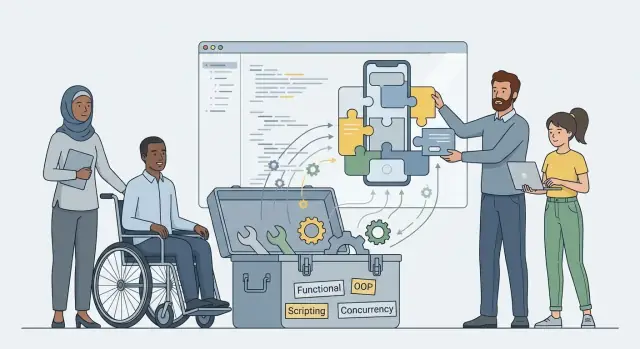
What “Multi-Paradigm” Means (Without the Jargon)
A multi-paradigm language is simply a programming language that lets you solve problems in more than one style—without forcing you to pick a single “right way” forever.
Think of “paradigms” as different habits of organizing code:
- Object-oriented style: group data and behavior into objects and classes.
- Functional style: build programs by composing functions and avoiding hidden state.
- Procedural style: write clear step-by-step logic.
A multi-paradigm language lets a team mix these approaches where they fit best. You might model your domain with classes (OOP), transform data with map/filter (functional programming), and keep a simple script-like flow for glue code (procedural)—all in the same codebase.
Why this matters in real projects
Production software is rarely a single clean puzzle. Teams have deadlines, legacy systems, third-party libraries, and years of maintenance ahead. One day you’re shipping a feature; the next you’re debugging a production issue, integrating a payment provider, or rewriting one risky module without breaking the rest.
In that environment, flexibility isn’t academic—it reduces friction. A language that supports multiple styles helps you:
- keep straightforward code straightforward (no forced patterns),
- use functional techniques where they reduce bugs (like data transformations),
- still leverage familiar OOP structures for large systems and shared team conventions.
What “winning” means here
“Winning” doesn’t mean a paradigm is morally better. It means better outcomes: languages get adopted more often, teams ship reliably, developers stay productive, and code remains maintainable as requirements change. Multi-paradigm languages tend to win because they adapt to the work, instead of demanding the work adapt to them.
Real Projects Need More Than One Way to Solve Problems
Even if a project starts with a clear preference—object-oriented programming, functional programming, or something else—day-to-day work quickly becomes a mix of concerns that don’t all fit the same mold.
One product, many kinds of work
Most applications aren’t just “an app.” They’re a bundle of different jobs that benefit from different approaches:
- APIs and business rules need clear boundaries, reuse, and readable domain models.
- UI work often favors composition, immutable state updates, and predictable data flow.
- Data pipelines reward a functional style: mapping, filtering, transforming, and streaming.
- Concurrency and async workflows need safe patterns for coordination and failure handling.
- Testing benefits from small, pure functions where possible, plus well-isolated components.
Trying to force one paradigm everywhere can make parts of the system feel unnatural. For example, modeling every transformation as a class hierarchy can inflate boilerplate, while insisting everything be pure functions can make stateful integration points (caches, databases, UI events) awkward and over-engineered.
Requirements don’t stay still
Projects evolve. A simple CRUD service gains background jobs, real-time updates, analytics, or a second client app. Different modules end up with different pressures: performance here, correctness there, fast iteration somewhere else. A multi-paradigm language lets teams adapt locally without rewriting the project’s “rules of the road” every time the product shifts.
The hidden cost of “one true style”
When teams enforce a single paradigm too strictly, they often pay in:
- extra code to fit the style rather than solve the problem,
- harder onboarding (“learn our way, not the language’s way”),
- more friction across modules, and
- slower delivery when patterns don’t match the task.
Multi-paradigm programming works because real projects are multi-problem—and practical software design follows the work.
The Core Paradigms and What They’re Good At
Multi-paradigm languages work because most software isn’t “one shape.” A single product might have long-lived domain models, short data-processing steps, glue code, and configuration-like rules—all in the same codebase. Different paradigms excel at different parts.
Object-Oriented Programming (OOP): modeling things that stick around
OOP shines when you’re representing entities with state and behavior that evolve over time.
Think: a shopping cart, a user account, an order workflow, a device connection. These are “nouns” with rules attached, and OOP’s classes/objects help teams keep that logic organized and discoverable.
Functional Programming: transforming data with fewer surprises
Functional style is great for pipelines: take input, apply transformations, produce output. Because it favors immutable data and pure-ish functions, it’s easier to test and reason about.
Think: parsing events, calculating totals, mapping API responses into UI-ready shapes, validating inputs, or building a data export.
Procedural Programming: straightforward steps and scripting
Procedural code is the “do this, then that” approach. It’s often the clearest option for glue code, orchestration, and small tasks.
Think: a migration script, a CLI command, a background job that calls three services in sequence, or a one-off admin tool.
Declarative Programming: describing the result, not the steps
Declarative style focuses on what you want, leaving the how to the framework or runtime.
Think: UI layouts, database queries, routing rules, build pipelines, or configuration-driven validation.
Paradigms are tools, not religions. The goal isn’t to “pick a side”—it’s to match the style to the problem so the code stays clear, testable, and easy for the team to extend.
Why Teams Prefer Languages That Bend, Not Break
Teams rarely pick a language because it’s “pure.” They pick it because work shows up in many shapes: quick prototypes, long-lived services, data-heavy features, UI code, integrations, and the inevitable bug fixes. A multi-paradigm language lets the team use the simplest approach that fits the task—without forcing a rewrite when the task changes.
Faster delivery by choosing the simplest style
When you can mix styles, you can move quickly:
- A straightforward object with methods might be the fastest way to ship a feature.
- A small functional pipeline might be the fastest way to transform data safely.
The win isn’t that one paradigm is better—it’s that you’re not blocked when the “right” paradigm for today’s problem is different from yesterday’s.
Onboarding is easier with mixed backgrounds
Most teams aren’t made of developers who all learned the same way. Some are comfortable thinking in objects, others prefer functions and immutability, and many are somewhere in between. A language that supports multiple paradigms reduces friction during onboarding because new hires can be productive using familiar patterns, then gradually learn the team’s preferred style.
Incremental refactors without rewriting everything
Real codebases evolve. Multi-paradigm languages make it practical to adopt functional programming ideas—like pure functions, immutability, and composable transformations—in small, low-risk steps. You can refactor one module, one hot path, or one tricky piece of business logic at a time, instead of “starting over” to change the overall architecture.
Interoperability matters more than ideology
Libraries and frameworks often assume certain styles. UI frameworks may lean on component objects, while data libraries may encourage functional composition. Languages like TypeScript (with JavaScript), Kotlin (with Java), or even modern Java itself let you integrate with these ecosystems smoothly—so you spend time building product, not fighting assumptions.
OOP + Functional: A Practical Combination, Not a Debate
Most teams don’t choose between object-oriented programming (OOP) and functional programming (FP) as a philosophy. They mix them because different parts of the same product have different needs.
Where OOP is the right tool
OOP shines when you’re modeling a domain that will evolve over years: orders, invoices, subscriptions, permissions, workflows.
Classes and interfaces are useful when you need clear ownership of behavior (“this object is responsible for validating state”) and when extensibility matters (“we’ll add a new payment method next quarter”). In long-lived systems, that structure can make changes safer, because the code mirrors the way the business thinks.
Where FP pays off immediately
FP tends to win in areas that are naturally “data in, data out”: transforming API responses, filtering events, computing totals, building pipelines.
Immutability and pure-ish functions reduce hidden side effects, which makes concurrency less scary and testing simpler. Even in a UI app, FP-style composition is great for mapping state into views and keeping logic predictable.
Why multi-paradigm languages are practical
In real codebases, you often want OOP for your domain model and FP for your data flows—without jumping between languages or rewriting everything. Multi-paradigm languages let you keep a single set of tooling, libraries, and deployment while choosing the best style per module.
A simple rule: keep boundaries clear
Use OOP at the edges where concepts are stable and behavior belongs together (domain objects, service interfaces). Use FP internally where transformation and calculation dominate (pure functions, immutable data, composed pipelines).
Most problems start when styles are mixed within the same layer. Pick a “default” per area, and treat exceptions as deliberate design decisions—not personal preference.
Safety and Clarity: How Language Features Reduce Mistakes
Multi-paradigm languages often win because they make the “safe” choice the easy choice. When a language’s defaults, compiler messages, and editor support gently steer you toward clearer code, teams spend less time arguing about style—and less time debugging avoidable issues.
The “pit of success”: good defaults plus great tooling
A pit of success is when the path of least resistance leads to code that’s correct and maintainable. Think of:
- IDE hints that nudge you to handle all cases
- Linters/formatters that make consistency automatic
- Compiler errors that point to the exact risky line, not a vague crash later
TypeScript is a simple example: even if you start “loose,” the tooling encourages tightening types over time, and you get feedback while you type.
Type systems as guardrails (not handcuffs)
Static typing catches mismatched data early, but modern languages reduce the “ceremony” with type inference—so you don’t have to annotate everything to get benefits.
Null safety is another big guardrail. Kotlin’s nullable types (and Java’s newer Optional patterns, when used consistently) push teams to acknowledge “might be missing” data. That reduces a whole class of runtime failures that otherwise show up only in production.
Pattern matching and enums: fewer footguns, less boilerplate
Enums let you model a closed set of options (“Pending / Paid / Failed”) instead of passing strings around and hoping nobody misspells one.
Pattern matching (available in several modern languages, and expanding in others) helps you process those options clearly. Combined with exhaustive checks, it’s harder to forget a case when you add a new variant later.
Flexibility still needs conventions
Multi-paradigm features can multiply styles: some code becomes heavily object-oriented, some becomes deeply functional, and the project can start to read like multiple teams wrote it.
To avoid chaos, agree on conventions: where immutability is preferred, how errors are represented, and when to use classes vs. plain data structures. The language can guide you—but the team still needs a shared playbook.
Ecosystem Fit: Libraries, Tooling, and Hiring Matter
A language can look perfect on paper and still fail in a real organization because it doesn’t fit the environment it has to live in. Most teams aren’t building in isolation—they’re shipping into a world of existing systems, deadlines, and constraints.
Enterprise constraints shape the “best” choice
Typical project realities include legacy integrations (old databases, SOAP services, JVM/.NET stacks), compliance requirements (auditing, access control, data retention), and long support cycles where code must be understandable years later.
Multi-paradigm languages tend to handle these constraints better because they let you adopt new approaches without rewriting everything. You can keep the object-oriented structures that match existing frameworks, while gradually introducing functional patterns (immutability, pure transformations) where they reduce risk.
Integration beats elegance
The biggest productivity wins usually come from libraries and tooling: authentication packages, PDF generators, message queues, observability, testing frameworks, and mature build systems.
Languages like Java/Kotlin or JavaScript/TypeScript don’t just offer multiple paradigms—they sit on ecosystems where “the boring stuff” is already solved. That makes it easier to integrate with existing infrastructure and reduces the pressure to build custom plumbing.
Hiring and team mobility are part of the cost
Mainstream multi-paradigm languages often have larger talent pools. That matters when you need to scale a team, replace a contractor, or hand a service to a different group. If many developers already know the language (or a close cousin), onboarding is faster and training costs drop.
Tooling can matter more than syntax
Autocompletion, refactoring tools, linters, formatters, and CI templates quietly determine how consistently a team can deliver. When those tools are strong, teams spend less time debating style and more time shipping. For many organizations, that’s the real competitive advantage: not a perfect paradigm, but a complete ecosystem.
Common Multi-Paradigm Languages You Already Use
Many teams don’t “adopt multi-paradigm programming” as a strategy—they just pick a practical language, and the language quietly supports more than one way of thinking.
TypeScript (and modern JavaScript)
TypeScript is often used as scripting glue for web apps and tooling, while still enabling structure.
You’ll see FP-style transforms with map/filter/reduce over arrays, and OOP-style structure with classes, interfaces, and dependency injection in larger codebases. On the same day, a team might write a tiny script to migrate data, then a well-typed domain model for a feature.
Kotlin (on the JVM)
Kotlin lets teams keep Java-style OOP for organizing services and modules, but add functional patterns where they help.
Common examples: using immutable data classes, when expressions, and collection pipelines (map, flatMap) for data shaping, while still relying on classes for boundaries and lifecycle (e.g., controllers, repositories).
C# (.NET)
C# is typically structured around OOP (classes, interfaces, access modifiers), yet it’s full of FP-friendly tools.
LINQ is a mainstream example: teams use it to express filtering and projections clearly, while keeping object-oriented architecture for APIs, background jobs, and UI layers.
Swift (Apple platforms)
Swift blends paradigms in day-to-day app development.
Teams may use protocols to define capabilities (composition over inheritance), value types (struct) for safer models, and higher-order functions for UI state updates and data transforms—while still using classes where reference semantics matter.
Java (with modern features)
Even Java has grown more multi-paradigm: lambdas, streams, and records support a more functional, data-oriented style.
In practice, teams keep OOP for core structure (packages, services) and use streams for “pipeline” transformations—especially in parsing, validation, and reporting.
Tradeoffs: Flexibility Can Turn Into Inconsistency
Multi-paradigm languages are powerful because they let you solve different problems in different ways. The downside is that “different ways” can turn into “different codebases” inside the same repository.
Risk 1: Inconsistent style across teams
If one team writes everything as classes and mutable objects while another team prefers pure functions and immutability, the project can feel like it has multiple dialects. Even simple tasks—like naming, error handling, or organizing files—become harder when every module has its own conventions.
The cost shows up in onboarding and reviews: people spend time decoding style instead of understanding business logic.
Risk 2: Feature overuse (too many patterns)
When a language supports many paradigms, it also supports many “clever” abstractions. That can lead to:
- multiple competing patterns for the same problem
- overly generic helper layers
- code that’s technically elegant but hard to change under deadlines
A good heuristic: prefer the simplest approach that your team can explain quickly, and reach for advanced patterns only when they clearly remove repetition or reduce bugs.
Risk 3: Performance surprises
Some idioms can allocate more objects, create extra intermediate collections, or hide expensive work behind small-looking expressions—especially in FP-heavy code. This isn’t an argument against functional techniques; it’s a reminder to measure hot paths and understand what common helpers do under the hood.
Mitigations that actually work
Flexibility becomes an advantage again when teams agree on guardrails:
- A shared style guide and a few “blessed” patterns per problem type
- Linters/formatters to enforce consistency automatically
- Code reviews that focus on readability and shared conventions
- Small reference modules or templates that show the preferred approach
These guardrails keep the language flexible while making the code feel unified.
How to Choose the Right Language for Your Next Project
Choosing a multi-paradigm language isn’t about picking “the most powerful” option. It’s about choosing a tool that fits your team and your constraints—while still giving you room to grow.
A simple decision checklist
Use this quick checklist before you fall in love with syntax:
- Team experience: What does the team already write well—object-oriented programming, functional programming, or a mix? A language that supports both can reduce friction while you level up gradually.
- Domain fit: UI-heavy apps often benefit from composition and immutability; data-heavy backends may lean on strong modeling and clear boundaries.
- Runtime constraints: Consider performance, startup time, memory limits, and platform requirements (browser, JVM, mobile, serverless). These often eliminate options faster than feature debates.
If you’re comparing close neighbors (for example, TypeScript vs JavaScript, or Kotlin and Java), prioritize what will actually change outcomes: type safety, tooling quality, and how well the language supports your preferred architecture.
Pilot before you commit
Instead of a full rewrite, run a small pilot:
- Pick one module with clear inputs/outputs (auth, pricing, reporting).
- Define conventions up front (naming, error handling, when to use classes vs pure functions).
- Measure outcomes for 2–4 weeks: defect rate, PR review time, onboarding speed, and how often people “fight” the language.
This turns language selection into evidence, not opinion.
Set “preferred patterns” per layer
Multi-paradigm power can create inconsistency unless you guide it. Establish default patterns by layer:
- UI: composition-first, minimal shared state
- Domain: explicit models and rules, predictable side effects
- Data/integration: clear boundaries, adapters, and consistent error handling
Documentation: examples beat theory
Write a short team playbook with “golden path” examples—one per layer—so people can copy working patterns. A few practical snippets will do more for consistency than pages of philosophy.
A note on modern build workflows
If your goal is to move faster without giving up maintainability, it helps to pick tools that respect the same “right tool for the job” mindset.
For example, Koder.ai is a vibe-coding platform where you can create web, backend, and mobile apps through a chat interface—then export the source code when you’re ready to evolve it like a normal codebase. In practice, teams often use it to prototype a React UI, a Go backend, and a PostgreSQL data model quickly, then apply the same multi-paradigm guidelines from this article (clear OOP boundaries, functional transformations, and procedural orchestration) as the project hardens.
Features like planning mode, snapshots, and rollback also align well with the “pilot before you commit” approach: you can iterate, compare outcomes, and keep changes reversible.
Team Playbook: Keeping Multi-Paradigm Code Maintainable
Multi-paradigm languages give teams options—but options need boundaries. The goal isn’t to ban styles; it’s to make choices predictable so the next person can read, change, and ship safely.
A lightweight “paradigm charter”
Add a short PARADIGMS.md (or a README section) that answers: what goes where.
- Domain model: primarily OOP (entities/value objects), small methods, clear invariants.
- Business rules: functional-first where possible (pure functions, no hidden state), especially for calculations and transformations.
- Side effects: isolated at the edges (I/O, network, database). Treat these as “boundary” modules.
- Concurrency/async: pick one preferred style (e.g., coroutines/promises) and document patterns.
Keep it to one page. If people don’t remember it, it’s too long.
Enforceable rules (so consistency isn’t optional)
- Formatting: one formatter, auto-run on save/CI.
- Linting: a small ruleset that catches real issues (unused vars, unsafe casts, implicit any, etc.).
- Naming: agree on conventions (file names,
Result/Errortypes, suffixes like*Service,*Repository). - Testing baseline: define minimum expectations (e.g., unit tests for pure logic; integration tests for boundaries). Gate merges on it.
Code review prompts that work
Ask reviewers to look for:
- Simplicity: “Could this be a pure function?” or “Is this object doing too much?”
- Consistency: “Does this match how we solved similar problems elsewhere?”
- Clarity: “Will a new teammate understand the data flow and side effects?”
If you’re standardizing practices across teams, keep more guidance in /blog and include your support/plan expectations in /pricing.
Conclusion: Winning by Matching Tools to the Work
Multi-paradigm languages win in real projects because real projects are mixed by default. A single codebase often includes data processing, UI work, integrations, concurrency, and long-lived domain logic—all under deadlines, staffing changes, and shifting requirements. When a language supports more than one programming style, teams can use the simplest approach that fits each part of the problem instead of forcing everything through one model.
Flexibility is a feature—until it isn’t
The tradeoff is that flexibility can turn into inconsistency. If half the team writes everything as classes and the other half writes everything as pipelines of functions, the codebase can feel like several mini-projects stitched together. That’s not a language problem—it’s a coordination problem.
A good multi-paradigm codebase usually has:
- Clear conventions (where OOP is expected, where functional patterns are encouraged)
- A small set of preferred patterns (not “anything goes”)
- Lightweight review checklists focused on readability and consistency
What to do next
If you’re choosing a language—or reassessing one—start from pain points, not ideology. Where are bugs recurring? Where does onboarding stall? Which parts of the code resist change?
Then run a small trial: take one contained feature or service and implement it with explicit conventions, measuring outcomes like review time, defect rate, and ease of modification.
If you want more practical guidance on tools, tradeoffs, and team practices, browse the related articles in /blog.
FAQ
What does “multi-paradigm” mean in plain English?
A multi-paradigm language supports multiple programming styles in the same codebase—commonly object-oriented, functional, procedural, and sometimes declarative. Practically, it means you can model long-lived domain concepts with classes, write data transforms as function pipelines, and keep orchestration as simple step-by-step code without “fighting” the language.
Why do multi-paradigm languages fit real projects better than “pure” languages?
Because real systems contain different kinds of work:
- Domain modeling and boundaries (often clearer with OOP)
- Data shaping and calculations (often safer as pure-ish functions)
- Glue code and orchestration (often simplest procedurally)
- Framework-driven areas like UI and queries (often more declarative)
A language that supports multiple styles lets you pick the clearest tool per module instead of forcing one approach everywhere.
How should a team mix OOP and functional programming without creating a mess?
A practical split is:
- OOP at the boundaries: domain objects, service interfaces, lifecycle-managed components.
- FP inside the boundaries: pure functions for calculations, validation, mapping, and transformations.
- Side effects at the edges: I/O, database calls, network requests isolated behind adapters.
This keeps stateful concerns contained while making most logic easier to test and reason about.
When is procedural code the best choice in a multi-paradigm codebase?
Keep glue code procedural when it’s mostly orchestration:
- calling a few services in sequence
- handling retries/timeouts
- running a migration or one-off admin task
Use a small number of well-named functions and avoid inventing class hierarchies just to “be consistent.” If the script grows, extract reusable logic into pure functions or a small service object.
What are the biggest downsides of multi-paradigm languages?
Good signals are recurring friction and inconsistency, for example:
- PRs debate style more than behavior
- similar problems have multiple competing patterns
- onboarding requires learning “house architecture” before being productive
- error handling and naming vary by module
Mitigate with a short playbook (e.g., PARADIGMS.md), a formatter/linter in CI, and a few “golden path” examples people can copy.
Which language features most improve safety and clarity in multi-paradigm code?
Tooling makes the “pit of success” real:
- Types catch mismatches earlier (often without heavy annotation via inference).
- Null safety forces you to handle missing values deliberately.
- Enums + pattern matching reduce stringly-typed bugs and make cases explicit.
- IDE refactors + linters/formatters enforce consistency without manual policing.
In practice, strong tooling reduces avoidable bugs and shortens feedback loops during development.
Why do ecosystem and hiring often matter more than the “best” paradigm?
They win because they minimize organizational friction:
- You can integrate with existing libraries and frameworks without rewriting architecture.
- Hiring is easier when the language is common (or close to one the team already knows).
- Mature tooling (build, test, observability, CI templates) saves more time than “perfect” syntax.
When evaluating options, prioritize ecosystem fit and operational reality over ideological purity.
Can functional-style pipelines cause performance problems?
Yes—especially in hot paths. Watch for:
- extra allocations from chaining transformations
- creating intermediate collections in pipelines
- hidden costs behind “small-looking” helper calls
Use FP where it improves correctness and testability, but measure performance-critical code. Many teams keep a functional style for most logic and optimize only the few bottlenecks proven by profiling.
How do you keep a multi-paradigm codebase consistent across teams?
Create guardrails that are easy to follow:
- One formatter + auto-run in CI
- A small linter ruleset that catches real issues
- Default patterns by layer (UI/domain/integration)
- Consistent error and result representation (e.g., a
Resulttype)
Document it briefly and point people to examples (e.g., a reference module). Consistency should be mostly automated, not enforced by opinion-heavy reviews.
How should we choose a language for our next project if we expect mixed paradigms?
Run a small pilot instead of debating:
- Pick one contained module with clear inputs/outputs.
- Decide conventions up front (classes vs functions, error handling, naming).
- Track outcomes for 2–4 weeks (defects, review time, onboarding friction).
If you want more guidance on operational tradeoffs and team practices, keep related references in your internal docs and link supporting articles from /blog.