

Why Programming Languages Rarely Die—They Find New Niches
Programming languages rarely vanish. Learn how ecosystems, legacy systems, regulation, and new runtimes help older languages survive by shifting into niches.
What It Really Means for a Language to “Die”
People say a programming language is “dead” when it stops trending on social media, drops in a developer survey, or isn’t taught in the latest bootcamp. That’s not death—it’s a loss of visibility.
A language is truly “dead” only when it can no longer be used in practice. In real terms, that usually means several things happen at once: there are no real users left, no maintained compilers or interpreters, and no reasonable way to build or run new code.
A practical definition of “dying”
If you want a concrete checklist, a language is near-dead when most of these are true:
- No active implementations (compilers/interpreters don’t run on current operating systems or hardware)
- No viable toolchain (build tools, debuggers, package managers, editors are broken or abandoned)
- No ecosystem movement (libraries can’t be updated, security issues can’t be patched)
- No new code in meaningful contexts (not just hobby projects—real work stops)
Even then, “dead” is rare. Source code and specifications can be preserved, forks can restart maintenance, and companies sometimes pay to keep a toolchain alive because the software is still valuable.
The main idea: languages don’t vanish—they shift shape
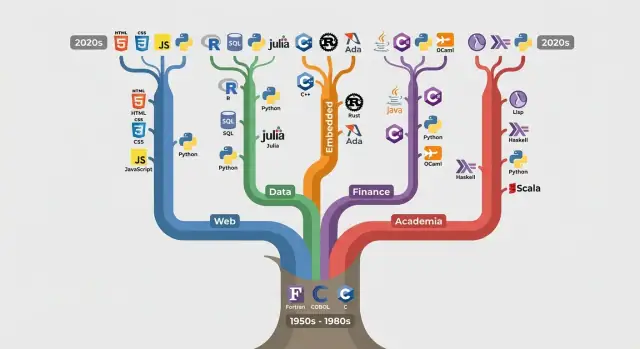
More often, languages shrink, specialize, or get embedded inside newer stacks.
- Shrink: fewer greenfield projects, but plenty of maintenance work.
- Specialize: concentrated use in a domain where the language is still efficient or trusted.
- Embedded: the language becomes the “inside” layer—scripting, extensions, glue code, or runtime dependencies.
What to expect in the real world
Across industries you’ll see different “afterlives”: enterprise systems keep older languages in production, science holds onto proven numerical tools, embedded devices prioritize stability and predictable performance, and the web keeps long-running languages relevant through constant platform evolution.
This article is written for non-technical readers and decision-makers—people choosing technologies, funding rewrites, or managing risk. The goal isn’t to argue that every old language is a good choice; it’s to explain why “dead language” headlines often miss what actually matters: whether the language still has a viable path to run, evolve, and be supported.
Software Outlasts Trends
Programming languages don’t survive because they win popularity contests. They survive because the software written in them keeps delivering value long after the headlines move on.
A payroll system that runs every two weeks, a billing engine that reconciles invoices, or a logistics scheduler that keeps warehouses stocked isn’t “cool”—but it’s the kind of software a business can’t afford to lose. If it works, is trusted, and has years of edge cases baked in, the language underneath gets a long life by association.
Business value beats technical fashion
Most organizations aren’t trying to chase the newest stack. They’re trying to reduce risk. Mature systems often have predictable behavior, known failure modes, and a trail of audits, reports, and operational knowledge. Replacing them isn’t just a technical project; it’s a business continuity project.
Switching costs are real (and often underestimated)
Rewriting a working system can mean:
- Retraining teams (or hiring scarce expertise)
- Migrating data and rebuilding integrations
- Accepting downtime risk during cutover
- Re-validating results, controls, and compliance requirements
Even if a rewrite is “possible,” it may not be worth the opportunity cost. That’s why languages associated with long-lived systems—think mainframes, finance platforms, manufacturing controls—remain in active use: the software still earns its keep.
Analogy: infrastructure vs. gadgets
Treat programming languages like infrastructure rather than gadgets. You might replace your phone every few years, but you don’t rebuild a bridge because a newer design is trending. As long as the bridge carries traffic safely, you maintain it, reinforce it, and add on-ramps.
That’s how many companies treat core software: maintain, modernize at the edges, and keep the proven foundation running—often in the same language for decades.
Legacy Systems Keep Languages in Active Use
A “legacy system” isn’t a bad system—it’s simply software that has been in production long enough to become essential. It may run payroll, payments, inventory, lab instruments, or customer records. The code might be old, but the business value is current, and that keeps “legacy languages” in active use across enterprise software.
Why rewrites are riskier than they sound
Organizations often consider rewriting a long-running application in a newer stack. The problem is that the existing system usually contains years of hard-earned knowledge:
- Hidden business rules that were never fully documented
- Edge cases discovered only after real customers and real data hit production
- Compliance behavior (audit trails, reporting, retention) that has been validated over time
When you rewrite, you don’t just re-create features—you re-create behavior. Subtle differences can cause outages, financial errors, or regulatory issues. That’s why mainframe and COBOL systems, for example, still power critical workflows: not because teams love the syntax, but because the software is proven and dependable.
Incremental modernization is the common path
Instead of a “big bang” rewrite, many companies modernize in steps. They keep the stable core and gradually replace pieces around it:
- Wrapping older services with APIs
- Migrating specific modules while leaving the rest untouched
- Moving data access or user interfaces to newer components
- Using language interoperability to connect old and new runtimes
This approach reduces risk and spreads cost over time. It also explains programming language longevity: as long as valuable systems depend on a language, skills, tooling, and communities continue to exist around it.
Stability can be a competitive advantage
Older codebases often prioritize predictability over novelty. In regulated or high-availability environments, “boring” stability is a feature. A language that can run the same trusted program for decades—like Fortran in science or COBOL in finance—can remain relevant precisely because it does not change rapidly.
Ecosystems and Tooling Are Survival Gear
A programming language isn’t just syntax—it’s the surrounding ecosystem that makes it usable day after day. When people say a language is “dead,” they often mean, “It’s hard to build and maintain real software with it.” Good tooling prevents that.
Tooling that keeps a language practical
Compilers and runtimes are the obvious foundation, but survival depends on the everyday workbench:
- Package managers and registries make it easy to reuse libraries, patch security issues, and standardize builds across teams.
- IDEs and editor plugins reduce friction with autocomplete, refactoring, jump-to-definition, and debugging.
- Linters and formatters help teams write consistent code and catch mistakes early.
- Test runners and CI integrations turn “it works on my machine” into repeatable releases.
Even an older language can stay “alive” if these tools remain maintained and accessible.
Better tooling can spark renewed interest
A surprising pattern: tooling upgrades often revive a language more than new language features do. A modern language server, faster compiler, clearer error messages, or a smoother dependency workflow can make an old codebase feel newly approachable.
That matters because newcomers rarely evaluate a language in the abstract—they evaluate the experience of building something with it. If setup takes minutes instead of hours, communities grow, tutorials multiply, and hiring becomes easier.
Stability: LTS and conservative upgrade paths
Longevity also comes from not breaking users. Long-term support (LTS) releases, clear deprecation policies, and conservative upgrade paths let companies plan upgrades without rewriting everything. When upgrading feels safe and predictable, organizations keep investing in the language instead of fleeing it.
Documentation is part of the ecosystem
Docs, examples, and learning resources are as important as code. Clear “getting started” guides, migration notes, and real-world recipes lower the barrier for the next generation. A language with strong documentation doesn’t just endure—it stays adoptable.
Standards and Backward Compatibility Reduce Risk
A big reason languages stick around is that they feel safe to build on. Not “safe” in the security sense, but safe in the business sense: teams can invest years into software and reasonably expect it to keep working, compiling, and behaving the same way.
Standards bodies and stable specs
When a language has a clear, stable specification—often maintained by a standards body—it becomes less dependent on a single vendor or a single compiler team. Standards define what the language means: syntax, core libraries, and edge-case behavior.
That stability matters because large organizations don’t want to bet their operations on “whatever the newest release decided.” A shared spec also allows multiple implementations, which reduces lock-in and makes it easier to keep old systems running while gradually modernizing.
Backward compatibility is an enterprise feature
Backward compatibility means older code keeps working with newer compilers, runtimes, and libraries (or at least has well-documented migration paths). Enterprises value this because it lowers the total cost of ownership:
- Fewer emergency rewrites when platforms update
- Less time spent retesting unchanged functionality
- Smaller training burden for teams maintaining long-lived codebases
Predictable behavior is especially valuable in regulated environments. If a system has been validated, organizations want updates to be incremental and auditable—not a full requalification because a language update subtly changed semantics.
The alternative: breaking changes that drain trust
Frequent breaking changes push people away for a simple reason: they convert “upgrade” into “project.” If each new version requires touching thousands of lines, reworking dependencies, and chasing subtle differences in behavior, teams delay upgrades—or abandon the ecosystem.
Languages that prioritize compatibility and standardization create a boring kind of confidence. That “boring” is often what keeps them in active use long after hype has moved on.
Interoperability Lets Languages Plug Into New Stacks
A language doesn’t have to “win” every new trend to stay useful. Often it survives by plugging into whatever stack is current—web services, modern security requirements, data science—through interoperability.
Libraries and runtimes as adapters
Older languages can access modern capabilities when there’s a maintained runtime or a well-supported set of libraries. That might mean:
- Calling web APIs (REST/GraphQL) through HTTP client libraries
- Using modern crypto via vetted implementations rather than rolling their own
- Handing off machine-learning work to external tools while keeping existing business logic intact
This is why “old” doesn’t automatically mean “isolated.” If a language can talk to the outside world reliably, it can keep doing valuable work inside systems that constantly evolve.
FFI, explained without jargon
FFI stands for foreign function interface. In plain terms: it’s a bridge that lets code written in one language call code written in another.
That bridge is especially important because many ecosystems share common building blocks. A huge amount of performance-critical and foundational software is written in C and C++, so being able to call into C/C++ is like getting access to a universal parts bin.
Common interoperability patterns
One pattern is calling C/C++ libraries from “higher-level” languages. Python uses C extensions for speed; Ruby and PHP have native extensions; many newer languages also offer C-ABI compatibility. Even when the application code changes over time, those C libraries often remain stable and widely supported.
Another pattern is embedding interpreters. Instead of rewriting a large system, teams embed a scripting language (like Lua, Python, or JavaScript engines) inside an existing application to add configurability, plugin systems, or quick feature iteration. In this setup, the embedded language is a component—powerful, but not the whole product.
Interoperability reframes “survival”: a language can remain essential as glue code, an extension layer, or a stable core that delegates modern tasks to specialized modules.
Industries and Regulation Create Sticky Niches
Some programming languages persist because specific industries value stability more than novelty. When a system moves money, routes emergency calls, or monitors medical devices, “working predictably” is a feature you don’t trade away lightly.
High-stakes domains reward boring reliability
Finance is the classic example: core banking and payment processing often run huge, well-tested codebases where downtime is expensive and behavior changes are risky. Languages associated with long-lived enterprise software—like COBOL on mainframes, or Java in large transaction systems—remain in active use because they’ve proven they can process massive volumes with consistent results.
Telecom systems are similar: carrier networks depend on continuous operation, long hardware lifecycles, and carefully managed upgrades. Technologies that support deterministic behavior and mature operational tooling tend to stick.
In aerospace and defense, certification is a survival filter. Standards like DO-178C make changes costly, so teams favor languages and toolchains with strong safety properties, predictable performance, and certification-friendly ecosystems. That’s part of why Ada and carefully controlled C/C++ subsets remain common.
Healthcare adds another layer: patient safety and traceability. For medical software and devices (often aligned with IEC 62304 or FDA expectations), being able to document requirements, testing, and change history matters as much as developer convenience.
Regulation, audits, and certification slow down “switching”
Regulatory regimes and audits (think SOX, PCI DSS, HIPAA, or industry-specific equivalents) push organizations toward technologies that are well understood, well documented, and easier to validate repeatedly. Even if a new language is “better,” proving it’s safe, compliant, and operationally controllable can take years.
Procurement cycles and support contracts lock in ecosystems
Large enterprises buy multi-year vendor support contracts, train staff, and standardize on approved stacks. Procurement cycles can outlast tech trends, and regulators often expect continuity. When a language has a mature vendor ecosystem, long-term support, and talent pipelines, it keeps its niche.
The result: languages survive not only because of nostalgia, but because their strengths—safety, determinism, performance, and proven operational behavior—match the constraints of regulated, high-consequence industries.
Education and Research Keep Ideas Alive
A language doesn’t have to dominate job listings to stay alive. Universities, textbooks, and research labs keep many languages circulating for decades—sometimes as primary teaching materials, sometimes as the “second language” students use to learn a new way of thinking.
Languages as teaching tools for paradigms
In classrooms, languages often serve as clear examples of a paradigm rather than as a direct route to employment:
- Functional programming courses commonly use languages that make immutability and higher-order functions feel natural.
- Logic and declarative programming courses use languages that force you to express what you want, not how to compute it.
- Systems courses often lean on languages that expose memory, types, and compilation details so students learn what higher-level abstractions hide.
This “teaching tool” role is not a consolation prize. It creates a steady pipeline of developers who understand the language’s ideas—and may later bring those ideas into other stacks.
Research prototypes seed mainstream features
Academia and industrial research groups frequently build new language features as prototypes first: type systems, pattern matching, garbage collection techniques, module systems, concurrency models, and formal verification approaches. Those prototypes may live in research languages for years, but the concepts can later influence mainstream languages through papers, conferences, and open-source implementations.
That influence is one reason old languages rarely vanish completely: even when the syntax isn’t copied, the ideas persist and reappear in new forms.
Educational use is real-world impact
Educational adoption also creates practical effects outside the classroom. Graduates carry libraries, interpreters, compilers, and tooling into the wider world; they write blogs, build niche open-source communities, and sometimes deploy what they learned in specialized domains.
So when a language remains common in courses and research, it’s not “dead”—it’s still shaping how software gets designed.
Some Languages Stay Because They’re Still the Best Tool
Not every language survives because of nostalgia or old codebases. Some stick around because, for certain jobs, they still do the job better—or with fewer unpleasant surprises—than newer alternatives.
Performance and predictability beat novelty
When you’re pushing hardware limits or running the same computation millions of times, small overheads become real money and real time. Languages that offer predictable performance, simple execution models, and tight control over memory tend to stay relevant.
That’s also why “hardware proximity” keeps showing up as a reason for longevity. If you need to know exactly what the machine will do (and when), a language that maps cleanly to the underlying system is hard to replace.
Examples where “old” is still best-in-class
Fortran for numerical computing is a classic example. In scientific and engineering workloads—large simulations, linear algebra, high-performance computing—Fortran compilers and libraries have been optimized for decades. Teams often care less about how trendy the syntax is and more about getting stable, fast results that match validated research.
C for embedded systems persists for similar reasons: it’s close to the metal, widely supported on microcontrollers, and predictable in resource usage. When you have tight memory, hard realtime constraints, or custom hardware, that straightforward control can matter more than developer conveniences.
SQL for data querying endures because it matches the problem: describing what data you want, not how to fetch it step by step. Even when newer data platforms appear, they often keep SQL interfaces because it’s a shared language across tools, teams, and decades of knowledge.
The “right tool” mindset
A healthy engineering culture doesn’t force one language to do everything. It picks languages the way you’d pick tools: based on constraints, failure modes, and long-term maintenance. That’s how “older” languages remain practical—because they’re still the most reliable choice in their niche.
How Languages Get Revivals and New Niches
A language doesn’t have to “win” the popularity charts to get a second life. Revivals usually happen when something changes around the language—how it runs, how it’s packaged, or where it fits in modern workflows.
Common triggers for a revival
Most comebacks follow a few repeatable patterns:
- A new runtime or compilation target that makes the language faster, safer, or easier to deploy (for example, better JITs, native-image options, or WebAssembly targets)
- A stronger package ecosystem: a modern dependency manager, better docs, and curated libraries that remove day-to-day friction
- Clear governance: a stable roadmap, predictable releases, and a trusted foundation that lowers the risk for teams
- Corporate adoption (or sponsorship) that funds full-time work on tooling, performance, and long-term support
How a “new niche” forms
New niches often emerge when a language becomes the best fit for a specific surface area, even if it’s not the “main” application language.
A few common paths:
- Scripting inside apps: embedding a language for plugins, customization, game mods, or automation workflows
- Infrastructure tooling: CLIs, build systems, configuration, policy-as-code, and deployment helpers
- Glue code for new stacks: a language becomes the convenient bridge between systems, APIs, and services
Once a niche is established, it can be self-reinforcing: tutorials, libraries, and hiring pipelines start to align with that use case.
Community catalysts (and why hype isn’t enough)
Open source maintainers and community events matter more than they get credit for. A few dedicated maintainers can modernize tooling, keep releases timely, and respond to security issues. Conferences, meetups, and “hack weeks” create shared momentum—new contributors arrive, best practices spread, and success stories get documented.
What doesn’t create longevity on its own: hype. A spike of attention without dependable tooling, governance, and real production wins usually fades fast. A revival sticks when it solves a recurring problem better than the alternatives—and keeps doing so year after year.
Practical Guidance: Choosing Languages for Long-Term Work
Picking a language for “long-term” work isn’t about predicting which one will be fashionable. It’s about choosing a tool that will remain operable, maintainable, and hireable as your product and organization change.
Criteria that age well
Start with constraints you can verify rather than opinions:
- Hiring market: How easy is it to find experienced developers locally or remotely? Also check whether juniors are learning it (a steady entry pipeline matters).
- Library maturity: Are the core libraries stable and well-documented? Do critical dependencies have active maintainers and clear release practices?
- Deployment targets: Where must this run—browsers, mobile, embedded devices, serverless, mainframes, air‑gapped environments? Some languages shine only in certain targets.
- Integration needs: Can it talk to the systems you already have (databases, message queues, identity providers)? Interop and bindings can matter more than elegance.
Measure total cost, not just developer preference
A language choice affects costs that don’t show up in a hello-world demo:
- Training time: ramp-up for new hires and cross-functional teams
- Maintenance burden: debugging, upgrades, dependency management, tooling friction
- Long-term support: availability of LTS releases, security patching, vendor/community support options
A “cheaper” language can become expensive if it requires niche specialists or frequent rewrites.
De-risking tactics before you commit
Reduce uncertainty with small, deliberate steps:
- Build a prototype around the hardest requirement (performance, compliance, or integration).
- Prefer gradual migration paths over big-bang rewrites.
- Use interoperability bridges (FFI, stable APIs, shared protocols) so you can swap components without replacing everything.
If your biggest risk is simply “how fast can we validate this approach?”, tools that accelerate prototypes can help—especially when you want something you can later maintain like a normal codebase. For example, Koder.ai is a vibe-coding platform that lets teams build web, backend, and mobile prototypes through chat, then export the source code (React on the front end, Go + PostgreSQL on the back end, Flutter for mobile). Used carefully, that can shorten the time between an idea and a working proof-of-concept, while still keeping an exit path via exported code and incremental refactoring.
Reusable checklist
Before you lock in a stack, confirm:
- We can hire for it within our timeline and budget
- Critical libraries are mature and actively maintained
- It supports our deployment targets today and likely next year
- It integrates cleanly with our existing systems
- There is an LTS/support story (community or vendor)
- We proved the riskiest part with a prototype
- We have an exit plan (interop, modular boundaries, migration path)
FAQ
What does it actually mean for a programming language to be “dead”?
A language is effectively “dead” when you can’t use it in practice anymore—meaning you can’t reasonably build, run, or maintain software with it on current systems.
Losing popularity, memes, or bootcamp coverage is more about visibility than real-world viability.
Why do “dead language” headlines often get it wrong?
Because trends measure attention, not operational reality. A language can drop in surveys while still running critical payroll, billing, logistics, or infrastructure systems.
For decision-makers, the key question is: Can we still operate and support systems built in it?
What are the practical signs a language is dying?
A language is near-dead when most of these are true:
- No maintained compiler/interpreter on current OS/hardware
- Tooling is broken or abandoned (debugging, builds, editors)
- Libraries can’t be updated or security issues can’t be patched
- Real production work stops (not just fewer hobby projects)
Even then, it can be revived via forks, preserved toolchains, or paid support.
How do legacy systems keep older languages in active use?
Because valuable software outlasts fashion. If a system reliably delivers business value, organizations tend to maintain it rather than risk replacing it.
The language stays “alive by association” as long as the software remains essential and supported.
Why are rewrites of long-running systems riskier than they sound?
Rewrites aren’t just code changes—they’re business continuity events. Typical hidden costs include:
- Retraining/hiring for a new stack
- Data migration and integration rebuilds
- Cutover downtime and rollback planning
- Re-validating compliance, audits, and edge-case behavior
Often the safer path is incremental modernization, not replacement.
Why do tooling and ecosystems matter more than language features for survival?
Because usability depends on the surrounding “workbench,” not just the syntax. A language stays practical when it has:
- Maintained compilers/runtimes
- Dependency management and repeatable builds
- Debugging, testing, CI support
- Good documentation and examples
Tooling upgrades can make an older language feel modern without changing the language itself.
How do standards and backward compatibility help languages last longer?
Standards and compatibility reduce operational risk. They help ensure code keeps compiling and behaving predictably across time.
Practically, this can mean:
- Less “upgrade as a project” pain
- More than one viable implementation (less lock-in)
- Clear deprecation and migration paths
For regulated environments, predictable behavior can matter as much as developer speed.
What is interoperability (and FFI) and why does it keep languages relevant?
Interoperability lets a language plug into modern systems instead of being isolated. Common approaches include:
- Calling modern services via HTTP APIs
- Using vetted crypto and core libraries via maintained bindings
- Using an FFI (foreign function interface) to call code in another language (often C/C++)
- Embedding a scripting language for plugins or automation
This is how a language can remain essential as a “core” or “glue” layer.
Why do regulated industries tend to keep older languages?
High-stakes domains reward stability because changes are expensive and risky. Examples include finance, telecom, aerospace/defense, and healthcare.
Regulation, audits, certification, and long vendor support cycles create “sticky” niches where proven toolchains and predictable behavior beat novelty.
How should a non-technical team choose a language for long-term work?
Use criteria you can verify, not hype:
- Hiring pipeline (seniors and juniors)
- Library maturity and maintenance health
- Deployment targets (now and likely next year)
- Integration with existing systems
- LTS/support options and security patching
De-risk with a prototype for the hardest requirement and prefer incremental migration paths over big-bang rewrites.