

Why Rust Is Gaining Adoption for Systems and Backend Work
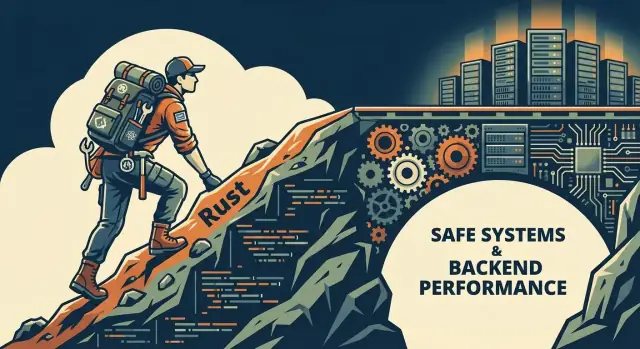
Rust is harder to learn than many languages, yet more teams use it for systems and backend services. Here’s what’s driving the shift and when it fits.
What This Post Covers (and What It Doesn’t)
Rust is often described as a “systems language,” but it’s increasingly showing up in backend teams building production services. This post explains why that’s happening in practical terms—without assuming you’re deep into compiler theory.
What we mean by “systems” and “backend”
Systems work is code that sits close to the machine or critical infrastructure: networking layers, storage engines, runtime components, embedded services, and performance-sensitive libraries that other teams depend on.
Backend work powers products and internal platforms: APIs, data pipelines, service-to-service communication, background workers, and reliability-heavy components where crashes, leaks, and latency spikes cause real operational pain.
What “adoption” actually looks like
Rust adoption usually isn’t a dramatic “rewrite everything” moment. More commonly, teams introduce Rust in one of these ways:
- A new service where reliability and predictable performance matter from day one
- A rewrite of a single hot path (e.g., parsing, compression, crypto, request routing)
- A shared library used across multiple services to eliminate recurring memory-safety issues
- A small “edge” component (CLI tools, agents, sidecars) that benefits from static binaries and low overhead
How we’ll treat the learning curve
Rust can feel hard at first—especially if you’re coming from GC languages or you’ve relied on “try it and see” debugging in C/C++. We’ll acknowledge that upfront and explain why it feels different, along with concrete ways teams reduce ramp-up time.
What this post won’t do
This isn’t a claim that Rust is best for every team or every service. You’ll see trade-offs, cases where Go or C++ may still be a better fit, and a realistic view of what changes when you put Rust into a production backend.
For comparisons and decision points, jump ahead to /blog/rust-vs-go-vs-cpp and /blog/trade-offs-when-rust-isnt-best.
The Real Problems Teams Want to Solve in Systems/Backend Code
Teams don’t rewrite critical systems and backend services because a new language is trendy. They do it when the same painful failures keep happening—especially in code that manages memory, threads, and high-throughput I/O.
The bugs that hurt the most: memory errors
A lot of serious crashes and security issues trace back to a small set of root causes:
- Use-after-free: code keeps a pointer/reference to memory that’s already been released, then reads or writes through it.
- Buffer overflows/out-of-bounds access: writing past the end of an array or reading invalid memory.
- Double free: freeing the same allocation twice, corrupting allocator state.
- Null/dangling pointers: trying to access something that isn’t there (or isn’t there anymore).
- Data races in concurrent code: two threads access the same data at the same time, with at least one write.
These issues aren’t just “bugs.” They can become production incidents, remote code execution vulnerabilities, and heisenbugs that vanish in staging but appear under real load.
Why they’re expensive
When low-level services misbehave, the cost compounds:
- Outages and degraded performance that affect customers immediately
- Incident response that drags senior engineers into late-night debugging
- Slow fixes because the failure is hard to reproduce—and even harder to prove you eliminated
- Security work involving emergency patches, audits, and long-term trust damage
Why “fast” and “safe” often conflict
In C/C++-style approaches, getting maximum performance often means manual control over memory and concurrency. That control is powerful, but it also makes it easy to create undefined behavior.
Rust is discussed in this context because it aims to reduce that trade-off: keep systems-level performance while preventing whole categories of memory and concurrency bugs before code ships.
Rust’s Safety Model in Plain English
Rust’s headline promise is simple: you can write low-level, fast code while avoiding a large class of failures that often show up as crashes, security issues, or “it only fails under load” incidents.
Ownership and borrowing: a practical mental model
Think of a value in memory (like a buffer or a struct) as a tool:
- Ownership means exactly one person “holds the tool” at a time and is responsible for putting it away (freeing memory).
- Borrowing means someone can use the tool without owning it.
Rust allows either:
- Many readers (shared borrows) at the same time, or
- One writer (a mutable borrow) at a time,
but not both simultaneously. That rule prevents situations where one part of your program changes or frees data while another part still expects it to be valid.
What the compiler checks (and why it matters)
Rust’s compiler enforces these rules at compile time:
- You don’t use memory after it’s freed.
- You don’t read uninitialized memory.
- You don’t have two parts of the code mutating the same data in an unsafe way.
- In multi-threaded code, values shared across threads must be safe to share.
The key benefit is that many failures become compile errors, not production surprises.
“No garbage collector” and latency
Rust does not rely on a garbage collector (GC) that periodically pauses your program to find and free unused memory. Instead, memory is reclaimed automatically when the owner goes out of scope.
For latency-sensitive backend services (tail latency and predictable response times), avoiding GC pause behavior can make performance more consistent.
Yes, unsafe exists—and it’s intentionally limited
Rust still lets you drop down to unsafe for things like OS calls, tight performance work, or interfacing with C. But unsafe is explicit and localized: it marks “here be dragons” areas, while the rest of the codebase stays under the compiler’s safety guarantees.
That boundary makes reviews and audits more focused.
Performance Without Surprises: Why Rust Fits Backend Needs
Backend teams rarely chase “max speed” for its own sake. What they want is predictable performance: solid throughput on average, and fewer ugly spikes when traffic surges.
Predictable throughput and tail latency
Users don’t notice your median response time; they notice the slow requests. Those slow requests (often measured as p95/p99 “tail latency”) are where retries, timeouts, and cascading failures begin.
Rust helps here because it doesn’t rely on stop-the-world GC pauses. Ownership-driven memory management makes it easier to reason about when allocations and frees happen, so latency cliffs are less likely to appear “mysteriously” during request handling.
This predictability is especially useful for services that:
- run with tight latency SLOs
- handle bursty traffic
- sit on critical paths (API gateways, auth, storage proxies)
“Zero-cost abstractions” in normal words
Rust lets you write high-level code—using iterators, traits, and generics—without paying a big runtime penalty.
In practice, that often means the compiler can turn “nice” code into efficient machine code similar to what you’d write by hand. You get cleaner structure (and fewer bugs from duplicated low-level loops) while keeping performance close to the metal.
Startup time, memory usage, and steady state
Many Rust services start quickly because there’s usually no heavy runtime initialization. Memory usage can also be easier to reason about: you choose data structures and allocation patterns explicitly, and the compiler nudges you away from accidental sharing or hidden copies.
Rust often shines in steady state: once caches, pools, and hot paths are warmed up, teams commonly report fewer “random” latency cliffs caused by background memory work.
Language helps, design decides
Rust won’t fix a slow database query, an over-chattery microservice graph, or an inefficient serialization format.
Performance still depends on design choices—batching, caching, avoiding unnecessary allocations, selecting the right concurrency model. Rust’s advantage is reducing “surprise” costs, so when performance is bad, you can usually trace it to concrete decisions rather than hidden runtime behavior.
Concurrency and Reliability: Fewer Late-Night Incidents
Backend and systems work tends to fail in the same stressful ways: too many threads touching shared data, subtle timing issues, and rare race conditions that only show up under production load.
The core challenge: shared state under pressure
As services scale, you typically add concurrency: thread pools, background jobs, queues, and multiple requests in flight at once. The moment two parts of the program can access the same data, you need a clear plan for who can read, who can write, and when.
In many languages, that plan lives mostly in developer discipline and code review. That’s where late-night incidents happen: an innocent refactor changes timing, a lock is missed, and a rarely-triggered path starts corrupting data.
How Rust blocks many data races before you run anything
Rust’s ownership and borrowing rules don’t just help with memory safety—they also constrain how data can be shared across threads.
- If a value is mutable, Rust wants to know there’s only one active “writer” at a time.
- If it’s shared, Rust pushes you toward safe patterns (immutable sharing, message passing, or explicit synchronization types).
The practical impact: many would-be data races fail at compile time. Instead of shipping “probably fine” concurrency, you’re forced to make the data-sharing story explicit.
Async/await for high-concurrency network services
Rust’s async/await is popular for servers that handle lots of network connections efficiently. It lets you write readable code for concurrent I/O without manually juggling callbacks, while runtimes like Tokio handle scheduling.
The caution: Rust can’t architect your system
Rust reduces entire categories of concurrency mistakes, but it doesn’t eliminate the need for careful design. Deadlocks, poor queueing strategies, backpressure, and overloaded dependencies are still real problems. Rust makes unsafe sharing harder; it doesn’t automatically make the workload well-structured.
Where Rust Is Being Used in Practice (Without the Hype)
Rust’s real-world adoption is easiest to understand by looking at where it behaves like a “drop-in improvement” for parts of a system that already exist—especially the parts that tend to be performance-sensitive, security-sensitive, or hard to debug when they fail.
Common, practical use cases
A lot of teams start with small, contained deliverables where Rust’s build + packaging story is predictable and the runtime footprint is low:
- CLI tools for internal automation, migrations, log inspection, or release tooling
- Agents and daemons (monitoring collectors, sidecar-style processes, host agents) where stability matters and memory leaks are expensive
- Proxies and gateways (HTTP/TCP, service mesh components, protocol translation) that need high throughput under load
- Libraries that implement parsing, compression, crypto, policy evaluation, or other “hot path” logic
These are good entry points because they’re measurable (latency, CPU, memory) and failures are obvious.
Incremental adoption: FFI or service boundaries
Most organizations don’t “rewrite everything in Rust.” They adopt it incrementally in two common ways:
- Service boundaries: build a new microservice in Rust and integrate it through HTTP/gRPC/queues. This keeps risk low because rollback is simple.
- FFI integration: use Rust to replace a problematic C/C++ component behind a stable API. This is common when you need to keep an existing app architecture but want safer internals.
If you’re exploring the latter, be strict about interface design and ownership rules at the boundary—FFI is where safety benefits can erode if the contract is unclear.
Replacing C/C++ vs complementing them
Rust often replaces C/C++ in components that historically required manual memory management: protocol parsers, embedded utilities, performance-critical libraries, and parts of networking stacks.
It also frequently complements existing C/C++ systems: teams keep mature code where it’s stable, and introduce Rust for new modules, security-sensitive parsing, or concurrency-heavy subsystems.
Production expectations: testing and observability
In practice, Rust services are held to the same bar as any other production system: comprehensive unit/integration tests, load testing for critical paths, and solid observability (structured logs, metrics, tracing).
The difference is what tends to stop happening as often: fewer “mystery crashes” and less time spent debugging memory-corruption-style incidents.
The Learning Curve: What Makes Rust Feel Hard at First
Rust feels slower at the beginning because it refuses to let you defer certain decisions. The compiler doesn’t just check syntax; it asks you to be explicit about how data is owned, shared, and mutated.
Why early progress can feel slower
In many languages, you can prototype first and clean up later. In Rust, the compiler pushes some of that cleanup into the first draft. You may write a few lines, hit an error, adjust, hit another error, and repeat.
That isn’t you “doing it wrong”—it’s you learning the rules Rust uses to keep memory safe without a garbage collector.
Common stumbling blocks (and why they happen)
Two concepts cause most of the early friction:
- Borrowing and mutability: Rust requires that “shared” access and “mutable” access don’t happen at the same time. Newcomers often see errors like “cannot borrow as mutable because it is also borrowed as immutable” and feel blocked.
- Lifetimes: Lifetimes describe how long references must remain valid. You’ll most often run into them when returning references from functions, storing references in structs, or wiring together several layers of abstractions.
These errors can be confusing because they point at symptoms (a reference could outlive its data) while you’re still searching for the design change (own the data, clone intentionally, restructure APIs, or use smart pointers).
The payoff: confidence during refactors
Once the ownership model clicks, the experience flips. Refactors become less stressful because the compiler acts like a second reviewer: it catches use-after-free, accidental sharing across threads, and many subtle “works in tests, fails in prod” bugs.
Teams often report that changes feel safer even when touching performance-sensitive code.
A realistic ramp-up timeline
For an individual developer, expect 1–2 weeks to feel comfortable reading Rust and making small edits, 4–8 weeks to ship non-trivial features, and 2–3 months to design clean APIs confidently.
For teams, the first Rust project typically needs extra time for conventions, code review habits, and shared patterns. A common approach is a 6–12 week pilot where the goal is learning and reliability, not maximum velocity.
How Teams Get Productive with Rust Faster
Teams that ramp up quickly treat early friction as a training phase—with guardrails.
Use the tooling like a coach
Rust’s built-in tools reduce “mystery debugging” if you lean on them early:
- Compiler errors as guidance: encourage devs to read the full message (and the “help” suggestions) instead of trying random fixes.
clippyandrustfmt: standardize style and catch common mistakes automatically so code reviews focus on architecture and correctness.- Docs that meet you where you are: the official book, Rust by Example, and standard library docs are unusually practical.
A simple team norm: if you touch a module, run formatting and linting in the same PR.
Make code review rules explicit
Rust reviews go smoother when everyone agrees on what “good” looks like:
- Prefer simpler ownership models (clear owners, fewer shared mutable references).
- Use
Resultand error types consistently (one approach per service). - Add small, focused tests around boundary code (parsing, I/O, retries).
Pairing helps most during the first few weeks—especially when someone hits lifetime-related refactors. One person drives the compiler; the other keeps the design simple.
Train with small, real projects
Teams learn fastest by building something that matters but won’t block delivery:
- A CLI tool that transforms data
- A background worker
- A small internal HTTP service
Many orgs succeed with a “Rust in one service” pilot: pick a component with clear inputs/outputs (e.g., a proxy, ingest, or image pipeline), define success metrics, and keep the interface stable.
One pragmatic way to keep momentum during a Rust pilot is to avoid spending weeks hand-building surrounding “glue” (admin UI, dashboards, simple internal APIs, staging environments). Platforms like Koder.ai can help teams spin up companion web/backoffice tools or simple Go + PostgreSQL services via chat—then keep the Rust component focused on the hot path where it adds the most value. If you do this, use snapshots/rollback to keep experiments safe and treat the generated scaffolding like any other code: review, test, and measure.
Rust vs C/C++ vs Go: A Practical Comparison
Choosing between Rust, C/C++, and Go usually isn’t about “best language.” It’s about what kind of failures you can tolerate, what performance envelope you need, and how quickly your team can ship safely.
Safety: compile-time vs runtime
- Rust pushes many safety checks to compile time. The borrow checker prevents entire classes of memory bugs (use-after-free, double-free, many data races) before code runs.
- C/C++ rely heavily on developer discipline and testing. You can build safe systems, but it takes rigorous reviews, careful APIs, sanitizers, and time.
- Go emphasizes developer speed with runtime safety: garbage collection avoids many memory-management bugs, and the language keeps unsafe features limited. You still need to manage data races and shared-state design.
Performance and predictability
- C/C++: top-end performance and lowest-level control, but also the sharpest edges.
- Rust: often C/C++-level performance with stronger guarantees; great when you need speed and want fewer memory-related incidents.
- Go: strong throughput for many services, but garbage collection and runtime scheduling can introduce latency variability—important for tail-latency-sensitive backends.
Ecosystem and integration
- C/C++: widest systems ecosystem; easiest when you must integrate with existing native codebases.
- Rust: excellent C FFI and a fast-growing crate ecosystem; a common pattern is wrapping existing C libraries while writing new logic in Rust.
- Go: straightforward standard library and tooling; C interop exists (cgo) but can complicate builds and performance tuning.
Hiring and familiarity
- Go is generally easiest to hire for and ramp up.
- C/C++ has a large talent pool, but “safe C++ at scale” is a specialized skill.
- Rust talent is growing; plan for training and mentorship, especially early.
A simple decision matrix
| If you care most about… | Usually pick |
|---|---|
| Maximum low-level control / legacy native integration | C/C++ |
| Memory safety + high performance in long-lived services | Rust |
| Fast delivery, simple concurrency patterns, standard tooling | Go |
The practical takeaway: pick the language that reduces your most expensive failures—whether that’s outages, latency spikes, or slow iteration.
Trade-Offs and When Rust Might Not Be the Best Choice
Rust can be a great fit for services that need speed and safety, but it’s not “free wins.” Before you commit, it helps to name the costs you’ll actually pay—especially as the codebase and team grow.
The hidden costs teams feel later
Rust’s compiler does a lot of work to keep you safe, and that shows up in everyday workflow:
- Build times and tooling weight: Large crates, heavy generics, and lots of dependencies can slow incremental builds. CI can get expensive if you don’t invest in caching and build hygiene.
- Compile complexity: Error messages are generally good, but the mental model (lifetimes, traits, async) can make “simple changes” feel slower at first.
- Expertise needs: A team can ship Rust without everyone being an expert, but you’ll want a few people who can set patterns, review tricky PRs, and prevent “fighting the borrow checker” from becoming the default.
Ecosystem gaps that can matter
For common backend work (HTTP, databases, serialization), Rust is in good shape. The gaps show up in more specialized domains:
- Some enterprise integrations, niche protocols, or vendor SDKs may be missing or less mature than in Go/Java.
- Observability libraries (APM, tracing exporters) may exist, but not always with the same polish or documentation you’d get elsewhere.
- GUI, data science, and certain cloud-provider “one-liner” workflows can be less convenient.
If your product depends on a specific library being stable and well-supported, verify that early rather than assuming it will appear.
Interoperability and operational reality
Rust interoperates well with C and can be deployed as static binaries, which is a plus. But there are operational concerns to plan for:
- Debugging and profiling: Tooling is solid, yet workflows can differ from what your team is used to (especially around async stacks, flamegraphs, and symbolication).
- FFI boundaries: Mixing languages introduces safety and build-system complexity; you’ll need conventions, tests, and clear ownership.
Plan for long-term ownership
Rust rewards teams that standardize early: crate structure, error handling, async runtime choices, linting, and upgrade policies. Without that, maintenance can drift into “only two people understand this.”
If you can’t commit to ongoing Rust stewardship—training, code review depth, dependency updates—another language may be a better operational fit.
A Simple Adoption Playbook: From Pilot to Production
Rust adoption tends to go smoothly when you treat it like a product experiment, not a language switch. The goal is to learn quickly, prove value, and limit risk.
1) Choose the right pilot
Pick a small, high-value component with clear boundaries—something you can replace without rewriting the world. Good candidates include:
- A data processing job that’s CPU-heavy
- A request/response service that’s sensitive to tail latency
- A library used by multiple services where memory bugs would be costly
Avoid making the first pilot a “core everything” piece (auth, billing, or your main monolith). Start where failure is survivable and learning is fast.
2) Define success metrics before you write code
Agree on what “better” means, and measure it in ways the team already cares about:
- Reliability: incident count, on-call pages, crash rate
- Performance: p95/p99 latency, throughput, CPU time
- Efficiency: memory footprint, container size, cloud cost signals
- Developer time: time-to-ship, time spent debugging, review cycle length
Keep the list short, and baseline the current implementation so you can compare apples to apples.
3) Ship safely with controlled rollout patterns
Treat the Rust version as a parallel path until it earns trust.
Use:
- Feature flags to switch traffic or behavior without redeploying
- Canary releases to expose a small percent of traffic first
- Clear ownership (one team responsible for alerts, dashboards, and fixes)
Make observability part of “done”: logs, metrics, and a rollback plan that anyone on-call can execute.
4) Expand with a repeatable template
Once the pilot hits the metrics, standardize what worked—project scaffolding, CI checks, code review expectations, and a short “Rust patterns we use” doc. Then pick the next component using the same criteria.
If you’re evaluating tooling or support options for faster adoption, it can help to compare plans and fit early—see /pricing.
FAQ
What’s the difference between “systems” work and “backend” work in this post?
Systems code is closer to the machine or critical infrastructure (networking layers, storage engines, runtimes, embedded services, performance-sensitive libraries). Backend code powers products and platforms (APIs, pipelines, workers, service-to-service communication) where crashes, leaks, and latency spikes turn into operational incidents.
Rust shows up in both because many backend components have “systems-like” constraints: high throughput, tight latency SLOs, and concurrency under load.
What does Rust adoption usually look like in real teams?
Most teams adopt Rust incrementally rather than rewriting everything:
- Build a new service where predictable performance and reliability matter.
- Rewrite one hot path (parsing, compression, crypto, routing).
- Introduce a shared library to eliminate recurring memory-safety issues.
- Ship small edge components (CLIs, agents, sidecars) as static, low-overhead binaries.
This keeps blast radius small and makes rollback straightforward.
What are ownership and borrowing, in practical terms?
Ownership means one place is responsible for a value’s lifetime; borrowing lets other code temporarily use it.
Rust enforces a key rule: either many readers at once or one writer at once, but not both simultaneously. That prevents common failures like use-after-free and unsafe concurrent mutation—often turning them into compile errors instead of production incidents.
Does Rust “guarantee” reliability for backend services?
It can eliminate classes of bugs (use-after-free, double-free, many data races), but it doesn’t replace sound design.
You can still have:
- Deadlocks and poor locking strategy
- Bad backpressure/queueing
- Inefficient queries or chatty service graphs
- Over-allocation or poor data structure choices
Rust reduces “surprises,” but architecture still decides outcomes.
Why does “no garbage collector” matter for backend latency?
Garbage collectors can introduce runtime pauses or shifting costs during request handling. Rust typically frees memory when the owner goes out of scope, so allocation and freeing happen in more predictable places.
That predictability often helps tail latency (p95/p99), especially in bursty traffic or critical-path services like gateways, auth, and proxies.
When should you use `unsafe`, and how do you keep it under control?
unsafe is how Rust allows operations the compiler can’t prove safe (FFI calls, certain low-level optimizations, OS interfaces).
It’s useful when needed, but you should:
- Keep
unsafeblocks small and well-documented. - Wrap them behind safe APIs.
- Add focused tests around boundary behavior.
This makes audits and reviews concentrate on the few risky areas instead of the whole codebase.
How does Rust handle high-concurrency services (async/await)?
Rust’s async/await is commonly used for high-concurrency network services. Runtimes like Tokio schedule many I/O tasks efficiently, letting you write readable async code without manual callback wiring.
It’s a good fit when you have lots of concurrent connections, but you still need to design for backpressure, timeouts, and dependency limits.
How can we integrate Rust into an existing Go/Java/C++ system safely?
Two common strategies:
- Service boundaries: write a new Rust service and integrate via HTTP/gRPC/queues for easy rollback.
- FFI integration: replace a problematic C/C++ component behind a stable API.
FFI can dilute safety benefits if ownership rules are unclear, so define strict contracts at the boundary (who allocates, who frees, threading expectations) and test them heavily.
How steep is the Rust learning curve, and what’s a realistic ramp-up timeline?
Early progress can feel slower because the compiler forces you to be explicit about ownership, borrowing, and sometimes lifetimes.
A realistic ramp-up many teams see:
- 1–2 weeks: comfortable reading Rust and making small edits
- 4–8 weeks: shipping non-trivial features
- 2–3 months: designing clean APIs confidently
Teams often run a 6–12 week pilot to build shared patterns and review habits.
What’s a practical playbook for moving from a Rust pilot to production?
Pick a small, measurable pilot and define success before coding:
- Reliability: crash rate, incidents, on-call pages
- Performance: p95/p99 latency, throughput, CPU
- Efficiency: memory footprint, container size, cost signals
Ship with safety rails (feature flags, canaries, clear rollback), then standardize what worked (linting, CI caching, error handling conventions). For deeper comparisons and decision points, see /blog/rust-vs-go-vs-cpp and /blog/trade-offs-when-rust-isnt-best.