

Why Startup Ideas Fail: Distribution, Timing, and Behavior
Most startup ideas fail because founders miss distribution, launch at the wrong time, or misunderstand user behavior. Learn how to spot and fix these risks.
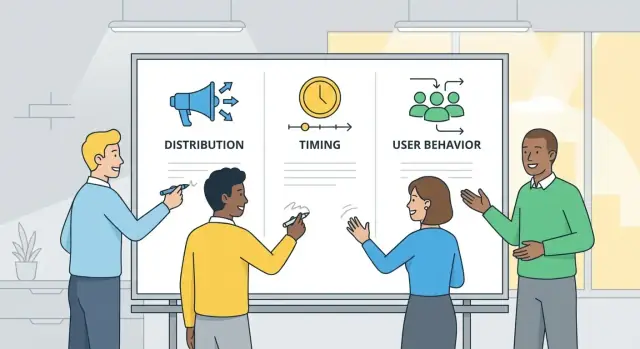
The Real Reasons “Good Ideas” Still Fail
A painful myth in startups is that great technology guarantees success. It doesn’t. Many products are genuinely well-built—sometimes even impressive—yet they stall because the non-technical parts of the business never worked.
The myth: “If it’s better, people will find it”
“Better” is not a distribution plan. A product can be 10× better and still lose to something merely familiar, easier to adopt, or already embedded in a workflow.
Startups don’t fail only because they lacked features—they fail because they couldn’t reliably reach the right people, at the right time, and ask for a behavior change that real humans would actually make.
Three drivers that quietly kill good ideas
Distribution: If you don’t know how customers will discover you, evaluate you, and buy you, you’re guessing. Channels have rules—some reward content, some reward partnerships, some reward sales effort. Choosing the wrong channel can make a good product look like it has “no demand.”
Timing: Even real demand can be premature demand. If the market isn’t ready—budgets, regulations, habits, or enabling tech—your pitch lands as “interesting” instead of “urgent.”
User behavior: Your product competes with inertia. If adoption requires people to learn, switch, trust, or coordinate, that behavior change becomes a core requirement—not an afterthought.
What this post is for (and who it’s for)
This post is for early founders, product builders, and indie hackers who want practical checks before building more. You’ll learn how to pressure-test a go-to-market path, sanity-check timing, and validate whether real humans will adopt the behavior your product needs.
Distribution: The Missing Half of Most Startup Plans
Many founders treat “building the product” as the main job and “marketing” as something you bolt on after launch. In practice, adoption is part of the product. If people don’t reliably discover it, try it, and decide to pay (or keep using it), the technology doesn’t matter.
Distribution, in plain terms
Distribution is the path your product takes from “exists” to “used.” It includes:
- How people hear about you (recommendations, search, communities, ads, partnerships)
- How they try you (demo, free trial, referral flow, onboarding)
- How they buy (self-serve checkout, sales calls, procurement)
A go-to-market plan isn’t a list of channels—it’s a repeatable system that turns attention into usage and usage into revenue.
The “default channels” for your category
Every category has a few channels customers already trust and use by habit. Those are your “default channels.” Examples:
- Developer tools often spread through GitHub, docs, and peer recommendations.
- Local services often win via Google reviews and maps.
- B2B software frequently moves through referrals, LinkedIn, and targeted outbound.
If your plan ignores the default channels, you’re asking customers to change behavior twice: adopt something new and find it in an unfamiliar way.
Early warning sign: no repeatable path
A common failure pattern is “we’ll go viral” or “we’ll do content” with no specifics. A clearer test is simple:
Can you name one channel where you can reach your target customer repeatedly, at a cost and effort you can sustain, with a realistic conversion path?
If the answer is vague, distribution isn’t missing—it’s undefined.
Choosing Channels That Actually Fit Your Product
Founders often pick a channel because it’s trendy (or because they personally like it), not because it matches how buyers discover and trust products.
Channel choice is a product decision: it shapes pricing, onboarding, sales motion, and even what “quality” means.
Common distribution channels (and what they’re good at)
- SEO / content: best when people actively search for a solution (“best invoicing tool for freelancers”). Compounds over time, but slow early.
- Partnerships: best when someone else already has your customer’s trust (agencies, platforms, integrators). Great for credibility, usually slower to set up.
- Outbound (email, LinkedIn, calling): best for clear B2B targets and high-value deals. Fast feedback, but requires strong positioning.
- Communities: best when identity and peer learning drive adoption (founder groups, niche forums). Works through trust, not volume.
- App marketplaces: best when your product is an add-on to an existing workflow (Shopify, Slack, Salesforce). Discovery is built in, but competition is intense.
Channel–product fit: a quick way to sanity-check
Ask: How does a buyer reduce risk?
If they need proof and compliance, outbound + case studies may beat TikTok. If they’re already searching for “how to fix X,” SEO is a natural fit. If your product only makes sense inside another tool, a marketplace listing may be your real front door.
Also match sales motion to price. A $19/mo tool can’t afford a heavy human sales process. A $20k/yr contract usually can.
“We’ll go viral” isn’t a plan
Virality is an outcome of distribution mechanics (sharing incentives, network effects, timing), not a baseline strategy. If your plan depends on a spike you can’t reliably repeat, you don’t yet have a channel.
Simple exercise: pick 1–2 primary channels and write a weekly plan
Choose one primary and one secondary channel for the next 4 weeks.
Weekly plan template:
- Goal (one number): e.g., 15 sales calls booked, 30 trials started
- Inputs you control: e.g., 40 outbound messages, 2 partner intros, 2 articles shipped
- One experiment: change one thing (audience, offer, landing page, subject line)
- Review (30 minutes): what converted, what didn’t, what to repeat next week
If you can’t write the inputs, you don’t have a channel—you have a hope.
Distribution Economics: Cost, Saturation, and Compounding
A channel isn’t “good” because it works for someone else—it’s good when its economics work for you. Many startup ideas fail after a promising launch because the math of distribution quietly breaks.
The real costs behind a channel
Most founders only price the obvious spend (ad budget, event fees). But channel cost is wider:
- CAC (Customer Acquisition Cost): money and incentives required to get a paying customer.
- Time cost: founders doing sales, support, demos, follow-ups instead of improving the product.
- Learning curve: experimentation to find targeting, messaging, and funnel steps that convert.
- Tooling: CRM, analytics, email sequencing, attribution, landing page builders.
- Content production: writing, editing, distribution—often the hidden “salary” you pay in hours.
If a channel requires heavy education, the learning curve becomes part of CAC.
Saturation: where channels get expensive
As channels mature, they crowd:
- Paid ads rise in cost as bidding competition increases.
- Inboxes fill up, lowering reply rates and making outbound more labor-intensive.
- Influencers and communities become selective, raising the bar for attention.
A saturated channel can still work, but only if you have a strong hook (clear outcome, proof, and a tight target segment).
Compounding: the distribution that gets cheaper over time
Some channels compound: SEO, partnerships, referral loops, and community-led distribution can keep generating leads without proportional spend. They’re slower early on, but they create an asset that improves with each iteration.
Checkpoint: can you survive until retention pays you back?
Before committing, ask: can you afford this channel until activation and retention stabilize? If payback takes 6 months and you have 8 weeks of runway, the channel isn’t “bad”—it’s simply unaffordable right now.
Timing: When the Market Is (and Isn’t) Ready
Timing isn’t luck. It’s the overlap between market readiness, buyer urgency, and switching costs. You can have a great product and still fail if customers don’t feel a “now” moment—or if changing their current workflow feels too risky.
What “ready” actually means
A market is ready when:
- Buyers have a clear problem and budget (or a painful cost of doing nothing).
- The solution fits existing workflows without major retraining.
- Switching away from the status quo is cheaper than staying put (in money, time, and political capital).
If any of these are missing, your job becomes education and persuasion, not growth.
Tech triggers vs. behavior triggers
Tech triggers are enabling changes: a new platform, cheaper compute, new regulations, better APIs. They make your product possible.
Behavior triggers are what make people actually change habits: a deadline, a new boss, a public failure, a budget cut, a competitor’s move, a compliance audit. These create urgency.
Many startups confuse “possible” with “wanted.” A technology can exist for years before a behavior trigger makes adoption feel safe and necessary.
Classic timing mismatches
Too early: You must teach the category (“Why do this at all?”), and every sale is slow because the buyer is also learning internally.
Too late: The market is crowded, channels are saturated, and your differentiation sounds like a minor feature (“Why you instead?”).
A quick timing test
Ask: What event makes your buyer search for this now?
If you can’t name a specific trigger—“new compliance rule,” “hiring surge,” “tool contract renewal,” “incident last week”—you likely don’t have urgency yet. Build your go-to-market around the trigger, not the product description.
Building a Real “Why Now” Narrative
A “why now” narrative explains why your product should exist at this moment, not just why it’s better. Features describe what you built. “Why now” explains what changed in the world so your solution is suddenly urgent, cheaper to adopt, or newly possible.
“Why now” is about external change, not internal ambition
If your pitch starts and ends with features, customers can always reply: “Cool—check back next quarter.” A real “why now” gives them a reason to prioritize you over the status quo.
Look for concrete forces that make switching feel rational:
- Regulations and compliance shifts: new reporting rules, security requirements, or penalties that make old workflows risky.
- Platform changes: API access, app store policy updates, new ad targeting constraints, or ecosystem consolidation that breaks existing playbooks.
- New workflows and norms: remote/hybrid processes, AI-assisted expectations, or cross-team collaboration patterns that didn’t exist (or weren’t acceptable) a year ago.
- Budget and accountability pressure: CFO scrutiny, “do more with less,” or a mandate to reduce vendor sprawl.
Timing is also calendars, not just trends
Even when the need is real, buying happens in windows. Seasonality and procurement cycles shape adoption more than founders expect.
Examples: HR tools sell around hiring plans; security budgets often align with annual renewals; mid-market buyers may freeze spend at quarter-end; enterprise decisions can require security review, legal, and board-level sign-off.
A strong “why now” acknowledges when decisions are made—and designs your launch and pricing to match.
Founder prompt (write this in one sentence)
Fill in the blanks for your ICP:
“Right now, [ICP] is facing [external change], which makes [old approach] too [costly/risky/slow]; we help them achieve [measurable outcome] within [timeframe] before [consequence/next cycle].”
User Behavior: The Hidden Product Requirement
Many startup ideas fail because the product assumes users will behave “rationally.” But real behavior is driven by habits, incentives, fears, social proof, and effort.
If your plan depends on people changing routines quickly, you’re not just building features—you’re asking for a behavior change. That’s a core product requirement.
What actually drives behavior
Users usually pick what feels safe and familiar. They follow cues like:
- Habit: “This is how I already do it.”
- Incentives: savings, status, convenience, or avoiding pain.
- Fears: wasting money, looking incompetent, breaking something.
- Social proof: “People like me are using this.”
- Effort: time to learn, steps to set up, mental load.
If you don’t design around these forces, you’ll interpret low adoption as a marketing problem when it’s a behavior problem.
Why surveys mislead founders
Surveys capture what people think they’ll do, not what they actually do when busy, distracted, or under pressure. Users also tend to be polite and optimistic: they’ll say they want a better workflow, then stick with a worse one because it’s familiar.
The most useful “research” is watching real choices: what they use today, what they pay for, what they tolerate, and what triggers a switch.
Switching costs are bigger than they look
“Just try it” isn’t just one click. Switching can require moving data, learning new terminology, trusting a new vendor, and rewriting a routine. Even when your product is better, the total cost of change can exceed the perceived benefit.
Rule of thumb: people choose the path of least change. Your job is to make adoption feel like a small step, not a leap.
Understanding the Buyer vs. the User
Many startups design for the person who will use the product—and forget the person who must approve it. When those are different people, you can have happy users and still lose every deal.
Three roles to separate
In most markets, there are at least three distinct roles:
- User: touches the product daily and cares about ease, speed, and not being interrupted.
- Buyer: controls budget and cares about ROI, risk, and procurement friction.
- Champion: pushes the purchase internally because it makes them look smart, protects their team, or fixes a visible pain.
Sometimes one person plays all three roles (common in small businesses). In larger organizations, they split—and your messaging must match each.
What each person is really optimizing for
Beyond “features,” people buy outcomes and social safety:
- Save time: reduce busywork, fewer tools, fewer steps.
- Reduce risk: compliance, audit trails, reliability, vendor stability.
- Look competent: a clear win they can explain to their boss.
- Avoid blame: “No one gets fired for choosing X” is a real force.
If you only sell “better” or “cooler,” you’re asking someone to take career risk for marginal upside.
Why nice-to-have gets ignored
“Nice-to-have” products die because the buyer already has an acceptable workaround, and switching costs create a default answer: not now.
Without a strong risk-reduction story, your product becomes a low-priority experiment—first to be cut when budgets tighten.
A simple worksheet you can use this week
Try a one-page interview summary:
- Job-to-be-Done (JTBD): “When ___, I want to ___, so I can ___.”
- Top 3 anxieties: what could go wrong if they adopt? (security, downtime, training time, political fallout)
- Role mapping: who is user, buyer, champion—and what proof each needs to say yes.
This clarifies who you’re truly building and selling for—and what objections you must solve before growth is possible.
Adoption Mechanics: Activation, Habit, and Trust
A surprising number of “good” products fail because users never get far enough to feel the value, never return long enough to build a routine, or never trust the product with real usage.
Activation: the moment value is felt
Activation isn’t “sign up.” It’s the first time a user clearly experiences the promised outcome—the moment they think, “Oh, this works.”
Define that moment explicitly (e.g., “saved 10 minutes,” “received the first qualified lead,” “created the first invoice and got paid”). Then design every step to reach it quickly.
A useful test: can a new user hit activation in the first 5 minutes without reading documentation? If not, onboarding friction is likely your biggest growth bottleneck.
The first 5 minutes: reduce onboarding friction
Treat onboarding like a funnel with one goal: remove anything that doesn’t help users reach activation.
Common friction points include long forms, unclear next steps, empty-state screens, and requiring integrations before showing value. Consider progressive setup (collect the minimum now, ask for the rest after activation) and guided defaults (templates, example data, or a “do it for me” starter).
Habit formation: triggers, rewards, reminders
Products that stick usually have a simple loop:
- Trigger: a reason to open the product (a task due, a notification, a weekly rhythm)
- Reward: a tangible payoff (progress, saved time, a result, social feedback)
- Reminder: a nudge that fits the user’s workflow (email, calendar, in-app)
The key is relevance. Reminders that don’t align with the user’s real schedule feel like spam and hurt retention.
Trust signals: help users believe you
Trust is an adoption feature. Build it with visible proof and clarity: testimonials and case studies, clear guarantees or cancellation terms, familiar security cues (SSO, encryption notes), and transparent pricing (/pricing) with no surprises.
If users hesitate, they won’t reach activation—and you’ll misread “no demand” when the issue is confidence.
Product–Market Fit Is a System, Not a Feature
Product–market fit (PMF) isn’t something you “add” after the product is built. It’s the outcome of a whole system working: the right people hearing about you, at the right moment, in a way that matches how they already behave.
PMF is retention + willingness to pay (not compliments)
Early praise is cheap. “This is cool” often means “this is understandable” or “this is novel.” A tighter definition is:
- Retention: people come back and keep using it without being pushed.
- Willingness to pay: someone commits money, time, or reputation to get the value again.
If you can’t get repeat usage or real commitment, you don’t have PMF—just interest.
Distribution, timing, and behavior decide the outcome
- Distribution affects who tries the product first. The wrong channel can attract curious testers instead of real buyers, inflating sign-ups but killing retention.
- Timing changes the baseline. If the market isn’t ready, your onboarding looks “hard” because users don’t yet have the problem in a painful, urgent way.
- User behavior is a hidden requirement. A product that requires people to change habits dramatically must deliver huge, immediate payoff—or it will be ignored.
Metrics that tell you what’s real
Watch the measures that reflect repeated value, not just attention:
- Activation rate: % who reach the first meaningful outcome.
- Retention cohorts: week-1/week-4 (or month-1/month-3) return rates by signup date.
- Referral rate: % who invite others or share organically.
- Sales cycle length: time from first contact to close (and where deals stall).
Clicks and sign-ups show interest. Consistent repeat usage and paid renewals show demand.
Validation Playbook: Test Before You Build Too Much
Most failed ideas don’t fail because the product is impossible to build—they fail because nobody reliably discovers, buys, or sticks with it.
Validation is how you learn those answers cheaply, before you invest months of engineering.
Start with “proof of demand,” not a feature list
Run small tests that force real commitment, even if the product is still manual:
- Landing page + waitlist: Describe one clear outcome, show pricing (or “starting at”), and ask for an email. Add a second step (company size, role, problem) to filter curiosity from intent.
- Concierge MVP: Deliver the result by hand (spreadsheets, calls, manual workflows). You’re testing whether the outcome matters enough—not whether automation is perfect.
- Manual service: Offer it as a done-for-you package first. If people won’t pay for the service, they usually won’t pay for the software.
- Paid pilot: The strongest signal. Even a small paid pilot beats a hundred “sounds great” calls.
If you want to shrink the build time for these tests, tools that accelerate prototyping can be a strategic advantage. For example, Koder.ai is a vibe-coding platform that lets you create web, backend, and mobile apps from a chat interface—useful when you need to ship a realistic prototype, iterate quickly, and still keep the option to export source code later. The goal isn’t to “build faster” in the abstract; it’s to get to activation tests and channel tests sooner.
Test channels early (before you “need” them)
Distribution is not a post-launch problem. Validate where customers can realistically be reached.
Try three lightweight channel probes:
- Cold outreach: 30–50 targeted messages to a specific role with a specific pain. Track reply rate, call-to-pilot conversion, and objections.
- Partner conversations: Talk to agencies, platforms, or consultants who already serve your buyer. Ask what they’d need to recommend you—and what would stop them.
- Small ad tests: Spend a small fixed budget to compare positioning. You’re measuring cost-per-lead and message clarity, not scaling.
Timing checks: confirm urgency and purchasing windows
Ask buyers directly about:
- Budget cycles: When do they approve new tools? Who signs?
- Urgency triggers: What events create pain now (compliance dates, headcount growth, churn, outages, seasonal spikes)?
- Status quo strength: What are they doing today, and why hasn’t it been “bad enough” to change?
The practical goal
Before scaling the build, validate one repeatable acquisition path: a channel + message + offer that consistently produces qualified conversations and at least a few paid commitments. Once you have that, product development becomes a multiplier—not a gamble.
A Founder Checklist to Reduce Failure Risk
Before you invest another month building, pressure-test your idea with three plain questions:
-
How will we reach them? (a real channel, not “we’ll go viral”)
-
Why now? (a trigger that makes people care this month, not “someday”)
-
What will they actually do? (the specific behavior you need after they discover you)
Quick red flags to watch for
If any of these are true, your risk is high:
- No channel owner: nobody on the team can name, access, and run a primary acquisition channel.
- No urgency: users agree it’s “nice,” but there’s no deadline, pain, or budget forcing action.
- Big behavior change: success requires users to learn a new habit, invite others, or switch tools immediately.
- Fuzzy buyer: the person who feels the pain isn’t the one who can approve payment.
- Unit economics hand-waving: you can’t estimate CAC vs. payback period even roughly.
A simple next-step plan (2 weeks)
Pick one weakness above and run a focused experiment:
- Channel weakness: run 20–30 targeted outbound messages or a small paid test to measure cost per qualified conversation.
- Timing weakness: interview 10 buyers and look for “active projects” and current spend, not opinions.
- Behavior weakness: build a tiny prototype or concierge flow and measure completion (activation), not sign-ups.
Define a pass/fail threshold upfront, then decide: double down, change approach, or stop.
Related reading
For more practical guides, browse /blog. If you’re comparing tools or budgets for distribution and validation, see /pricing.
FAQ
Why do “good ideas” fail even when the product is well-built?
Because “better” doesn’t automatically create discovery, trust, or a buying path. A product can be objectively superior and still lose if:
- the right people never reliably hear about it
- it arrives before budgets or habits are ready
- adoption requires a behavior change users won’t make
You need a repeatable system that turns attention into activation, retention, and revenue.
What does “distribution” mean in a startup context?
Distribution is the end-to-end path from “exists” to “used” and “paid for.” It includes:
- how customers discover you
- how they evaluate and try you
- how they purchase (self-serve vs. sales/procurement)
If any step is vague, you don’t have distribution—you have a hope.
What are “default channels,” and why do they matter?
Default channels are the places your customers already trust and use to find solutions in your category (e.g., SEO for search-driven problems, marketplaces for add-ons, referrals for B2B tools).
If you ignore them, you’re asking customers to change behavior twice:
- where they look
- what they adopt
That extra friction can make demand look smaller than it is.
How do I choose the right acquisition channel for my product?
Pick based on buyer behavior and risk-reduction, not trends. A quick sanity-check:
- If buyers search for the problem, prioritize SEO/content.
- If trust is the barrier, prioritize partnerships, proof, and referrals.
- If targets are well-defined and deal size supports it, outbound can be fastest.
- If your product lives inside another tool, marketplaces may be the front door.
Also match sales motion to price: low price needs low-touch acquisition.
Why isn’t “we’ll go viral” a real go-to-market plan?
Virality is an outcome of mechanics (sharing incentives, network effects, timing), not a reliable starting strategy.
If your plan depends on a spike you can’t repeat, you don’t have a channel yet. A real channel has controllable inputs (messages sent, posts shipped, partner intros) that produce predictable outputs over time.
What costs should I include when evaluating distribution economics?
Look beyond obvious spend. Channel cost often includes:
- founder time (sales, demos, follow-ups)
- experimentation and learning curve
- tools (CRM, analytics, sequencing)
- content production or creative work
A channel “works” only if customer acquisition cost and payback period fit your runway and retention.
How can I tell if my market timing is too early?
You’re too early when customers say “interesting” but don’t act—because budgets, regulations, enabling tech, or norms aren’t in place.
Use a trigger test: identify the event that makes your buyer search and buy now (renewal, compliance deadline, outage, hiring surge). If you can’t name a specific trigger, urgency is probably missing.
What’s a practical way to create a convincing “why now” narrative?
A strong “why now” ties your product to an external change, not just features. Write it as:
“Right now, [ICP] is facing [external change], which makes [old approach] too [costly/risky/slow]; we help them achieve [outcome] within [timeframe] before [consequence/next cycle].”
This frames prioritization and makes switching feel rational.
Why are surveys unreliable for validating adoption?
Surveys capture intentions, not real behavior under time pressure and switching costs. People often say they’ll switch, then default to what’s familiar.
Prefer observation and commitment signals:
- what they use and pay for today
- what triggers them to switch
- whether they’ll do a paid pilot or spend time onboarding
What’s the fastest validation playbook before building more product?
Start with tests that force real commitment before you build too much:
- landing page with a clear outcome and pricing signal
- concierge MVP (deliver the result manually)
- done-for-you service offer
- paid pilot (strongest signal)
In parallel, probe channels early (targeted outbound, partner conversations, small ad tests) to find one repeatable acquisition path.