

Why Many Successful Products Start as Rough First Versions
Many great products began as imperfect first releases. Learn why rough starts help teams learn faster, reduce risk, and build what users truly want.
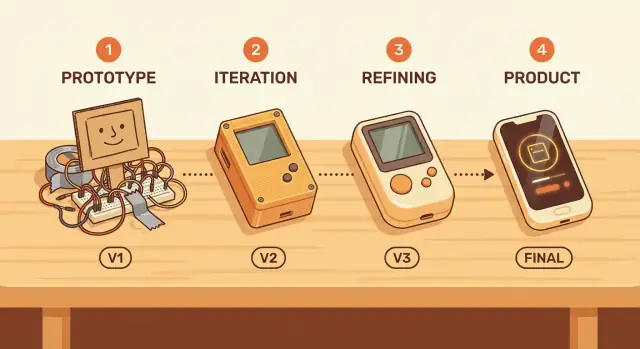
Why rough first versions are so common
A “rough first version” isn’t the same as careless quality. It’s a product that works well enough to be tried by real people, but still has missing features, clunky workflows, and plenty of room to improve. The difference is intent: rough means focused and limited; careless means unreliable and unsafe.
Perfection is rare at the start because most of what “perfect” means is unknown until users interact with the product. Teams can guess which features matter, what wording makes sense, or where people will get stuck—but guesses are often wrong. Even experienced builders regularly discover that the real problem customers want solved is slightly different than what was imagined.
Rough doesn’t mean “ship junk”
The point of an imperfect start is learning, not lowering standards. A good rough first version still respects the user:
- It solves one clear problem end-to-end.
- It’s stable enough that failures are the exception, not the rule.
- It sets honest expectations about what’s included (and what isn’t).
When teams adopt a learn-first mindset, they stop treating the first release as a final exam and start treating it as a field test. That shift makes it easier to narrow scope, release earlier, and improve based on evidence instead of opinions.
In the next sections, you’ll see practical examples—like MVP-style releases and early adopter programs—and guardrails to avoid common mistakes (for example: how to draw a hard line between “imperfect” and “unusable,” and how to capture feedback without getting pulled into endless custom requests).
Uncertainty is highest at the beginning
Early in a product’s life, confidence is often an illusion. Teams can write detailed specs and roadmaps, but the biggest questions can’t be answered from a conference room.
What you can’t truly know upfront
Before real users touch your product, you’re guessing about:
- Who the most motivated users actually are (and which “ideal customer” descriptions are wishful thinking)
- Real workflows: how people do the job today, what they refuse to change, and what they’ll happily outsource to software
- Pricing and willingness to pay: what sounds fair in interviews vs. what gets a credit card out
- Acquisition channels: where attention is affordable, which messages resonate, and what gets ignored
You can research all of these, but you can’t confirm them without usage.
Why plans break without real usage data
Traditional planning assumes you can predict needs, prioritize features, then build toward a known destination. Early-stage products are full of unknowns, so the plan is built on assumptions. When those assumptions are wrong, you don’t just miss a deadline—you build the wrong thing efficiently.
That’s why early releases matter: they turn debates into evidence. Usage data, support tickets, churn, activation rates, and even “we tried it and stopped” are signals that clarify what’s real.
“Nice-to-have” features often hide assumptions
A long list of enhancements can feel customer-focused, but it often contains buried bets:
- “Users will want dashboards” assumes users will check the tool frequently.
- “Team roles and permissions” assumes multi-user adoption from day one.
- “Integrations with everything” assumes switching costs are your biggest blocker.
Build these too early and you’re committing to assumptions before you’ve validated them.
Validated learning: progress you can trust
Validated learning means the goal of an early version isn’t to look finished—it’s to reduce uncertainty. A rough first version is successful if it teaches you something measurable about user behavior, value, and willingness to continue.
That learning becomes the foundation for the next iteration—one based on evidence, not hope.
Speed of learning beats speed of building
Teams often treat progress as “more features shipped.” But early on, the goal isn’t to build fast—it’s to learn fast. A rough first version that reaches real users turns assumptions into evidence.
Short feedback cycles change everything
When you ship early, feedback loops shrink from months to days. Instead of debating what users might do, you see what they actually do.
A common pattern:
- Months of guessing: writing long requirement docs, perfecting designs, building edge cases for problems no one has confirmed.
- Days of real feedback: launching a small version, watching where people get stuck, and adjusting with clarity.
That speed compounds. Every short cycle removes uncertainty and prevents “building the wrong thing really well.”
Learning you can measure
“Learning” isn’t a vague feeling. Even simple products can track signals that show whether the idea works:
- Activation: Do people reach the first meaningful moment (e.g., create a project, invite a teammate, complete a task)?
- Retention: Do they come back next week without being chased?
- Support tickets and questions: What confuses users repeatedly? What do they request in their own words?
These metrics do more than validate. They point to the next improvement with higher confidence than internal opinions.
Fast, but never reckless
Speed doesn’t mean ignoring safety or trust. Early releases must still protect users from harm:
- Be clear about what the product does and doesn’t do.
- Avoid features that could expose sensitive data or create financial/legal risk.
- Add basic guardrails (permissions, backups, clear undo) before “growth hacks.”
Build for learning first—while keeping users safe—and your rough first version becomes a purposeful step, not a gamble.
MVPs: small releases that test the riskiest idea
An MVP (minimum viable product) is the smallest version of your product that can test whether a key promise is valuable to real people. It’s not “the first version of everything.” It’s the shortest path to answering one high-stakes question like: Will anyone use this? Pay for it? Change their routine for it?
What an MVP is—and what it isn’t
An MVP is a focused experiment you can ship, learn from, and improve.
An MVP is not:
- A glossy demo that avoids real usage
- A “half-broken” release that frustrates people
- A pile of features that delays learning
The goal is viable: the experience should work end-to-end for a narrow set of users, even if the scope is small.
Common MVP shapes that work
Different products can test the same value in different forms:
- Concierge MVP: You deliver the value manually (high-touch) to a few users. Great for understanding needs and willingness to pay.
- “Manual behind the scenes” (Wizard-of-Oz): Users see a simple interface, but the work is done manually or with scrappy tools internally. Great for validating demand before building automation.
- Limited-feature product: You build only the core workflow that proves the main benefit, and intentionally leave out “nice-to-haves.” Great when the interaction itself needs software.
Start with the riskiest assumption
MVP scope should match your biggest uncertainty. If the risk is demand, prioritize testing real usage and payment signals. If the risk is outcomes, focus on proving you can reliably deliver results—even if the process is manual.
One practical way to support this approach is to use a build-and-iterate workflow that minimizes setup cost. For example, a vibe-coding platform like Koder.ai lets you prototype web, backend, or mobile apps via chat, then export source code and deploy—useful when you want a real, end-to-end MVP without committing to a long engineering cycle before you’ve validated the core promise.
The difference between “imperfect” and “unusable”
A rough first version can still be a great start—if it helps a specific person get a specific job done. “Good enough” isn’t a universal standard; it depends on the user’s job-to-be-done. A prototype-to-product journey works best when you define that job clearly (for example: “send an invoice in under two minutes” or “share a file securely with one link”).
A simple quality bar: reliable for the core task
An imperfect start is allowed to be small and a bit awkward. It’s not allowed to be unreliable at the one thing it promises.
A practical minimum quality bar for an MVP:
- The core task works end-to-end, every time, without manual fixes.
- Errors are understandable (no mysterious failures).
- Users can recover (undo, retry, or get clear next steps).
If the core flow breaks, early adopters can’t give useful feedback—because they never reach the moment where the product delivers value.
Tradeoffs: fewer features, more clarity
“Shipping fast” often goes wrong when teams cut the wrong things. Cutting extra features is fine; cutting clarity is not. A minimum viable product should prefer:
- Fewer options, but clearer defaults
- Simple onboarding, not a long feature list
- One well-defined use case, not five partially-supported ones
This makes iteration faster because feedback is about what matters, not confusion.
Non-negotiables: accessibility and basic performance
Even in an early release, accessibility and basic performance shouldn’t be treated as “nice-to-haves.” If text can’t be read, actions can’t be completed with a keyboard, or pages take too long to load, you’re not testing product-market fit—you’re testing people’s patience. Continuous improvement starts with a baseline that respects users’ time and needs.
Finding product-market fit requires real usage
Product-market fit (PMF) is best defined in plain terms: users would genuinely miss your product if it disappeared. Not “they like the idea,” not “they clicked the announcement,” but real dependence—something they’ve folded into their routine.
Why you can’t predict PMF from the inside
Teams are biased toward their own assumptions. You know the roadmap, you understand the edge cases, and you can imagine all the future value. But customers don’t buy your intention—they experience what exists today.
Internal opinions also suffer from “sample size = people like us.” Colleagues, friends, and early testers often share your context. Real usage introduces the messy constraints you can’t simulate: time pressure, competing alternatives, and zero patience for confusing flows.
Early signals that PMF is forming
Look for behavior that suggests the product is solving a recurring problem:
- Repeat usage: people come back without reminders, and usage holds after the novelty wears off.
- Referrals: users recommend it unprompted because it makes them look helpful.
- Willingness to pay: not just saying “I’d pay,” but actually paying, upgrading, or accepting a meaningful tradeoff.
Don’t overread vanity metrics
Early numbers can mislead. Be cautious with:
- Page views and sign-ups that don’t translate into activation
- Free trial spikes driven by curiosity or promotions
- Social engagement that signals interest in the topic, not the product
A rough first version is valuable because it gets you to these reality checks quickly. PMF isn’t a meeting outcome—it’s a pattern you observe once real users put the product to work.
Early adopters help shape the product
Early adopters don’t tolerate rough edges because they enjoy glitches—they do it because the benefit is unusually high for them. They’re the people with a sharp, frequent problem, who are actively looking for a workaround. If your rough first version removes a major pain point (even imperfectly), they’ll trade polish for progress.
Why early adopters accept imperfections
Early adopters are often:
- Paying time or money for clunky alternatives (spreadsheets, manual checks, copy-paste workflows)
- Experiencing the problem more intensely than average users
- Willing to invest effort if it means getting relief sooner
When the “before” is painful enough, a half-finished “after” still feels like a win.
How to find the right early adopters
Look for places where the pain is already being discussed: niche Slack/Discord groups, subreddits, industry forums, and professional communities. Another reliable signal: people who have built their own hacks (templates, scripts, Notion boards) to manage the problem—they’re telling you they need a better tool.
Also consider “adjacent” niches—smaller segments with the same core job-to-be-done but fewer requirements. They can be easier to serve first.
Set expectations openly
Be explicit about what’s included and what’s not: what the product can do today, what’s experimental, what’s missing, and the kinds of issues users might hit. Clear expectations prevent disappointment and increase trust.
Create fast feedback channels
Make feedback simple and immediate: a short in-app prompt, a reply-to email address, and a few scheduled calls with active users. Ask for specifics: what they tried to do, where they got stuck, and what they did instead. That detail turns early usage into a focused roadmap.
Constraints can lead to better decisions
Constraints get a bad reputation, but they often force the clearest thinking. When time, budget, or team size is limited, you can’t “solve” uncertainty by piling on features. You have to decide what matters most, define what success looks like, and ship something that proves (or disproves) the core value.
Constraints create simplicity
A tight constraint acts like a filter: if a feature doesn’t help validate the main promise, it waits. That’s how you end up with simple, clear solutions—because the product is built around one job it does well, not ten jobs it does poorly.
This is especially useful early on, when you’re still guessing what users truly want. The more you constrain scope, the easier it is to connect an outcome to a change.
Extra features can hide unclear value
Adding “nice-to-haves” can mask the real problem: the value proposition isn’t sharp yet. If users aren’t excited by the simplest version, more features rarely fix that—they just add noise. A feature-rich product can feel busy while still failing to answer the basic question: “Why should I use this?”
Practical examples of constraint-driven validation
A few constraint-friendly ways to test the riskiest idea:
- Landing page test: Write one clear promise and one call to action (waitlist, demo request, preorder). If people don’t convert, you learned something without building the full product.
- Prototype over platform: A clickable prototype can validate whether the flow makes sense before you invest in engineering.
- Single-feature tool: Many products start as one sharp utility (one report, one automation, one button) that people return to repeatedly.
Saying “no” protects focus
Treat “no” as a product skill. Say no to features that don’t support the current hypothesis, no to extra user segments before one segment is working, and no to polish that doesn’t change decisions. Constraints make those “no’s” easier—and they keep your early product honest about what it really delivers.
Avoiding the trap of overbuilding
Overbuilding happens when a team treats the first release like the final verdict. Instead of testing the core idea, the product becomes a bundle of “nice-to-haves” that feel safer than a clear yes/no experiment.
Why teams overbuild
Fear is the biggest driver: fear of negative feedback, fear of looking unprofessional, fear that a competitor will appear more polished.
Comparison adds fuel. If you benchmark yourself against mature products, it’s easy to copy their feature set without noticing they earned those features through years of real usage.
Internal politics can push things further. Extra features become a way to satisfy multiple stakeholders at once (“add this so Sales can pitch it,” “add that so Support won’t complain”), even if none of it proves the product will be wanted.
The hidden cost: sunk cost slows change
The more you build, the harder it becomes to change direction. That’s the sunk cost effect: once time, money, and pride are invested, teams defend decisions that should be revisited.
Overbuilt versions create expensive commitments—complex code, heavier onboarding, more edge cases, more documentation, more meetings to coordinate. Then even obvious improvements feel risky because they threaten all that investment.
How rough versions reduce wasted effort
A rough first version limits your options in a good way. By keeping scope small, you learn earlier whether the idea is valuable, and you avoid polishing features that won’t matter.
A simple rule helps:
Build the smallest thing that answers one question.
Examples of “one question”:
- Will people complete this task if we remove manual help?
- Do users prefer option A or B when they must choose?
- Is this problem urgent enough that someone returns tomorrow?
If your “MVP” can’t clearly answer a question, it’s probably not minimal—it’s just early-stage overbuilding.
Risks of shipping early—and how to manage them
Shipping early is useful, but it’s not free. A rough first version can create real damage if you ignore the risks.
The most common risks
The biggest risks usually fall into four buckets:
- Trust and credibility: a buggy first experience can make people assume the product is careless or unreliable.
- Security and privacy: early code often has gaps—especially around authentication, permissions, and data handling.
- Data loss: if users invest time entering information and it disappears, they may never come back.
- Bad first impressions: confusing onboarding or unclear value can lead to “I don’t get it” churn.
Practical mitigations that keep you moving
You can reduce harm without slowing to a crawl:
- Label it clearly: “Beta” or “Preview” sets expectations. Say what’s ready and what isn’t.
- Limit access: start with a small group (invite-only, waitlist, or a specific customer segment) so mistakes are contained.
- Backups and undo: even simple safeguards—export options, version history, or nightly backups—protect users from worst-case outcomes.
- Clear support paths: a visible help email/chat and quick response times can rescue shaky moments and build goodwill.
If you’re using a platform to ship quickly, look for safety features that support early iteration. For instance, Koder.ai includes snapshots and rollback (so you can recover from a bad release) and supports deployment/hosting—helpful when you want to move fast without turning every change into a high-stakes event.
Staged rollouts and feature flags (in plain terms)
Instead of releasing to everyone at once, do a staged rollout: 5% of users first, then 25%, then 100% as you gain confidence.
A feature flag is a simple switch that lets you turn a new feature on or off without redeploying everything. If something breaks, you flip it off and keep the rest of the product running.
When you should not ship early
Don’t “test in production” when the stakes are high: safety-related features, legal/compliance requirements, payments or sensitive personal data, or anything needing critical reliability (e.g., medical, emergency, core finance). In those cases, validate with prototypes, internal testing, and controlled pilots before public use.
Turning early feedback into steady improvement
Shipping a rough first version is only useful if you turn real reactions into better decisions. The goal isn’t “more feedback”—it’s a steady learning loop that makes the product clearer, faster, and easier to use.
What to measure (so you don’t guess)
Start with a few signals that reflect whether people are actually getting value:
- Activation: what percentage reaches the “aha” moment (e.g., completes a first project, invites a teammate, publishes something)
- Time-to-value: how long it takes to get that first result
- Retention: who comes back after a day/week/month
- Churn reasons: the why behind cancellations or drop-offs (price, missing feature, confusion, poor fit)
These metrics help you separate “people are curious” from “people are succeeding.”
Collect qualitative feedback that explains the numbers
Numbers tell you what happened. Qualitative feedback tells you why.
Use a mix of:
- Short interviews with new users (15 minutes is enough)
- Lightweight surveys after key moments (“What was confusing?” “What almost stopped you?”)
- Support logs and chat transcripts (often the most honest feedback)
Capture exact phrases users use. Those words are fuel for better onboarding, clearer buttons, and simpler pricing pages.
Turn feedback into a roadmap you can actually ship
Don’t make a to-do list of every request. Group input into themes, then prioritize by impact (how much it improves activation/retention) and effort (how hard it is to deliver). A small fix that removes a major point of confusion often beats a big new feature.
Link learning to a regular release rhythm—weekly or biweekly updates—so users see progress and you keep reducing uncertainty with each iteration.
A practical framework to start imperfect and succeed
A rough first version works when it’s intentionally rough: focused on proving (or disproving) one key bet, while still being trustworthy enough that real people will try it.
Step 1: Pick a single core promise
Write one sentence that explains the job your product will do for a user.
Examples:
- “Help freelancers send an invoice in under 2 minutes.”
- “Let teams see yesterday’s sales in one screen.”
If your MVP can’t clearly keep that promise, it’s not ready—no matter how polished the UI is.
Step 2: Set a clear quality bar (imperfect, not unusable)
Decide what must be true for users to trust the experience.
Checklist:
- Core promise: What is the one outcome you guarantee?
- Quality bar: What would make this feel broken or risky (wrong totals, lost data, confusing checkout, etc.)?
- Success metrics: What numbers will tell you it’s working (activation rate, repeat usage, time-to-value, retention after 7 days)?
Step 3: Define the smallest test that can teach you something
Reduce scope until you can ship quickly without weakening the test. A good rule: cut features that don’t change the decision you’ll make after launch.
Ask:
- What’s the riskiest assumption?
- What’s the fastest way to validate it with real usage?
If your bottleneck is implementation speed, consider a toolchain that shortens the path from idea → working software. For example, Koder.ai can generate a React web app, a Go + PostgreSQL backend, or a Flutter mobile app from a chat-driven spec, then let you export the code when you’re ready to own the repo—useful for getting to a real user test faster.
Step 4: Run a short feedback loop
Ship to a small, specific group, then collect feedback in two channels:
- Behavior: what they actually do (drops, repeats, time-to-value)
- Conversation: 10–15 minute calls or short surveys that focus on the outcome, not opinions
Timeline suggestion (for a ~3000-word article plan)
- Week 1: pick the core promise + quality bar, gather 3–5 user stories
- Week 2: build only what’s required to deliver the promise once
- Week 3: release to early users, measure, run interviews
- Week 4: tighten the experience around what’s being used; remove what isn’t
Call to action
Take five minutes today: write your core promise, list your quality bar, and circle the single riskiest assumption. Then cut your MVP scope until it can test that assumption in the next 2–3 weeks.
If you want more templates and examples, browse related posts in /blog.
FAQ
What is a “rough first version,” and how is it different from a careless launch?
A rough first version is intentionally limited: it works end-to-end for one clear job, but still has missing features and awkward edges.
“Careless” quality is different—it’s unreliable, unsafe, or dishonest about what it can do.
Why is perfection so hard at the start of a product?
Early on, the biggest inputs are still unknown until people use the product: real workflows, who the motivated users are, what language makes sense, and what they’ll actually pay for.
Shipping a small real version turns assumptions into evidence you can act on.
How do I decide whether my early version is “imperfect” vs. “unusable”?
Set a minimum bar around the core promise:
- The core task works end-to-end consistently.
- Errors are understandable (no mysterious failures).
- Users can recover (retry/undo/clear next step).
Cut features, not reliability or clarity.
What does “MVP” actually mean in practice?
An MVP is the smallest viable experiment that tests a high-stakes assumption (demand, willingness to pay, or whether users will change behavior).
It’s not a glossy demo, and it’s not a half-broken product—it should still deliver the promised outcome for a narrow use case.
What are some MVP formats that work well for rough first versions?
Common shapes include:
- Concierge MVP: you deliver value manually to a few users.
- Wizard-of-Oz: a simple interface with manual work behind the scenes.
- Limited-feature product: only the core workflow, intentionally leaving out nice-to-haves.
Pick the one that answers your riskiest question fastest.
Which metrics matter most right after an early release?
Start with signals tied to real value, not attention:
- Activation: reaching the first meaningful moment.
- Time-to-value: how fast they get a result.
- Retention: do they come back without reminders?
- Churn reasons: why they stop (confusion, missing feature, poor fit, price).
Use a small set so you can make decisions quickly.
How do I find early adopters who will tolerate a rough version?
Early adopters feel the problem more sharply and often already use clunky workarounds (spreadsheets, scripts, manual checks).
Find them where the pain is discussed (niche communities, forums, Slack/Discord), and set expectations clearly that it’s a beta/preview so they opt in knowingly.
What are the biggest risks of shipping early, and how can I reduce them?
Reduce risk without waiting for perfection:
- Label it Beta/Preview and state what’s included.
- Limit access (invite-only or a single segment).
- Add basic safeguards (exports/backups/undo where feasible).
- Provide a clear support path and respond fast.
These protect trust while still keeping feedback loops short.
What are feature flags and staged rollouts, and why do they help?
A staged rollout releases changes to a small percentage first (e.g., 5% → 25% → 100%) so you can catch issues before everyone hits them.
A feature flag is an on/off switch for a feature, letting you disable it quickly without redeploying the entire product.
When should you *not* ship a rough first version?
Don’t ship early when failure could cause serious harm or irreversible damage—especially with:
- Payments or sensitive personal data
- Legal/compliance requirements
- Safety-critical or medical/emergency contexts
- Anything requiring strict reliability guarantees
In these cases, validate with prototypes, internal testing, and controlled pilots first.