

Why Vibe Coding Rewards Product Instincts Over Framework Depth
Vibe coding rewards builders who spot user needs, test quickly, and iterate. Learn why product instincts beat deep framework mastery for results.
What “Vibe Coding” Means (and What It Doesn’t)
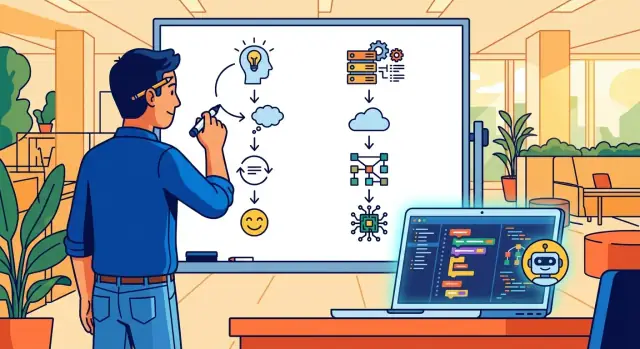
“Vibe coding” is a practical way of building where you move fast by combining intuition (your sense of what users need) with modern tools (AI assistants, templates, ready-made components, hosted services). You’re not starting from a perfect plan—you’re sketching, trying, adjusting, and shipping small slices to see what actually works.
What it means in plain terms
Vibe coding is:
- Building a usable version quickly, even if it’s not elegant yet.
- Using AI to generate scaffolding, suggest options, and unblock you when you’re stuck.
- Making product decisions continuously: what to include, what to postpone, what to simplify.
The “vibe” part isn’t randomness. It’s direction. You’re following a hypothesis about user value and testing it with real interaction, not just internal debate.
What it doesn’t mean
This isn’t an argument against engineering discipline.
Vibe coding is not:
- “No planning” (you still need a goal and constraints).
- “No quality” (you still need basic correctness, security, and reliability).
- “No engineering” (you still benefit from good structure—just not upfront perfection).
It’s also not a claim that framework expertise is worthless. Knowing your stack well can be a superpower. The point is that, for many early-stage products and experiments, framework trivia rarely decides whether users care.
The core claim
Vibe coding rewards builders who repeatedly make strong product choices: picking a clear user, narrowing the job-to-be-done, shaping the simplest flow, and learning quickly from feedback. When you can do that, AI and modern tooling shrink the gap between “knows every framework detail” and “can deliver a useful experience this week.”
Why Product Instincts Often Decide the Outcome
Vibe coding makes writing code cheaper. The hard part is choosing what to build, who it’s for, and what success looks like. When AI can scaffold a UI, generate CRUD routes, and suggest fixes in minutes, the bottleneck shifts from “Can we implement this?” to “Is this the right thing to implement?”
Builders with strong product instincts move faster not because they type faster, but because they waste less time. They make fewer wrong turns, ask better questions early, and cut ideas down to a version that can be tested quickly.
The real speed advantage: problem framing
Clear problem framing reduces rework more than any framework feature. If you can describe:
- the user’s goal in one sentence,
- the pain that blocks it,
- the smallest behavior change your product enables,
…then the code you generate has a higher chance of surviving the first week of real feedback.
Without that clarity, you’ll ship technically impressive features that get rewritten—or removed—once you learn what users actually needed.
Simple example: same idea, better scope wins
Imagine a “study planner” app.
Team A (framework-first) builds: accounts, calendars, notifications, tags, integrations, and a dashboard.
Team B (product-first) ships in two days: a single screen where a student picks an exam date, enters topics, and gets a daily checklist. No accounts—just a shareable link.
Team B gets feedback immediately (“checklists are great, but I need time estimates”). Team A is still wiring settings pages.
Vibe coding rewards the builder who can cut scope without cutting value—because that’s what turns code into progress.
The Product Instincts That Vibe Coding Rewards
AI can draft a lot of “acceptable” code quickly. That shifts the bottleneck away from typing and toward deciding what to build, why, and what to ignore. The builders who win aren’t the ones who know every corner of a framework—they’re the ones whose product instincts keep the work pointed at real user value.
Empathy: feeling the user’s friction
Empathy is the ability to picture a user’s day and spot where your product helps (or annoys). In vibe coding, you’ll generate multiple UI and feature options fast. Empathy lets you choose the one that reduces confusion, steps, and cognitive load—without needing a perfect architecture to start.
Prioritization: deciding what matters this week
When everything is easy to generate, it’s tempting to add everything. Strong prioritization means picking the smallest set of features that proves the idea. It also means protecting the “one thing” the product should do exceptionally well.
Clarity: making decisions legible
Clarity shows up in sharp problem statements, simple user flows, and readable copy. If you can’t explain the feature in two sentences, AI-generated code will likely become AI-generated clutter.
Taste: choosing the simplest thing users will love
Taste isn’t aesthetics alone. It’s the instinct to prefer the simplest solution that still feels delightful and “obviously right” to users—fewer settings, fewer screens, fewer edge-case promises. Taste helps you say, “This is enough,” then ship.
Willingness to cut: shipping without regret
Cutting isn’t lowering quality; it’s removing non-essential scope while preserving the core benefit. This is where product-first builders pull ahead: deep framework knowledge can optimize implementation, but these instincts optimize outcomes.
How AI Shrinks the Advantage of Deep Framework Knowledge
A few years ago, knowing a framework inside out was a real moat. You could move faster because you had API details in your head, you’d avoid common pitfalls, and you could stitch features together without stopping to look things up.
AI-assisted coding and high-quality templates compress that advantage.
AI + templates turn memorization into autocomplete
When you can ask an assistant, “How do I implement auth middleware in Next.js?” or “Generate a CRUD screen using X pattern,” the value of memorizing the exact API surface drops. The assistant can draft scaffolding, name the files, and mirror common conventions.
Templates take it further: standard projects now start with routing, auth, forms, UI components, and deployment already wired. Instead of spending days assembling the “standard stack,” you begin at the point where product decisions actually matter.
If you want a more end-to-end version of this, platforms like Koder.ai push the idea further: you can describe an app in chat, iterate on screens and flows, and generate a working web/backend/mobile foundation (e.g., React on the frontend, Go + PostgreSQL on the backend, Flutter for mobile). The point isn’t the specific stack—it’s that setup time collapses, so product choices dominate.
Glue code is cheaper; value decisions aren’t
Most of what slows teams down isn’t writing another endpoint or configuring another plugin. It’s deciding:
- What’s the smallest feature that proves the idea?
- Which edge cases matter now vs. later?
- What should the UI say so users don’t get confused?
AI makes glue code cheaper—connecting services, generating boilerplate, translating patterns between libraries. But it can’t reliably decide what’s worth building, what to cut, or what success looks like. Those are product instincts.
Frameworks churn; user needs are steady
Framework best practices change quickly: new routers, new data-fetching patterns, new recommended tooling. Meanwhile, user needs stay stubbornly consistent: clarity, speed, reliability, and a workflow that matches how they think.
That’s why vibe coding tends to reward builders who can choose the right problem, simplify the solution, and iterate based on real use—not just those who can recite framework internals.
Short Feedback Loops Beat Perfect Code
Vibe coding works best when you treat building like a series of small bets, not a single grand construction project. The goal isn’t to “finish the codebase.” It’s to reduce uncertainty—about the user, the problem, and the value—before you invest months polishing the wrong thing.
The loop that actually creates progress
A practical product loop looks like this:
Hypothesis → prototype → test → learn → iterate.
- Hypothesis: “If we pre-fill the report and let users tweak it, they’ll complete it in under 2 minutes.”
- Prototype: A thin, believable version—sometimes even a fake backend.
- Test: Put it in front of real people doing the real job.
- Learn: Where do they hesitate, what do they misunderstand, what do they avoid?
- Iterate: Adjust the flow, copy, default settings, or scope.
This loop rewards product instincts because it forces you to make explicit choices: what’s essential, what’s noise, and what signal would change your mind.
Why short loops beat perfect architecture early on
Early-stage “perfect code” often optimizes for problems you don’t have yet: scale you haven’t earned, abstractions you don’t understand, edge cases your users won’t hit. Meanwhile, the biggest risk is usually simpler: you’re building the wrong feature or presenting it in the wrong way.
Short feedback loops beat deep framework mastery here because they prioritize:
- Speed to a real user moment (the first time someone tries the thing)
- Clarity over cleverness (defaults, copy, and flow)
- Reversibility (small changes you can undo tomorrow)
If the prototype reveals the core value is real, you can earn the right to refactor.
Lightweight validation methods that work
You don’t need a full release to test demand or usability:
- Demos: Show a working slice on a call and watch where people lean in—or tune out.
- Concierge tests: Do the service manually behind the scenes while the user experiences “the product.”
- Smoke pages: A simple landing page with a clear promise and a “Request access” button to measure interest.
The point isn’t to be sloppy—it’s to be deliberate: build just enough to learn what to build next.
Shipping: The Art of Cutting Scope Without Killing Value
Vibe coding makes it tempting to keep adding “one more thing” because AI can generate it quickly. But speed is useless if you never ship. The builders who win are the ones who decide, early and often, what to ignore.
The hidden skill: choosing what not to build
Shipping isn’t about typing faster—it’s about protecting the core promise. When you cut scope well, the product feels focused, not incomplete. That means saying no to features that are:
- hard to explain in one sentence
- nice for “power users” before you have regular users
- improvements to flows people haven’t tried yet
“Minimum viable” vs. “minimum lovable” (plain English)
Minimum Viable Product (MVP) is the smallest version that technically works and proves the idea. It might feel rough, but it answers: Will anyone use this at all?
Minimum Lovable Product (MLP) is the smallest version that feels clear and satisfying for the target user. It answers: Will someone finish the journey and feel good enough to return or recommend?
A good rule: MVP proves demand; MLP earns trust.
Ruthless prioritization checklist
When deciding what ships this week, sort every item into one bucket:
Must-have (ship now)
- Without it, the core job can’t be completed
- It directly supports the main outcome (the “why”)
- You can explain it in one breath
Nice-to-have (only if time remains)
- Makes the experience smoother, not possible
- Reduces friction for the second or third use
- Has a cheap workaround (manual step, simple default)
Later (explicitly not now)
- Requires new complexity (roles, settings, edge cases)
- Helps a “maybe” user segment
- Needs real user feedback to design correctly
Cutting scope isn’t lowering standards. It’s choosing a smaller promise—and keeping it.
User Experience and Clarity: Where Wins Actually Come From
People don’t fall in love with your framework choice. They fall in love with the moment they get value—fast. In vibe coding, where AI can generate “working” features quickly, the separator is whether your product makes a clear promise and guides users to that first win.
Your promise + onboarding beats your stack
A clear promise answers three questions immediately: What is this? Who is it for? What should I do first? If those aren’t obvious, users bounce before your tech decisions matter.
Onboarding is simply the shortest path from curiosity to outcome. If your first-time experience requires reading, guessing, or configuring, you’re spending trust you haven’t earned.
Mistakes no framework can save
Even a perfectly engineered app loses when the product is confusing. Common killers:
- Too many options on the first screen (“choose your destiny” paralysis)
- Vague labels like “Continue,” “Submit,” or “Next” with no context
- Asking for sign-up before showing any value
- Hidden primary action (users can’t tell what the product does)
- Inconsistent terminology (same thing called three different names)
- Error states that blame the user instead of guiding them
Quick wins you can ship today
Reduce friction with a few rules that compound:
- Fewer steps: remove fields, combine screens, default smartly.
- Clearer copy: write buttons as outcomes (“Create my plan,” “Get summary”), not mechanics.
- One primary action per screen: everything else should support it, not compete.
If you do nothing else, make the first successful action obvious, fast, and repeatable. That’s where momentum starts—and where vibe coding actually pays off.
When Framework Knowledge Still Matters (and When It Doesn’t)
Vibe coding lowers the barrier to getting something working, but it doesn’t erase the value of framework knowledge. It changes where that knowledge pays off: less in memorizing APIs, more in making the right trade-offs at the right time.
A “good enough” stack is usually the best stack
If your goal is to ship and learn, pick a stack that is:
- Familiar: you (and your teammates) can move without constant context-switching.
- Supported: strong docs, active community, common integrations.
- Simple: fewer moving parts means fewer failure modes.
A sensible default often looks like “popular frontend + boring backend + managed database + hosted auth,” not because it’s trendy, but because it minimizes time spent fighting infrastructure instead of validating value.
Don’t optimize a product you haven’t proven
The most common failure mode isn’t “the framework can’t scale.” It’s shiny-tool switching: rewriting because a new library looks cleaner, or chasing performance metrics before users complain.
Premature optimization shows up as:
- Refactoring for elegance instead of fixing the top user pain.
- Switching frameworks to avoid a small limitation.
- Building abstractions for future features that aren’t demanded.
If a workaround is slightly ugly but safe and reversible, it’s often the correct move while you’re still learning what users want.
When framework depth actually matters
Deep framework knowledge becomes valuable when you hit problems that AI can’t reliably patch with generic snippets:
- Complex state and data flow: multi-step forms, realtime updates, offline support.
- Performance constraints: slow rendering, large lists, expensive computations.
- Scale and reliability: caching strategies, background jobs, rate limits.
- Security and correctness: auth edge cases, permissions, injection risks.
Rule of thumb: use AI and simple patterns to get to “works,” then invest in framework depth only when a real constraint shows up in metrics, support tickets, or churn.
The Risks of Vibe Coding Without Product Discipline
Vibe coding feels magical: you describe what you want, the AI fills in the gaps, and something works fast. The risk is that speed can hide whether you’re shipping signal or shipping noise.
Common failure modes
One trap is shipping features that are easy to generate but hard to justify. You end up polishing micro-interactions, adding settings, or rebuilding UI because it’s fun—while the actual user problem stays untested.
Another is building only for yourself. If the only feedback loop is your own excitement, you’ll optimize for what’s impressive (or novel) instead of what’s useful. The result is a product that demos well but doesn’t stick.
A third is “not listening” in a subtle way: collecting feedback, then selectively acting on comments that match your original idea. That’s not iteration—it’s confirmation.
The danger of skipping fundamentals
AI can scaffold screens quickly, but fundamentals don’t disappear:
- Data integrity: What happens when records are duplicated, missing, or out of date?
- Auth and permissions: Who can see what, and what’s the worst-case mistake?
- Error handling: What does the user see when something fails—silence, or a clear next step?
If these are hand-waved, early users don’t just churn; they lose trust.
Guardrails that keep speed honest
Define one success metric per iteration (e.g., “3 users complete onboarding without help”). Keep a lightweight changelog so you can connect changes to outcomes.
Most importantly: test with real users early. Even five short sessions will surface issues no prompt will catch—confusing copy, missing states, and workflows that don’t match how people actually think.
A Practical Workflow to Build Like a Product-First Builder
Vibe coding works best when you treat building like a series of small product bets, not a quest for perfect architecture. Here’s a workflow that keeps you focused on value, learning, and shipping.
1) Pick a narrow user, one problem, one outcome
Start by making the target painfully specific: “Freelance designers who send 5–10 invoices/week” beats “small businesses.” Then choose one problem you can observe and describe in a sentence.
Finally, define a single outcome you can measure within two weeks (e.g., “create and send an invoice in under 2 minutes” or “reduce missed follow-ups from 5/week to 1/week”). If you can’t measure it, you can’t learn.
2) Write a crisp definition of done
Your “done” should be user-visible, not technical:
- A user can complete the core task end-to-end
- There’s a clear success state (confirmation, receipt, saved result)
- Basic failure handling exists (empty states, error message, retry)
Anything else goes into “later.”
3) Make a 7–14 day shipping plan
Plan the smallest version you can ship, then timebox it:
- Day 1: Sketch the flow, write 10–15 issues (one sentence each)
- Days 2–4: Build the happy path only
- Days 5–7: Add the 3 most likely edge cases + polish the UI copy
- Days 8–10 (optional): Integrate one “must-have” (payments, export, sharing)
- Day 10–14: Ship, onboard 5 users, iterate based on real friction
If you’re using a chat-driven build tool (for example, Koder.ai), this is also where it shines: you can iterate on flows in “planning mode,” snapshot what’s working, and roll back quickly if an experiment makes the product worse. That keeps the loop fast while still staying disciplined.
4) Keep a simple operating system
Use an issue list (GitHub Issues, Linear, or a single doc), block 60–90 minutes daily for uninterrupted building, and schedule weekly 20-minute user calls. In each call, watch them attempt the core task and note where they hesitate—those moments are your roadmap.
Measure What Matters: Proof Over Opinions
Vibe coding can generate features quickly, but speed only helps if you can tell what’s working. Metrics are how you replace “I feel like users want this” with proof.
Metrics that actually reflect value
A few signals tend to stay useful across products:
- Activation: the moment a new user reaches the “aha.” Example: created their first project, connected a calendar, invited a teammate.
- Time-to-value (TTV): how long it takes to reach that moment. If users activate in 2 minutes instead of 20, you usually win.
- Retention: do they come back? Track 1-day/7-day/30-day return rates or “did they complete the core action again?”
- Revenue signals: free-to-paid conversion, trial-to-paid, upgrade rate, churn, expansion. If you’re pre-revenue, use strong proxies like “requested invoice” or “clicked upgrade.”
Leading vs. lagging indicators (plain English)
Leading indicators predict outcomes sooner. Example: “% of users who finish onboarding” often predicts retention.
Lagging indicators confirm results later. Example: “30-day retention” or “monthly revenue.” Useful, but slow.
Let metrics decide what to build next
When you ship a feature, tie it to one metric.
If activation is low, improve onboarding, defaults, and the first-run experience before adding more features.
If activation is good but retention is weak, focus on repeat value: reminders, saved state, templates, or a clearer “next step.”
If retention is solid but revenue is flat, adjust packaging: plan limits, pricing page clarity, or a higher-value paid feature.
That’s product instinct in action: build, measure, learn—then iterate where the numbers point.
Closing Checklist: Build Instincts That Compound
Vibe coding is a speed multiplier—but only when you’re steering with product instincts. Framework depth still helps, yet it’s usually a supporting actor: the winners are the builders who can pick the right problem, shape a clear promise, and learn quickly from real users.
A quick self-assessment (score yourself 1–5)
Use this to spot what already compounds—and what needs attention:
- Problem clarity: Can you explain the user pain in one sentence, without solution words?
- Audience focus: Do you know who it’s for (and who it’s not for)?
- Value hypothesis: Can you state what changes for the user after using it?
- Scope discipline: Can you cut 50% of features and keep the core value intact?
- Feedback velocity: Can you get meaningful user input within 48 hours?
- Decision-making: When feedback conflicts, do you have a principle for choosing?
- UX clarity: Can a first-time user succeed without instructions?
If your lowest scores are in scope discipline or feedback velocity, don’t “study more framework.” Tighten your loop.
Your next steps: one small bet, one tight loop
Pick one product bet you can test this week:
- Write a one-line promise (“Help X do Y without Z”).
- Build the smallest version that delivers that promise once.
- Define one success signal (e.g., “3 users complete onboarding without help”).
- Ship it to 5–10 target users, watch where they hesitate, and revise.
Keep a running log of your “instinct reps”: the assumptions you made, what users did, what you changed. Over time, this is what compounds—faster than memorizing another framework API.
If you do share your learnings publicly, some platforms (including Koder.ai) even run earn-credits programs for content and referrals—an extra nudge to document the loop while you build.
FAQ
What is vibe coding, in plain English?
Vibe coding is a fast, iterative way of building where you combine product intuition with modern tools (AI assistants, templates, hosted services) to ship small, usable slices and learn from real interaction.
It’s guided experimentation—not “winging it.”
Does vibe coding mean “no planning”?
No. You still need a goal, constraints, and a rough plan for what “done” means.
The difference is you avoid over-planning details before you’ve validated that users care.
Does vibe coding mean shipping low-quality code?
It’s not “no quality.” You still need basic correctness, security, and reliability—especially around auth, permissions, and data handling.
Vibe coding is about deferring non-essential polish and premature architecture, not skipping fundamentals.
Why do product instincts matter more when using AI coding tools?
Because AI makes “acceptable implementation” cheaper, the bottleneck shifts to deciding what to build: who it’s for, what outcome matters, and what to ignore.
Builders with strong product instincts waste fewer cycles on features that don’t survive first contact with users.
How do I frame the problem so I don’t build the wrong thing?
Use this quick framing:
- User goal: What are they trying to accomplish?
- Friction: What’s blocking them today?
- Behavior change: What’s the smallest action your product enables?
If you can’t write these in a few lines, the code you generate is likely to become clutter or rework.
What’s the best way to cut scope without cutting value?
Prioritize for a fast, real user moment:
- Ship the simplest flow that completes the core job end-to-end.
- Remove accounts/settings/integrations unless they’re required.
- Prefer defaults over configuration.
A tight scope that gets feedback beats a broad scope that delays learning.
What’s the difference between MVP and “minimum lovable product” (MLP)?
MVP is the smallest version that proves the idea works at all.
MLP is the smallest version that feels clear and satisfying enough that users finish the journey and would come back.
A practical rule: prove demand with MVP, earn trust with MLP.
What does a good feedback loop look like in vibe coding?
A short loop looks like:
- Hypothesis → prototype → test → learn → iterate
Keep each iteration tied to one observable signal (e.g., “3 users complete onboarding without help”) so you’re learning, not just adding features.
When does deep framework knowledge still matter?
Framework depth matters most when real constraints show up, such as:
- Complex state/data flow (multi-step forms, realtime, offline)
- Performance issues (slow rendering, large lists)
- Scale/reliability needs (caching, background jobs, rate limits)
- Security/correctness edge cases (auth, permissions, injection risks)
Use AI to reach “works,” then invest in depth when metrics or incidents demand it.
What metrics should I track to know if vibe coding is working?
Track a small set of value signals:
- Activation: users reach the “aha” moment
- Time-to-value: how fast they get there
- Retention: they return and repeat the core action
- Revenue proxies: upgrade clicks, trial-to-paid, churn
Tie each shipped change to one metric so your roadmap follows evidence, not vibes.