

Yann LeCun: Pioneer of Deep Learning & Self‑Supervised AI
Explore Yann LeCun’s key ideas and milestones—from CNNs and LeNet to modern self-supervised learning—and why his work still shapes AI today.
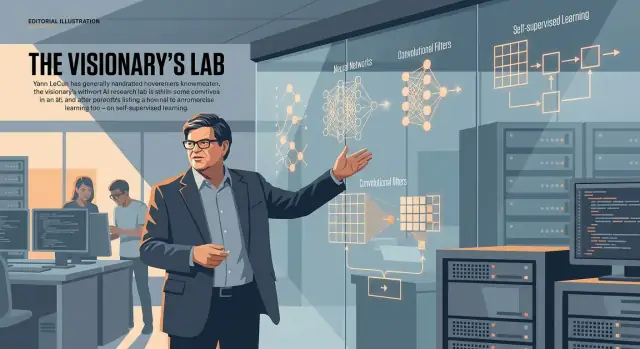
Why Yann LeCun Still Shapes How AI Is Built
Yann LeCun is one of the researchers whose ideas quietly became the “default settings” of modern AI. If you’ve used Face ID–style unlock, automatic photo tagging, or any system that recognizes what’s in an image, you’re living with design choices LeCun helped prove could work at scale.
Why he matters (even if you don’t read research papers)
LeCun’s influence isn’t limited to a single invention. He helped push a practical engineering mindset into AI: build systems that learn useful representations from real data, run efficiently, and improve with experience. That combination—scientific clarity plus an insistence on real-world performance—shows up in everything from computer vision products to today’s model-training pipelines.
Deep learning vs. self-supervised learning, in plain terms
Deep learning is a broad approach: using multi-layer neural networks to learn patterns from data rather than hand-coding rules.
Self-supervised learning is a training strategy: the system creates a learning task from the data itself (for example, predicting missing parts), so it can learn from huge amounts of unlabeled information. LeCun has been a major advocate of self-supervision because it better matches how humans and animals learn—through observation, not constant instruction.
What this article will cover
This is part biography, part tour of the core ideas: how early neural-network work led to convolutional networks, why representation learning became central, and why self-supervised learning is now a serious path toward more capable AI. We’ll close with practical takeaways for teams building AI systems today.
A quick note on the “godfather of deep learning” label: it’s a popular shorthand (often applied to LeCun, Geoffrey Hinton, and Yoshua Bengio), not a formal title. What matters is the track record of ideas that became foundations.
Early Work and the Road to Neural Networks
Yann LeCun’s early career is easiest to understand as a consistent bet on one idea: computers should learn the right features from raw data, instead of relying on humans to hand-design them.
A quick timeline (without the academic detour)
In the mid-to-late 1980s, LeCun focused on a practical, stubborn problem: how to get machines to recognize patterns in messy real-world inputs like images.
By the late 1980s and early 1990s, he was pushing neural-network methods that could be trained end-to-end—meaning you feed in examples, and the system adjusts itself to get better.
This period set up the work he’s best known for later (like CNNs and LeNet), but the key story is the mindset: stop arguing about rules; start learning from data.
What made his approach different from earlier AI
A lot of earlier AI tried to encode intelligence as explicit rules: “if X, then Y.” That can work in tightly controlled situations, but it struggles when the world is noisy—different handwriting styles, lighting changes in photos, slight shifts in viewpoint.
LeCun’s approach leaned toward statistical learning: train a model on many examples, let it discover patterns that humans might not even be able to describe clearly. Instead of building a long list of rules for what a “7” looks like, you show the system thousands of sevens, and it learns a representation that separates “7” from “1,” “2,” and so on.
The recurring theme: representation learning
Even early on, the goal wasn’t just “get the right answer.” It was to learn useful internal representations—compact, reusable features that make future decisions easier. That theme runs through everything he did next: better vision models, more scalable training, and eventually the push toward self-supervised learning.
Convolutional Neural Networks (CNNs), Explained Simply
CNNs are a type of neural network designed to “see” patterns in data that looks like an image (or anything arranged on a grid, like frames in a video). Their main trick is convolution.
Convolution, in intuitive terms
Think of convolution as a small pattern detector that slides across an image. At each position, it asks: “Do I see something like an edge, a corner, a stripe, or a texture right here?” The same detector is reused everywhere, so it can spot that pattern no matter where it appears.
The three big ideas
Local connectivity: Each detector looks at a small patch (not the whole image). That makes learning easier because nearby pixels are usually related.
Shared weights: The sliding detector uses the same numbers (weights) at every location. This dramatically reduces parameters and helps the model recognize the same feature in different places.
Pooling (or downsampling): After detecting features, the network often summarizes nearby responses (for example, taking a max or an average). Pooling keeps the strongest signals, reduces size, and adds a bit of “wiggle room” so small shifts don’t break recognition.
Why CNNs fit images so well
Images have structure: pixels close together form meaningful shapes; the same object can appear anywhere; and patterns repeat. CNNs bake these assumptions into the architecture, so they learn useful visual features with less data and compute than a fully connected network.
Common misconceptions
A CNN is not “just a big classifier.” It’s a feature-building pipeline: early layers find edges, middle layers combine them into parts, and later layers assemble parts into objects.
Also, CNNs don’t inherently “understand” scenes; they learn statistical cues from training data. That’s why data quality and evaluation matter as much as the model itself.
LeNet and the Case for Practical Deep Learning
LeNet is one of the clearest early examples of deep learning being useful, not just interesting. Developed in the 1990s by Yann LeCun and collaborators, it was designed for recognizing handwritten characters—especially digits—like the ones found on checks, forms, and other scanned documents.
What LeNet was built to do
At a high level, LeNet took an image (for example, a small grayscale crop containing a digit) and produced a classification (0–9). That sounds ordinary now, but it mattered because it tied together the whole pipeline: feature extraction and classification were learned as one system.
Instead of relying on hand-crafted rules—like “detect edges, then measure loops, then apply a decision tree”—LeNet learned internal visual features directly from labeled examples.
Why it was influential
LeNet’s influence wasn’t based on flashy demos. It was influential because it showed an end-to-end learning approach could work for real vision tasks:
- A single model could learn multiple layers of features automatically.
- Training was done by optimizing the whole network together, not piece by piece.
- Performance was good enough to justify deployment in constrained, high-volume settings like document processing.
This “learn the features and the classifier together” idea is a major through-line into later deep learning successes.
How it foreshadowed modern workflows
Many habits that feel normal in deep learning today are visible in LeNet’s basic philosophy:
- Start with raw-ish inputs (pixels) rather than engineered measurements.
- Use a general-purpose training procedure (gradient-based optimization) instead of bespoke logic.
- Evaluate on real data distributions and iterate.
Even though modern models use more data, more compute, and deeper architectures, LeNet helped normalize the idea that neural networks could be practical engineering tools—especially for perception problems.
A careful historical note
It’s worth keeping the claim modest: LeNet wasn’t “the first deep network,” and it didn’t single-handedly trigger the deep learning boom. But it is a widely recognized milestone showing that learned representations could outperform hand-designed pipelines on an important, concrete problem—years before deep learning became mainstream.
Representation Learning: The Core Idea Behind the Breakthroughs
Representation learning is the idea that a model shouldn’t just learn a final answer (like “cat” vs “dog”)—it should learn useful internal features that make many kinds of decisions easier.
An everyday analogy
Think of sorting a messy closet. You could label every item one by one (“blue shirt,” “winter coat,” “running shoes”). Or you could first create organizing categories—by season, by type, by size—and then use those categories to quickly find what you need.
A good “representation” is like those categories: a compact way of describing the world that makes lots of downstream tasks simpler.
Why learned features often beat hand-crafted ones
Before deep learning, teams commonly engineered features by hand: edge detectors, texture descriptors, carefully tuned measurements. That approach can work, but it has two big limits:
- It bakes in human assumptions about what matters.
- It tends to break when the data shifts (new lighting, angles, styles, languages, devices).
LeCun’s core contribution—popularized through convolutional networks—was demonstrating that learning the features directly from data can outperform hand-designed pipelines, especially when problems get messy and varied. Instead of telling the system what to look for, you let it discover patterns that are actually predictive.
Representations enable transfer learning
Once a model has learned a strong representation, you can reuse it. A network trained to understand general visual structure (edges → shapes → parts → objects) can be adapted to new tasks with less data: defect detection, medical imaging triage, product matching, and more.
That’s the practical magic of representations: you’re not starting from zero each time—you’re building on a reusable “understanding” of the input.
Practical takeaway: data + objective + evaluation
If you’re building AI in a team setting, representation learning suggests a simple priority order:
- Data: get coverage of real-world variation.
- Objective: choose a training goal that rewards useful general features, not shortcuts.
- Evaluation: test for generalization (new users, new conditions), not just a single benchmark.
Get those three right, and better representations—and better performance—tend to follow.
Self-Supervised Learning: What It Is and Why It Matters
Self-supervised learning is a way for AI to learn by turning raw data into its own “quiz.” Instead of relying on people to label every example (cat, dog, spam, not spam), the system creates a prediction task from the data itself and learns by trying to get that prediction right.
Learning from the data itself (no jargon)
Think of it like learning a language by reading: you don’t need a teacher to label every sentence—you can learn patterns by guessing what should come next and checking whether you were right.
Simple examples you’ve likely seen
A few common self-supervised tasks are easy to picture:
- Predicting missing parts: Hide a chunk of text, a patch of an image, or a moment in audio, then ask the model to fill it in.
- Next-step prediction: Given the first part of a sentence, video, or sound clip, predict what comes next.
- Contrastive learning: Show the model two “views” of the same item (for example, two different crops of the same photo) and teach it that these belong together, while other items should be kept apart.
Why it matters: fewer human labels, more usable knowledge
Labeling is slow, expensive, and often inconsistent. Self-supervised learning can use the huge amount of unlabeled data organizations already have—photos, documents, call recordings, sensor logs—to learn general representations. Then, with a smaller labeled dataset, you fine-tune the model for a specific job.
Where it’s used today
Self-supervised learning is a major engine behind modern systems in:
- Vision: strong image features for search, detection, and quality checks
- Language: better understanding and generation of text
- Audio: speech recognition and speaker/audio-event understanding
- Multimodal systems: models that connect text + images (and sometimes audio/video) for richer, more flexible AI
Supervised vs. Self-Supervised: How to Choose the Right Path
Choosing between supervised, unsupervised, and self-supervised learning is mostly about one thing: what kind of signal you can realistically obtain at scale.
The difference in plain English
Supervised learning trains on inputs paired with human-provided labels (e.g., “this photo contains a cat”). It’s direct and efficient when labels are accurate.
Unsupervised learning looks for structure without labels (e.g., clustering customers by behavior). It’s useful, but “structure” can be vague, and results may not map cleanly to a business goal.
Self-supervised learning is a practical middle ground: it creates training targets from the data itself (predict missing words, next frame, masked parts of an image). You still get a learning signal, but you don’t need manual labels.
When labels are worth it—and when they become the bottleneck
Labeled data is worth the effort when:
- The task is narrow and stable (e.g., defect detection for a fixed manufacturing line)
- Mistakes are expensive and you need clear accountability
- You can label consistently (well-defined taxonomy, low ambiguity)
Labels become a bottleneck when:
- The domain changes often (new products, new slang, new environments)
- Labeling is slow/expensive (medical imaging, legal text, rare events)
- The “right label” is subjective or context-dependent
How self-supervised pretraining + fine-tuning works in practice
A common pattern is:
- Pretrain a model on lots of unlabeled (or weakly curated) data to learn general representations.
- Fine-tune on a smaller labeled set for your specific task.
This often reduces labeling needs, improves performance in low-data settings, and transfers better to related tasks.
A quick decision guide for teams
- If you have plenty of high-quality labels and a clear target: start supervised.
- If you have lots of raw data but few labels: start self-supervised, then fine-tune.
- If your goal is exploration (segments, anomaly discovery) rather than prediction: consider unsupervised, then validate with downstream metrics.
The best choice is usually constrained by labeling capacity, expected change over time, and how broadly you want the model to generalize beyond one narrow task.
Energy-Based Models and a Broader View of Intelligence
Energy-based models (EBMs) are a way to think about learning that’s closer to “ranking” than “labeling.” Instead of forcing a model to output a single right answer (like “cat” or “not cat”), an EBM learns a scoring function: it assigns low “energy” (good score) to configurations that make sense, and higher energy (bad score) to ones that don’t.
Scoring good vs. bad configurations
A “configuration” can be many things: an image and a proposed caption, a partial scene and the missing objects, or a robot state and a proposed action. The EBM’s job is to say, “This pairing fits together” (low energy) or “This looks inconsistent” (high energy).
That simple idea is powerful because it doesn’t require the world to be reduced to a single label. You can compare alternatives and pick the best-scoring one, which matches how people often solve problems: consider options, reject the implausible ones, and refine.
Why researchers care
Researchers like EBMs because they allow flexible training objectives. You can train the model to push real examples down (lower energy) and push incorrect or “negative” examples up (higher energy). This can encourage learning useful structure in the data—regularities, constraints, and relationships—rather than memorizing a mapping from input to output.
Connection to world models and planning
LeCun has linked this perspective to broader goals like “world models”: internal models that capture how the world tends to work. If a model can score what is plausible, it can support planning by evaluating candidate futures or action sequences and preferring the ones that stay consistent with reality.
From Research to Real Systems: Leadership and Influence
LeCun is unusual among top AI researchers because his influence spans both academic research and large industry labs. In universities and research institutes, his work helped set the agenda for neural networks as a serious alternative to hand-crafted features—an idea that later became the default approach in computer vision and beyond.
Why leadership matters in AI
A research field doesn’t move forward only through papers; it also advances through the groups that decide what to build next, which benchmarks to use, and which ideas are worth scaling. By leading teams and mentoring researchers, LeCun helped turn representation learning—and later self-supervised learning—into long-term programs rather than one-off experiments.
Why industry labs accelerate progress
Industry labs matter for a few practical reasons:
- Data: Many real-world problems require diverse, messy datasets that academic teams can’t always access or curate.
- Compute: Training large models and running extensive experiments often needs infrastructure beyond typical university budgets.
- Deployment feedback: When research ideas reach products, you learn quickly what breaks—latency, edge cases, privacy constraints, and human expectations.
Meta AI is a prominent example of this kind of environment: a place where fundamental research teams can test ideas at scale and see how model choices affect real systems.
How research directions show up in everyday products
When leaders push research toward better representations, less reliance on labels, and stronger generalization, those priorities ripple outward. They influence tools people interact with—photo organization, translation, accessibility features like image descriptions, content understanding, and recommendations. Even if users never hear the term “self-supervised,” the payoff can be models that adapt faster, need fewer annotations, and handle variability in the real world more gracefully.
Recognition and the Turing Award (with Hinton and Bengio)
In 2018, Yann LeCun received the ACM A.M. Turing Award—often described as the “Nobel Prize of computing.” At a high level, the award recognized how deep learning transformed the field: instead of hand-coding rules for vision or speech, researchers could train systems to learn useful features from data, unlocking major gains in accuracy and practical usefulness.
The recognition was shared with Geoffrey Hinton and Yoshua Bengio. That matters, because it reflects how the modern deep learning story was built: different groups pushed different pieces forward, sometimes in parallel, sometimes building directly on each other’s work.
What the award was really acknowledging
It wasn’t about one killer paper or a single model. It was about a long arc of ideas turning into real-world systems—especially neural networks becoming trainable at scale, and learning representations that generalize.
Credit, collaboration, and how science moves
Awards can make it look like progress happens through a few “heroes,” but the reality is more communal:
- Breakthroughs rely on shared tools (datasets, compute, open-source libraries) and thousands of incremental improvements.
- Debate and disagreement are part of the process—ideas get tested, revised, and sometimes replaced.
- Students, lab teams, and independent researchers often do the hands-on work that makes theories usable.
So the Turing Award is best read as a spotlight on a turning point in computing—one powered by a community—where LeCun, Hinton, and Bengio each helped make deep learning both credible and deployable.
Debates, Limits, and What Self-Supervised AI Tries to Fix
Even with the success of deep learning, LeCun’s work sits inside an active debate: what today’s systems do well, what they still struggle with, and what research directions might close the gap.
Common critiques and open questions
A few recurring questions show up across AI labs and product teams:
- “Are we just scaling pattern matching?” Critics argue that many models excel at correlations but lack deeper, causal understanding.
- Brittleness under shift: Small changes in lighting, camera angle, wording, or context can cause outsized errors.
- Unclear reasoning and transparency: It’s often hard to explain why a network made a decision, which complicates trust and debugging.
- Long-tail behavior: Systems can perform great on typical cases yet fail on rare or safety-critical ones.
Practical limits: data hunger and generalization
Deep learning has historically been data-hungry: supervised models may require large labeled datasets that are expensive to collect and can encode human bias.
Generalization is also uneven. Models can look impressive on benchmarks and still struggle when deployed into messier real settings—new populations, new devices, new workflows, or new policies. This gap is one reason teams invest heavily in monitoring, retraining, and evaluation beyond a single test set.
Why self-supervised learning is a proposed path forward
Self-supervised learning (SSL) tries to reduce reliance on labels by learning from the structure already present in raw data—predicting missing parts, learning invariances, or aligning different “views” of the same content.
The promise is straightforward: if a system can learn useful representations from vast unlabeled text, images, audio, or video, then smaller labeled datasets may be enough to adapt it to specific tasks. SSL also encourages learning more general features that can transfer across problems.
What’s proven vs. what’s still research
What’s proven: SSL and representation learning can dramatically improve performance and reuse across tasks, especially when labels are scarce.
What’s still research: reliably learning world models, planning, and compositional reasoning; preventing failures under distribution shift; and building systems that learn continually without forgetting or drifting.
Practical Takeaways for Teams Building AI Today
LeCun’s body of work is a reminder that “state of the art” is less important than fit for purpose. If you’re building AI in a product, your advantage often comes from choosing the simplest approach that meets real-world constraints.
Start with objectives and evaluation
Before picking a model, write down what “good” means in your context: the user outcome, the cost of mistakes, latency, and maintenance burden.
A practical evaluation plan usually includes:
- A primary metric tied to the product goal (e.g., recall at fixed precision for safety filters)
- A small set of stress tests (edge cases, rare classes, lighting/angle shifts)
- A baseline you can beat (simple heuristic, classical model, or smaller network)
Data strategy: labeling + using unlabeled data
Treat data like an asset with a roadmap. Labeling is expensive, so be deliberate:
- Label for the decisions you actually need, not everything you can annotate
- Use augmentation to simulate realistic variation (cropping, blur, color shifts), but validate it doesn’t change the meaning
- If you have lots of unlabeled data, explore self-supervised or weakly supervised approaches to learn useful representations, then fine-tune with a smaller labeled set
A helpful rule: invest early in data quality and coverage before chasing bigger models.
Model selection: when CNNs still shine
CNNs remain a strong default for many vision tasks, especially when you need efficiency and predictable behavior on images (classification, detection, OCR-like pipelines). Newer architectures can win on accuracy or multimodal flexibility, but they may cost more in compute, complexity, and deployment effort.
If your constraints are tight (mobile/edge, high throughput, limited training budget), a well-tuned CNN with good data often beats a “fancier” model shipped late.
Turning research lessons into working software
One recurring theme across LeCun’s work is end-to-end thinking: not just the model, but the pipeline around it—data collection, evaluation, deployment, and iteration. In practice, many teams stall not because the architecture is wrong, but because it takes too long to build the surrounding product surface (admin tools, labeling UI, review workflows, monitoring dashboards).
This is where modern “vibe-coding” tools can help. For example, Koder.ai lets teams prototype and ship web, backend, and mobile apps via a chat-driven workflow—useful when you need an internal evaluation app quickly (say, a React dashboard with a Go + PostgreSQL backend), want snapshots/rollback during rapid iteration, or need to export source code and deploy with a custom domain once the workflow stabilizes. The point isn’t to replace ML research; it’s to reduce the friction between a good model idea and a usable system.
What to read next
If you’re planning an AI initiative, browse /docs for implementation guidance, see /pricing for deployment options, or explore more essays in /blog.
FAQ
Why does Yann LeCun still matter to modern AI if I’m not reading research papers?
He helped prove that learned representations (features discovered from data) can outperform hand-crafted rules on real, noisy inputs like images. That mindset—end-to-end training, scalable performance, and reusable features—became a template for modern AI systems.
What’s the difference between deep learning and self-supervised learning?
Deep learning is the broad approach of using multi-layer neural networks to learn patterns from data.
Self-supervised learning (SSL) is a training strategy where the model creates its own learning signal from raw data (e.g., predict missing parts). SSL often reduces the need for manual labels and can produce reusable representations.
What does “convolution” mean in CNNs, in simple terms?
Convolution “slides” a small detector (a filter) across an image to find patterns like edges or textures anywhere they appear. Reusing the same detector across the image makes learning more efficient and helps recognition work even when an object moves around in the frame.
What are the key design ideas behind CNNs?
Three core ideas:
- Local connectivity: each filter looks at a small patch, not the whole image.
- Shared weights: the same filter is reused everywhere, reducing parameters.
- Pooling/downsampling: summarizes nearby activations to add tolerance to small shifts and reduce compute.
Why is LeNet considered a milestone in practical deep learning?
LeNet showed that an end-to-end neural network could handle a real business-like task (handwritten digit recognition) with strong performance. It helped normalize the idea that you can train the feature extractor and classifier together rather than building a hand-crafted pipeline.
What is representation learning, and why is it so central to LeCun’s influence?
It’s the idea that models should learn internal features that are broadly useful, not just a final label. Strong representations make downstream tasks easier, enable transfer learning, and often improve robustness compared to manually engineered features.
How do I choose between supervised, self-supervised, and unsupervised learning?
Use supervised learning when you have plenty of consistent labels and a stable task.
Use self-supervised pretraining + fine-tuning when you have lots of raw data but limited labels, or you expect the domain to change.
Use unsupervised methods when your goal is exploration (clustering/anomaly discovery), then validate with downstream metrics.
What are common self-supervised learning tasks, and how are they used in practice?
SSL creates training tasks from the data itself, such as:
- Masking/predicting missing parts (text spans, image patches)
- Next-step prediction (next token/frame)
- Contrastive learning (different views of the same item should match)
After pretraining, you typically fine-tune on a smaller labeled dataset for your target task.
What is an energy-based model (EBM), and why do researchers care about it?
An energy-based model learns a scoring function: plausible configurations get low energy, implausible ones get high energy. This framing can be useful when you want to compare alternatives (rank options) instead of forcing a single label, and it connects to ideas like world models and planning.
What are the most practical takeaways from LeCun’s work for teams building AI today?
Start with what “good” means and how you’ll measure it:
- Define a primary metric tied to the user outcome and the cost of errors.
- Build stress tests for shifts and edge cases.
- Invest early in data quality and coverage.
- Consider CNNs when you need efficiency and predictable deployment; consider SSL when labels are the bottleneck.
Treat evaluation and data strategy as first-class engineering work, not afterthoughts.