

YC Lessons: Why the Best Startups Start Small and Boring
Y Combinator-style lessons on building momentum: start with a narrow, almost boring idea, win a tiny market, then expand with evidence—not hype.
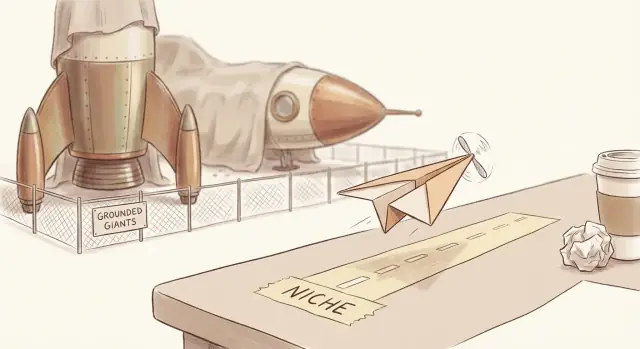
What YC Means by “Start Small” (and What It Doesn’t)
Y Combinator’s “start small” advice is easy to misread as “think small.” That’s not the point. “Small” is about scope—what you build first, who it’s for, and what promise you can reliably keep—while ambition can stay huge.
“Small” means scope, not ambition
Starting small means choosing an initial version of your company that can actually work. A smaller scope lets you ship, learn, and improve faster. It also forces clarity: you can’t hide behind a broad mission statement when your first users are counting on one specific outcome.
A startup can aim to become a massive company and still begin with something that looks almost unimpressive: one user type, one workflow, one clear benefit.
Narrow beats vague
Founders often confuse “bigger” with “better” and try to serve everyone with a long feature list. YC’s version of “small” is the opposite:
- Fewer features, but the right ones for a specific user
- Fewer users at first, but the right users
- A clearer promise, not a broader one
Vague positioning sounds like: “We help teams be more productive.” Narrow positioning sounds like: “We help independent dental offices reduce no-shows by automatically filling last-minute cancellations.”
What “narrow” looks like in practice
A good starting point is a specific user + specific job:
- User: “Shopify store owners doing $20k–$100k/month”
- Job: “Recover abandoned carts with a simple SMS flow”
That’s small enough to validate quickly, and focused enough to build something people will pay for.
Focus first, scale later
Starting small isn’t a permanent identity—it’s a sequence. Win a tiny, well-defined slice of the market first. Once you reliably deliver value there, you expand outward with confidence instead of guessing.
Pick a Narrow Ideal Customer (ICP) and Commit to It
A narrow Ideal Customer Profile (ICP) is a simple decision: who exactly is this for, and what situation triggers the need? Not “small businesses” or “teams”—but a specific person with a specific job to do.
Define your ICP in plain language
Use this format:
It’s for: [role + type of company]
When: [a repeatable moment of pain / deadline / risk]
Example: “It’s for independent CPAs when they’re onboarding a new monthly client and need to collect documents without chasing emails.”
Why a sharp ICP makes everything easier
When the ICP is tight, your startup stops guessing.
Messaging becomes straightforward because you can describe one familiar day-in-the-life problem.
Pricing gets simpler because you can anchor to a known budget owner and a clear value metric (per client, per seat, per project).
Product decisions get faster because you’re building for one workflow, not five. You can say “no” without guilt because it’s not for everyone—yet.
Signals you’ve found a real niche
Look for:
- The same use case repeating in sales calls without you steering it
- Clear urgency (“I need this by Friday” beats “interesting”)
- Similar objections and buying steps across customers
- Early users returning to the product without reminders
Quick exercises to narrow fast
1) Write a “not for” list (10 minutes). List 5–10 customer types you will not serve in the next 90 days.
2) Pick your top 1–2 customer types. From your conversations, choose the two groups with the sharpest pain and fastest decisions. Commit to one as the default ICP, and treat the other as “later.”
Why “Almost Boring” Ideas Often Win
“Boring” is usually shorthand for “I understand it immediately.” That’s not a weakness—it’s a sales advantage.
Reframe “boring” as obvious value
An “almost boring” startup has three traits: obvious value, a clear buyer, and proven demand. The customer already knows the problem is real, already has budget or urgency, and can picture success without a long explanation.
That clarity speeds up everything: your pitch, your pricing, your roadmap, and your first few customer conversations.
Familiar problems are easier to sell (and build)
When you pick a familiar pain—missed invoices, compliance checklists, scheduling chaos, churn in subscriptions—you’re not asking the market to learn a new category. You’re offering a better way to solve something they already try to solve.
That means:
- Shorter sales cycles (less convincing, more comparing)
- Clearer product requirements (you can copy “what good looks like”)
- Faster iteration (customers can judge improvements right away)
“Boring” reduces risk by reducing education
Early on, the biggest bottleneck is not engineering—it’s learning. If your idea requires heavy education, you’ll struggle to tell whether people don’t want it or just don’t understand it yet.
Almost-boring ideas reduce that ambiguity. When a prospect says “yes,” you can attribute it to real value, not hype or novelty.
What’s actually risky: novel tech with unclear buyers
Novel technology can be powerful, but it’s risky when the buyer is undefined. If you can’t answer “who buys this?” and “what budget line does it come from?” you end up building toward applause instead of purchase.
The counterintuitive move is to anchor innovation to a familiar, painful use case—so the market pulls the product out of you, rather than you pushing a new story into the market.
Look for a Painful, Specific Problem (Not a Big Vision)
A “big vision” is easy to talk about and hard to buy. Early customers don’t pay for visions—they pay to make an immediate problem go away.
The “hair-on-fire” problem
A hair-on-fire problem is:
- Urgent: they want it fixed this week, not “someday.”
- Expensive: it costs real money (lost revenue, penalties, overtime, churn).
- Frequent: it happens often enough that a tool becomes a habit.
- Measurable: they can tell when it’s solved (time saved, errors reduced, fewer tickets).
Strong vs. weak problems (examples)
Strong problems (people actively search, complain, or budget for these):
- A team is missing invoice deadlines every month and paying late fees.
- A business can’t ship orders on time because address errors keep bouncing deliveries.
- A clinic is losing appointments due to no-shows and needs a way to reduce them.
Weak problems (nice-to-have, unclear owner, no budget):
- “We should improve collaboration.”
- “Our dashboard could look more modern.”
- “It’d be great to have AI insights someday.”
Why urgency boosts conversion and retention
Urgency shortens sales cycles because the buyer already agrees the problem is real—and they’re motivated to act. It also improves retention: when your product is tied to a recurring pain (missed deadlines, failed compliance checks, revenue leakage), customers keep paying because stopping would reintroduce the problem.
Quick urgency checklist (before building more)
Ask 5–10 target users:
- Did this happen in the last 7 days?
- What did it cost (time, money, customers)?
- Who feels the pain enough to own fixing it?
- What are they doing now (spreadsheets, manual workarounds, agencies)?
- Is there an existing budget line item you can replace?
- If you solved it tomorrow, what metric would improve immediately?
Do Things That Don’t Scale to Get the First 10 Customers
Early on, your biggest advantage isn’t automation—it’s attention. “Do things that don’t scale” means being willing to deliver the product in a hands-on way so you can get real users, real feedback, and real learning before you invest in building the “perfect” system.
What it looks like in practice
For the first 10 customers, you might do manual onboarding over a call, set up their account yourself, import their data, or tailor a workflow to their exact situation.
This can look like concierge support: creating templates for them, writing the first draft (if you’re a writing tool), configuring integrations, or even sending reminders and check-ins. It’s not a permanent operating model—it’s a learning strategy.
Why it matters (more than speed)
When you personally onboard users, you see where they hesitate, what they try to do first, and what they actually value. That helps you:
- Learn faster than competitors who rely on generic surveys
- Avoid building features nobody uses
- Discover the “minimum lovable” version that people will pay for
Practical ways to find your first users
Start where your ideal customers already gather:
- Niche communities (Slack/Discord groups, subreddits, forums, meetups)
- Warm referrals (past coworkers, friends of customers, industry connectors)
- Direct outreach (short, specific messages that mention the exact problem you solve)
A simple approach: offer a highly specific setup help session in exchange for trying the product for a week.
Guardrails so you don’t get stuck
Keep it ethical: be transparent about what’s manual and what’s product. Document everything you do repeatedly (requests, steps, objections), then turn the top 1–2 repetitive actions into lightweight automation later. The goal is to earn learning and trust now—then scale what works.
Build a Simple Wedge Product, Not a Full Platform
What “wedge” means
A wedge product is the smallest product that completes one job end-to-end for a specific customer. Not a demo. Not a partial workflow. It’s the minimal version that actually delivers the result someone is trying to achieve—and makes them say, “I’d pay for this because it saves me time/money/stress.”
Think “send invoices and get paid” rather than “a finance platform,” or “book 10 qualified sales calls” rather than “a CRM ecosystem.” The wedge is your way into the market: narrow, sharp, and easy to judge.
Outcomes over feature lists
Early teams often debate feature checklists because it feels safer than committing. Instead, define the outcome first:
- What does success look like for the customer?
- How fast can they reach it?
- What proof do they get at the end (a report, a booked appointment, a shipped package, a posted listing)?
If your product doesn’t reliably produce that outcome, adding more features won’t fix the core problem.
Choosing the first feature set
A simple rule: must-have features are the ones required to deliver the promised outcome without workarounds.
Nice-to-have features are everything else—even if competitors have them.
A practical test: if you removed a feature, would the customer still get the outcome with similar effort and confidence? If yes, it’s not must-have (yet).
Don’t go “platform first”
“Platform first” thinking pushes you to build accounts, permissions, integrations, extensibility, and dashboards before you’ve proven demand. Those are expensive detours.
Build the wedge, charge for it, learn what’s missing, and only then expand into a broader product surface—pulled by real usage, not by imagination.
Speeding up the wedge without overbuilding
One way to stay disciplined is to prototype in tools that bias toward shipping. For example, Koder.ai (a vibe-coding platform) can help founders turn a narrow workflow into a working web app through chat, then iterate quickly with features like planning mode, snapshots, and rollback. When you’re ready, you can export the source code and keep scaling—without committing to a “platform-first” build on day one.
Validate with Real Usage and Revenue (Not Excitement)
Early on, the most dangerous signal is enthusiasm without commitment. Compliments, “This is cool,” and big social numbers can feel like progress—but they don’t tell you whether the product is solving a real problem.
What “evidence” looks like
Prioritize behaviors that cost the customer something: time, money, reputation, or workflow change. Strong validation usually shows up as:
- Retention: people return on their own after the first use.
- Repeat usage: the product becomes part of a weekly (or daily) routine.
- Referrals: users pull others in without being asked.
- Willingness to pay: even small payments prove the pain is real and the solution is worth budget.
If you’re not seeing at least one of these, “interest” may just be politeness.
Lightweight ways to validate (without overbuilding)
You don’t need a perfect product to test willingness to pay. Try:
- Pre-sales: sell the outcome before the software is finished (with honest timelines).
- Pilots: a 2–4 week paid pilot with a clear success metric (e.g., “reduce manual reporting time by 30%”).
- Paid trials: charge from day one, even if it’s a low founder-friendly price.
The goal is simple: get customers to take a real step, not just say yes.
What to ignore early
Treat these as weak signals:
- Social followers, email signups, page views
- Press mentions and “thought-leader” attention
- Vague praise like “We’d use this someday”
They can support a story, but they don’t prove demand.
Set a go/no-go timeline
Pick a short window (often 14–30 days) and define the decision in advance. For example: “If we can’t get 3 paying pilot customers or 5 users who return weekly by day 30, we narrow the ICP, change the offer, or kill the idea.” Clear deadlines prevent drifting and keep learning honest.
Why Startups Go Too Broad Too Early
Early on, “going broad” feels like momentum: more features, more customer types, more marketing channels. But breadth usually hides a simple problem—your startup hasn’t learned enough yet to know what works.
The common traps
Most teams don’t decide to be unfocused. They slide into it:
- Broad positioning: “for startups and enterprises,” “for any team,” “for everyone who uses spreadsheets.”
- Too many personas: trying to satisfy buyers, users, admins, and executives from day one.
- Too many channels: SEO, paid ads, partnerships, outbound, content, social—before any one channel proves repeatable.
Why breadth slows learning (and inflates costs)
When you aim at multiple audiences, every signal becomes noisy. A feature request might be critical for Persona A and useless for Persona B. Your messaging gets vague, your demos drift, and onboarding turns into a choose-your-own-adventure.
Costs rise in quiet ways:
- More edge cases to support
- Longer build cycles because requirements conflict
- Higher customer acquisition costs because targeting is fuzzy
- Slower iteration because you can’t tell what actually caused results
Narrow focus is not about limiting ambition; it’s about creating fast, clear feedback loops.
The psychology behind “too broad”
Founders often widen scope for emotional reasons:
- Fear of missing out: “What if we pick the wrong niche?”
- Avoidance of sales: it’s easier to rework the product than to hear “no” from a specific buyer.
- Identity comfort: a big mission statement can feel safer than a small, testable promise.
A quick “focus reset” checklist
If things feel stuck, try this reset for the next 2–4 weeks:
- Pick one ICP you can reach directly (not “any SMB”).
- Pick one job-to-be-done they’ll pay to solve this month.
- Define one success metric (e.g., weekly active teams, paid conversions, time-to-value).
- Cut or pause two channels and double down on the one giving the cleanest conversations.
- Ship one improvement per week tied to activation or retention—not “nice-to-have” breadth.
Focus isn’t permanent. It’s a tool to learn faster than your runway runs out.
How to Expand After You Win a Small Market
Winning a small market doesn’t mean you’re done—it means you’ve earned the right to grow. The key is timing: expand only after one segment is truly “locked.”
Signs you’re ready to expand
You’re ready when your message converts consistently and growth feels repeatable, not random. Practical signals include:
- A clear ICP where most new customers look similar
- A simple pitch that works without rewriting it every week
- Reliable onboarding: people get value with minimal hand-holding
- Retention that holds up after the first few weeks
If you still need heroic effort to close each deal, you haven’t “won” yet—you’re still discovering.
Three clean expansion paths
Once you’ve nailed one wedge, expand by choosing the next closest step:
- Adjacent persona: same workflow, different role (e.g., from operations managers to team leads).
- Adjacent workflow: same customer, new job-to-be-done (e.g., from invoicing to collections).
- Adjacent geography: same ICP and use case, new region (often easiest if product and compliance allow).
Pick the path with the fewest changes so you can reuse your positioning, product, and acquisition channels.
Sequence it: one new variable at a time
The common failure mode is stacking changes—new ICP and new use case and new channel. Instead, keep two things constant while you change one. For example: same persona + same workflow, but a new geography.
Keep the core stable while exploring
Treat expansion as a controlled experiment. Maintain the “core” product that your first segment loves, and test the new segment with lightweight additions:
- Feature flags or optional settings (not a rewrite)
- Separate landing page copy for the new segment
- A small pilot cohort with fast feedback
When the new segment shows repeatable conversion and retention, you can fold what you learned back into the main product—without breaking what already works. For more on staying focused, see /blog/startup-focus.
Small and Narrow Can Still Be a Great Business
A narrow product can look “too small” on a pitch deck, yet still be a genuinely good business—especially early on.
“Default alive” in plain terms
Y Combinator often talks about being default alive: you’re spending less than you earn (or can reliably raise), so the company can keep going without a miracle. Practically, it means you have a clear path to not running out of money—because revenue covers costs, or burn is low enough that funding isn’t a constant emergency.
Small markets can fund real momentum
A “small” market can still produce strong early revenue if the pain is intense and the buyer has budget.
If you solve one specific workflow for one specific role, you can often charge more than broad tools that feel generic. Even 50–200 customers can be meaningful when each customer pays enough to cover support, product development, and learning.
Pricing basics for narrow products
Start with value-based pricing: price against what the customer saves or earns, not your costs.
Keep it simple:
- One core plan that includes what most people need
- One higher tier for teams, advanced permissions, or compliance
Avoid complex menus early. You want buyers to decide quickly, and you want to learn what they actually value.
Operate cheaply while learning fast
You don’t need a big team or fancy tooling to win a narrow market.
Focus your budget on:
- Talking to customers weekly
- Fast iterations on the core use case
- Lightweight support (clear onboarding docs, templated responses)
When the product is narrow, your operations can be narrow too—which makes “default alive” much easier to reach.
A Practical Metrics and Learning Checklist
Starting small only works if you’re learning faster than you’re building. The easiest way to stay honest is to track a handful of “did this get better?” numbers, review them weekly, and tie them to specific customer conversations.
Core metrics (pick based on your business)
B2B SaaS: weekly active teams, % of accounts hitting the “aha” action, trial-to-paid conversion, churn (logo and revenue), time-to-first-value.
Consumer / prosumer app: activation rate, day-7 retention, weekly active users, invites/shared actions per user, paid conversion (if applicable).
Marketplace: successful matches per week, supply coverage (how often demand finds supply), repeat rate on both sides, take rate, cancellation rate.
Services / agency (your first wedge): qualified leads, close rate, average deal size, delivery time, gross margin, referrals.
Benchmarks are highly context-dependent, so use ranges sparingly. One safe anchor: early on, direction matters more than level—you want key rates (activation, conversion, retention) trending up as you iterate.
A weekly 30-minute review ritual
- Numbers: What moved up/down? Circle just 1–2 metrics that matter this week.
- Learnings: What did we hear repeatedly from customers? What surprised us?
- Experiments: What did we try? What was the expected outcome vs. what happened?
- Next steps: Pick one change to ship and one outreach goal (e.g., 10 conversations).
Write it down in a running doc so you can see the story of your progress.
Questions after every customer conversation
- What were you trying to do when the problem showed up?
- What happens if you don’t solve it this week?
- What have you tried already (and why didn’t it work)?
- How do you solve it today—exact steps, tools, people involved?
- What would a “good enough” solution look like?
- What would make you pay for this (or switch from your current approach)?
- Who else should I talk to who has the same problem?
If your metrics improve and these answers get sharper, you’re on the right narrow path.
A 30-Day Plan to Start Small (Without Stalling)
Starting small isn’t “waiting to build.” It’s a way to force clarity, get real feedback, and ship something people will pay for—fast. Here’s a focused 30-day plan that keeps you moving while staying narrow.
Week 1: Commit to a narrow ICP and one promise
Pick one ideal customer profile you can describe in a sentence (role, context, and constraint). Then choose one painful problem you can solve without a full product.
Write a one-sentence promise that’s specific and testable:
“We help [ICP] achieve [measurable outcome] in [timeframe] without [common headache].”
This becomes your filter. If a feature, meeting, or idea doesn’t strengthen that promise, it’s out.
Week 2: 15–25 conversations + pricing language tests
Talk to 15–25 people who match your ICP. Aim for pattern-finding, not validation.
Ask about the last time they felt the pain, what they tried, what it cost (time/money), and what “fixed” would look like.
Then test pricing language early. Don’t pitch a price as a negotiation—use it as a signal:
- “If this saved you 5 hours/week, would $99/month be reasonable?”
- “Would you expense this? Or does it need to fit under a team budget?”
Document exact phrases they use; those words should show up in your landing page and outreach.
Week 3: Deliver a manual version (pilot) and measure outcomes
Run 3–5 pilots where you do the work manually behind the scenes. The goal is to prove the outcome, not the interface.
Define one or two success metrics (e.g., time saved, fewer errors, faster turnaround) and track them per user. Iterate weekly based on what actually moved the metric.
Week 4: Productize what repeats + pick one acquisition channel
Identify the repeatable steps you performed in pilots and turn them into the smallest “wedge” product.
Prepare one acquisition channel you can execute consistently for the next month: targeted outbound, partnerships, a niche community, or a workflow integration. Keep everything pointed at your one-sentence promise and a simple next step (book a call, start a trial, or pay for onboarding).
FAQ
What does YC mean by “start small”?
“Small” refers to scope, not ambition. Start with:
- One clear user type
- One job-to-be-done
- One outcome you can reliably deliver
Ambition can stay huge, but your first version should be narrow enough to ship, learn, and improve quickly.
Is “start small” the same as “think small”?
It’s usually “think vague.” Broad positioning (“for any team”) creates noisy feedback and slow decisions.
A narrow promise forces clarity: you either deliver the outcome for that specific user, or you don’t—and you learn faster.
How do I define a narrow Ideal Customer Profile (ICP)?
Use a plain format:
- It’s for: role + company type
- When: a repeatable moment of pain / deadline / risk
Example: “It’s for independent CPAs when they onboard a new monthly client and need documents without chasing emails.”
What are the signs I’ve found a real niche?
Look for repeated, unprompted patterns:
- The same use case shows up across calls
- Urgency (“I need this by Friday”)
- Similar buying steps and objections
- Users return without reminders
If every conversation sounds different, your ICP (or promise) is still too broad.
Why do “almost boring” startup ideas often win?
Because “boring” often means immediately understandable. Familiar problems:
- Sell faster (less education)
- Have clearer requirements (you can copy “what good looks like”)
- Reduce ambiguity about whether people want it vs. don’t get it
The advantage is speed of learning and sales, not lack of innovation.
What is a “hair-on-fire” problem and how do I spot one?
It’s urgent, expensive, frequent, and measurable. Quick test questions:
- Did it happen in the last 7 days?
- What did it cost (money, time, churn, penalties)?
- Who owns fixing it?
- What’s the workaround today (spreadsheets, agencies, manual ops)?
If there’s no owner or no budget, it’s usually a weak problem.
What does “do things that don’t scale” look like for the first 10 customers?
It means manual, high-touch effort to get real users and real feedback before automating. Examples:
- Onboard customers on a call
- Import their data yourself
- Configure workflows/integrations manually
- Deliver the outcome concierge-style
Be transparent about what’s manual, document repeatable steps, then automate only what you do often.
What is a wedge product, and how do I choose the first features?
A wedge product completes one job end-to-end for a specific customer. It’s not a platform and not a partial workflow.
Define the outcome first:
- What success looks like
- How fast they get value
- What proof they receive (report, booked calls, paid invoices, shipped orders)
Build only the must-haves required to deliver that outcome without workarounds.
How should I validate demand without overbuilding?
Prioritize signals that cost the customer something:
- Retention and repeat usage
- Referrals
- Willingness to pay (even small)
Practical validation methods:
- Pre-sell the outcome with honest timelines
- Run a 2–4 week paid pilot with a success metric
- Charge for trials from day one
Ignore early vanity signals like followers, page views, and vague praise.
When should I expand beyond my initial narrow market?
You’re ready when things feel repeatable, not heroic:
- Most customers look like the same ICP
- A simple pitch works consistently
- Onboarding gets users to value with minimal hand-holding
- Retention holds after the first weeks
Expand with one new variable at a time:
- Adjacent persona or adjacent workflow or adjacent geography
Avoid changing ICP + use case + channel all at once.